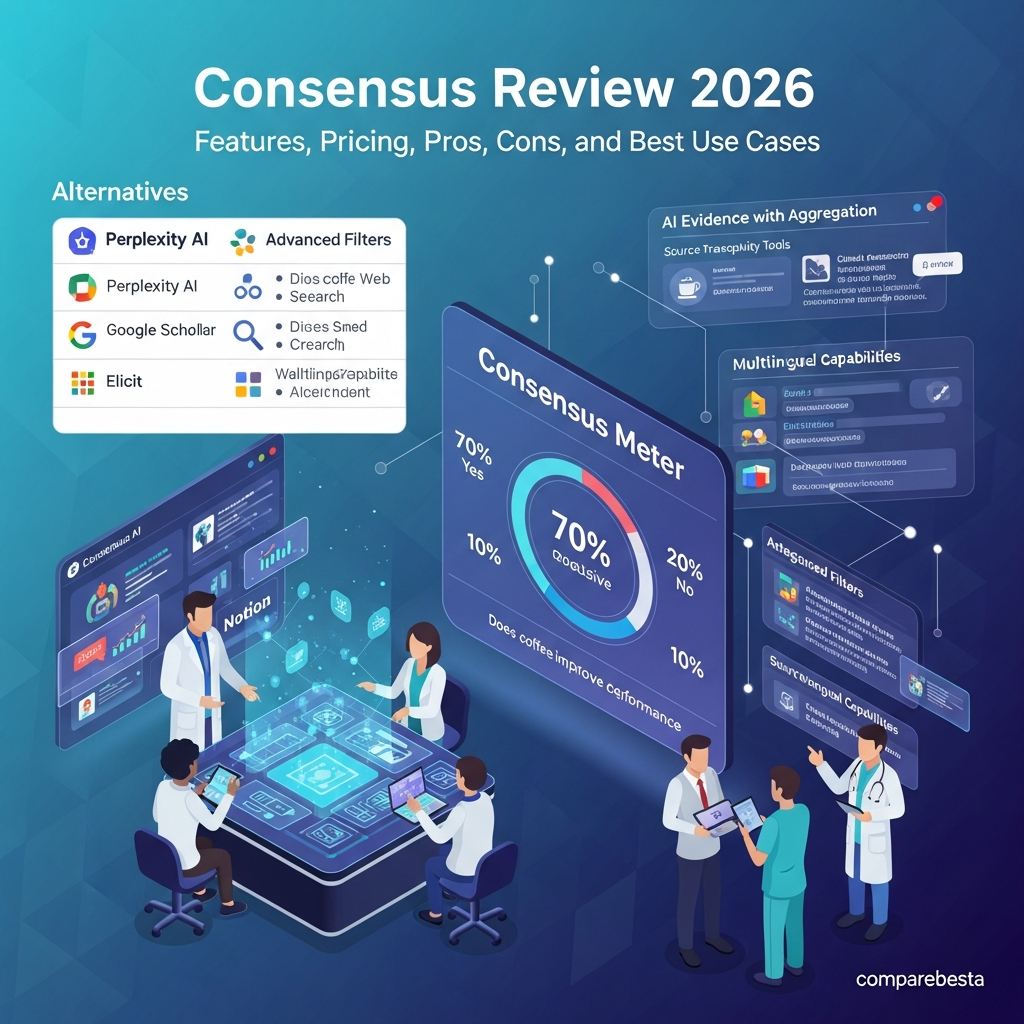

Quick Answer: Consensus is worth considering if you regularly need scientific papers, citation-grounded summaries, evidence synthesis, or faster literature reviews. Its biggest strengths are research-first retrieval, citation grounding, the Consensus Meter, Deep Review, and an expanding scholarly corpus. It is less useful for general web research, current news, creative work, or anyone who rarely needs academic evidence.
Last Updated: September 18, 2026
Published: July 10, 2026
By CompareBestAI Editorial Team
Consensus is an AI-powered research platform designed to help users find, understand, compare, and synthesize scientific literature.
Unlike a general-purpose chatbot that may answer from broad model knowledge, Consensus retrieves research first and then uses AI to analyze the relevant sources. Its current help documentation describes a research database containing more than 220 million peer-reviewed papers, while a September 2026 product update says its broader scholarly corpus has expanded beyond 400 million sources as publisher access and non-journal coverage have grown.
That distinction makes Consensus particularly relevant for students, academics, clinicians, educators, analysts, and professionals who need traceable evidence rather than an uncited answer.
You can also view the dedicated Consensus tool profile or browse other platforms in CompareBestAI's Research & Data category.
Consensus AI Review: Key Takeaways
| Area | Consensus in 2026 |
|---|---|
| Best for | Academic research, literature discovery, evidence synthesis |
| Free plan | Yes |
| Pro price | $20/month or $144/year |
| Deep price | $65/month or $540/year |
| Research coverage | 220M+ peer-reviewed papers; broader corpus reported at 400M+ scholarly sources |
| Standout features | Consensus Meter, Pro messages, Deep Review, Citation Grounding, Research Agent |
| API access | Available directly to users |
| Main limitation | Not a replacement for evaluating original studies |
| Best alternative type | General web research, citation mapping, citation analysis, specialized systematic-review tools |
Pricing was checked against Consensus's official subscription documentation on September 18, 2026. Current Pro pricing is $20 monthly or $144 annually, while the Deep plan is $65 monthly or $540 annually.
What Is Consensus AI?
Consensus is an AI research platform built around scientific literature.
Its workflow starts with retrieval rather than open-ended generation. When someone asks a research question, Consensus searches relevant academic literature, ranks the papers, and then uses AI to summarize or synthesize what those sources say.
According to its current technical explanation, Consensus combines semantic search with traditional keyword search techniques such as BM25. Relevant papers are then refined using signals that can include recency, citation count, journal reputation, and relevance.
This makes Consensus fundamentally different from a standard chatbot.
The important value proposition is not simply “AI can answer questions.” It is:
AI can help you inspect questions through identifiable scientific sources.
That makes it useful when citations, study quality, research traceability, and evidence disagreement matter.
Consensus uses a multi-stage retrieval and synthesis workflow.
First, it searches its research corpus using both semantic and keyword matching.
Next, it refines and ranks papers using relevance and quality signals.
Finally, its AI features can summarize individual studies or synthesize findings across several studies.
Consensus says it also uses relevance-checking models before allowing papers into AI-generated analyses. Retracted papers that the system identifies are flagged and excluded from AI analyses.
This architecture reduces two common AI-research risks: fabricated references and answers generated without first retrieving relevant evidence.
It does not, however, eliminate the possibility of misinterpreting a genuine study.
Consensus explicitly acknowledges that AI can still misunderstand or incorrectly summarize research, which is why original papers should be checked for important academic, clinical, legal, or policy decisions.
Consensus Research Database and Coverage
One of the strongest developments in 2026 is the expansion of Consensus's research corpus.
The current Help Center says Consensus searches over 220 million peer-reviewed research papers from sources including Semantic Scholar, OpenAlex, and Consensus's own crawl of the scholarly web.
A September 9, 2026 product update describes an even broader corpus exceeding 400 million scholarly sources after new publisher partnerships and expanded coverage. That update specifically mentions increased access to scholarly books, preprints, conference proceedings, and paywalled full text through publisher agreements.
This means the old description of Consensus as a system that uses “peer-reviewed content only” is now too simplistic.
Peer-reviewed research remains central to the platform, but its broader discovery environment has expanded.
Consensus Meter: How It Works
The Consensus Meter is one of the platform's most recognizable features.
It is designed for questions where scientific studies can be categorized by whether their conclusions support or oppose a claim.
Consensus says the Meter analyzes the top 20 relevant papers for a query and displays categories such as Yes, No, Possibly, or Mixed. At least five relevant papers are required before the Meter is shown.
For example, a user asking whether a specific intervention improves an outcome may see how the relevant studies lean instead of manually classifying each paper.
That does not mean the percentage should be interpreted as a formal meta-analysis.
Study quality, sample size, design, population, methodology, effect size, and statistical uncertainty still matter.
The Meter is best treated as a fast orientation tool that helps you decide which papers deserve closer examination.
Citation Grounding
Citation Grounding is a particularly useful improvement for research verification.
Consensus's September 2026 product update says AI citations can now be mapped to exact passages from the source material. Users can inspect the quote associated with a citation and, where available, see the section from which it was extracted.
This improves the research workflow because the user does not have to accept an AI paraphrase without context.
You can move from:
AI claim → citation → supporting passage → original paper
instead of stopping at the generated summary.
For academic and evidence-sensitive research, that traceability is more valuable than simply producing longer AI responses.
Consensus Pro Messages
Consensus's Pro experience goes beyond returning a list of papers.
Its current documentation describes Pro messages that can create research-grounded topic summaries, structured analyses, visualizations, evidence tables, research-gap views, and concise takeaways while remaining tied to scientific literature.
This can be useful when your real task is not finding one paper but understanding a research question across multiple studies.
For example, a researcher could ask Consensus to compare findings across interventions, summarize major conclusions, identify disagreement, or organize evidence into a structured view.
Deep Review
Deep Review is designed for more complex literature-review tasks.
Consensus says Deep Review can break a research question into multiple sub-questions, run up to 20 targeted searches, review more than 1,000 papers during retrieval, and synthesize the most relevant research. A typical Deep Review may analyze up to 50 papers, with up to 100 used when the topic benefits from a larger evidence set.
That makes it materially different from a simple single-query academic search.
Deep Review can be useful for exploratory literature reviews, research scoping, identifying themes, discovering counterarguments, and building an initial understanding of a field.
It should not automatically be treated as a substitute for a formal systematic review protocol.
Consensus Research Agent
Consensus has expanded beyond a conventional academic search interface.
In September 2026, the company described Consensus as a research workspace capable of planning and executing multi-step tasks. Its Research Agent can combine operations such as semantic search, paper search, DOI lookup, and citation-graph traversal rather than limiting the workflow to one search query.
This change matters because many real research questions require multiple steps.
For example, finding a foundational paper may then require identifying earlier work, discovering papers that cite it, examining related studies, and building a reading list.
Instead of manually moving between multiple databases and tabs, the Research Agent is intended to coordinate more of those steps inside one workflow.
Full-Text Chat, Citation Graphs, and Research Libraries
Consensus also provides tools for investigating individual papers and groups of papers.
Current documentation includes Chat with Full Text, which allows users to ask questions about papers, collections, or uploaded documents.
The Citation Graph can help users follow relationships between studies, identify foundational work, and discover subsequent research.
Consensus has also been developing its Library into a broader research workspace. Its September product update says users can add papers and other research documents, use their Library with the Research Agent, and share collections with collaborators.
Researchers primarily interested in visual citation exploration should also compare dedicated discovery platforms such as Connected Papers and ResearchRabbit.
Consensus Pricing in 2026
Consensus currently offers Free, Pro, Deep, Teams, and Enterprise options.
| Plan | Current Price | Suitable For |
|---|---|---|
| Free | $0 | Light research and product evaluation |
| Pro | $20/month or $144/year | Students, researchers, regular academic search |
| Deep | $65/month or $540/year | Heavy literature review and research workflows |
| Teams | Custom/team pricing | Labs and academic groups |
| Enterprise | Custom | Universities and large organizations |
The annual Pro price works out to $12 per month, while the annual Deep price is equivalent to $45 per month.
Consensus Free Plan
The Free plan is substantially more useful than the old “10 questions per month” description suggests.
Consensus currently lists unlimited basic Papers searches, limited Pro messages, three Deep reviews per month, ten Study Snapshots, and some API/MCP access on the Free tier.
That makes the Free plan sufficient for evaluating the platform and handling occasional academic searches.
Consensus Pro
Pro currently costs $20 per month or $144 annually.
It adds unlimited Pro messages, more Deep Review usage, unlimited Study Snapshots, and expanded API/MCP access.
For students, postgraduate researchers, analysts, educators, and professionals conducting research regularly, Pro is likely the first paid tier worth evaluating.
Consensus Deep
Deep costs $65 per month or $540 annually.
Its key distinction is much larger Deep Review capacity, making it more relevant for researchers, clinicians, and professionals running repeated literature-synthesis tasks.
Rather than upgrading because “Premium sounds better,” users should upgrade when Deep Review or advanced synthesis actually becomes a recurring part of their workflow.
Consensus API and MCP Access
A major factual change since earlier Consensus reviews is that API access is no longer restricted to large institutional customers.
Consensus now provides self-service API access and MCP connectivity so users can integrate scientific search into their own applications and AI workflows.
This is relevant for teams building:
research copilots, internal knowledge systems, evidence-checking workflows, scientific assistants, literature-search automations, and custom AI agents.
Consensus says paid users can purchase additional API/MCP usage beyond included allowances, with additional calls currently priced at $0.05 each within plan-specific limits.
One caveat: current Consensus help pages show slightly different included-call counts for some plans. The dedicated API documentation updated this week should therefore be checked alongside your account dashboard before budgeting production API usage.
Developers comparing research-oriented AI systems can also inspect tools such as ResearchGPT.
Exporting Research and Reference Management
Consensus supports exporting paper information in formats that fit established academic workflows.
Its documentation says users can export results as CSV or RIS for tools such as Zotero, EndNote, Mendeley, and Paperpile.
That is important because academic discovery rarely ends inside the search tool.
Researchers still need to organize sources, annotate them, create bibliographies, write papers, and manage citations over time.
A good research platform therefore needs to connect discovery to reference management rather than trapping results inside a proprietary interface.
Consensus Pros and Cons
| Strength | Why It Matters |
|---|---|
| Research-first retrieval | Answers start with retrieved academic literature |
| Citation grounding | Users can inspect evidence behind generated claims |
| Large corpus | Broad coverage across scientific disciplines |
| Consensus Meter | Fast view of agreement/disagreement |
| Deep Review | Multi-search literature synthesis |
| Research Agent | Supports multi-step research tasks |
| Free plan | Useful entry point before paying |
| API and MCP | Enables custom research workflows |
| Reference export | Works with established citation managers |
| Limitation | Why It Matters |
|---|---|
| AI can misinterpret papers | Original studies still require verification |
| Database is not exhaustive | Some literature will be missing |
| Not general web search | Weak fit for news and practical web information |
| Deep workflows cost more | Heavy research may require Pro or Deep |
| Citation ≠ evidence quality | A cited paper can still be weak or irrelevant to your exact question |
| Research synthesis ≠ formal systematic review | Methodological review standards still require human oversight |
Consensus itself acknowledges that it does not contain all research and that AI can still misread genuine papers.
That caveat should remain prominent in any responsible Consensus review.
Is Consensus Trustworthy?
Consensus has several design choices that make it more transparent than an uncited general-purpose AI response.
It retrieves research before generating answers, provides citations, exposes supporting evidence, runs relevance checks, and attempts to exclude identified retracted papers from generated analyses.
However, “trustworthy” should not be interpreted as “automatically correct.”
AI can still misunderstand methodology, populations, effect sizes, limitations, statistical results, or the meaning of a paper.
For undergraduate research or early discovery, Consensus can dramatically accelerate source finding.
For clinical practice, systematic reviews, policy decisions, or publishable academic conclusions, users should inspect the original studies and apply domain-appropriate appraisal methods.
Tools such as Scite AI can also complement Consensus when you want to examine how papers are cited by later research.
Consensus for Students
Students are one of the clearest use cases.
Consensus can help identify relevant papers, understand unfamiliar topics, discover useful terminology, find evidence for further reading, and create an initial map of the literature.
The Free plan is now much more practical for students because basic Papers searches are unlimited according to Consensus's current subscription documentation.
Students should still avoid treating generated summaries as ready-made academic arguments.
The strongest workflow is:
find the paper with Consensus, inspect the evidence, open the original research, understand the methodology, then cite the primary source.
For difficult individual papers, an additional tool such as Explainpaper may be useful.
Consensus for Researchers and Academics
Researchers receive more value from Consensus when the workload goes beyond occasional source discovery.
Deep Review, Research Agent workflows, full-text interaction, citation graphs, exports, libraries, and API access create a stronger workflow for repeated academic research.
For an early-stage literature review, Consensus can help identify important studies and research themes quickly.
For a systematic review or meta-analysis, however, researchers still need explicit inclusion criteria, reproducible search strategies, screening procedures, risk-of-bias assessment, data extraction protocols, and appropriate statistical methods.
Consensus is therefore better viewed as a research accelerator than an autonomous research methodology.
Consensus for Medical and Clinical Questions
Consensus covers medicine and the entirety of PubMed according to its current help documentation, making healthcare one of its most obvious use cases.
Clinicians and medical researchers can use it to locate relevant evidence, inspect studies, understand where research may agree or conflict, and identify papers worth reading.
But Consensus should not be used as a standalone diagnostic or treatment-decision system.
Clinical decisions require patient-specific context, professional judgment, current guidelines, regulatory information, and direct examination of the supporting evidence.
That distinction is essential for any responsible AI research workflow.
Consensus vs Perplexity AI
Consensus and Perplexity solve overlapping but different research problems.
Consensus is built around scholarly evidence retrieval and synthesis.
Perplexity is a broader AI search product that can work across general web information as well as research-oriented queries.
If you need scientific literature as the primary evidence base, Consensus is the more specialized workflow.
If you need recent news, websites, product information, industry sources, and scholarly materials inside one broader search experience, Perplexity AI may fit better.
The right choice therefore depends on source requirements, not just which interface looks easier.
Consensus vs Connected Papers and ResearchRabbit
Connected Papers and ResearchRabbit are especially useful when the goal is discovering relationships between publications.
They can help users explore citation networks, similar papers, authors, and related research paths.
Consensus is stronger when the user wants to ask a question and receive evidence-grounded synthesis.
A practical workflow could therefore use Consensus for evidence discovery and interpretation, then Connected Papers or ResearchRabbit for deeper literature-network exploration.
Consensus vs Scite
Scite focuses heavily on citation context.
Rather than only showing that one paper cited another, citation-analysis tools can help researchers inspect whether later research supports, disputes, or merely mentions a claim.
Consensus instead focuses on finding and synthesizing research around the user's question.
Researchers working on evidence verification may therefore use Scite AI alongside Consensus rather than treating the platforms as exact substitutes.
Who Should Use Consensus?
Consensus is a strong fit for people who regularly need answers grounded in scientific literature.
That includes university students, postgraduate researchers, academics, clinicians, educators, policy researchers, journalists working with scientific evidence, R&D teams, and analysts.
It is less compelling for users whose work is mainly creative writing, coding assistance, current news, general internet research, ecommerce research, or everyday “how do I…” questions.
In those cases, a broader AI search or assistant may offer more value.
Is Consensus AI Worth Paying For?
For light academic research, start with the Free plan.
It now provides enough access to determine whether Consensus meaningfully improves your workflow before paying.
Pro becomes more defensible when Pro messages, more Deep Reviews, unlimited Study Snapshots, and regular research synthesis save meaningful time.
Deep makes sense primarily when literature review is frequent enough to justify substantially higher Deep Review limits.
The decision should therefore be based on research frequency rather than feature count.
If you search academic literature only a few times per month, Free may be enough.
If evidence retrieval is part of your weekly work, Pro becomes easier to justify.
If large literature reviews are a core professional workflow, Deep deserves consideration.
How We Evaluated Consensus
CompareBestAI evaluates AI tools using publicly available provider documentation, current pricing information, product documentation, declared limitations, use-case fit, and comparisons with related tools.
For this Consensus AI review, the most important evaluation criteria are research-source transparency, literature coverage, citation traceability, evidence synthesis, workflow depth, pricing, export options, API availability, and the risk of over-relying on AI-generated interpretations.
You can read more about how CompareBestAI ranks AI tools.
Frequently Asked Questions
What is Consensus AI?
Consensus is an AI-powered research platform that searches scientific literature and uses AI to help users understand and synthesize the retrieved evidence. Its current research ecosystem includes paper search, citation-grounded summaries, the Consensus Meter, Deep Review, full-text interaction, citation graphs, and research-agent workflows.
Is Consensus AI free?
Yes. Consensus currently offers a Free plan with unlimited basic Papers searches, limited Pro messages, three Deep reviews per month, ten Study Snapshots, and limited API/MCP usage. Paid tiers increase access to advanced research and synthesis features.
How much does Consensus Pro cost?
Consensus Pro currently costs $20 per month or $144 per year, which equals $12 per month when paid annually. Pricing can change, so verify the provider's current pricing before subscribing.
Is Consensus reliable for academic research?
Consensus is useful for discovering and synthesizing scientific research because responses are tied to retrieved sources. However, its AI can still misinterpret genuine papers, and its database does not contain every study. Important claims should therefore be checked against original research.
What does the Consensus Meter do?
The Consensus Meter analyzes the top relevant papers for suitable yes/no-style questions and shows how the literature leans across categories such as Yes, No, Possibly, or Mixed. It requires at least five relevant papers before displaying results.
Can developers use the Consensus API?
Yes. Consensus now provides self-service API and MCP access. Users can integrate academic search into applications, research workflows, assistants, and other systems, subject to plan-specific usage allowances.
Consensus AI Review Verdict
Consensus has become substantially more capable than a simple “academic ChatGPT.”
Its strongest advantage is the workflow surrounding scientific evidence: retrieve relevant research first, synthesize it with AI, expose citations, show supporting passages, visualize agreement, run deeper literature reviews, and increasingly coordinate multi-step research tasks.
The trade-off is specialization.
Consensus is valuable precisely because it focuses on scholarly research. It is not designed to replace broad web search, creative AI tools, or expert interpretation of original studies.
For occasional academic searches, start with Free.
For regular evidence synthesis, Pro is the more practical upgrade.
For intensive literature-review workflows, Deep offers substantially more capacity.
Before subscribing, you can compare AI tools side by side and review related products in the Research & Data tools category.