
Quick Answer: Deribit is a cryptocurrency derivatives exchange offering options, futures, perpetual contracts, and selected spot markets. Acquired by Coinbase in August 2025, it provides portfolio-margin models, professional trading interfaces, and APIs. Its standard fees currently start at 0.03% maker/taker for options and 0.015% maker / 0.035% taker for futures and perpetuals. Derivatives carry substantial financial risk, and the platform restricts access in several jurisdictions, including the United States.
By CompareBestAI Editorial Team
Deribit is a cryptocurrency exchange with a strong historical focus on options and futures.
It offers products for traders and institutions managing derivatives exposure, volatility, and portfolio risk. Its infrastructure also includes market-data APIs, programmatic order entry, risk analytics, and a separate test environment.
However, using a derivatives exchange involves more than comparing published trading fees.
Eligibility, contract specifications, collateral requirements, liquidity, liquidation rules, custody arrangements, and operational risks can all affect the outcome of a trade.
This review explains Deribit's current products, fees, ownership, safety measures, restrictions, and limitations using publicly available documentation.
For a shorter product overview, see our Deribit tool profile . You can also browse the broader Finance & Trading category .
Deribit Review: Key Facts for 2026
Category | Deribit |
|---|---|
Platform type | Cryptocurrency derivatives exchange |
Owner | Coinbase, since August 2025 |
Main products | Options, futures, perpetuals, selected spot markets |
Options underlyings | BTC, ETH, and selected altcoins via USDC-linear contracts |
Standard options fee | 0.03% maker / 0.03% taker |
Standard futures/perpetual fee | 0.015% maker / 0.035% taker |
Spot fees | Depend on whether the pair is Coinbase-routed |
Margin | Standard and portfolio-margin models |
API | JSON-RPC over WebSocket/HTTP, FIX, additional institutional connectivity |
Test environment | Yes |
KYC | Required before deposits and live trading |
U.S. access | Restricted |
Daily Proof of Reserves page | Discontinued September 1, 2026 |
Main risk | Derivatives losses, liquidation, and exchange/custody exposure |
Fee figures reflect the standard tier in Deribit's September 14, 2026 schedule . Available products and fees can change.
What Is Deribit?
Deribit is a trading platform for cryptocurrency derivatives and selected spot markets.
It launched in 2016 and became associated with Bitcoin and Ethereum options trading.
Options enable market participants to obtain or manage exposure based on the price of an underlying asset, the option's strike price, time to expiry, volatility, and other factors.
Futures and perpetual contracts provide different forms of derivative exposure.
Deribit offers these products within a trading environment that also includes risk calculations, account monitoring, collateral management, and execution tools.
Unlike a simple buy-and-hold cryptocurrency application, its core interface is designed around derivative instruments and their associated risks.
Who Owns Deribit in 2026?
Coinbase completed its acquisition of Deribit on August 14, 2025.
Coinbase's official announcement described the transaction as part of its strategy to expand global cryptocurrency derivatives capabilities.
At the time of the acquisition, Coinbase reported that Deribit had recorded more than $185 billion in July 2025 trading volume and approximately $60 billion in platform open interest.
Those figures are historical, company-reported measurements from the acquisition announcement—not current September 2026 market statistics.
Source: Coinbase's acquisition announcement .
Does Coinbase Ownership Mean U.S. Residents Can Use Deribit?
No.
Coinbase ownership does not automatically extend Deribit's services to every jurisdiction where Coinbase operates.
Deribit continues to publish its own list of restricted jurisdictions. The United States remains on that list.
Eligibility must be checked for the specific Deribit service, account, and jurisdiction.
Deribit Trading Products
Deribit's products have expanded beyond the narrow BTC/ETH-only description found in older reviews.
Bitcoin and Ethereum Options
Deribit offers BTC and ETH options with different strikes and expiration dates.
Its product specifications include inverse and linear contract structures.
An inverse contract and a USDC-linear contract can have different contract multipliers, settlement currencies, and margin behavior.
Users should check the actual instrument specifications rather than assume that all options work identically.
Altcoin Options
Deribit's current USDC-linear options documentation includes underlyings such as:
AVAX, HYPE, SOL, TRX, and XRP, alongside BTC and ETH.
These contracts are European-style options, meaning they are exercised at expiry rather than before it.
The platform's linear-option documentation explains that in-the-money options settle through a corresponding futures contract before the resulting position is cash-settled in USDC.
See Deribit's linear USDC options specifications .
Futures and Perpetual Contracts
Futures have defined expiry dates.
Perpetual contracts do not expire in the same way and use funding mechanisms to help align their prices with the underlying market.
Trading costs may therefore include both execution fees and funding payments.
The relevant contract, funding rules, collateral currency, and margin method should be reviewed before placing a position.
Spot Trading
Deribit also provides selected spot markets.
In August 2026, it introduced routing for certain spot pairs through Coinbase Exchange.
Pairs listed in its September documentation as Coinbase-routed include BTC/USDC, ETH/USDC, SOL/USDC, XRP/USDC, BNB/USDC, and PAXG/USDC.
Other pairs may continue trading on Deribit's native spot book.
This routing arrangement matters because fees and certain order behaviors differ by execution venue.
See the official spot-instrument guide .
Deribit Trading Fees in 2026
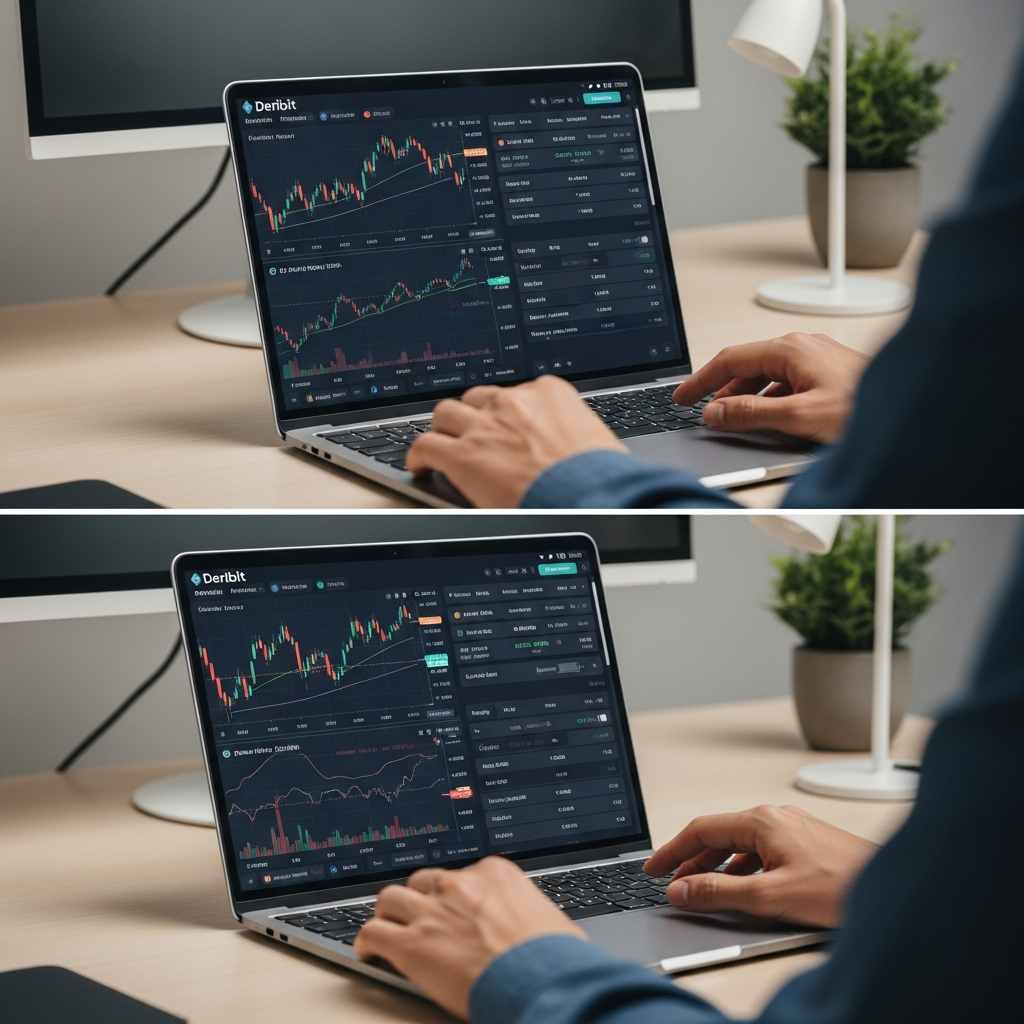
Deribit uses a maker-taker fee model.
A maker order adds liquidity to the order book, while a taker order removes available liquidity.
The applicable fee depends on the instrument, account tier, and whether any specific discount or cap applies.
Standard Trading Fees
Product | Maker fee | Taker fee |
|---|---|---|
Futures and perpetuals | 0.015% | 0.035% |
Options | 0.03% | 0.03% |
Coinbase-routed spot pairs | 0.02% | 0.05% |
Native Deribit spot pairs | 0% | 0% |
The standard options fee is also subject to a cap of 12.5% of the option premium, according to the published fee schedule.
Higher-volume or qualifying-equity accounts can receive different rates.
These figures are from Deribit's official fees page , updated September 14, 2026.
Understanding the Options Fee Cap
An options fee calculated from underlying notional value can be disproportionately large compared with a low-priced option premium.
Deribit's fee cap limits that relationship.
This is an important detail for anyone comparing options execution costs because a quoted basis-point fee does not always equal the final amount charged.
VIP Fee Tiers
Deribit publishes automatic fee tiers based on eligible trading volume and/or equity requirements.
Qualifying accounts may receive reduced maker and taker fees, and certain high-volume futures tiers offer maker rebates.
However, the available tier should be confirmed directly in the account.
Do not assume that institutional status alone provides a specific discounted rate.
Other Deribit Costs
Trading fees are only part of the total cost.
Settlement and Delivery Fees
Deribit's published schedule includes:
BTC/ETH options delivery fees of 0.015%, subject to the option-value cap;
selected futures delivery fees of 0.025%;
different treatment for certain daily options and weekly futures.
The applicable rules depend on the instrument and expiry.
Liquidation Fees
Liquidations can incur fees beyond ordinary trading charges.
The exchange's fee documentation provides separate liquidation formulas for options and futures.
These should not be summarized as one universal percentage.
A liquidation may also occur during unfavorable market conditions when available liquidity is limited.
Funding Payments
Perpetual-contract funding is distinct from maker/taker execution fees.
Depending on the contract and funding rate, a position may pay or receive funding.
A position's total economic result therefore cannot be calculated from the trading fee alone.
Collateral Fees
Deribit also publishes collateral fees for certain negative settlement-currency balances in cross-collateral arrangements.
Its documented default is 0.05% per day while the relevant balance remains negative, with time-based calculation.
Traders using cross collateral should understand when these charges apply.
For the current rules, consult the complete Deribit fee schedule .
How Deribit Margin Works
Deribit supports different margin models.
They should not be described as interchangeable.
Standard Margin
Under standard margin, the exchange calculates margin requirements for positions individually and then combines those requirements.
Its documentation distinguishes segregated standard margin from cross standard margin.
Deribit currently states that segregated standard margin is the default for new accounts.
See Standard Margin .
Portfolio Margin
Portfolio margin evaluates eligible positions together using stress scenarios.
The exchange then determines margin requirements based on the risk measured across those scenarios.
This can treat certain offsetting exposures differently from standard margin.
However, a lower margin requirement is not the same as a lower-risk position.
Portfolio losses, sudden volatility, changing correlations, and liquidation remain possible.
See Portfolio Margin .
Deribit Risk Management and Liquidation
Deribit's risk management system monitors margin levels and can reduce positions when accounts breach required thresholds.
The exchange also maintains an insurance fund intended to absorb certain losses remaining after a bankrupt account's positions are liquidated.
That fund should not be confused with deposit insurance or a guarantee of customers' trading balances.
Deribit's own insurance-fund documentation explains that losses could be socialized among winning traders if the insurance fund were exhausted.
Its risk controls are designed to manage exchange exposure, not eliminate market risk.
See Deribit's risk-management documentation and Insurance Fund .
Is Deribit Safe?
Deribit documents a multi-layer custody and risk-management framework.
Its published custody policy describes cold-wallet storage, split private keys, multi-signature controls, and restricted access procedures.
It also provides separate custody arrangements for certain institutional clients.
These measures are relevant to evaluating custody practices, but they do not establish that deposited funds cannot be lost.
Proof of Reserves: September 2026 Update
An important change occurred in September 2026.
Deribit announced that its daily Proof of Reserves page would be discontinued from September 1 because its wallet infrastructure was changing as part of Coinbase integration.
That means a review should not currently advertise the old daily Proof of Reserves page as an available verification feature.
Source: Deribit's Proof of Reserves announcement .
Risks That Remain
Relevant risks include:
losses caused by leveraged derivatives;
liquidation during volatile markets;
exchange operational interruptions;
custodial and counterparty exposure;
funding, settlement, and collateral charges;
changes in market access or regulation.
A platform's security features do not guarantee a profitable trade or protect a customer against all types of loss.
Deribit Supported Countries and KYC Requirements
Deribit requires individual customers to complete Know Your Customer verification before making deposits and trading.
Its verification process includes identity information and may involve additional documents.
The platform also maintains jurisdictional restrictions.
Important Restricted Markets
Deribit's published restricted-jurisdiction list includes the United States, Canada, Japan, and several other countries and territories.
Certain locations have narrower restrictions.
For example, its list specifies restrictions on retail clients in the United Kingdom and allows retail investors in the United Arab Emirates and Panama to trade spot products only.
Requirements depend on the actual legal and residency circumstances.
For the latest eligibility rules, consult Deribit's Restricted Jurisdictions page .
Do not rely on a VPN, inaccurate residency declaration, or false identity information to bypass restrictions.
Deribit API and Algorithmic Trading
Deribit offers several programmatic interfaces.
Its September 2026 API guidance documents:
JSON-RPC over WebSocket;
JSON-RPC over HTTP;
FIX connectivity;
authenticated account methods;
market-data subscriptions;
order-management functions;
API scopes and rate limits.
The platform also documents additional low-latency infrastructure for eligible professional participants.
In August 2026, Deribit rolled out its Starbase matching engine, with separate high-performance connectivity options.
That does not mean ordinary public API users receive the same latency or connectivity conditions as colocated institutional participants.
See the Deribit API guidance .
Deribit Testnet
Deribit provides a separate test environment at test.deribit.com.
It can be used to explore the interface and test integrations with synthetic funds.
However, Deribit explicitly cautions that testnet liquidity, market activity, and trading volume do not realistically reproduce production conditions.
Successful testnet execution is not evidence that a live trading strategy will perform similarly.
See Deribit Testnet documentation .
Deribit Pros and Cons
Pros | Cons |
|---|---|
Established cryptocurrency options venue | Derivatives involve substantial financial risk |
BTC, ETH, and selected altcoin derivatives | Access prohibited or limited in multiple jurisdictions |
Standard and portfolio-margin models | Margin and liquidation rules are complex |
Published trading-fee schedules | Settlement, funding, and collateral costs need separate review |
WebSocket, HTTP, and FIX APIs | API integration requires technical expertise |
Separate test environment | Testnet does not simulate live execution faithfully |
Documented custody practices | Custody and exchange risks remain |
Expanded spot routing via Coinbase | Routed spot markets have different fees and order behavior |
Deribit vs Binance, OKX, and Other Alternatives
Exchange comparisons should be based on the actual product and jurisdiction rather than a broad claim that one exchange is universally superior.
Evaluation factor | Deribit | Alternative-exchange considerations |
|---|---|---|
Core product focus | Derivatives and selected spot markets | Some competitors offer broader spot and retail services |
Options coverage | BTC, ETH, and selected USDC-linear altcoin options | Available contracts differ by platform |
Margin models | Standard and portfolio margin | Terms and eligibility vary |
Trading costs | Product-specific published schedule | Compare equivalent instruments and VIP tiers |
Market access | Country and client-type restrictions | Restrictions differ by platform |
Execution | Native and selected Coinbase-routed spot markets | Compare spreads, order books, and actual fills |
API | Multiple professional interfaces | Rate limits and connectivity differ |
A meaningful cost comparison should use the same underlying asset, contract type, trade size, and execution assumptions.
Comparing a futures maker fee on one exchange with an options taker fee on another is not informative.
For related CompareBestAI coverage, see the Binance Pro review .
If your interest is automated trading software rather than an exchange, review WunderTrading or our Zignaly crypto copy-trading review . Those are different product categories and introduce their own risks.

How to Evaluate Deribit Before Using It
A careful evaluation should begin with eligibility.
Confirm that the service and intended product are permitted for your location and account type.
Next, review the exact contract specifications, including settlement currency, expiry, contract size, and margin requirements.
Then evaluate the full potential cost of the transaction—not only maker and taker fees.
Finally, understand the consequences of liquidation and the risks associated with keeping assets on a centralized exchange.
A practical sequence is:
Eligibility → KYC → product specifications → total costs → margin and liquidation rules → custody review → operational testing.
This is an evaluation process, not a recommendation to enter a trade.
How We Evaluated Deribit
This update is based on Deribit's official product and fee documentation, Coinbase's acquisition announcement, the current jurisdiction list, custody and margin documentation, and published changes to spot routing and proof-of-reserves reporting.
We have not independently benchmarked September 2026 order execution, verified all account-specific fee tiers, or conducted a security audit of Deribit's infrastructure.
Accordingly, this review does not claim a universal fee advantage, guaranteed execution speed, or an independently verified safety rating.
You can review CompareBestAI's broader editorial methodology .
Frequently Asked Questions
What is Deribit?
Deribit is a cryptocurrency trading platform specializing in options, futures, and perpetual contracts. It also offers selected spot markets and professional trading interfaces.
Who owns Deribit?
Coinbase completed its acquisition of Deribit on August 14, 2025. Deribit continues to publish its own product documentation and jurisdictional restrictions.
What are Deribit's trading fees in 2026?
At the standard tier, futures and perpetuals cost 0.015% maker and 0.035% taker, while options cost 0.03% maker and 0.03% taker, subject to applicable caps. Spot rates depend on the routing venue.
Can U.S. residents use Deribit?
Deribit's published restricted-jurisdiction list includes the United States. Coinbase ownership does not change that restriction automatically.
Does Deribit require KYC?
Yes. Individual clients must complete Deribit's Know Your Customer process before deposits and live trading. Additional documentation may be requested.
Does Deribit support altcoin options?
Yes. In addition to BTC and ETH, its USDC-linear options documentation includes assets such as AVAX, HYPE, SOL, TRX, and XRP.
Is Deribit's Proof of Reserves page still available?
Deribit announced that it would discontinue its daily Proof of Reserves page from September 1, 2026, during Coinbase-related wallet-infrastructure changes.
Final Verdict
Deribit remains a specialized cryptocurrency derivatives venue with multiple contract types, advanced margin models, and professional API infrastructure.
Its current product offering is broader than the BTC/ETH-only description in older reviews, and its 2026 fee schedule differs substantially from the rates often quoted in outdated comparisons.
The platform also has important limitations.
Jurisdictional restrictions, liquidation risk, custody exposure, settlement mechanics, and total transaction costs require careful evaluation.
For readers comparing trading platforms, start with the relevant product and legal eligibility rather than a headline exchange ranking.
You can review the Deribit product profile , browse Finance & Trading tools , or compare available tools side by side Editorial disclosure: This article is informational and does not constitute investment, trading, legal, or tax advice. Cryptocurrency derivatives can result in substantial losses.