![dYdX Review [2026]: Trading Fees, Features, Safety & Risks](https://cbai.s3.us-east-1.amazonaws.com/dYdX_Review_2026__Honest_Guide_to_Fees__Trading__Features___Security_image.png)

Quick Answer: dYdX is a decentralized cryptocurrency derivatives protocol focused on perpetual futures trading. It operates on a purpose-built blockchain and offers order-book trading, multiple order types, and non-custodial account control. However, leveraged trading carries substantial liquidation risk, trading and funding costs vary, and dYdX-operated interfaces restrict users in jurisdictions including the United States, Canada, and the United Kingdom. This review examines its features, fees, security model, and limitations using official documentation.
Choosing a cryptocurrency trading platform requires more than comparing advertised fees or the number of available markets.
For perpetual futures, traders must also understand collateral requirements, funding payments, liquidation rules, custody arrangements, and the legal availability of the service in their jurisdiction.
dYdX offers a different operating model from conventional centralized exchanges. Its blockchain-based infrastructure allows users to trade supported perpetual contracts through decentralized network mechanisms.
However, decentralization does not eliminate financial, technical, or regulatory risks.
This dYdX review examines the protocol's functionality, trading costs, security considerations, and practical suitability for different types of users.
For a broader overview of trading software, explore our Finance & Trading tools category .
What Is dYdX?
dYdX is a decentralized trading protocol primarily associated with cryptocurrency perpetual futures.
Perpetual futures are derivative contracts that allow traders to obtain price exposure to an underlying asset without holding that asset directly.
Unlike conventional futures, perpetual contracts do not have a fixed expiration date.
The protocol uses mechanisms such as funding payments and margin requirements to maintain market operation.
dYdX Chain is a purpose-built blockchain built using the Cosmos SDK. It supports decentralized validation, trading-related state management, and on-chain settlement.
The platform's operating model differs from a centralized exchange, where a company typically manages order execution infrastructure and customer accounts.
However, its decentralized architecture does not remove the need to evaluate the software, validators, market liquidity, and the interface used to access it.
What is the difference between dYdX and a centralized exchange?
A centralized exchange usually maintains an internal account system and handles user balances through its own custody arrangements.
dYdX instead uses blockchain-based accounts and protocol mechanisms.
Traders retain control over the credentials associated with their accounts, while collateral committed to trading is subject to the protocol's rules.
The distinction is important: non-custodial control does not mean funds cannot be lost through liquidation, software problems, or other risks.
For a comparison with a more conventional exchange model, see our Bitstamp review .
dYdX Review 2026: Key Features at a Glance
The following table summarizes the protocol's documented characteristics.
Feature | dYdX |
|---|---|
Platform type | Decentralized derivatives protocol |
Main trading product | Perpetual futures |
Blockchain | dYdX Chain |
Trading mechanism | Order-book-based trading |
Collateral | USDC-based trading infrastructure |
Order types | Market, limit, stop-market, stop-limit, take-profit market, and take-profit limit |
Margin | Cross-margin and isolated-margin functionality |
Trading fees | Maker-taker model, subject to current schedule |
Funding | Periodic payments between long and short positions |
Governance | DYDX token-based network governance |
Staking | Validator delegation with associated risks |
API | Developer-accessible trading infrastructure |
Geographic access | Restricted in certain jurisdictions |
These capabilities are documented in the official dYdX Trading Help Center .
Available markets, risk parameters, fees, and interface functionality can change through governance or software updates.

1. How Does dYdX Trading Work?
dYdX allows eligible users to trade supported cryptocurrency perpetual contracts.
A typical trading workflow involves accessing a supported interface, connecting or establishing an account, funding it with compatible collateral, and selecting a market.
The trader then chooses an order type, position size, and applicable margin settings.
Once an order executes, the resulting position is subject to changes in the underlying market price and applicable funding payments.
Order-book trading
dYdX uses an order-book model.
Buy and sell orders are matched according to the available liquidity and the protocol's trading rules.
A market order seeks immediate execution against available opposing orders.
A limit order specifies the price at which a trader is willing to execute.
The actual execution price and filled quantity depend on the order book.
Supported order types
The official dYdX documentation describes six principal order types:
Order type | Function |
|---|---|
Market | Attempts immediate execution |
Limit | Executes at a specified price or better |
Stop Market | Triggers a market order when conditions are met |
Stop Limit | Triggers a limit order when conditions are met |
Take Profit Market | Triggers a market order at a profit-taking condition |
Take Profit Limit | Triggers a limit order at a profit-taking condition |
These order types provide different ways to manage execution and positions.
However, conditional orders do not guarantee execution at a particular price, especially during volatile markets or when available liquidity is limited.
See the official dYdX order-type documentation .
2. dYdX Leverage and Margin Trading
Leverage allows a trader to obtain exposure to a position larger than the collateral committed to it.
This amplifies both potential gains and potential losses.
The maximum leverage available on dYdX depends on the market and its applicable risk parameters.
It should not be described as a single fixed maximum for every asset.
Understanding leverage with an example
Suppose a trader has $100 in collateral and opens a $500 position.
The position represents 5x exposure relative to the committed collateral.
A 5% change in the underlying price corresponds to a $25 change in the position's value before fees and funding.
That change is equivalent to 25% of the original $100 collateral.
This example illustrates why relatively small market movements can have a substantial effect on leveraged accounts.
The actual liquidation threshold depends on the applicable margin requirements and account conditions.
Cross margin vs isolated margin
dYdX supports different margin configurations.
Cross margin allows eligible positions to share available collateral within the relevant account structure.
Isolated margin assigns collateral to a particular position, allowing its exposure to be managed separately.
Neither arrangement eliminates liquidation risk.
The appropriate mechanics depend on the market and the protocol's current configuration.
The official isolated-margin guide explains how dYdX implements these positions.
3. dYdX Trading Fees in 2026
dYdX uses a maker-taker fee model.
Maker orders add liquidity to the order book, while taker orders remove existing liquidity.
The applicable fees may depend on trading volume, current protocol settings, and the fee schedule displayed by the interface.
The previous version of this article states that all traders pay a fixed 0.02% maker fee and 0.05% taker fee.
Those figures should not be presented as universal current rates.
Where can users find current fees?
According to the official dYdX Help Center, users of the dydx.trade interface can navigate to:
Portfolio → Fees
This section displays the applicable fee schedule and the user's relevant fee information.
The protocol's fee parameters may change through governance.
See the official dYdX trading fee documentation .
Are dYdX trades gas-free?
The default trading configuration does not charge users a separate gas fee for ordinary trades.
However, this does not mean every blockchain operation is free.
Wallet transfers, bridging, withdrawals, staking, and transactions involving other networks may incur costs.
The actual amount depends on the operation and relevant network conditions.
What other trading costs matter?
Trading fees are only one part of the cost of maintaining a perpetual position.
Users should also consider funding payments, slippage, liquidation costs, and any transfer-related expenses.
A comparison based only on headline maker and taker fees may therefore be incomplete.
4. dYdX Funding Rates Explained
Perpetual contracts do not expire at a fixed date.
Funding payments help keep perpetual contract prices aligned with their underlying reference prices.
The payment direction depends on the applicable funding rate and position direction.
When the funding rate is positive, long positions generally pay short positions.
When it is negative, short positions generally pay long positions.
How often are funding payments applied?
dYdX's official documentation describes an hourly funding-payment mechanism under the default protocol configuration.
The funding rate is calculated using market-related premium information.
These parameters can be adjusted through governance.
Funding payments may increase or decrease a trader's realized profit and loss while a position remains open.
For detailed mechanics, see the official dYdX funding-rate explanation .
Why do funding rates matter?
Funding can affect the total cost of holding a position.
A trade that appears inexpensive based on execution fees alone may incur additional costs over time.
Users evaluating dYdX should therefore examine the relevant market's funding information alongside its trading fee schedule.
5. dYdX Security: What Are the Main Risks?
Security is a central consideration for any cryptocurrency derivatives platform.
dYdX's architecture provides blockchain-based account control, but the system remains exposed to multiple categories of risk.
These include software vulnerabilities, validator-related problems, market volatility, liquidation mechanisms, oracle-related issues, and user-side security failures.
Non-custodial account control
The protocol's account model allows users to control the credentials associated with their blockchain accounts.
However, funds committed as trading collateral are subject to protocol rules.
They can be affected by losses, liquidations, and other mechanisms.
Non-custodial architecture should not be interpreted as an assurance against financial loss.
Liquidation risk
A position may be liquidated when the account no longer meets its maintenance-margin requirements.
The protocol's liquidation engine can partially or fully close affected positions.
During extreme market conditions, the resulting execution may be less favorable than expected.
The official liquidation documentation explains the mechanism.
Deleveraging risk
The dYdX documentation also describes deleveraging when an account's value becomes negative.
Under certain conditions, offsetting positions may be reduced to address the resulting deficit.
This means users can face position-related effects even when they are on the opposite side of an undercollateralized trade.
Phishing and wallet security
Users should verify that they are accessing the intended provider and avoid untrusted links.
Seed phrases and private keys should never be shared.
The official dYdX documentation warns that anyone with access to a wallet's relevant private key can control the associated assets.
Does the insurance fund guarantee protection?
No.
An insurance mechanism may be used in specified liquidation or loss-related circumstances, but it is not equivalent to a universal guarantee of user deposits.
The previous article's claims about covering a fixed percentage of incidents or reimbursing all eligible users are not supported by the documentation reviewed for this rewrite.
Users should not treat protocol insurance as a substitute for understanding the risk of leveraged trading.
6. Can US Residents Use dYdX in 2026?
Geographic eligibility is particularly important for CompareBestAI's primary US audience.
According to dYdX Operations Services Ltd.'s April 23, 2026 help-center guidance, its operated frontends are unavailable to users in certain restricted jurisdictions.
These include the United States, Canada, and the United Kingdom.
Restrictions may also apply to other jurisdictions.
What happens when an account is restricted?
The official documentation describes a close-only state that may allow affected users to cancel orders, reduce or close positions, and withdraw funds.
It does not permit opening new positions or making new deposits.
Eligibility should be established through the provider's current terms and applicable local requirements.
The availability of an open-source protocol does not establish permission to use a restricted trading interface.
For US readers, this article is an informational review rather than an invitation to open a restricted derivatives account.
See the official dYdX geographic restrictions .
7. dYdX Governance and DYDX Staking
dYdX Chain supports governance and validator participation through its native DYDX token.
DYDX holders can participate in network governance according to the applicable rules.
They may also delegate tokens to validators.
How does staking work?
Staking involves bonding DYDX tokens to a validator that participates in securing the network.
The official documentation describes USDC-denominated staking rewards derived from protocol-related revenue, subject to applicable deductions and conditions.
Returns are variable and are not guaranteed.
What is the unstaking period?
The official dYdX guidance specifies a 30-day unstaking period.
During that period, tokens cannot be immediately retrieved.
Validator-related risks and applicable protocol conditions should be reviewed before participating.
The official staking guide explains the process.
Is staking the same as trading?
No.
Trading perpetual contracts creates market exposure through derivatives positions.
Staking involves validator delegation and participation in the network's security and governance arrangements.
The financial risks, technical requirements, and liquidity conditions differ.
8. dYdX MegaVault: Features and Risks
dYdX also provides MegaVault functionality.
According to the official documentation, MegaVault allows eligible users to add USDC that supports automated trading strategies across protocol markets.
The strategies can involve volatile and illiquid assets.
How can MegaVault generate returns?
The official documentation identifies several potential sources, including trading profit and loss, funding payments, fee-related revenue, and community incentives.
However, these are not guaranteed sources of positive returns.
MegaVault can lose money.
Is the displayed APR guaranteed?
No.
The displayed APR is an estimate based on historical performance and current vault conditions.
The official help center explains that changes in vault assets and performance can affect the resulting annualized figure.
Past results are not a guarantee of future outcomes.
MegaVault is also subject to geographic restrictions.
Users should read the official MegaVault FAQ before evaluating the product.
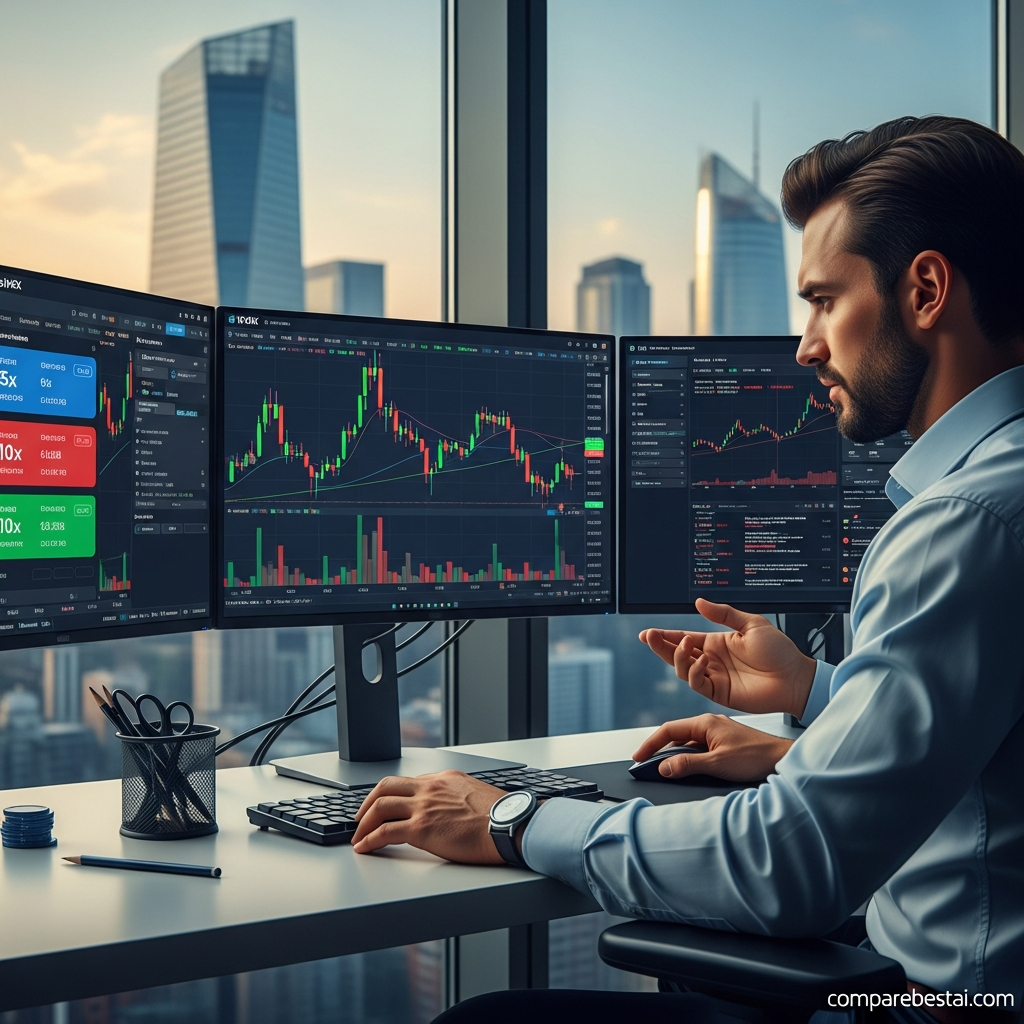
9. dYdX Mobile Trading and User Experience
dYdX provides mobile access, including an iOS interface described in its official documentation.
The mobile experience supports different interface modes intended for users with different levels of trading experience.
Simplified and Pro interfaces
The official iOS documentation describes a simplified mode and a Pro mode.
The simplified interface presents a more streamlined trading experience.
The Pro interface provides access to more advanced trading functionality.
However, a simplified interface does not reduce the financial risk of leveraged perpetual contracts.
What should users check before trading on mobile?
Users should understand the applicable position size, margin requirements, liquidation price, and funding conditions.
They should also check the provider's current application availability and account-security requirements.
The official mobile interface guide describes the relevant functionality.
The earlier article's claims about mobile trading volume, execution reliability, and support response times should not be retained without reproducible evidence.
10. dYdX API and Automated Trading
dYdX's infrastructure is relevant to developers researching automated trading and blockchain-based market data.
However, API availability does not guarantee execution speed, uninterrupted operation, or profitable trading results.
What should developers evaluate?
A developer should examine supported endpoints, authentication requirements, market-data availability, transaction signing, order handling, and rate limits.
The protocol's implementation and the selected frontend can affect these requirements.
The official documentation also describes equity-based limits on the number of open orders a subaccount may maintain.
For example, the relevant limits can depend on account equity and the applicable position structure.
Is dYdX suitable for algorithmic trading?
Its developer-accessible infrastructure makes it relevant to researching programmatic trading workflows.
However, a production strategy should account for network behavior, market liquidity, price movement, operational failures, and the applicable geographic restrictions.
Automated execution does not remove market or liquidation risk.
For a broader look at charting and trading software, explore our TradingView Premium review .
11. dYdX Pros and Cons
The following assessment summarizes the protocol's documented characteristics and practical limitations.
Potential advantages | Limitations and risks |
|---|---|
Decentralized, blockchain-based trading infrastructure | Leveraged derivatives carry substantial financial risk |
Multiple order types | Liquidation and deleveraging are possible |
Order-book trading model | Market liquidity varies by instrument |
Maker-taker fee structure | Funding and transfer costs may apply |
Cross-margin and isolated-margin functionality | Requires understanding of collateral and risk parameters |
DYDX governance and staking | Staking has unbonding and validator-related risks |
Developer-accessible infrastructure | Operational and API limitations must be evaluated |
Mobile access | Geographic restrictions affect eligibility |
The appropriate interpretation depends on the user's requirements, experience, and jurisdiction.
These features do not establish that dYdX is universally safer, cheaper, or more suitable than other exchanges.
12. dYdX vs Other Crypto Trading Platforms
Not all cryptocurrency platforms offer the same products.
Some focus on spot trading, others specialize in derivatives, and others provide charting or analytical tools without functioning as an exchange.
This distinction matters when evaluating alternatives.
dYdX vs centralized exchanges
A centralized exchange generally manages customer accounts and trading infrastructure through its own operating entity.
dYdX uses a blockchain-based protocol model.
The difference affects account control, trading mechanics, eligibility, and risk.
For example, Binance Pro's trading features include multiple crypto trading products, subject to regional availability.
Users should compare the specific product available in their jurisdiction rather than assuming that every exchange offers the same services.
dYdX vs Bitstamp
Bitstamp is a centralized cryptocurrency exchange with a different operating model.
Its product offerings and regional availability differ from those of dYdX.
For users primarily evaluating spot-market access and conventional exchange functionality, the Bitstamp product profile provides a separate reference point.
dYdX vs Bookmap
Bookmap is an order-flow visualization platform, not a direct substitute for a perpetual futures exchange.
Its tools can help users analyze market depth and executed volume.
That information serves a different purpose from the exchange infrastructure used to maintain derivatives positions.
Read our Bookmap review for an explanation of its market-depth functionality.
Which factors matter in an exchange comparison?
A meaningful comparison should examine trading products, eligibility, custody, fee structure, margin rules, market liquidity, and the risks associated with the actual service.
Avoid comparing a spot-trading fee with a perpetual futures fee as if they represented identical transactions.
13. Who Should Consider dYdX?
The documented functionality is relevant to several research and trading use cases.
However, geographic restrictions and financial risks are essential considerations.
User profile | Relevant consideration |
|---|---|
Experienced derivatives traders | Order types, funding, margin, and market liquidity |
DeFi researchers | Blockchain architecture and governance |
Developers | APIs, transaction handling, and rate limits |
DYDX holders | Staking, validator participation, and governance |
Beginners | Complexity and the risk of leveraged losses |
Users in restricted jurisdictions | Access restrictions and applicable local rules |
A user should not interpret a product's technical capabilities as a recommendation to trade.
For US readers in particular, the provider's geographic restrictions must be established before any account or trading-related action.
14. How to Evaluate dYdX Before Using It
A systematic evaluation starts with product eligibility and an understanding of the underlying risks.
Step 1: Confirm geographic eligibility
Review the provider's current terms and determine whether the relevant interface is available in your jurisdiction.
Do not assume that blockchain accessibility overrides geographic restrictions.
Step 2: Understand perpetual contracts
Learn how perpetual prices, funding payments, collateral, leverage, and liquidation mechanisms work.
The financial implications differ from those of buying and holding a cryptocurrency.
Step 3: Review current trading fees
Check the applicable fee schedule, including maker and taker rates.
Account for funding, potential slippage, and transfer-related costs.
Step 4: Evaluate the selected market
Review the market's liquidity, risk parameters, and supported order types.
Do not assume that conditions observed in one market apply to every trading pair.
Step 5: Understand custody and security
Check how account credentials and trading collateral are handled.
Review the relevant security documentation and operational risks.
Step 6: Assess the complete workflow
Evaluate the interface, account requirements, market data, and any additional tools needed for your use case.
For users researching market-depth analysis separately, the Bookmap tool profile provides additional information about that software category.
Frequently Asked Questions About dYdX
What is dYdX used for?
dYdX is a decentralized derivatives protocol primarily used for trading supported cryptocurrency perpetual contracts. Its infrastructure includes order-book trading, margin functionality, and blockchain-based settlement.
Can US residents trade on dYdX?
dYdX's official help center lists the United States among the restricted jurisdictions for interfaces operated by dYdX Operations Services Ltd. Users must verify current eligibility and applicable requirements.
Does dYdX charge trading fees?
Yes. dYdX uses a maker-taker fee model. Applicable rates may depend on trading activity and current protocol settings. Funding and other transaction-related costs may also apply.
Is dYdX completely safe?
No trading platform is risk-free. dYdX users face market, liquidation, software, validator, and wallet-security risks. Non-custodial account control does not guarantee protection from losses.
Does dYdX support leverage?
Yes. Supported perpetual markets allow leveraged positions. The available leverage depends on the market's risk parameters, and leverage amplifies potential gains and losses.
What is the dYdX MegaVault?
MegaVault allows eligible users to add USDC to support automated trading strategies. Returns are variable, and the official documentation warns that participants can lose money.
How CompareBestAI Evaluates dYdX
This review uses information from official dYdX documentation to explain the protocol's functionality, fee mechanisms, trading risks, and geographic restrictions.
It distinguishes documented product features from financial outcomes that depend on market conditions.
This article does not represent a new independent trading benchmark, security audit, or live execution test.
Trading volume, market depth, funding rates, and applicable fees can change. Readers should use current provider information when evaluating these variables.
CompareBestAI may earn commissions through certain partner links. Commercial arrangements do not eliminate the need to independently verify platform eligibility and risk.
Final Thoughts: Understanding dYdX in 2026
dYdX provides decentralized infrastructure for cryptocurrency perpetual futures trading, with order-book functionality, multiple order types, margin configurations, and blockchain-based governance.
Its technical design differs from a conventional centralized exchange.
However, using a decentralized protocol does not eliminate the risks of leverage, liquidation, software vulnerabilities, or market volatility.
Geographic restrictions are also a material consideration, particularly for readers in the United States, Canada, and the United Kingdom.
Before evaluating dYdX for trading, confirm eligibility, review the official fee schedule, and understand the financial implications of perpetual contracts.
Continue your research: Explore the CompareBestAI Finance & Trading category to compare relevant trading and market-analysis tools.