
Quick Answer: Is Pionex Worth Using?
Pionex can be worth considering for eligible crypto traders who want trading bots built directly into an exchange without paying a separate monthly bot subscription.
The global platform currently offers 16 bot families, including Spot Grid, DCA or Martingale-style strategies, Rebalancing Bot, futures bots and Signal Bot. Its standard spot trading fee is currently 0.05% for both maker and taker orders.
However, Pionex is not available everywhere. Pionex.com's current terms restrict users in the United States, Singapore, the United Kingdom, Canada and several other jurisdictions. U.S. users should note that the former Pionex.US service was transitioned to the separate Webot brand.
Pionex trading bots automate rules. They do not guarantee profits, and leveraged or Martingale-style strategies can create significant losses.
Information checked August 19, 2026.
Check Pionex availability in your regionKey Takeaways
- Pionex currently lists 16 trading-bot families.
- Standard global spot fees are 0.05% maker and 0.05% taker.
- Standard futures fees are currently 0.02% maker and 0.05% taker.
- Eligible traders may receive lower fees through Pionex's VIP program.
- Built-in bots do not require a separate subscription, but normal trading fees still apply to executed orders.
- Pionex's DCA product is a Martingale-style, price-based strategy rather than simple calendar-based dollar-cost averaging.
- Pionex provides REST, WebSocket and Bot APIs.
- Pionex.com is restricted in multiple jurisdictions, including the United States and Singapore.
- Automated trading does not remove crypto-market, leverage, liquidity or liquidation risk.
What Is Pionex?
Pionex is a cryptocurrency exchange built around integrated automated trading tools.
Unlike standalone bot software that connects to outside exchanges through API keys, Pionex hosts both the trading venue and its bot tools in the same ecosystem.
Current bot families include spot and futures strategies such as Grid, DCA or Martingale, Rebalancing, Futures Grid, Signal Bot and several leveraged or advanced variants.
It is more accurate to call these automated trading bots than to describe the entire product suite as AI-powered.
Pionex's own terms say trading robots execute according to predetermined algorithms, formulas and parameters confirmed by the user. Some bot interfaces also include AI Strategy features that use historical backtests to suggest parameters.
Those suggestions are not predictions and should not be treated as expected returns.
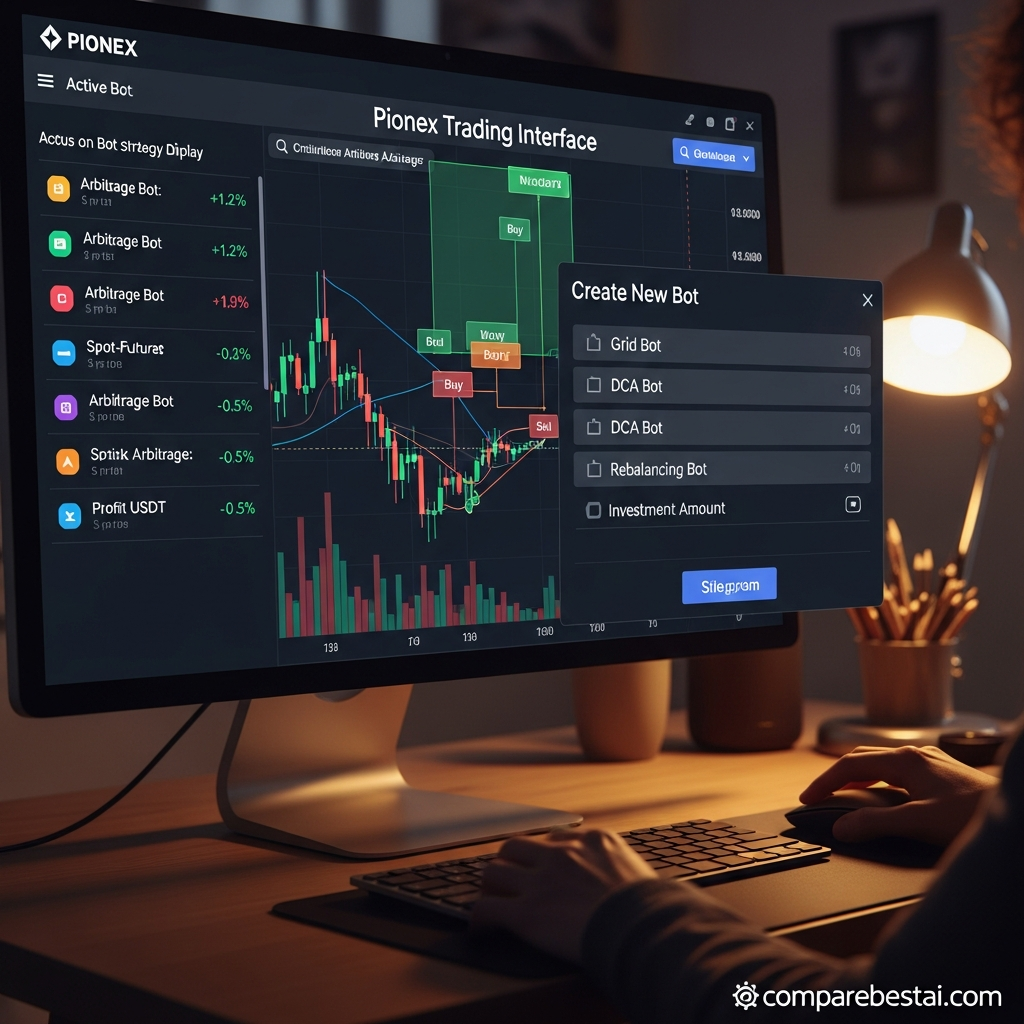
Pionex Trading Bots
Spot Grid Bot
The Spot Grid Bot places buy and sell orders inside a price range selected by the user.
It can work best when a market repeatedly moves within that range, but a grid can stop trading effectively if price breaks outside the configured boundaries.
The important settings include:
- lower and upper price
- number of grids
- investment amount
- stop loss
- take profit
- trigger price
- grid mode.
Pionex also provides AI-assisted parameter suggestions based on historical backtests.
Past backtest results do not guarantee future performance.
DCA or Martingale Bot
Pionex's DCA product is officially labelled the DCA (Martingale) Bot.
It is not the same as simply investing the same dollar amount every week or month.
The bot can add safety orders when price falls and increase the total position before attempting to exit when the combined position reaches a configured take-profit condition.
That structure can increase capital exposure during a prolonged decline, so users should review the full planned investment, safety orders and exit settings before starting.
Rebalancing Bot
The Rebalancing Bot maintains a portfolio close to selected target weights by buying and selling assets as allocations change.
Rebalancing can automate portfolio maintenance, but it does not prevent losses when the assets in the portfolio decline together.
Futures and Leveraged Bots
Pionex also offers futures and leveraged automation.
These products introduce additional risks including leverage, funding costs, liquidation and larger losses.
They should not be grouped with non-leveraged spot bots when discussing suitability for beginners.
Signal Bot
Signal Bot connects supported TradingView strategy alerts to automated execution on Pionex through webhooks.
This gives more advanced traders another automation route beyond Pionex's preconfigured bot strategies.

Pionex Fees in 2026
Pionex uses transaction fees rather than a normal monthly bot subscription.
| Cost | Current Standard Rate |
|---|---|
| Spot maker | 0.05% |
| Spot taker | 0.05% |
| Futures maker | 0.02% |
| Futures taker | 0.05% |
| Crypto deposits | Generally listed as free |
| Crypto withdrawals | Varies by asset and network |
| Built-in bot subscription | No separate monthly subscription |
Eligible higher-volume traders may qualify for reduced rates through Pionex's VIP program.
This means the 0.05% spot rate is the standard starting point rather than necessarily the final rate for every account.
Do Bot Fees Add Up?
Yes.
Pionex does not need to charge a separate monthly bot subscription for trading costs to matter.
Every executed trade can incur the applicable trading fee. A strategy that generates many fills can therefore accumulate more fees than a buy-and-hold position.
For grid strategies in particular, expected profit per completed grid needs to be large enough to justify fees, spread, slippage and market risk.
Is Pionex Available in the United States?
The global Pionex.com service is not currently available to U.S. residents under Pionex's published eligibility terms.
The global terms also restrict several other jurisdictions, including Singapore, the United Kingdom, Canada, the Netherlands, Spain and France.
The former Pionex.US service was transitioned to the Webot brand in December 2025.
U.S. readers should therefore evaluate Webot separately rather than assuming that features, fees, licensing or protections described for Pionex.com automatically apply to them.
Is Pionex Safe?
No cryptocurrency exchange or trading bot should be described as risk-free.
Pionex has published proof-of-reserves information and previously commissioned independent third-party reviews of its reserve data.
That is a useful transparency measure, but it is not the same as a guarantee against insolvency, custody failure, market losses or hacking.
Pionex's own terms state that digital-asset trading can result in loss of some or all invested capital. They also allow Pionex to use third-party custody or wallet providers for some assets.
Do not interpret trading automation, proof of reserves or account-security features as a guarantee that funds cannot be lost.
Does Pionex Have an API?
Yes.
Pionex currently publishes REST and WebSocket APIs covering trading, market data, wallets and other platform functions.
Its developer documentation also lists Bot API functionality.
That makes the current claim that Pionex lacks API-based automation outdated.
Explore the Pionex APIPionex Pros and Cons
Pros
- 16 integrated bot families
- No separate monthly subscription for built-in bots
- Standard spot fee of 0.05%
- Grid and rebalancing automation
- AI-assisted parameter suggestions on some strategies
- REST and WebSocket APIs
- Signal Bot for TradingView-based automation
- Web and mobile access
- VIP fee tiers for eligible traders.
Cons
- Pionex.com is unavailable in several major markets, including the United States
- DCA Bot uses Martingale-style logic that can increase exposure during declines
- Futures and leveraged bots introduce liquidation risk
- Every bot fill can generate trading fees
- Withdrawal fees vary by cryptocurrency and network
- Native automation is tied primarily to the Pionex trading ecosystem
- Backtests and AI Strategy suggestions cannot predict future returns
- Exchange custody introduces risks that do not exist with self-hosted bot software where funds remain at a separately chosen exchange.
Who Should Consider Pionex?
Pionex may suit eligible users who:
- already understand crypto-market risk
- want grid or other rules-based automation
- prefer bots integrated directly into an exchange
- do not want a separate monthly bot subscription
- understand how transaction fees affect frequent strategies
- can monitor bot settings and exit conditions.
Pionex is less suitable if you:
- live in a restricted jurisdiction
- require trading across many exchanges from one dashboard
- want all funds held at a separate exchange or self-custodied wallet
- need highly customized self-hosted strategies
- are uncomfortable with Martingale, futures or leverage risk
- expect a bot or AI strategy to provide guaranteed or passive profits.
How Pionex Stacks Up Against Competitors
Comparing Pionex to the leading alternatives reveals key differences in cost structures, target audiences, features, and risk profiles. Let’s break down how Pionex stands up to Gunbot, Bitsgap, BingX, and 3Commas—some of the most commonly researched competitors by crypto traders in 2026.
Gunbot is often considered by advanced traders seeking maximum customization. It’s a software bot you install and run locally or on a VPS, connecting to your exchange accounts via API keys. Unlike Pionex, Gunbot itself is not an exchange: you still need to trade on Binance, Kraken, or another major exchange. Gunbot is highly scriptable, supports custom strategies and backtesting, and is best for users with technical chops. On cost, Gunbot requires an up-front lifetime license (starting at $499) but has no trade commissions. This model suits high-volume or power users—however, it has a steeper learning curve and potentially greater setup complexity. For the average “set and forget” user who wants safety and automation without configuration headaches, Pionex remains easier and more accessible. You can learn more about Gunbot and get started at Try Gunbot now.
Bitsgap positions itself as the ultimate multi-exchange crypto automation platform. Its killer feature is universal integration: you can connect all your exchange accounts and run bots across them from a single dashboard. Bitsgap supports grid bots, DCA bots, and arbitrage, but it’s entirely subscription-based (starting at $19/month as of July 2026). For traders running strategies on several exchanges, this cross-platform freedom can be indispensable. However, it’s not ideal for simple users who want a “one app does it all” experience or those who dislike monthly subscription models. In contrast, Pionex focuses on hosting both the exchange and bots, keeping everything in one regulated, cost-predictable package. Access Bitsgap at their official site or review full VS comparisons for a side-by-side feature breakdown.
3Commas is well known for its advanced smart trading tools and customizable strategies. It offers sophisticated features like trailing stop-loss, portfolio balancing, and detailed analytics, but is fully reliant on external exchanges and requires a monthly subscription (starting from $29/month). For advanced users, the added analytics and API control may justify the cost. Still, for those content with integrated bots on a single platform, Pionex is simpler and cheaper. In 2026, most users rate Pionex as more intuitive, especially for grid and DCA strategies, with a lower all-in price over time.
BingX increasingly challenges Pionex for traders interested in spot and derivatives with bot automation. BingX is itself a regulated exchange and offers some basic bots for free, though their feature set and UI are less mature as of July 2026. Their fees are marginally higher (0.1% per trade), and the learning curve for setup is a bit steeper than Pionex’s hands-on grid bot wizard. Where BingX stands out is leverage trading and unique contract types, making it a strong pick for users wanting to combine advanced trading and automation. Check BingX at Try BingX now.
If your priorities are ease of use, built-in safety controls, and flat, transparent pricing, Pionex remains a consistent favorite. For highly advanced strategies or multi-exchange portfolio management, however, the alternatives (particularly Gunbot and Bitsgap) can’t be ignored. When reading through a pionex grid trading review or exploring the best crypto trading bot options, focus on your personal workflow, willingness to pay a subscription, and appetite for technical complexity. That’s where the differences are most acute.
How We Evaluated Pionex
Our assessment of Pionex is based on a multi-layered methodology, combining hands-on usage, cross-checking with public user feedback, and review of competitor claims as of July 2026. We examined the availability and performance of Pionex crypto bots, the clarity of the pricing model, platform safety credentials, and regulatory information. Transparency was verified directly from the official Pionex website (https://www.pionex.com), as well as major third-party crypto communities and user support forums.
We paid particular attention to user security (including custody policies and regulatory status), fees (including any hidden costs or exceptions), and cross-platform usability (reviewing both the mobile app and web interface). Comparisons with Gunbot, Bitsgap, BingX, and 3Commas relied on up-to-date data from vendor sites, as well as feedback in major crypto trading communities (e.g., r/CryptoCurrency and Telegram groups). All features and costs were checked for accuracy as of July 2026, with any claims or statistics only included if directly referenced from vendor documentation or community-verified sources.
Alternatives to Pionex
While Pionex is a compelling all-in-one platform, it won’t fit every crypto investor’s needs. Several competitors cover use cases that Pionex can’t, especially for power users and those seeking cross-exchange automation. Here’s a brief rundown of the best alternatives, so you can make the most informed purchasing decision:
- Gunbot: Perfect for the trader who wants complete control and flexibility over strategies. Upfront license fee, but unlimited trading on supported exchanges. Best for technical users.
- Bitsgap: The ideal choice for users managing assets across multiple exchanges. Offers subscription-based access and sophisticated grid, DCA, and arbitrage bots for portfolio-wide management. Integration is the key selling point.
- 3Commas: Strong analytics and intelligent automation for traders who want every detail and aren’t averse to monthly subscription costs. Better for those who value deep reporting and advanced strategy stacking.
- BingX: A regulated exchange with free bots and a focus on derivatives. Solid for those looking for leveraged or contract trading integrated with automation.
Choosing the right alternative largely depends on your trading habits, technical expertise, and appetite for monthly costs. If simplicity, safety, and minimal fees are your baseline, Pionex remains hard to beat for most traders as of July 2026.
Frequently Asked Questions
Is Pionex available in the United States?
Not through the current global Pionex.com platform. Its published eligibility terms list the United States as a restricted jurisdiction. The former Pionex.US service was transitioned to Webot in late 2025.
How much does Pionex charge?
The current standard global spot fee is 0.05% maker and 0.05% taker. Futures fees currently start at 0.02% maker and 0.05% taker. VIP users may qualify for lower rates.
Are Pionex trading bots free?
Pionex does not charge a separate monthly subscription to activate its standard built-in bot ecosystem, but each executed trade can still incur the applicable trading fee.
“Free bot” should therefore not be interpreted as “free trading.”
How many trading bots does Pionex have?
Pionex's current Bot Finder compares 16 bot families. Product availability and exact settings can vary by region and platform version.
Is the Pionex DCA Bot normal dollar-cost averaging?
No.
Pionex labels it DCA (Martingale). It uses price-triggered safety orders and can increase exposure as the market falls.
That is different from fixed-schedule dollar-cost averaging.
Does Pionex guarantee profit with its Grid Bot?
No.
A grid bot follows rules inside a selected price range. Fees, liquidity, volatility and a price move outside the range can affect results.
Pionex itself warns that trading bots cannot guarantee profit.
Does Pionex have an API?
Yes. Pionex currently provides REST and WebSocket APIs as well as Bot API functionality.
Does Pionex charge withdrawal fees?
Pionex publishes asset- and network-specific withdrawal fees. The exact amount depends on the cryptocurrency and blockchain network selected.
Is Pionex safe?
Pionex provides security controls and has published proof-of-reserves material, but cryptocurrency trading and custodial exchanges still carry significant risks.
Its own terms state that users can lose some or all of their investment.
Final Verdict: Is Pionex Worth It in 2026?
Pionex has a clear advantage for eligible traders who want automated crypto strategies built directly into an exchange without paying a separate bot-software subscription.
Its standard 0.05% spot fee, 16 current bot families, Grid Bot, Signal Bot and API access make the platform more capable than the current article suggests.
But Pionex should not be presented as effortless passive income or universally “safe.”
The DCA Bot uses Martingale-style logic, leveraged products can be liquidated, frequent bot fills generate transaction costs, and Pionex.com is unavailable in several major jurisdictions.
The strongest fit is an experienced-enough crypto trader who understands the strategy being automated, checks current regional eligibility and fees, and has a defined loss and exit plan before starting a bot.
For most users, Pionex justifies its price through reliability, accessibility, and transparent cost—especially when ongoing fees or technical hurdles would derail your automation elsewhere.
Found this guide useful? Share it with your team.