
By 2026, the digital landscape has shifted dramatically from the experimental phases of the early 2020s. We are no longer asking if artificial intelligence can write; we are defining how it should govern the flow of information. As agent-based search engines and personalized content feeds dominate the market, the sheer volume of synthetic media has created a new challenge: the crisis of trust.
For modern digital strategists, mastering AI content creation is no longer just about efficiency—it is about survival and authority. While algorithms can generate thousands of words in seconds, they cannot replicate the nuanced empathy required to build genuine brand loyalty. The winners in this mature AI economy are not those who automate everything, but those who strategically weave human insight into the computational fabric.
This guide explores how enterprise leaders and content marketers can navigate the complex ecosystem of 2026, ensuring that their output remains compliant, engaging, and deeply human despite the technological backbone driving it.
Navigating the Saturation of Synthetic Media
The internet of 2026 is flooded with automated text. Because the barrier to entry for content production has effectively vanished, the value of generic information has plummeted to zero. Users are increasingly skeptical of content that lacks a distinct point of view or personal experience.
To stand out, brands must pivot from "content volume" to "content resonance." This requires a fundamental shift in how we view generative AI tools. They are not replacements for creators; they are exoskeletons that amplify capability. The goal is to use these tools to handle data synthesis and structural drafting, allowing human creators to focus on narrative arcs and emotional intelligence.
Successful strategies now prioritize "information gain"—providing new data, unique perspectives, or proprietary research that a Large Language Model (LLM) cannot hallucinate or scrape from existing datasets. This approach is endorsed by major platforms, as seen in the evolution of quality guidelines from Google Search Central.
Integrating AI Content Creation into Enterprise Workflows
Adopting AI content creation at an enterprise level requires more than a subscription to a chatbot. It demands a rigorous operational framework that ensures consistency across all channels. In 2026, the most successful marketing teams utilize a hybrid workflow.
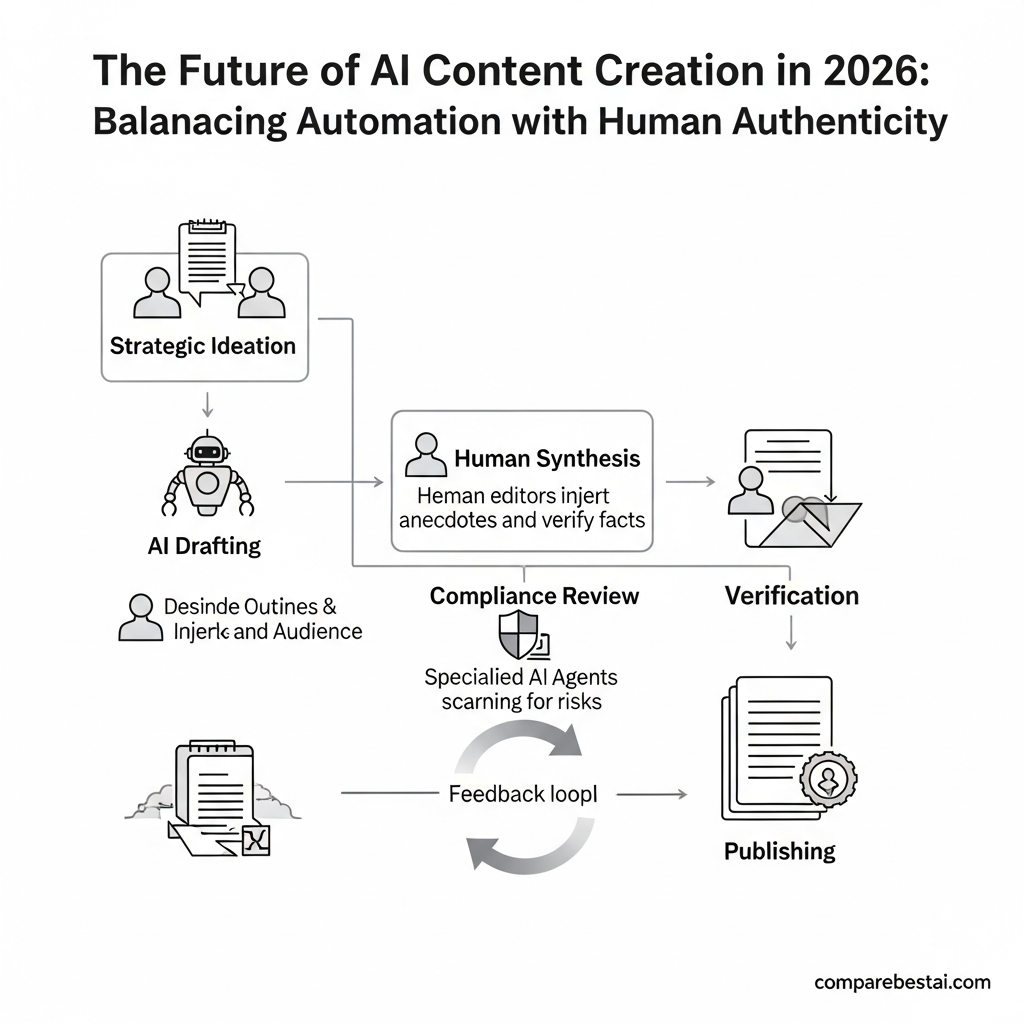
A standardized workflow typically follows these stages:
- Strategic Ideation: Humans define the intent, audience, and emotional hook.
- AI Drafting: Software generates outlines, summarizes research, and produces rough drafts.
- Human Synthesis: Subject matter experts inject anecdotes, verify facts, and adjust tone.
- Compliance Review: specialized AI agents scan for copyright risks and bias.
By compartmentalizing these tasks, organizations prevent the "drift" often seen in purely automated content, where the brand voice becomes diluted over time.
Mastering the Human-in-the-Loop Methodology
The concept of "human-in-the-loop" (HITL) has graduated from a buzzword to a critical operational standard. In the context of 2026 marketing, HITL ensures that an authentic brand voice is preserved. An algorithm can mimic style, but it cannot understand cultural nuance or rapid shifts in consumer sentiment.
Key areas where human intervention is non-negotiable include:
- Cultural Context: Ensuring references are appropriate and timely.
- Empathy and Humor: AI struggles with sarcasm and deep emotional connection.
- Strategic Alignment: Verifying that the content serves the broader business goal, not just the keyword requirement.
This synergy creates a final product that resonates with users who are increasingly using AI detection tools to filter out low-effort content from their feeds.
Establishing Ethical Compliance and Governance Standards
With great power comes significant legal responsibility. The regulatory environment in 2026 is strict. Governments and platforms enforce transparency regarding the use of automated writing software. Failing to disclose AI assistance or inadvertently infringing on copyright can lead to severe penalties and reputation damage.
Data Privacy and IP Protection
Enterprise AI models must be ring-fenced. Smart organizations use private LLMs trained on their own data to prevent intellectual property leaks. Public models should never be fed sensitive customer data or proprietary trade secrets.
Transparency Protocols
Trust is built through honesty. Leading brands now include "AI-Assisted" disclaimers or "Human-Verified" badges on their content. This transparency signals to the reader that while technology helped assemble the information, a human has vouched for its accuracy.
Evaluating Top Tier Generative Tools for 2026
The tool landscape has consolidated. We have moved past simple text generators to comprehensive content intelligence platforms. When selecting software, the focus is on integration and customization.
Ideation and Research Agents
These tools connect directly to live data streams, providing real-time market analysis. They don't just suggest topics; they predict trend trajectories, helping marketers stay ahead of the curve. Insights from platforms like the HubSpot Blog suggest that predictive content planning is the highest ROI activity for marketing teams.
Style-Matching Editors
Modern tools can ingest a brand's style guide and past high-performing content to learn a specific voice. This "style transfer" capability is essential for maintaining consistency across global teams.
Adapting SEO Strategies for Agent-Based Search
SEO in 2026 is unrecognizable compared to the keyword-stuffing days of the past. Search engines have evolved into answer engines, often providing direct responses without requiring a click. Consequently, SEO strategy 2026 focuses on optimizing for "Entity Authority" rather than just keywords.
To win in this environment, content must be structured to be easily parsed by AI agents. This involves:
- Schema Markup: extensive use of structured data to explain relationships between concepts.
- Topic Clusters: Creating deep webs of interlinked content that demonstrate comprehensive expertise.
- Direct Answers: Formatting key information in concise lists and definitions that search agents can easily extract.
Furthermore, "optimizing for agents" means your content must be cited by other authoritative sources. Digital PR and legitimate backlinking are more vital than ever, as AI agents trust what other trusted entities validate.
Conclusion
As we navigate 2026, the divide between high-performing brands and the rest will be defined by how they balance technology with humanity. AI content creation provides the scale and speed necessary to compete, but it is the human element—the strategy, the ethics, and the authentic voice—that converts attention into trust.
The future belongs to those who view AI not as a creator, but as a capability. by implementing robust human-in-the-loop workflows, adhering to strict compliance standards, and optimizing for the next generation of search agents, your brand can thrive in this automated era. We must remember: technology is the vehicle, but human intent remains the driver.