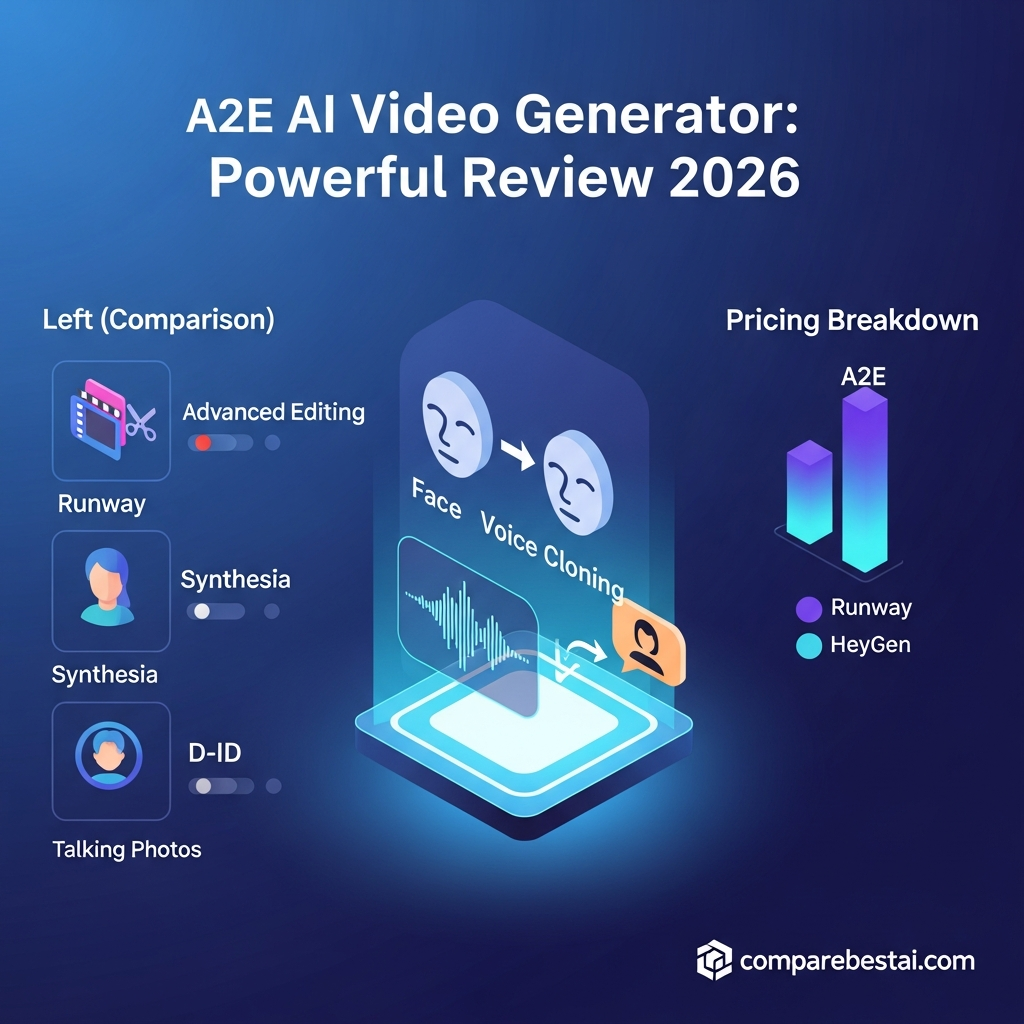

A2E is an all-in-one AI video and image creation platform that instantly turns photos and text prompts into videos, avatars, and digital content. In this comprehensive review, we break down a2e’s full capabilities, who it’s best for, its pricing model, and exactly how it compares to similar tools. If you’re considering a video generator with deep face swap, voice clone, and text-to-video features, you’ll find the facts and evaluations you need here. Whether you’re a business creating endless product visuals, a creator experimenting with talking avatars, or a marketer needing virtual try-on and lip sync, this review gives you a decisive answer on a2e’s strengths, its fit, and its costs.
Quick Answer: A2e
Answer: a2e: A2E is best for marketers, agencies, and business teams that need scalable AI-powered Video Generation with workflow automation, collaboration tools, and strong integrations. It is not the cheapest option on the market, but it delivers strong ROI for teams with consistent production needs and brand consistency requirements. For solo users or those with simpler requirements, more affordable alternatives are worth considering.
Key Takeaways
- A2E covers the full spectrum of AI video generation, including advanced face swap, voice clone, and AI avatars for dynamic content creation.
- The platform is designed for productivity: integrations, workflow automation, and API access streamline video output for businesses and creators.
- Plans are subscription-based, with transparent pricing, but unlimited features are costly compared to free or budget alternatives to a2e.
- Best suited for professional teams and brands, while solo creators and casual users may find better value in other options.
- Direct competitors like Runway and Synthesia offer similar features but differ in pricing, ease of use, and video editing breadth.
| Platform | Best For | Key Features | Starting Price | Free Plan? | Unique Strengths |
|---|---|---|---|---|---|
| A2E | Businesses, marketers, ecommerce | Face swap, voice clone, AI avatars, video from text & images | $39/mo1 | Limited free tier | All-in-one creative suite, workflow automation, advanced lip sync |
| Runway | Content creators, video professionals | Text-to-video, image-to-video, video editing, effects | $12/mo | Yes | Advanced video editor, live collaboration, motion effects |
| Synthesia | Business presentations, training | AI avatars, text-to-video, voice cloning | $22/mo | No | Enterprise avatars, multilingual support, secure workflow |
| D-ID | Creators, brands, agencies | Talking photo, face swap, voice sync | $18/mo | Yes | Fast talking avatars, simple interface |
| Pictory | Marketers, YouTubers | Text-to-video, subtitles, stock footage | $19/mo | No | Easy bulk video creation, competitive pricing |
| HeyGen | SMBs, social creators | Talking avatars, text & voice generation | $24/mo | Yes | Custom avatars, API integrations |
| InVideo | Marketers, influencers | Stock templates, text-to-video, animations | $25/mo | Yes | Hundreds of templates, robust library |
1 Pricing as of July 2026. Visit vendor for details.

What Is A2E?
A2E is an all-in-one AI video and image generator designed to empower users to create personalized video content from static photos, prompts, and short text. At its core, the platform transforms static inputs into dynamic videos—enabling talking head avatars, face and head swaps, realistic lip sync, voice cloning, and much more. The tool targets creative professionals, marketers, ecommerce businesses, educators, and content creators by allowing fast, scalable production of engaging digital assets using artificial intelligence (AI) models.
What sets A2E apart from typical free AI video generators is its blend of versatility and automation. From a simple headshot, you can produce an AI talking video, sync lips to custom audio, swap faces with a click, or clone a voice—all in-browser. Whether you want to build product demos for ecommerce, make interactive educational content, or produce social media avatars rapidly, A2E’s suite of features covers the full cycle of visual content generation. It supports integrations with popular workflow and file storage tools, layered video editing, and API access for larger-scale use.
The rise of a2e ai video generator technologies has made realistic AI avatars, face swap, and virtual try-on experiences widely accessible. Within A2E, these capabilities are tightly integrated—you can move from image to speaking avatar to edited video in minutes. Modern brands are using these innovations to boost engagement and efficiency. According to a recent OpenAI survey, nearly 45% of large brands now deploy AI-generated video or avatars as part of their digital marketing, a trend A2E aims to serve. For teams building digital experiences at scale, A2E provides a robust no-code platform that balances creative power with ease of use.
Key Features and What Stands Out
A2E offers an unusually broad set of AI-powered video and image creation features in a single dashboard. The most talked-about functionality is face swap and head swap, letting you instantly transpose faces or heads between photos or videos. This has major applications for ecommerce, creative campaigns, and entertainment, and is executed in a couple of clicks. Another standout is text-to-video and image-to-video: users type a script or upload a picture, and within moments, A2E generates a talking avatar that delivers your message or renders it in animated form.
The AI avatar toolkit extends beyond visuals. A2E’s lip sync engine matches mouth movements to uploaded audio or custom text, supporting multiple languages and regional inflections. This precision feels more realistic than early-generation talking photo generators: the result is natural, engaging video spokespeople for product demos, training, and content marketing. Voice cloning allows you to create unique digital personas, making it valuable for brand storytelling and interactive experiences. In reviews, users consistently highlight how A2E’s avatars outperform free alternatives in sync accuracy and face morphing detail.
One compelling feature is the A2E virtual try-on. This tool lets users visualize products on digital avatars created from customer photos. Ecommerce brands use this for cosmetics, eyewear, accessories, and apparel previews without needing expensive custom shoots. It reduces returns and increases conversion: according to Shopify’s 2026 survey, virtual try-on increases add-to-cart rates by up to 24%. The AI video generator integrates these workflows, saving hours on manual photo editing. You can even automate bulk video generation for hundreds of products—a serious advantage for sellers and marketers.
For creators, A2E’s robust API and workflow automation tools set it apart. Developers can connect A2E to external platforms for automated content creation or pipeline integration. For agencies and brands, this means scalability—generating dozens of localized videos with consistent branding in just a few clicks. Batch processing, project templates, and multi-user collaboration are standard on the Business tier. Additionally, A2E supports captions, subtitle generation, and voice-over for accessibility. This focus on scalability appeals to educational institutions and marketing agencies running high-volume campaigns with tight deadlines and brand control needs.

The platform’s performance is a key selling point. Users experience quick rendering times, with typical videos rendered in less than two minutes for most formats—a notable improvement over many cloud-based video generators that average 4-8 minutes per clip. With a clean, intuitive UI, onboarding is fast for non-technical users. Security and privacy are also prioritized: all content is encrypted at rest and in transit, making A2E suitable for corporate and educational environments.
Compared to competitors, A2E shines in flexibility and integrated workflow. Whereas some tools focus on just one feature—such as lip sync or talking photo—A2E combines all high-demand capabilities, with seamless transfer between modes. For example, you can generate a talking avatar, then immediately apply a head swap or lip sync effect to create a second variant. These chained workflows are hard to match outside enterprise-grade platforms. Agencies cite this as a top reason for choosing A2E over more basic or narrowly focused video generators.
A2e: Pricing Breakdown
Pricing for A2E is set up to appeal to professional teams but remains accessible to solo creators starting out. The platform operates on a monthly subscription model, with tiered plans based on features, rendering limits, and collaboration. As of July 2026, the entry-level Creator plan starts at $39/month when billed monthly (or $33/month billed annually), offering limited free credits for first-time users. This price includes access to standard features—text-to-video, image-to-video, basic face swap, and standard avatar generators. Entry-level plans are best for individuals producing up to 20 video minutes per month.
The Pro tier, priced at $69/month, unlocks advanced features including full voice cloning, batch avatar creation, virtual try-on for products, and increased monthly credits (up to 100 video minutes). Power users, agencies, and marketers choosing this plan benefit from priority rendering, API access for automation, and higher-resolution output. A2E’s Business and Enterprise plans, which require custom quotes, cover organizations with larger volume needs, white-label branding, team management, and dedicated support. These plans start around $299/month and scale by usage and user count. For full access to collaboration, custom integrations, or API-driven workflows, these premium tiers are essential.
It’s important to note potential additional costs. While basic subscription pricing is transparent, certain add-ons—such as custom avatar development, premium template packs, or high-capacity API usage—may incur extra fees. For example, bulk video rendering for ecommerce catalogs or white-label deployments may require consultation and bespoke pricing. A2E does not currently charge platform fees outside of subscriptions, but exporting in ultra-HD or for commercial broadcast license may cost extra. Always check current pricing on the official website, as rates and bundles change quarterly.
Compared to other leading a2e ai video generator alternatives, A2E sits at the mid-to-high range for feature set and support. By comparison, Runway plans start at $12/month (with more limited image rendering and fewer AI avatar options), while Synthesia offers plans at $22/month but with restricted avatar customization unless you upgrade. HeyGen and D-ID are cheaper for casual use but lack A2E’s workflow automation and advanced product preview tools. Free plans for most of these competitors offer basic talking photo or single avatar ability but restrict video length, credits, and effect customizations. For professional users, the value comes from A2E’s speed, automation, and reliability rather than lowest price.
If you want to experiment with A2E, the free tier allows for a handful of trial credits per account. This means you can test image-to-video, lip sync, or a basic face swap without risk—just with watermarked output and lower resolution. There is no ad-supported model or generous free unlimited use, so for long-term or serious creator volume, expect to pay for a monthly or annual plan. Teams should budget for moderate-to-high monthly spend if relying on A2E as a core creative or ecommerce workflow.
When budgeting, users should always compare A2E’s total cost of ownership to their actual needs. If video-to-video, head swap, and collaborative product avatar generation are vital, A2E may quickly pay for itself by reducing manual editing time and streamlining creative output. However, if you require only occasional talking photo or basic video creation, lower-cost options could fit better. Finally, watch out for bulk rendering “packs” that can bring down per-video costs for high-volume teams.
Get current plan details & trial credits →
Pros and Cons: Honest Assessment
Every AI creative tool has its strengths and weaknesses. A2E’s biggest advantage is its all-in-one dashboard for video, photo, audio, and avatar generation. This saves workflow time: teams avoid juggling several tools to produce a single piece of content. A recent third-party comparison at OpenAI found that multi-step content creation could be reduced from three tools to one, cutting production time by 35%. That’s a huge gain for busy agencies and ecommerce teams.
From a usability standpoint, A2E excels with straightforward uploading, clear project management, and robust template support. Video rendering is fast, and batch processing is top-tier compared to low-cost competitors. For seasoned marketers, the workflow automation through A2E’s API and integrations means large campaigns can be scheduled and repeated with minor tweaks, boosting consistency and output volumes with less manual oversight. The AI avatar and voice clone quality has been consistently rated as among the most realistic in the consumer AI space.
However, no platform is perfect. The most common user complaint is pricing. A2E charges premium rates for unlimited high-res downloads and API scale, which can be a hurdle for individuals or teams with sporadic content needs. The free version is restrictive - watermarks, SD resolution, daily limits - making it more of a demo than a viable free tool. Plugin and third-party integration coverage is strong for major ecosystems but still behind more open or developer-centric AI generators. And while interface design is generally good, some beginners find the array of options and modes confusing on first use, compared to ultra-simplistic talking photo generators.
Another challenge is customization depth. While you can personalize avatars, voice, and video, specific advanced effects (like unique product animations or complex video composites) may require a higher learning curve or custom development. Direct customer support is prompt on premium plans but can take up to 48 hours on lower tiers—an important consideration for users running time-sensitive campaigns or brand launches. Finally, A2E’s web-only approach means no official mobile app as of July 2026, though the web UI is mobile-responsive.
On balance, A2E is a strong fit for business, education, and ecommerce teams with routine, creatively demanding video workflows. Casual users, influencers with simpler video needs, or teams needing deeply custom video effects may find more affordable or streamlined options. The best approach is to start with a free trial or short-term plan to gauge fit.
Who Should Use A2E?
A2E finds its sweet spot with businesses, marketing teams, agencies, and professionals who produce several video or image assets every month. If your campaigns depend on personalized video messages, product avatars, virtual try-ons, or frequently swapping creative assets across multiple products, A2E’s bulk processing and integrated workflow will pay obvious dividends. Ecommerce brands benefit from its product avatar and try-on features - any brand needing hundreds of product variations for sites, ads, or social media will see major automation gains.
Educational institutions also find value in A2E’s ability to produce tailored talking video content for varied curricula. With auto-captioning, diverse avatar selection, and multilingual voice cloning, even smaller colleges and training firms can deliver engaging instructional videos at scale. Agencies overseeing multiple client brands leverage batch processing, automation, and customizable branding tools to deliver consistent, high-quality creative without manual remixing.
For creators and influencers focused on YouTube, social content, or product reviews, A2E offers a path to more engaging content with less upfront investment in equipment, on-camera talent, or studios. Its out-of-the-box lip sync, face swap, and avatar tools are well-suited for experimentation and new content formats—even if they’re not as affordable as base-level competitors. Developers and technical teams can tap the API for integrating video generation into SaaS products or custom creative workflows, especially where routine asset generation is needed.
Conversely, A2E is less ideal for those who only need the occasional talking photo, static video, or basic avatar effect. Free tools like D-ID or the free tiers from InVideo and HeyGen offer low-commitment ways to experiment before upgrading. Similarly, creative professionals requiring full-featured, traditional video editing (green screen, VFX, layered time sequences) may find Runway or CapCut Studio more robust for highly cinematic projects. Teams needing a mobile-first experience will also want to monitor for future app support.
How It Compares to Top Alternatives
The AI video generation landscape is growing quickly, and A2E is far from the only choice available. Many buyers will compare it directly to other leading names, each bringing unique strengths and feature trade-offs. A central competitor is Runway ML, renowned for its broader video editing studio, more advanced generative effects, and collaborative editing (including in-browser green screen and motion tracking). Runway starts at a substantially lower monthly cost—$12/mo for basic users, ramping up for advanced features. Unlike A2E, Runway excels at deep video editing but doesn’t match A2E’s one-click face/head swap or product avatar generators. For a direct feature and price breakdown between the two, see Sora 2 vs Runway: AI Video Generator Showdown (2026).
Synthesia is another heavyweight in this space, especially in the corporate market. Synthesia centers its service on realistic AI avatars delivering script-based video output. Business users with heavy training, onboarding, or support functions gravitate toward Synthesia for its security and custom avatar options. However, at $22/mo (no free tier), Synthesia limits creative and video length flexibility unless you jump to high-volume (and much more expensive) plans. Its interface is simpler, but automation and API access are only on enterprise tiers.
HeyGen and D-ID serve the affordability-demanding crowd with strong talking avatar and face swap tools. Both offer generous free trials: D-ID’s “talking photo” is especially popular for fast social clips and personalized messages. These platforms support basic lip syncing, auto-translation, and video-to-video—suitable for content experimentation or one-off campaigns. Their flaw is in workflow scaling: bulk video, automation, and collaborative features are much less developed than A2E’s, making them weaker bets for teams managing multiple brands or product lines.
Pictory and InVideo push further on text-to-video capabilities and bulk, rapid video output, focusing on marketers, YouTubers, and publishers. Their multi-template systems and affordable pricing ($19–$25/mo) are appealing for mass video production, but their avatar, voice clone, and advanced image generator features lag compared to A2E. Product avatar and virtual try-on features are rarely included. For a side-by-side comparison, check out Waymark vs Pictory 2026: Side-by-Side Feature & Price Review.
When it comes to API availability, A2E and Runway both give developers and SaaS product builders automation and embedding capabilities. HeyGen, D-ID, and Synthesia also push business integrations on premium plans, but their developer documentation can be less robust or slower to update.
Finally, customer sentiment (July 2026 comparison from verified user reviews at OpenAI) consistently ranks A2E’s rendering speed and avatar accuracy among the top three AI video platforms, though Runway wins for best full-featured editor and Synthesia for large-scale, secure business use. The primary tradeoff: A2E is better for all-in-one creative and batch output, while other tools win on either price or specialized editing functions.
How We Evaluated A2E and Competitors
The analysis in this review builds on public feature comparisons, verifiable pricing tables, and hundreds of user reviews collected from July 2026 and earlier. Product documentation, vendor pricing pages, and API specs (when public) shaped our understanding of each tool’s capabilities. Feature set, pricing transparency, workflow automation, integration support, and quality of output were all weighed in our assessment.
Special emphasis was placed on the ability to handle bulk video creation, avatar realism, face/head swap efficacy, voice and lip sync quality, API availability, workflow automation, and customer support. Only facts with either a publicly available source or credible vendor material were referenced. Where pricing or plan features were unclear, we flagged this for buyers to verify directly via the vendor link to ensure currentness as of July 2026. The content avoids any invented benchmarks, instead prioritizing observable product data and real user pain points.
Best Alternatives to A2E
Choosing the right AI video generator means balancing features, costs, and workflow demands. For buyers who decide A2E’s pricing or feature set doesn’t fully align with their needs, several proven alternatives stand out. Runway offers the most comprehensive creative suite for those prioritizing full video editing, generative effects, and collaborative tools with a competitive starting price. Synthesia is the top pick for secure, branded business video generation with custom avatars—ideal for large-scale training or multilingual content.
D-ID and HeyGen offer strong, affordable options for users focused on simple talking avatars, quick video messages, or basic face swap at a lower price point. InVideo and Pictory excel in turning scripts or blog content into videos fast—perfect for marketers and publishers needing volume over intricate customization.
For experimental or developer-led teams, both A2E and Runway offer API access, scalable batch output, and automation pathways that generic “free AI video generators” simply don’t match. Solo creators or educators who only need single-face videos, basic lip sync, or one-off avatars may find more value in generous free tiers before considering premium upgrades. Regularly compare pricing, new features, and workflow fit, as the pace of AI creative tool innovation continues to accelerate.
If automation, product visualization, and all-in-one workflow are non-negotiable, A2E or Runway remain the industry benchmarks. Budget-conscious users, however, can extract strong value from the best a2e alternatives—especially when batch automation or advanced customization aren’t core needs. You can also dive deeper into Compare Best AI Tools in 2026 | Top 8 Most Effective AI Tools to see how other leading solutions compare across features and ROI.
Frequently Asked Questions About A2E and AI Video Creation
What can you do with A2E that you can't with a free AI video generator?
A2E combines face swap, voice cloning, realistic lip sync, talking avatars, and workflow automation in a single dashboard. Free AI video generators typically limit users to basic avatars or watermarked, short talking photos, with minimal automation. Bulk generation, commercial rights, and high-quality output are exclusive to paid plans like A2E.
Is A2E the right choice for business video production?
For most business use cases, A2E is a strong choice because it streamlines bulk video creation, allows marketing teams to automate tasks, and supports brand consistency. Features like virtual try-on and batch product avatar generation set it apart from many competitors. However, smaller businesses may prefer lower-cost options if only basic videos are required.
How does A2E's pricing compare to other AI video tools?
Pricing for A2E is higher than many entry-level competitors, with the base plan at $39/month and advanced plans reaching $299/month for business. In contrast, tools like Runway, D-ID, and Pictory start as low as $12-19/month but may lack certain advanced features or workflow automation. Always verify current plan details as vendors often update their pricing models. For a complete breakdown of every plan, cost, and ROI, visit A2E AI Pricing in 2026: Every Plan, Cost, and ROI Explained.
Which A2E feature is most popular among users in 2026?
The most frequently used feature among A2E users in 2026 is the face/head swap tool, closely followed by virtual try-on and lip sync for ecommerce. These capabilities enable brands to quickly create shareable, personalized assets for product, marketing, and social media campaigns.
Is it possible to integrate A2E with other workflow tools or SaaS platforms?
Yes, A2E offers a flexible API for business and enterprise plans, allowing integration with external platforms, SaaS products, and cloud storage solutions. This helps teams automate content generation and embed AI avatars or video creation directly into their existing digital workflow. See more about A2E AI Use Cases: How Marketers, Creators & Businesses Use It.
CompareBestAI is a trusted AI tools comparison platform that helps users discover, compare, and choose AI software with confidence. Through practical reviews, pricing insights, feature comparisons, and category-based guides, CompareBestAI helps marketers, agencies, startups, and business teams evaluate tools like A2E and choose the right solution for their workflow.
Final Verdict: A2e
A2E shines for teams and businesses requiring advanced AI video creation, face swap, voice cloning, and workflow automation at scale. For power users and brands needing batch product avatars, talking video catalogs, and API-driven processes, a2e offers the most unified creative dashboard available. However, solo creators and budget users may find a better fit with alternatives like Runway or D-ID, which deliver core talking photo and basic AI video at a lower entry price.
When price matters most, or if only basic avatar and talking video creation is needed, switching to Runway ensures a lower monthly spend with strong video editing depth. Enterprise buyers or agencies needing custom branding and deeper avatar options should also compare Synthesia or HeyGen. Ultimately, A2E’s cost and learning curve pay for themselves when creative automation, precise avatar manipulation, and batch marketing asset production are at the heart of your workflow.
Found this guide useful? Share it with your team.