
Quick Answer: In the A2E AI vs Moonvalley AI comparison, A2E AI is better for creators, marketers, e-commerce teams and developers who want a broad AI-media toolkit, while Moonvalley AI is stronger for filmmakers who prioritize cinematic video quality, licensed training data and precise directorial control. A2E combines avatars, voice cloning, lip sync, image-to-video, multiple AI models and APIs. Moonvalley's Marey focuses more deeply on professional filmmaking with camera, trajectory, pose, motion and reference controls.
Published: June 7, 2026
Last Updated: August 30, 2026
For current A2E specifications and our editorial score, see the A2E AI tool profile. For Moonvalley's current product positioning, see the Moonvalley AI tool profile.
A2E AI vs Moonvalley AI at a Glance
| Category | A2E AI | Moonvalley AI / Marey |
|---|---|---|
| Best for | Creators, marketers, e-commerce, developers | Filmmakers, studios, directors, VFX teams |
| Primary strength | Broad generative-media toolkit | Cinematic control and production-focused video |
| Free option | Yes | No stable public free-plan information verified |
| Paid pricing | Pro/Ultra + credits | Direct subscription pricing not publicly exposed |
| Text-to-video | Yes through supported workflows/models | Yes |
| Image-to-video | Yes | Yes |
| AI avatars | Yes | Not the core product |
| Voice cloning | Yes | Not the core product |
| Lip sync | Yes | Not the core product |
| Camera control | Model/workflow dependent | Dedicated control |
| Trajectory control | Model dependent | Dedicated control |
| Motion transfer | Model/workflow dependent | Dedicated control |
| Pose transfer | Not a primary A2E feature | Dedicated control |
| Keyframing | Model dependent | Yes |
| Licensed-training focus | Varies by underlying model | Marey is trained on licensed footage |
| Direct developer API | Yes | Direct Moonvalley API waitlist |
| Third-party API | — | Marey available via fal.ai |
| Maximum advertised output | Up to 4K on eligible Ultra workflows | Native 1080p documented for Marey v1.5 on fal.ai |
| Overall choice | Best for breadth | Best for filmmaker control |
The decision therefore depends less on which platform has “more features” and more on which workflow you are trying to build.
A2E is broad.
Moonvalley is specialized.
That is the central distinction.
What Is A2E AI?
A2E AI is a browser-based generative-media platform covering AI avatars, talking photos, voice cloning, text-to-speech, lip sync, image-to-video, face and head swapping, product visuals, image generation and developer APIs.
Its developer documentation exposes REST APIs for avatar video, TTS, voice cloning, image-to-video, face swap, dubbing and other media-processing workflows.
A2E also supports multiple external and internal AI models rather than forcing every job through a single video model.
That makes it particularly useful when your workflow combines several media tasks.
For example:
Prompt → image → video → voice → avatar → final creative
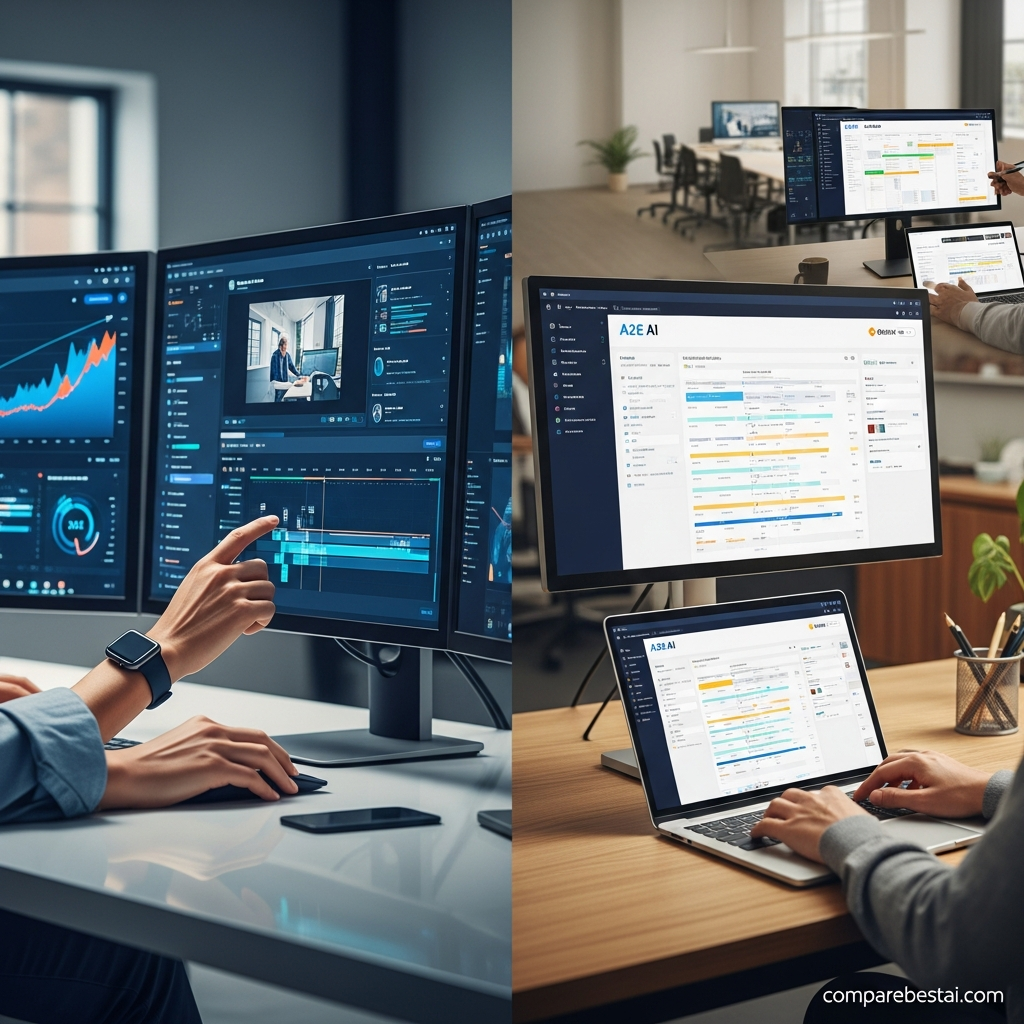
A2E Canvas takes this further with a node-based editor that lets users connect different AI models into reusable workflows and run repeatable generation pipelines from the browser.
For a deeper product evaluation, read our A2E AI review.
What Is Moonvalley AI?
Moonvalley AI is the company behind Marey, a generative-video model designed specifically around professional filmmaking.
Moonvalley describes Marey as being trained only on licensed, high-resolution footage rather than scraped internet content. The company positions that training approach as giving filmmakers greater commercial confidence when generating professional content.
Marey's differentiator is not avatars or marketing automation.
It is directorial control.
Current Moonvalley documentation highlights camera movement, motion transfer, trajectory control, keyframing, separate subject references, pose control and shot extension.
Marey also emphasizes:
- prompt adherence
- natural physics
- dynamic motion
- advanced lighting
- composable layers
- cinematic detail
- scene consistency
Moonvalley therefore competes more naturally with professional AI-video systems than with simple “script-to-video” applications.
A2E AI vs Moonvalley AI: Pricing
Pricing is one area where the old version of this article needs a complete reset.
A2E AI Pricing
A2E currently offers a genuine Free plan at $0.
Its primary pricing cards currently list:
| Plan | Current Main-Card Price |
|---|---|
| Free | $0 |
| Pro | $14.90 |
| Ultra | $59.90 |
The Free plan includes daily bonus credits, watermarked 720p output and limited avatars/voice slots.
Pro adds no watermark, higher resolution, more avatars, API support and credit top-ups.
Ultra increases credit allocation, processing priority and supports up to 4K on eligible workflows.
Pricing caution: A2E's own pricing page currently contains inconsistent figures between its main pricing cards and a comparison table farther down the same page. Always confirm the final checkout amount before purchasing.
Moonvalley AI Pricing
Moonvalley's public marketing website does not currently expose a stable public subscription pricing page.
Its Terms of Service confirm recurring subscriptions and state that overage fees may apply when usage exceeds the included allowance, but the terms do not list specific current plan prices.
There is, however, transparent public usage pricing for Marey through fal.ai.
Current fal listings show:
| Marey Workflow | Public fal.ai Cost |
|---|---|
| Text-to-video, 5 sec | $1.50 |
| Text-to-video, 10 sec | $3.00 |
| Image-to-video, 5 sec | $1.50 |
| Image-to-video, 10 sec | $3.00 |
| Pose Transfer | $2.00 per video |
That makes A2E easier to evaluate as a conventional consumer subscription, while Marey's developer-access cost is easier to calculate per generated clip.
Pricing transparency winner: A2E AI for direct subscriptions
Usage-based developer pricing: Moonvalley/Marey via fal.ai is also clearly documented
Video Generation Quality and Creative Control
This is where Moonvalley becomes much more competitive than the existing article suggests.
A2E AI: Breadth and Model Choice
A2E's strength is flexibility.
Users can move across multiple video-generation models and combine them with other media tools.
This means a creator is not forced to rely on one model for every scene.
If one model performs better for cinematic movement and another performs better for product consistency, the workflow can change accordingly.
That flexibility is valuable for:
- social content
- product creatives
- avatar videos
- explainer videos
- e-commerce media
- marketing experiments
- developer applications
A2E's own image-to-video API also provides duration, prompt, negative-prompt and aspect-related controls for programmatic generation.
Moonvalley: Directorial Precision
Marey's architecture and interface are much more focused on controlling a shot.
Its camera control can convert a single 2D image into a scene where the camera can be directed more intentionally.
Motion Transfer allows motion from a reference video to influence a newly generated scene.
Trajectory Control lets a user define where an object should move.
Keyframing lets multiple reference images guide transitions.
Pose Control can transfer human movement and performance.
Shot Extension continues generated footage while attempting to preserve scene dynamics.
For professional filmmakers, that level of control can matter more than having dozens of unrelated AI tools in the same account.
Winner for general media breadth: A2E AI
Winner for filmmaking control: Moonvalley Marey
Commercial Safety and Training Data
Moonvalley has a distinctive advantage here.
Moonvalley says Marey was trained exclusively on licensed, high-resolution footage rather than scraped content or user submissions.
That matters particularly to:
- studios
- agencies
- advertising teams
- film producers
- brands with strict IP policies
The phrase “commercially safe” is Moonvalley's own positioning, so it should not be interpreted as a legal guarantee for every possible output or use case.
Users still need to comply with Moonvalley's terms and make sure that any inputs, references or third-party materials they use are properly authorized.
A2E's available model roster can involve different underlying providers and models, so training-data and licensing considerations may differ by workflow.
If clean training provenance is one of your top procurement requirements, Moonvalley has the clearer public positioning.
Workflow Automation
A2E has the stronger story here—but for a different reason than the original article claimed.
A2E Canvas is a node-based AI workflow builder.
A user can connect models in sequence and save the workflow for reuse.
A simplified example might be:
Text Prompt → Image Generation → Image Processing → Image-to-Video
That pipeline can then be rerun using other prompts or assets.
This is useful for high-volume repetitive workflows such as:
- product-image generation
- campaign asset variations
- image-to-video batches
- localized creative production
- multi-model experimentation
However, workflow automation should not be confused with team collaboration.
A2E's own Canvas comparison lists collaboration as unavailable, so claims about robust multi-user approvals, stakeholder commenting or enterprise review cycles should not be added unless separately verified.
Moonvalley's primary advantage is creative control rather than broad automation across multiple media categories.
Workflow automation winner: A2E AI
API and Developer Access
A2E AI API
A2E has a mature public API surface.
Current documentation covers:
- avatar video generation
- text-to-speech
- voice cloning
- image-to-video
- talking photos
- face swapping
- dubbing
- image generation
- related media processing
That makes A2E particularly useful for developers building media-generation features into their own applications.
Moonvalley API
Moonvalley currently has a public API waitlist on its own website.
However, that does not mean Marey lacks programmatic access.
Moonvalley officially launched Marey Realism v1.5 through fal.ai, where developers can use APIs for text-to-video, image-to-video, motion transfer and pose transfer.
Moonvalley also promotes native Comfy workflows.
So the accurate comparison is:
A2E: direct first-party public APIs.
Moonvalley: Moonvalley direct API waitlist, but Marey API access already exists through fal.ai.
Output Resolution
A2E currently advertises:
- 720p on Free
- up to 2K on Pro
- up to 4K on Ultra
depending on the workflow and model.
Moonvalley documents native 1080p for Marey Realism v1.5 through fal.ai and specifically emphasizes that the output does not rely on upscaling.
The raw resolution number therefore does not tell the whole story.
A2E has the higher advertised maximum resolution.
Moonvalley is focused more heavily on native cinematic fidelity, motion and production controls.
A2E AI Pros and Cons
Pros
- Free tier available
- Broad collection of AI media tools
- Multiple video-generation options
- AI avatars
- Voice cloning
- Talking Photo and lip sync
- Image-to-video
- Direct API access
- Node-based reusable workflows
- Up to 4K on eligible premium workflows
Cons
- Credit usage can vary considerably by model
- Pricing information is currently inconsistent across A2E's own pricing page
- Model quality varies depending on the selected underlying model
- A2E Canvas has a moderate learning curve
- Collaboration should not be confused with workflow automation
Moonvalley AI / Marey Pros and Cons
Pros
- Designed specifically for professional filmmaking
- Licensed training-data strategy
- Native 1080p output documented for Marey v1.5
- Camera control
- Motion Transfer
- Pose Transfer
- Trajectory Control
- Keyframing
- Advanced lighting
- Strong reference-based control
- fal.ai API access
- Commercial-production focus
Cons
- Direct subscription pricing is less transparent publicly
- Direct Moonvalley public API remains waitlisted
- More specialized than A2E
- Not an avatar/voice/content-automation suite
- Advanced directorial controls may be unnecessary for simple social content
Who Should Choose A2E AI?
Choose A2E AI if you need several different AI-media capabilities in one ecosystem.
It makes the most sense for:
- marketing teams
- e-commerce brands
- social creators
- educators
- avatar-content creators
- developers
- users experimenting across multiple video models
- teams building repeatable AI-generation pipelines
If your workflow might involve an avatar today, a product video tomorrow, voice cloning next week and API integration later, A2E's breadth becomes valuable.
See our A2E AI use cases guide for practical workflow examples.
Who Should Choose Moonvalley AI?
Choose Moonvalley if your priority is directing high-quality generated video rather than accessing dozens of unrelated media tools.
It is especially relevant to:
- filmmakers
- directors
- VFX artists
- animation studios
- advertising production teams
- cinematic content creators
- brands concerned about training-data provenance
Marey's motion, camera, pose, reference, lighting and trajectory tools are designed around how professional filmmakers control a shot rather than around one-click social-video automation.
Which Is Better for U.S. Buyers?
For U.S. creators and businesses, the better choice depends on the job.
Choose A2E AI when you value:
breadth + avatars + voice + multiple models + workflow automation + direct API
Choose Moonvalley Marey when you value:
cinematic fidelity + licensed data + camera direction + motion control + filmmaking workflows
Neither platform wins every category.
That's a more useful conclusion than declaring one tool universally superior.
If neither matches your production workflow, browse CompareBestAI's Video Generation category or read our 2026 AI video generator comparison.
For another professional-production option, compare Runway AI. For Google's current video-generation ecosystem, see Veo 3.1.
Frequently Asked Questions
Which is better, A2E AI or Moonvalley AI?
A2E AI is better for broad generative-media workflows involving avatars, voice, multiple models, APIs and automation. Moonvalley Marey is better for professional filmmakers who prioritize cinematic generation, licensed training data and detailed camera, motion, pose and trajectory controls.
Is Moonvalley AI cheaper than A2E AI?
A direct subscription comparison is difficult because Moonvalley's public website does not currently expose stable plan prices. A2E has a $0 Free tier and paid Pro/Ultra plans. Marey can also be accessed through fal.ai with usage-based pricing starting at $1.50 for a five-second text- or image-to-video generation.
Does Moonvalley AI have an API?
Moonvalley's own public API is currently waitlisted, but Marey is available programmatically through fal.ai APIs for workflows such as text-to-video, image-to-video, motion transfer and pose transfer.
Does A2E AI have a free plan?
Yes. A2E currently offers a $0 Free plan with daily bonus credits, 720p watermarked video and limited avatar and voice-clone capacity.
Which platform is better for filmmaking?
Moonvalley Marey is more purpose-built for professional filmmaking because it provides dedicated camera, motion, trajectory, pose, reference, lighting and keyframe controls. A2E is broader and more suitable when filmmaking is only one part of a wider AI-media workflow.
Which platform is better for developers?
A2E is simpler if you want direct first-party APIs covering multiple media types. Marey is also developer-accessible through fal.ai, while Moonvalley's direct public API is currently on a waitlist.
Final Verdict: A2E AI vs Moonvalley AI
A2E AI and Moonvalley AI solve different problems, so neither should be presented as the universal winner.
A2E is the stronger choice for users who want one ecosystem spanning video, avatars, voice, image transformation, multiple generation models and APIs.
Moonvalley's Marey is the stronger choice for filmmakers who need more deliberate control over camera movement, human performance, object trajectories, references, lighting and cinematic consistency.
If you're producing high-volume marketing assets, product content, avatar videos or automated media pipelines, A2E AI is probably the more practical fit.
If you're directing cinematic scenes and want greater control over how the shot actually moves and behaves, Moonvalley Marey deserves serious consideration.
The decision therefore comes down to:
A2E AI = generative-media breadth and automation
Moonvalley Marey = cinematic specialization and directorial control