
Quick Answer: Adobe pricing ranges from free plans to $199.99/month and beyond, depending on the product. Creative Cloud Standard costs $54.99/month, Creative Cloud Pro is $69.99/month, major Single App plans start around $22.99/month, Firefly paid plans start at $9.99/month, Adobe Express Premium is $9.99/month, Acrobat Standard starts at $14.99/month, and Adobe Stock subscriptions start around $29.99/month. Many Creative Cloud and Acrobat prices require an annual commitment billed monthly, so the cheapest-looking monthly price is not always a cancel-anytime subscription.
Pricing checked: August 31, 2026
Market: United States
Currency: USD before applicable taxes
Adobe Pricing at a Glance
| Adobe product | Current starting / regular price | Best for |
|---|---|---|
| Adobe Express Free | $0 | Basic social and marketing content |
| Adobe Express Premium | $9.99/mo | Marketers, small businesses, social creators |
| Firefly Standard | $9.99/mo | Moderate generative AI use |
| Acrobat Standard | $14.99/mo | Basic professional PDF workflows |
| Photography | $19.99/mo | Photoshop + Lightroom users |
| Firefly Pro | $19.99/mo | Regular AI image/video/audio creation |
| Acrobat Pro | $19.99/mo | Advanced PDF and e-signature work |
| Photoshop / major Single App | From $22.99/mo | Users needing one professional creative app |
| Acrobat Studio | $24.99/mo | PDF + AI + Adobe Express workflows |
| Adobe Stock | From $29.99/mo | Stock images/video/assets |
| Creative Cloud Standard | $54.99/mo | 20+ desktop apps, light AI use |
| Creative Cloud Pro | $69.99/mo | Full creative suite + heavy generative AI |
| Firefly Pro Plus | $49.99/mo regular | High-volume AI generation |
| Firefly Premium | $199.99/mo regular | Very high-volume Firefly use |
Adobe regularly runs promotions, particularly on Creative Cloud Pro, education plans and higher Firefly tiers. For evergreen budgeting, use the regular renewal price, not the temporary promotional price.
How Adobe Pricing Works
There is no single “Adobe subscription.”
Adobe now operates several distinct product families:
Creative Cloud covers professional design, photo and video applications.
Firefly focuses on generative AI for images, video and audio.
Adobe Express targets fast template-based marketing and social content.
Acrobat covers PDF, document and e-signature workflows.
Adobe Stock sells licensed creative assets through subscriptions and credit packs.
This matters because the cheapest plan depends on the job you actually need done.
Buying Creative Cloud Pro solely because it contains the most apps can be poor value if your real requirement is only PDF editing or social graphics.
Adobe Creative Cloud Pricing
Creative Cloud is Adobe's main professional creative-software ecosystem.
Creative Cloud Standard — $54.99/month
Creative Cloud Standard currently costs:
$54.99/month
on an annual contract billed monthly.
It includes more than 20 desktop Creative Cloud applications and 25 monthly generative credits.
Standard is designed for users who want Adobe's professional desktop applications but do not expect to use premium generative AI heavily.
Creative Cloud Pro — $69.99/month
Creative Cloud Pro currently has a regular US price of:
$69.99/month
on an annual contract billed monthly.
It includes:
20+ creative applications, Adobe Express Premium, Frame.io for Creative Cloud, 100GB cloud storage, unlimited standard creative-AI image/vector generations and 4,000 monthly premium generative credits.
Creative Cloud Pro is the current successor to the older Creative Cloud All Apps naming.
If you see older Adobe pricing pages referring to All Apps at $52.99 or $59.99, they may be describing a previous plan structure.
For the complete Standard-vs-Pro breakdown, see our Adobe Creative Cloud pricing guide.
Adobe Single App Pricing
Major standalone professional Creative Cloud apps commonly start around:
$22.99/month
on an annual contract billed monthly.
Adobe's current pricing page lists this as the starting price for a Single App subscription, typically including:
the selected application, 25 monthly generative credits, fonts/templates and approximately 100GB cloud storage.
This can be the better option when you truly use one professional application.
For example, a dedicated video editor may prefer Premiere alone instead of paying for 20+ applications.
Our Adobe Premiere review goes deeper into whether Premiere's standalone subscription is worth it.
Adobe Photography Pricing
The current Adobe Photography plan costs:
$19.99/month
on an annual contract billed monthly.
It includes:
Photoshop, Lightroom, Lightroom Classic and 1TB of cloud storage.
For photographers who use both Photoshop and Lightroom, this can be better value than purchasing Photoshop separately.
Adobe Firefly Pricing
Adobe Firefly is now a broader generative-AI platform—not simply a standalone product called “Firefly Video.”
Its current individual plan structure is:
| Firefly plan | Regular monthly price | Generative credits |
|---|---|---|
| Free | $0 | Limited |
| Standard | $9.99 | 2,000 |
| Pro | $19.99 | 4,000 |
| Pro Plus | $49.99 | 10,000 |
| Premium | $199.99 | 50,000 |
Firefly's premium AI workflows include image, audio and video capabilities.
The Standard plan is appropriate for moderate AI usage.
Pro increases credits and also includes Adobe Express Premium plus Photoshop on web/mobile.
Pro Plus and Premium target significantly heavier AI-generation workloads.
Adobe is currently running temporary promotions on some higher Firefly plans. Those offers change, so the regular prices above are safer for evergreen comparison.

How Adobe Generative Credits Work
Generative credits are Adobe's usage currency for supported Firefly-powered AI features.
Adobe currently has one type of generative credit, but how it is consumed depends on whether a feature is classified as standard or premium.
Creative Cloud Pro and paid Firefly plans can include unlimited access to standard generations, while premium features such as higher-cost AI video/audio generation consume monthly credits.
Credits:
- renew each month,
- do not roll over,
- can be supplemented through eligible Firefly or additional-credit plans.
If you use all your premium credits, you may need to wait for the monthly reset, upgrade your Firefly plan or purchase additional eligible credit capacity.
This makes AI usage volume an important part of Adobe's real total cost.
Adobe Express Pricing
Adobe Express has one of the simplest pricing structures in the Adobe ecosystem.
Adobe Express Free
$0
The Free plan provides basic content creation, editing and limited generative-AI access.
Adobe Express Premium
$9.99/month
Premium currently includes:
250 monthly generative credits, premium templates, 200M+ royalty-free assets, advanced editing features, one-click resizing and 100GB storage.
For social media managers, small businesses and marketers who do not need Photoshop-level control, Express may provide significantly better value than a full Creative Cloud subscription.
For another lightweight design option, compare our Canva review.
Adobe Acrobat Pricing
Adobe's current individual Acrobat pricing includes three main paid options.
| Acrobat plan | Current price | Best for |
|---|---|---|
| Acrobat Standard | $14.99/mo | Essential PDF editing/conversion |
| Acrobat Pro | $19.99/mo | Advanced PDF, security and e-signatures |
| Acrobat Studio | $24.99/mo | Acrobat Pro + AI/design workflow |
These prices are shown for annual plans billed monthly.
Acrobat Standard
Best when you primarily need to:
create, edit, convert, organize and sign PDFs.
Acrobat Pro
Adds more advanced PDF tools including stronger document protection, comparison and professional e-signature workflows.
Acrobat Studio
Adobe currently positions Studio as a broader AI-powered PDF/design solution and combines Acrobat Pro capabilities with additional AI and Adobe Express functionality.
If your work revolves around documents rather than creative design, paying for Creative Cloud may be unnecessary.
Adobe Stock Pricing
Adobe Stock uses a different pricing model.
Unlike Creative Cloud and Firefly, Stock is primarily about licensing assets.
Current annual-commitment subscriptions include options such as:
$29.99/month — 10 standard assets or 1 video
with larger tiers available for more images, video and premium assets.
Adobe also sells one-time credit packs.
This distinction is important:
Adobe Stock credits are not generative AI credits.
Stock credits license existing marketplace assets.
Generative credits power Firefly-supported AI operations.
Adobe Student and Teacher Pricing
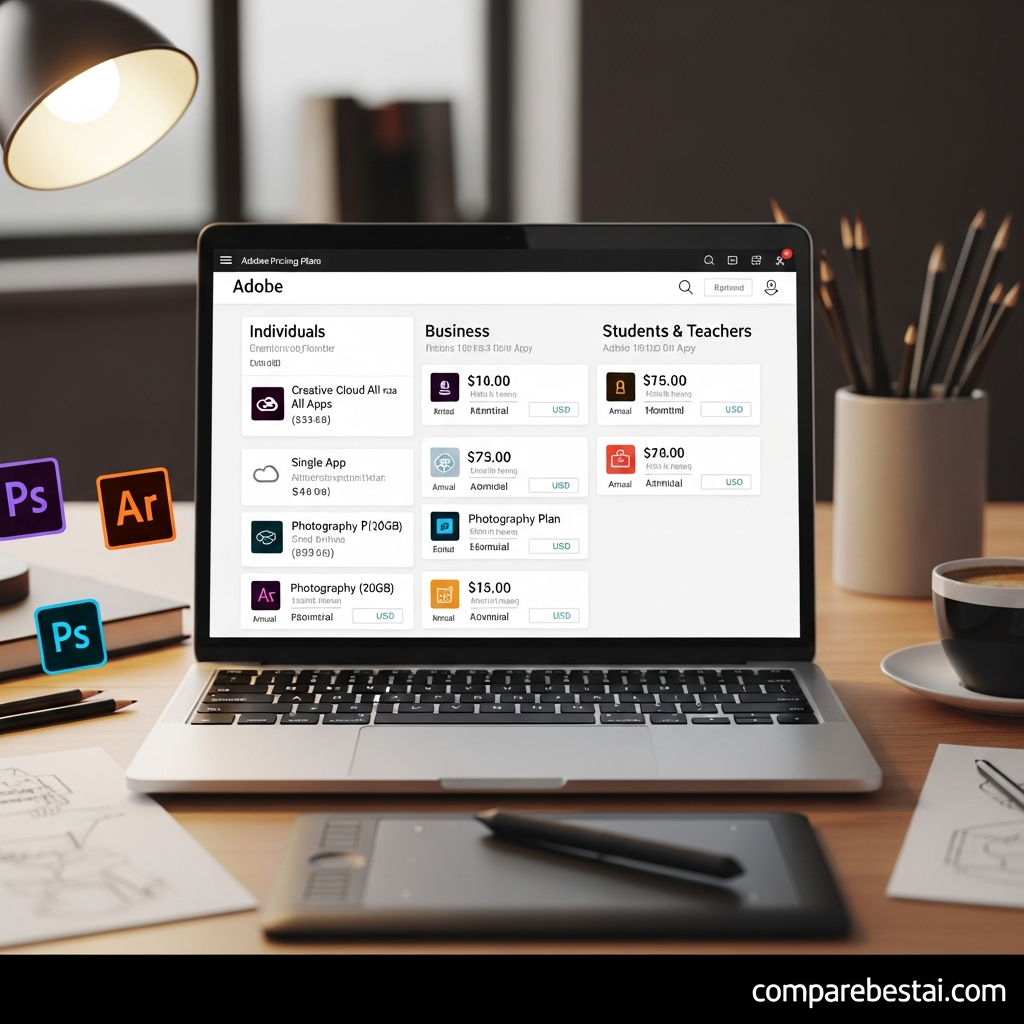
Eligible students and teachers receive substantial Creative Cloud Pro discounts.
Adobe's standard US education terms currently list:
$19.99/month for the first year
followed by:
$39.99/month on renewal
for an annual plan billed monthly.
Current August 2026 promotion
As of August 31, Adobe is temporarily offering eligible students and teachers:
$15.99/month for the first year
with the promotion ending September 2, 2026.
The price then increases to $39.99/month for subsequent years.
Because the $15.99 rate is promotional, do not make it the permanent headline price in evergreen content.
Adobe Pricing for Teams
Adobe's business pricing is higher because it adds centralized administration and larger business-oriented storage and support capabilities.
Current pricing includes:
Single App for teams — from $37.99/month per license
and:
Creative Cloud Pro for teams — $99.99/month per license
on annual contracts billed monthly.
Teams pricing makes more sense when organizations need to:
centrally assign licenses, manage company-owned assets, administer users and maintain a standardized creative stack.
Solo freelancers usually do not need those extra administration features.
Adobe Cancellation Fees: The Hidden Cost to Understand
The headline monthly price is not the entire Adobe pricing story.
A major distinction exists between:
annual plan, billed monthly
and:
true month-to-month billing.
For US annual plans billed monthly, Adobe currently states that cancelling after the initial 14-day cancellation period can result in an early termination fee equal to:
50% of your remaining contract balance.
For example, a $69.99 Creative Cloud Pro subscription listed as “per month” may still represent a 12-month commitment.
Always check the billing type—not only the monthly number.
Are Adobe's Promotional Prices Worth It?
Adobe frequently offers introductory discounts.
At the time of this update, for example, Creative Cloud Pro is temporarily advertised at $34.99/month for the first three months, before returning to its regular $69.99/month price for eligible new subscribers.
Promotions can be valuable, but evaluate them using:
renewal price × expected subscription duration
rather than focusing only on the first discounted payment.
This is particularly important with student plans and higher Firefly tiers.
Which Adobe Plan Is Best for You?
| Your main workflow | Best starting point |
|---|---|
| Simple social graphics/content | Adobe Express Free/Premium |
| AI image/video/audio generation | Firefly Standard or Pro |
| One professional creative app | Single App |
| Photoshop + Lightroom | Photography |
| Several desktop Adobe apps | Creative Cloud Standard |
| Several apps + heavy AI | Creative Cloud Pro |
| PDF/document workflows | Acrobat Standard or Pro |
| PDF + AI/design | Acrobat Studio |
| Licensed stock content | Adobe Stock |
| Eligible student/teacher | Creative Cloud Pro education plan |
| Company-wide creative software | Creative Cloud for teams |
The best Adobe subscription is therefore not necessarily the one with the biggest app bundle.
It's the lowest-cost plan that covers your real workflow.
Creative Cloud Standard vs Pro: Which Is Better Value?
This is one of Adobe's most important 2026 pricing decisions.
Standard: $54.99/month
Pro: $69.99/month
Difference:
$15/month
Standard gives you the desktop creative suite with limited AI capacity.
Pro dramatically expands generative AI with 4,000 premium monthly credits, unlimited standard creative-AI access and broader Firefly/web/mobile capabilities.
Choose Standard if your workflow is mainly Photoshop, Illustrator, InDesign, Premiere and other conventional desktop applications.
Choose Pro if generative AI has become part of your regular production workflow.
Adobe Pricing vs Cheaper Alternatives
Adobe usually becomes easier to justify when you use multiple connected professional applications.
It becomes harder to justify when you need only one simple job.
For example:
A social-media marketer who mainly needs templates may get better value from Adobe Express or Canva than Creative Cloud Pro.
A video editor who doesn't need Adobe integration may prefer a different NLE.
A user who only works with PDFs may need Acrobat rather than Creative Cloud.
For a broader software-cost benchmark, see our AI tool pricing comparison.
The key comparison is not:
Adobe vs cheaper software
but:
the Adobe workflow you will actually use vs the cost of the alternative workflow needed to replace it.
Hidden Adobe Costs to Watch
Adobe's real cost can rise because of several factors.
Annual commitment: lower monthly prices can come with cancellation fees.
Promotional renewals: introductory prices may rise substantially.
Generative AI usage: premium AI features consume credits.
Multiple individual subscriptions: buying several standalone apps can approach or exceed Creative Cloud bundle pricing.
Team seats: business pricing scales per license.
Adobe Stock: stock subscriptions and credit packs are separate from Creative Cloud.
Specialized add-ons: some document, AI or enterprise capabilities may require additional plans.
These are much more useful to evaluate than simply asking, “What's Adobe's cheapest monthly plan?”
Is Adobe Worth the Price?
Adobe is easiest to justify for professionals who repeatedly use several parts of its ecosystem.
Strong examples include:
designers moving between Photoshop and Illustrator, video teams using Premiere and After Effects, agencies that need shared creative workflows, and marketers combining Express, Firefly and professional Creative Cloud applications.
It can be poor value when:
you use only a tiny fraction of the bundle, your work is template-driven, or a specialized alternative handles your one core task for much less.
Adobe's strongest value proposition is therefore ecosystem depth, not lowest price.
Frequently Asked Questions About Adobe Pricing
How much does Adobe cost per month?
Adobe has no single monthly price. Express has a Free plan and $9.99 Premium plan; Firefly paid plans start at $9.99/month; Acrobat Standard starts at $14.99/month; major Creative Cloud Single App plans start around $22.99/month; Creative Cloud Standard costs $54.99/month; and Creative Cloud Pro has a regular price of $69.99/month.
What is the cheapest paid Adobe plan?
Adobe Express Premium and Firefly Standard both currently cost $9.99/month. The better choice depends on whether you need template-based content creation or generative AI.
How much is Adobe Creative Cloud?
Creative Cloud Standard currently costs $54.99/month, while Creative Cloud Pro has a regular price of $69.99/month on annual contracts billed monthly.
How much does Adobe Firefly cost?
Adobe Firefly has a Free tier. Firefly Standard costs $9.99/month, Pro costs $19.99/month, Pro Plus has a regular price of $49.99/month, and Premium has a regular price of $199.99/month.
How much is Adobe Acrobat?
Current US annual-billed-monthly pricing is $14.99 for Acrobat Standard, $19.99 for Acrobat Pro, and $24.99 for Acrobat Studio.
How much is Adobe Express?
Adobe Express offers a Free plan. Express Premium currently costs $9.99/month.
Does Adobe offer a student discount?
Yes. Adobe's standard Creative Cloud Pro education terms are currently $19.99/month for the first year and $39.99/month afterward, although temporary promotional rates can be lower.
Do Adobe generative credits roll over?
No. Adobe says monthly generative credits reset and do not roll over to the following month.
Does Adobe charge a cancellation fee?
For applicable US annual plans billed monthly, cancelling after the first 14 days can trigger an early termination fee equal to 50% of the remaining annual contract balance.
Is Adobe worth the price?
Adobe can be worth the price for professionals who rely on several connected applications or high-end creative workflows. Users who need only basic graphics, occasional AI generation, simple video editing or PDF work may save money by choosing a narrower Adobe plan or a specialized alternative.
Final Verdict: Adobe Pricing in 2026
Adobe's pricing is complicated because Adobe is no longer one software subscription.
It is an ecosystem.
For the lowest-cost Adobe experience:
Express Free → $0
For lightweight premium marketing content:
Express Premium → $9.99/month
For dedicated generative AI:
Firefly Standard → $9.99/month
For professional PDF work:
Acrobat Standard → $14.99/month
For one professional creative app:
Single App → from $22.99/month
For photographers:
Photography → $19.99/month
For a full desktop creative suite:
Creative Cloud Standard → $54.99/month
For the full suite plus serious AI usage:
Creative Cloud Pro → $69.99/month
The best-value choice is not the largest subscription.
It is the smallest Adobe plan that covers the applications, AI usage, storage and team features you actually need.
Before subscribing, check three things:
regular renewal price, billing commitment and generative-credit allowance.
Those three factors usually matter more than Adobe's promotional headline price.