
Quick Answer: Media.io AI Video is worth considering in 2026 if you want an easy browser-based workspace for text-to-video, image-to-video and multi-model AI video generation without constantly switching between separate tools. Its biggest advantage is convenience: Media.io currently provides access to models and workflows spanning Kling, Veo, Sora, Hailuo, Wan, Vidu, Runway and others, then lets you refine the output with built-in editing, music, subtitles and enhancement tools.
It is best for content creators, marketers and small teams producing social videos, product concepts, animated images and short creative clips.
It is less compelling if you need the deepest model-specific controls, professional timeline editing or a production workflow centered entirely around one frontier model.
Last updated: September 2, 2026
For a broader comparison before choosing one platform, see CompareBestAI’s AI video generator comparison for 2026.
Media.io AI Video Review: Our Verdict
Best for: Creators and marketers who value convenience and multi-model access
Main strength: Generation + editing in one browser workspace
Main limitation: Less model-specific control than using specialist platforms directly
Free access: Available, with AI generation depending on credits and current limits
Paid pricing: Subscription and credit-based; verify current checkout pricing
Verdict
Media.io is no longer interesting merely because it can turn text or pictures into video.
Many platforms can do that.
Its stronger 2026 proposition is:
one interface → multiple AI video models → built-in finishing tools.
Media.io’s current image-to-video workspace lists options including Kling 3.0, Kling 2.6, Vidu Q3, Veo 3.1, Sora 2, Hailuo 2.3, Wan 2.6, Runway and PixVerse.
That makes it useful for creators who want to experiment across different model families without maintaining a separate workflow for every provider.
The compromise is control.
A specialist who relies heavily on Runway, Kling or another single platform may prefer working directly in that platform to access its deepest native features and newest controls.
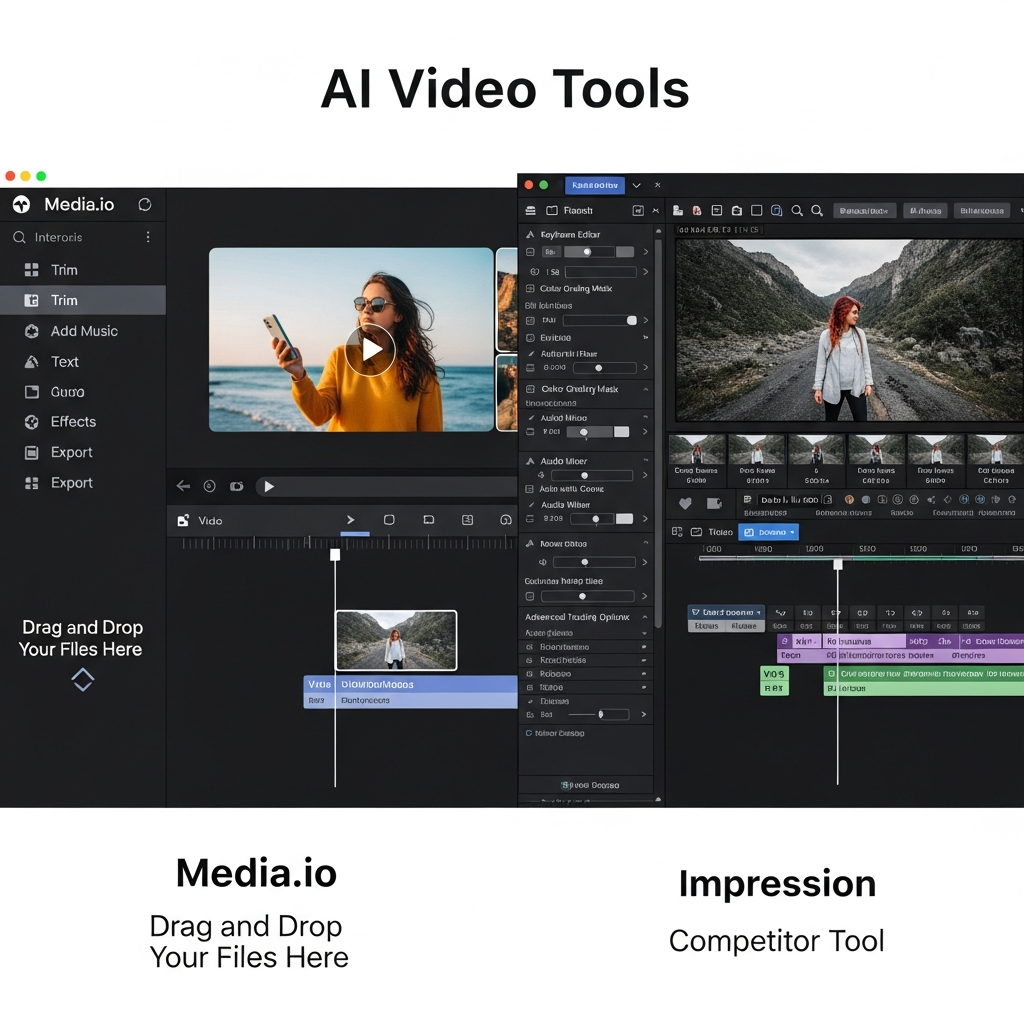
What Is Media.io AI Video?
Media.io is a browser-based AI creative platform combining video generation with image, audio and editing tools.
Its AI Video workflow currently supports three primary generation approaches:
Text to video — describe a scene and generate a video from the prompt.
Image to video — upload an image and use a prompt to describe movement, camera behavior or visual changes.
Template to video — use predefined effects or creative formats as the starting point.
Media.io’s own guide identifies these as its three main video-generation workflows.
The platform then adds adjacent tools for:
- subtitles;
- voiceovers;
- music;
- avatars;
- background/object editing;
- enhancement;
- compression;
- conversion;
- image editing.
That wider workflow is important.
A pure AI video model generates footage.
Media.io is attempting to cover more of the process between:
idea → generation → cleanup → finishing → export.
Media.io AI Video Models in 2026
One of Media.io’s most important changes is its multi-model strategy.
At the time of this update, its image-to-video interface shows access to models or routes including:
| Model / Route | Typical Reason to Consider It |
|---|---|
| Kling 3.0 / 2.6 | Motion and image-to-video experimentation |
| Google Veo 3.1 | Advanced generative-video workflows |
| Sora 2 | Prompt-led creative video generation |
| Hailuo 2.3 | Fast creative clip generation |
| Wan 2.6 | Alternative generative-video workflow |
| Vidu Q3 | Image/reference-driven generation |
| Runway | Established creative video ecosystem |
| PixVerse | Social and effects-oriented generation |
Available models can change, so treat this as a September 2026 snapshot, not a permanent list.
Why multi-model access matters
Different models fail in different ways.
One may handle:
- human motion better;
another:
- camera movement;
another:
- character consistency;
another:
- stylized animation.
A multi-model interface lets you retry the concept using another generation engine instead of abandoning the workspace.
That is especially useful during creative ideation.
What it does not mean
Access to multiple models does not mean Media.io automatically exposes every setting, model version or advanced feature available through the original provider.
If a specific model is central to professional production, compare Media.io with that model’s native platform before committing.

Media.io Text-to-Video
Media.io’s Text-to-Video tool converts a written visual prompt into a generated clip.
The platform recommends specifying elements such as:
- subject;
- action;
- visual style;
- camera movement.
Media.io says standard text-to-video generations commonly complete in under a minute, although processing time varies according to model, resolution and requested clip.
Best use cases
Text-to-video works well for:
short concepts;
social content;
B-roll ideas;
stylized scenes;
ad concepts;
visual experimentation.
It is less suited to a workflow where you need exact frame-by-frame creative direction from the first generation.
AI video remains iterative.
Expect to regenerate.
Media.io Image-to-Video
Image-to-video is arguably one of the more practical Media.io workflows.
You upload an existing image and describe what should happen.
That gives the model a stronger visual starting point than pure text.
Media.io currently supports prompts describing:
- movement;
- scene changes;
- mood;
- camera behavior;
- animation.
Its image-to-video workflow also connects directly to finishing tools such as background/object removal, enhancement, music, compression and conversion.
Why this is useful for marketers
A marketer can begin with:
product photo → motion prompt → generated clip → music → enhancement → social export
without building everything manually from scratch.
This can be useful for:
product teasers;
social ads;
Reels;
Shorts;
creative testing;
animated campaign graphics.
Media.io Script-to-Video
Media.io also now provides a more structured Script-to-Video workflow.
This goes beyond generating a single clip.
Media.io documents support for:
- structured story generation;
- characters;
- reference photos;
- storyboard preview;
- background music;
- subtitles/dialogue captions;
- multiple visual moments;
- export settings up to 4K depending on project configuration.
Text-to-video vs script-to-video
Use text-to-video when you want an individual visual scene.
Use script-to-video when the project has:
a story;
multiple shots;
characters;
narration;
structured progression.
That distinction makes Media.io potentially more useful than a basic “prompt in, clip out” generator.
Media.io Editing and Finishing Tools
Generation is only half the workflow.
Raw AI output often needs correction.
Media.io can reduce the need to move immediately into another application by providing tools around the generated asset.
Its current image-to-video page highlights workflows involving:
background removal;
object removal;
video enhancement;
music;
compression;
conversion.
The general AI Video Generator also promotes avatars, subtitles, voiceovers, music, effects and templates.
Why this matters
Consider the alternative workflow:
Generate in Platform A.
Download.
Upload to Platform B.
Remove an object.
Download again.
Upload to Platform C.
Add music.
Export.
Media.io’s advantage is reducing some of that tool switching.
That is a workflow benefit rather than a model-quality advantage.
Media.io Pricing in 2026
Pricing needs careful explanation because Media.io currently mixes:
free access + memberships + AI credits + promotional pricing.
Its current promotional page advertises annual membership rates around:
| Plan | Current Advertised Annual Rate* |
|---|---|
| Standard | ~$6.99/month |
| Premium | ~$12.99/month |
| AI credits | Sold separately in packs |
*Checked September 2, 2026. Promotional pricing and billing terms can change.
The same page shows regular comparison prices of roughly $9.99/month for Standard and $17.99/month for Premium before the promotional discount.
Important: credits matter more than sticker price
AI video generation can consume credits separately from the basic editing membership.
That means:
subscription price ≠ total AI video cost.
Before paying, calculate:
model used × number of generations × retries × final usable clips.
A $7 subscription is not inexpensive if your production volume requires frequent extra-credit purchases.
CompareBestAI’s existing AI Video by Media.io tool profile currently shows a different price snapshot, so that page should also be updated to prevent inconsistent pricing across the site.
Is Media.io Free?
Media.io is free to start, but free AI video generation is limited.
Media.io currently says new users can receive free credits to try text-to-video generation. AI creation can then move into credit-based usage.
Free access is therefore best treated as:
a testing environment
rather than:
unlimited professional production.
Always check:
- current credits;
- watermark rules;
- export quality;
- storage;
- model availability;
before deciding whether the free tier is enough.
Media.io Pros and Cons
Pros
Multi-model access
This is the standout advantage in 2026.
You can experiment with several leading video-model families inside one environment rather than maintaining separate workflows for each.
Text + image + script workflows
Media.io covers more than one generation format.
Beginner-friendly
The generation process is generally prompt/upload → generate → preview → export rather than a complex professional editing workflow.
Built-in finishing tools
Enhancement, music, background/object tools and other utilities can reduce application switching.
Useful for social content
Image animation and short creative video fit TikTok, Reels and Shorts particularly well.
Cons
Credit economics can become confusing
The membership price alone does not tell you the true cost of frequent generation.
Model access is not the same as native-platform control
Heavy Kling, Veo or Runway users may prefer those platforms directly.
Output still needs review
Motion, anatomy, object consistency and prompt interpretation can vary according to model.
Not a replacement for a professional NLE
Professional editors needing deep timeline, compositing or color workflows may still finish projects in dedicated editing software.
Media.io vs Runway
Media.io and Runway overlap but have different strengths.
Choose Media.io when:
you want multiple models;
you prefer an all-in-one browser workflow;
you create a range of social and marketing assets;
convenience matters more than maximum model-specific control.
Choose Runway when:
advanced AI filmmaking is central to your workflow;
you need deeper creative control;
you prefer working directly in a specialist generative-video environment.
For the deeper platform breakdown, see CompareBestAI’s Runway AI review.
Media.io vs Synthesia
These tools serve substantially different use cases.
Media.io is primarily suited to creative generative video, image animation and multimedia experimentation.
Synthesia is much more focused on structured business videos built around AI presenters, training, onboarding and localization.
If you primarily need talking-presenter content for organizations, the Synthesia AI video generator review is a more relevant comparison.
Who Should Use Media.io?
Media.io is strongest for:
Social Media Creators
Turn images or prompts into short creative clips and finish them without a complex editing stack.
Marketers
Create campaign concepts, promotional clips, product motion assets and creative variations.
Small Businesses
Produce simple video assets without maintaining a full internal video-production team.
Beginners
The browser interface reduces the technical entry barrier compared with advanced filmmaking software.
Multi-Model Experimenters
If the main goal is comparing outputs from different video models, Media.io’s aggregator-style approach becomes particularly attractive.
Who Should Skip Media.io?
Media.io may not be the best first choice for:
Professional Film Production
Teams requiring sophisticated timeline control, compositing, color workflows and professional post-production will still need specialist software.
One-Model Power Users
If 90% of your workflow depends on one model, using its native platform may provide more control.
Predictable High-Volume Generation
Heavy users should carefully calculate credit consumption before scaling.
Enterprise Training Video
If AI presenters, LMS workflows and structured corporate learning are the priority, a specialist avatar platform may fit better.
How We Would Test Media.io Before Paying
Do not choose Media.io based only on the demo gallery.
Run the same five production tasks you actually need:
- Text-to-video: use a realistic campaign prompt.
- Image-to-video: animate a real brand/product asset.
- Consistency test: regenerate the same concept several times.
- Finishing test: enhance, add music or captions, then export.
- Cost test: calculate how many credits were consumed to get one usable deliverable.
Then compare the same inputs with one specialist platform.
For a wider market benchmark, CompareBestAI’s best AI video generators comparison compares leading 2026 options by use case rather than brand alone.
Is Media.io Worth It in 2026?
Yes, for the right user.
Media.io is worth trying if your priority is:
convenience + multi-model experimentation + built-in finishing tools.
It is especially attractive to creators who do not want separate subscriptions or workflows for every type of media task.
But don't choose it solely because it provides access to major video-model names.
Test whether:
the model you need is available;
the controls are sufficient;
generation quality matches your use case;
credit cost remains reasonable after retries;
the final export workflow meets your requirements.
That determines whether Media.io is inexpensive—or simply inexpensive to start.
Frequently Asked Questions
Is Media.io AI Video good in 2026?
Media.io is a strong option for creators and marketers who want text-to-video, image-to-video and access to multiple AI-video models inside one browser-based creative workspace. Specialist platforms may offer deeper control for advanced users.
What AI video models does Media.io offer?
Media.io’s current image-to-video interface lists model options including Kling, Veo, Sora, Vidu, Hailuo, Wan, Runway and PixVerse. Availability and model versions can change.
Can Media.io turn text into video?
Yes. Media.io provides a text-to-video generator that converts written scene descriptions into generated video clips.
Can Media.io animate an image?
Yes. Its image-to-video workflow lets you upload an image and describe motion, camera direction, mood or scene behavior through a prompt.
Does Media.io support script-to-video?
Yes. Media.io documents a structured Script-to-Video workflow supporting story structure, characters, storyboard previews, subtitles, music and project-dependent exports up to 4K.
Is Media.io free?
Media.io is free to start and provides free access/credits for trying some AI-generation workflows. Continued AI generation can require credits or a paid plan.
How much does Media.io cost?
Pricing varies with subscription, billing period, promotion and AI-credit usage. As of September 2, 2026, Media.io’s official promotion page advertises Standard from about $6.99/month and Premium from about $12.99/month when billed annually. Verify current checkout pricing.
Is Media.io better than Runway?
Media.io is better suited to creators who value multi-model access and an all-in-one creative workspace. Runway is generally more appropriate when advanced generative filmmaking and deeper model-specific control are the priority.
Final Verdict
Media.io AI Video is one of the more interesting all-in-one AI-video workflows in 2026 because it is increasingly model-agnostic.
Its main advantage is not that Media.io has somehow built one generator that beats every specialist.
Its advantage is that creators can move between:
text → image → multiple AI models → editing → enhancement → audio → export
without constantly rebuilding the workflow.
That makes it particularly useful for:
social creators, marketers, beginners and teams experimenting across models.
The trade-off is that aggregating tools and models can sacrifice some of the deepest native controls available directly from specialist platforms.
So the buying decision is simple:
Choose Media.io for workflow convenience and breadth.
Choose a specialist platform when maximum control over one generation model matters more.
For readers comparing the whole category rather than Media.io alone, continue with CompareBestAI’s 2026 AI video generator comparison before choosing a paid plan.
Recommended CTA
Try Media.io with your own text and image prompts first, then verify current credit costs and export limits before upgrading.
That CTA fits this page much better than pushing an affiliate purchase immediately because this is a late-MOFU/BOFU review where the reader needs to validate quality and real credit economics before subscribing.