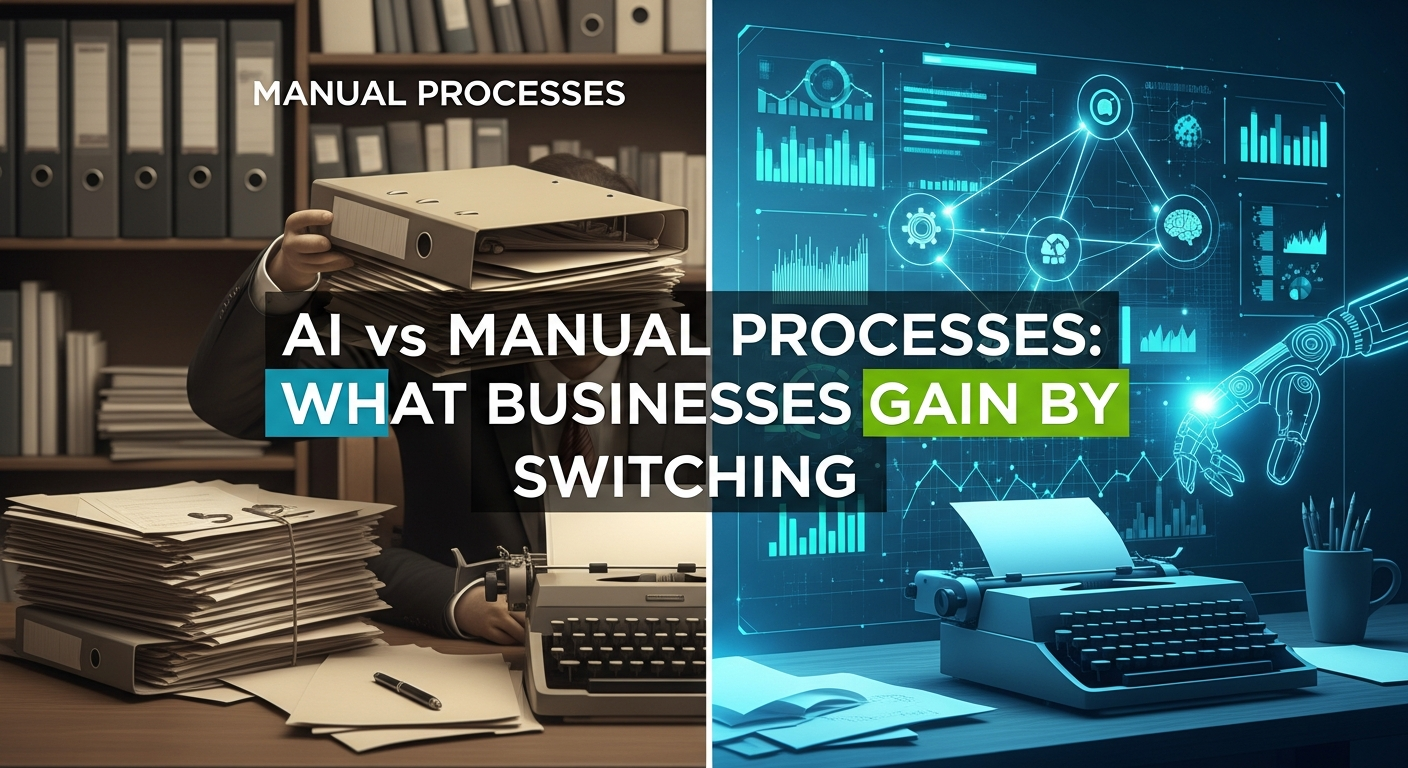

Quick Answer: AI can outperform manual processes when work is repetitive, high-volume, data-heavy and easy to verify. It can reduce time spent on drafting, sorting information, analyzing data, routing requests and moving information between systems.
But AI is not automatically cheaper, more accurate or better than people. Human judgment remains essential for ambiguous decisions, sensitive customer situations, exceptions, approvals and high-stakes work.
For most businesses in 2026, the strongest model is therefore not AI instead of humans. It is AI handling repeatable work while people supervise, decide and manage exceptions.
A randomized field experiment across 66 firms and 7,137 knowledge workers found that employees who actively used generative AI spent about two fewer hours per week on email during the latter half of the study. However, researchers did not find similarly broad changes in the overall quantity or composition of their work.
Last updated: September 2, 2026
AI vs Manual Processes at a Glance
| Area | Manual Process | AI-Powered Process | Better Approach |
|---|---|---|---|
| Repetitive data handling | Slow at high volume | Can process large volumes quickly | AI/automation |
| Standard document summaries | Requires employee time | Can create first-pass summaries | AI + review |
| Customer triage | Staff reviews every request | AI can classify and route requests | Hybrid |
| Complex negotiation | Strong human context | AI can assist but lacks accountability | Human-led |
| High-stakes approvals | Human review required | AI can provide supporting analysis | Human-led |
| Routine reporting | Repeated manual preparation | AI can draft or automate reporting | AI |
| Unusual exceptions | Humans adapt well | Models may fail outside normal patterns | Human |
| Relationship building | High empathy/context | Limited genuine relationship understanding | Human |
| Large-scale pattern analysis | Time-consuming | AI can surface patterns rapidly | AI + validation |
The important point is that “AI vs manual” is not a winner-takes-all decision.
The right question is:
Which steps should machines execute, and which steps still need human judgment?
What Is a Manual Business Process?
A manual process is a workflow in which people perform most steps directly instead of relying on software automation.
Examples include:
- copying customer information into a CRM;
- sorting incoming support requests;
- preparing weekly reports;
- checking documents individually;
- scheduling meetings;
- summarizing calls;
- moving information between spreadsheets;
- writing repetitive customer messages;
- approving routine requests.
Manual work is not automatically inefficient.
Some manual work exists because the task requires:
- judgment;
- discretion;
- empathy;
- negotiation;
- accountability;
- exception handling.
The problem begins when employees repeatedly perform tasks that software can complete reliably with less effort.
What Is an AI-Powered Process?
An AI-powered business process uses artificial intelligence to interpret information, generate an output, make a prediction, recommend an action or execute part of a workflow.
That might include:
Customer message → AI classifies intent → ticket routed to correct team
or:
Meeting → AI transcript → summary → action items → project tasks
or:
Invoices → AI extracts fields → employee reviews exceptions → accounting system updated
AI can work alongside traditional automation.
That distinction matters.
If a process follows a perfectly predictable rule, you may not need sophisticated AI at all.
For example:
If invoice amount exceeds $10,000 → send to finance director.
That is deterministic workflow automation.
But:
Read this invoice and identify the supplier, invoice number, total, due date and unusual clauses
is a task where AI can be useful because the input is less structured.
A useful rule is:
Use normal automation when the rule is predictable. Use AI when the system must interpret, classify, generate or reason over messy information.
What Businesses Actually Gain From AI
1. Less Time Spent on Repetitive Knowledge Work
This is one of the most defensible benefits.
AI can reduce the amount of employee time spent on:
- first drafts;
- summaries;
- routine emails;
- document classification;
- research preparation;
- meeting notes;
- information retrieval.
The 7,137-worker NBER field experiment found that active AI users spent around two fewer hours per week on email during the later portion of the experiment. They also reduced some after-hours work.
That is a much more credible way to describe AI productivity than claiming every company receives a 40–60% improvement.
The value depends on the task.
2. Higher Throughput
A human employee can review only a finite number of emails, records or documents per hour.
Software can process more.
That makes AI useful where the problem is:
volume.
For example, an organization might use AI to produce a first-pass classification of 10,000 customer messages and send only uncertain cases to human reviewers.
This changes the human role from:
inspect everything
to:
inspect what needs judgment.
That is often where automation produces the most meaningful operational leverage.
3. Faster First-Pass Analysis
AI can help teams move from raw information to a useful starting point more quickly.
For example:
Raw survey responses → themes
Long document → summary
Support messages → categories
Meeting transcript → action items
Large spreadsheet → anomalies or trends
The output should not automatically become the final decision.
Think of AI as reducing the time required to reach the review stage.
Humans still determine whether the analysis is correct and whether action is appropriate.
4. More Consistent Execution
Consistency can be valuable.
A manually performed process may vary between:
- employees;
- shifts;
- offices;
- experience levels.
A well-designed automated workflow can apply the same:
- classification logic;
- formatting;
- routing;
- checklist;
- output structure.
But consistency is not the same as correctness.
An AI system can make the same wrong decision consistently.
That is why production workflows need evaluation and monitoring.
NIST's AI Risk Management Framework emphasizes evaluating qualities such as validity, reliability, safety, accountability and transparency throughout an AI system's lifecycle.
5. Faster Customer Response
Customer-service AI can assist with:
- FAQ responses;
- intent detection;
- ticket routing;
- suggested replies;
- order-status questions;
- appointment support.
The strongest model is normally tiered.
Routine request → automation
Uncertain request → employee
Sensitive or escalated request → experienced human
This gives customers speed without forcing every interaction through automation.
A chatbot that refuses to escalate a frustrated customer is not efficient.
It simply moved the cost somewhere else.
6. Better Scalability—When the Architecture Supports It
AI can make growth less dependent on adding people at the same rate as transaction volume.
But the current article's claim that AI handles growth “effortlessly” should be removed.
Scaling AI introduces:
- usage costs;
- API limits;
- integrations;
- permissions;
- monitoring;
- security;
- quality evaluation;
- human-review capacity.
Before expanding a workflow, use CompareBestAI's guide to AI tools that scale cleanly to evaluate whether the system can handle higher user and transaction volume without operational deterioration.
7. Employees Can Spend More Time on Higher-Value Work
This is often the strategic benefit people actually want.
An accountant probably should not spend hours copying invoice fields.
A salesperson should not spend most of the day entering CRM notes.
A manager should not manually summarize every routine status update.
Removing that work creates capacity for:
- analysis;
- problem solving;
- customer conversations;
- strategy;
- creativity;
- decision-making.
But the extra capacity has to be intentionally redirected.
Simply saving employee time does not guarantee the organization will create more value.
The ILO's 2026 evidence review found that AI productivity effects are real but uneven, and time savings do not automatically become measurable improvements in output or earnings.
The Evidence Favors Human + AI, Not Human vs AI
One of the strongest lessons emerging from workplace research is that AI is often most valuable as a teammate or augmentation layer.
A field experiment involving 776 professionals at Procter & Gamble studied employees working on real product-development challenges. Individuals using AI were able to match aspects of the performance of two-person teams without AI, while AI also helped employees produce solutions that crossed traditional functional boundaries. The study was later published online in Organization Science in June 2026.
This does not mean one AI-enabled employee always replaces two people.
It means AI can change how expertise is combined and how certain tasks are completed.
Deloitte's August 2026 survey provides an even clearer enterprise signal: 75% of leaders said human collaboration with AI agents creates more value than automation alone.
That should change the way businesses frame implementation.
Do not ask:
“Which employees can AI replace?”
Start with:
“Which parts of their workflow should no longer require manual effort?”
Where Manual Processes Still Win
High-Stakes Decisions
Do not automatically delegate consequential decisions just because an AI system can produce an answer.
Examples may include:
- major financial approvals;
- legal decisions;
- safety decisions;
- sensitive employment decisions;
- regulated decisions.
AI can assist with analysis.
Accountable humans should remain in control where consequences are substantial.
Complex Exceptions
Automation performs best when inputs resemble the situations it was designed for.
Humans are often better when something unusual happens.
For example:
a straightforward refund request may be automated.
A customer whose payment failed after a medical emergency may require discretion.
Negotiation
AI can prepare:
- background information;
- talking points;
- comparisons.
But real negotiation involves:
- trust;
- tone;
- incentives;
- politics;
- relationship history;
- nonverbal information.
Those are difficult to reduce to workflow rules.
Relationship-Building
Important customer and employee relationships should not be optimized purely for speed.
Sometimes a human conversation is the business value.
Final Accountability
AI cannot accept organizational accountability.
Your business still owns:
- the outcome;
- customer harm;
- incorrect decisions;
- compliance failures;
- bad data;
- security incidents.
Automation changes who performs the task.
It does not remove responsibility.
Which Processes Should You Automate First?
Do not begin with whatever looks most impressive in a vendor demo.
Choose workflows using six criteria.
| Criterion | Strong Automation Candidate | Weak Candidate |
|---|---|---|
| Frequency | Happens every day | Happens twice a year |
| Volume | Hundreds/thousands of cases | Very few cases |
| Repetition | Similar steps each time | Every case is unique |
| Data | Accessible and reasonably clean | Missing or unreliable |
| Verification | Output can be checked quickly | Correctness is difficult to verify |
| Error cost | Mistakes are reversible | Mistakes cause serious harm |
A process that scores highly across the left column is usually a much better first AI project.
Good Early Candidates
Examples include:
- meeting summaries;
- inbox classification;
- document extraction;
- lead enrichment;
- FAQ handling;
- first-draft reporting;
- routine scheduling;
- repetitive data movement;
- knowledge search.
Poor First Candidates
Be cautious with:
- strategic decisions;
- sensitive HR decisions;
- complex negotiation;
- safety-critical actions;
- highly unusual workflows;
- workflows with bad underlying data.
AI Does Not Always Beat Traditional Automation
This deserves its own section because businesses frequently overuse AI.
Suppose you want to:
copy a form submission into your CRM.
You do not need a language model.
A normal integration can do it reliably.
Suppose instead you want to:
read the free-text form response, determine the customer's problem, identify urgency and route the lead.
That is where AI can add value.
A useful architecture is often:
rules + automation + AI + human review
rather than:
AI everywhere.
This keeps predictable tasks deterministic while reserving AI for the steps that genuinely require interpretation.
The Hidden Cost of Switching From Manual to AI
The current article focuses heavily on labor savings.
That is only one side of the calculation.
AI implementation can add:
- software subscriptions;
- credits;
- API usage;
- additional seats;
- integration work;
- data preparation;
- employee training;
- security review;
- human verification;
- workflow redesign;
- monitoring;
- migration costs.
CompareBestAI's guide to the hidden costs of AI tools explains why subscription price alone is a poor measure of total cost.
A more useful model is:
AI Total Cost = Software + Usage + Integration + Training + Review + Governance + Maintenance
Then compare that against:
Business Value = Time Saved + Extra Output + Reduced Errors + Faster Service + New Revenue
A workflow is valuable when net business value improves—not simply because fewer human minutes are involved.
How to Calculate Whether AI Is Actually Saving Money
Start with a single workflow.
Suppose five employees collectively spend:
25 hours per week
preparing routine reports.
After AI implementation:
- AI processing/setup = 2 hours;
- employee review = 5 hours;
- exception handling = 3 hours.
New human workload:
10 hours per week
Net saving:
15 hours per week
Then calculate:
15 hours × employee cost × working weeks
and subtract:
- software;
- integrations;
- implementation;
- maintenance;
- training.
That gives a much more useful estimate than:
“AI is cheaper than hiring.”
If your team is still selecting software, use CompareBestAI's practical AI tool selection framework to test workflow fit, real cost, security and integration before subscribing.
How to Switch From Manual Work to AI Safely
Step 1: Map the Current Process
Document what actually happens today.
Include:
- inputs;
- employee actions;
- systems used;
- approvals;
- exceptions;
- output.
Do not automate a process nobody understands.
Step 2: Establish a Baseline
Measure the current process before changing it.
Track:
- time;
- cost;
- volume;
- error rate;
- turnaround time;
- customer satisfaction where relevant.
Without a baseline, you cannot prove improvement.
Step 3: Automate One Bottleneck
Do not redesign the entire company at once.
Choose one repeated, measurable problem.
For example:
manual meeting notes
or:
support ticket categorization
or:
document data extraction.
Step 4: Keep Human Review Where Risk Requires It
Decide in advance which outputs can be:
automatically accepted
and which require:
human approval.
NIST's risk-management guidance treats AI trustworthiness as something organizations should actively govern, measure and manage throughout deployment and use.
Step 5: Pilot With Real Work
Vendor demos are designed to look good.
Test:
- normal cases;
- edge cases;
- poor-quality input;
- incomplete data;
- high volume.
Step 6: Measure Net Improvement
Track:
manual time before
versus:
AI time + review + correction + administration after.
If the AI saves three hours but creates two-and-a-half hours of checking, the improvement is small.
Step 7: Train the Team
Employees need to understand:
- what the AI does;
- what it does not do;
- when output needs review;
- how to escalate errors;
- what data should not be entered.
Deloitte's 2026 research reinforces that AI transformation requires redesigning workflows and organizational processes rather than merely deploying technology.
Step 8: Scale Only What Works
Do not expand based on enthusiasm.
Expand because:
- time decreased;
- quality remained acceptable;
- errors stayed controlled;
- economics make sense;
- employees actually use the system.
And before a workflow becomes mission-critical, review your AI vendor lock-in risk and exit plan so efficiency gains do not create an expensive future dependency.
AI vs Manual Processes by Business Function
Customer Service
Automate:
- FAQ handling;
- ticket classification;
- suggested replies;
- routine status questions.
Keep human-led:
- escalations;
- emotional complaints;
- unusual policy exceptions;
- important account relationships.
Marketing
Automate or assist:
- research summaries;
- content first drafts;
- data analysis;
- transcription;
- reporting.
Keep human-led:
- brand strategy;
- campaign judgment;
- final factual review;
- high-stakes messaging.
Sales
Automate:
- CRM updates;
- call summaries;
- lead enrichment;
- follow-up reminders.
Keep human-led:
- discovery calls;
- negotiation;
- relationship management;
- closing complex deals.
Finance
Automate or assist:
- document extraction;
- transaction classification;
- anomaly flagging;
- recurring report preparation.
Keep human-led:
- material approvals;
- interpretation;
- exceptions;
- accountability.
Operations
Automate:
- repetitive data movement;
- classification;
- routing;
- reporting;
- scheduling.
Keep human-led:
- process redesign;
- exception management;
- incident response;
- strategic trade-offs.
Why AI Projects Fail Even When the AI Works
Sometimes the model is not the problem.
The workflow is.
AI projects struggle when:
- the original process is already broken;
- nobody owns implementation;
- data is poor;
- employees do not trust the system;
- integration creates more work;
- outputs require constant correction;
- costs increase faster than value.
Deloitte found that only 5% of surveyed organizations considered their business processes highly prepared for AI agents, while only 15% had scaled orchestrated cross-functional multi-agent adoption.
That is a useful reminder:
Buying AI is easy. Rebuilding operations around it is harder.
Frequently Asked Questions About AI vs Manual Processes
Is AI always better than manual processes?
No. AI is most useful for repetitive, high-volume and data-heavy work. Humans remain stronger in areas requiring nuanced judgment, accountability, empathy, negotiation and unusual exception handling.
What manual processes should businesses automate first?
Start with frequent, repetitive tasks with clear inputs and measurable outputs, such as meeting summaries, document extraction, ticket classification, recurring reports and routine data movement.
Does AI reduce human error?
AI can reduce certain manual errors and apply processes more consistently, but it can introduce its own errors. AI outputs should be evaluated and monitored rather than assumed to be accurate.
Does AI save businesses money?
It can, but only when the value of time saved, extra output or reduced errors exceeds software, integration, training, human review, governance and maintenance costs.
How much time can AI save employees?
Savings depend heavily on the task. In one randomized field experiment involving 7,137 knowledge workers, active AI users spent roughly two fewer hours per week on email during the latter part of the study.
Should companies replace employees with AI?
A blanket replacement strategy is usually the wrong starting point. Current evidence supports redesigning tasks and workflows around human-AI collaboration. Deloitte's 2026 survey found 75% of leaders believed human collaboration with AI agents creates more value than automation alone.
What is the difference between AI and normal automation?
Traditional automation executes predefined rules. AI is useful when a workflow requires interpreting language, images, patterns or less-structured information. Many strong business workflows combine both.
How can a small business start using AI?
Choose one repetitive task, measure how much time it currently takes, test one or two tools on real work, retain human review, and expand only if the workflow produces measurable net savings.
Can AI run business processes without humans?
Some low-risk processes can become highly automated, but human oversight remains important for exceptions, security, accountability and high-impact decisions.
How do I know whether an AI automation is working?
Measure business outcomes: time saved, cost, turnaround time, error rate, review effort and customer outcomes. AI usage itself is not a useful success metric.
Final Verdict
The real AI vs manual processes question is not:
“Which one wins?”
It is:
“Which parts of this workflow should still require human effort?”
AI is strongest when work is:
- repetitive;
- high-volume;
- data-heavy;
- time-consuming;
- easy to verify.
Humans remain strongest where work requires:
- judgment;
- accountability;
- trust;
- empathy;
- negotiation;
- exception handling.
The best business process in 2026 is therefore often:
automation for predictable rules + AI for interpretation + humans for judgment and exceptions.
Research increasingly supports that hybrid model. AI can create meaningful time and productivity gains, but those gains vary by task, and simply adding AI does not automatically improve the whole organization.
For most businesses, the next step should not be “replace every manual process.”
Choose one expensive workflow.
Measure the baseline.
Automate the repetitive portion.
Keep humans where mistakes matter.
Measure the net result.
Then scale.
When you're ready to select the software for that workflow, use CompareBestAI's guide to choosing the right AI tool rather than choosing a product purely because it promises automation.