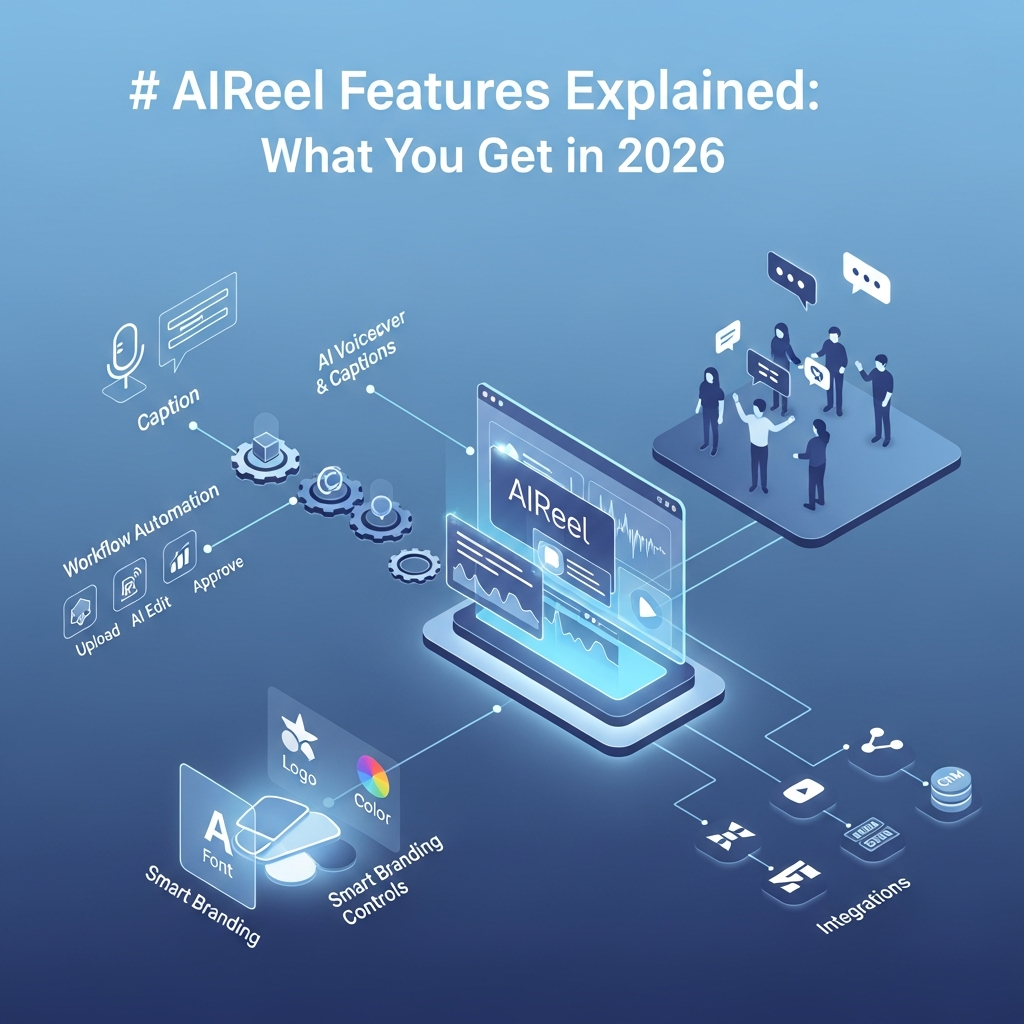

Quick Answer: AIReel is an all-in-one AI image and video creation platform that can generate video from text, animate images, create motion between start and end frames, use multiple visual references, generate and edit images, and route projects through different AI video models.
As of September 2026, AIReel.net lists models including AIReel 3.0, Seedance 2.5, Wan 3.0, Kling 3.0, Vidu Q3 Pro, Google Veo 3.1, Sora 2, Hailuo 2.3, Runway and PixVerse, among others.
Its biggest advantage is therefore not one proprietary model. It is access to several generation workflows and model families through one interface.
Important: This guide covers AIReel.net by FunCreate LIMITED. It does not cover the unrelated AIReel.co, AiReel.io/Personate Agent, AiReelEngine or other similarly named products. AIReel.net identifies FunCreate LIMITED as its operator.
Last Updated: September 2, 2026
For the broader buying verdict rather than a feature-by-feature explanation, read CompareBestAI's AIReel Review 2026.
AIReel Features at a Glance
| Feature | What It Does | Best For |
|---|---|---|
| Text-to-Video | Generates video from a written prompt | Concepts, ads, social clips |
| Image-to-Video | Animates a still image | Products, characters, social visuals |
| Reference-to-Video | Uses multiple reference images plus script | Character/product consistency |
| Start/End Frames | Generates motion between two images | Transformations, reveals |
| Text-to-Image | Generates images from prompts | Concepts, thumbnails, campaign assets |
| Image-to-Image | Restyles or transforms existing imagery | Creative variations |
| Multi-Model Access | Lets users choose different generation models | Testing visual styles |
| Prompt Assistance | Helps refine simple descriptions | Beginners |
| AI Effects | Applies themed AI transformations | Social/creative content |
| Web + Mobile Access | AIReel works through browser and mobile app | Cross-device creation |
These are not equivalent features.
For example, image-to-video answers a different creative problem from reference-to-video, while start/end-frame generation gives substantially more structural control than asking a model to freely animate a single still.
1. Text-to-Video Generation
AIReel's text-to-video feature turns a written description into generated video.
The workflow is straightforward:
write a prompt → select a model/style → generate the clip
AIReel's current text-to-video page exposes model families including Grok, Hailuo, Kling, Seedance, Sora, Veo, Wan, Vidu and others.
What should you put in the prompt?
A useful video prompt should normally specify:
Subject — who or what appears.
Action — what is happening.
Environment — where it happens.
Style — realistic, cinematic, anime, advertising, etc.
Camera — close-up, tracking shot, slow push-in, aerial view.
Lighting/mood — dramatic, daylight, warm, dark, futuristic.
Instead of:
A woman walking.
Try:
A woman in a red coat walks through a rainy neon-lit Tokyo street at night, cinematic tracking shot, reflections on wet pavement, shallow depth of field.
AIReel says simple prompts can work, while clearer mood, setting and motion instructions can improve results.
Best for
Text-to-video works well for:
- visual concepts;
- short ads;
- B-roll;
- social content;
- creative storytelling;
- mood scenes.
Limitation
A text prompt gives the model significant creative freedom.
If you need a particular person, product, outfit or environment to stay recognizable, the reference-to-video feature is usually a better starting point.
2. Image-to-Video
Image-to-video starts with an existing still image instead of a completely blank prompt.
Upload the image, describe the intended movement, and AIReel generates motion around that visual starting point.
AIReel describes the process as:
upload picture → describe the intended video → generate.
Why this is useful
Suppose you already have:
a product photo;
character artwork;
fashion photo;
AI portrait;
property image;
campaign key visual.
Instead of asking AI to recreate the subject from text, you can make that existing asset the visual foundation.
Good use cases
Product marketing: animate product photography.
Social media: turn a static post into a Reel/Short.
Character content: add movement to portraits or illustrations.
Real estate: animate architectural or interior imagery.
Creative testing: try several motions from one source image.
Limit
Animation can still change facial features, object geometry, logos or fine details.
Image-to-video should therefore be evaluated on your own visual assets rather than judging the tool entirely from curated demo galleries.
3. Reference-to-Video
Reference-to-video is one of the more useful AIReel features for users who need stronger visual guidance.
Rather than giving AI only one image, you can provide reference images representing:
- characters;
- products;
- clothing;
- locations;
- objects;
- scenes.
You then provide a written script or action description.
AIReel explains that each uploaded image acts as visual guidance for the generated video's subjects, setting and overall appearance.
Example
Imagine a clothing brand has:
Reference 1: model photo
Reference 2: jacket
Reference 3: city location
Then the prompt can describe:
The model walks through the city wearing the jacket as the camera moves alongside her.
This gives the system considerably more explicit visual context than a text-only prompt.
Best for
- product showcases;
- recurring characters;
- fashion;
- advertising concepts;
- storyboards;
- e-commerce content.
Privacy note
AIReel says that when signed in, references, scripts and settings can be stored in generation history for reuse and remain private to the account.
Users working with sensitive or unreleased brand assets should still review the current privacy policy before uploading them.
4. Start-and-End Frame Video Generation
AIReel also supports first-frame / last-frame generation.
This lets you specify both:
where the video starts
and
where it should finish.
The model then attempts to generate a visual transition connecting them.
This is fundamentally different from ordinary image-to-video.
With image-to-video:
Start = known
End = AI decides
With frame-to-video:
Start = known
End = known
Transition = AI generates
Useful examples
Before → after
Empty room → furnished room.
Transformation
Ordinary character → fantasy character.
Product reveal
Closed packaging → product displayed.
Camera transition
Wide landscape → close-up subject.
Time progression
Day → night.
AIReel currently recommends different model families for different transition behaviors, including Seedance, Wan, Kling, Google Veo and Hailuo.
5. Multi-Model AI Video Generation
This is arguably AIReel's most important platform-level feature.
AIReel is not limited to one generation engine.
Its current model catalog lists more than 20 options, including:
AIReel 3.0
Seedance 2.5
Seedance 2.0 Fast / Mini
Wan 3.0 / 3.0 Prime
MiniMax H3
Grok Imagine 1.5
Kling 3.0 / Kling 3.0 Turbo
Vidu Q3 Pro
Google Veo 3.1
Runway
Sora 2
Hailuo 2.3
PixVerse
and additional models.
AIReel itself says it offers 20+ AI generation models, while its About page says the platform is used by more than 100,000 creators and supports more than 50 languages. These are vendor-reported figures rather than independently audited CompareBestAI measurements.
Why model choice matters
AI video models have different strengths.
One model may be stronger for:
- cinematic motion;
another for:
- character consistency;
another for:
- speed;
another for:
- prompt adherence;
another for:
- transformations.
So when one generation fails, switching models can sometimes be more effective than rewriting the same prompt repeatedly.
Important limitation
Accessing a model through AIReel does not necessarily mean receiving every control or feature available from that model's original provider.
If Veo, Kling or Runway becomes central to your production workflow, compare the AIReel implementation against the native platform.
6. Text-to-Image Generation
AIReel is no longer purely a video generator.
Its text-to-image workflow creates still images from written prompts and exposes multiple image-generation models.
Users can specify factors such as:
- subject;
- visual style;
- environment;
- composition;
- aspect ratio;
- details.
AIReel positions the feature for everything from product concepts and portraits to posters and imaginative artwork.
Why an AI video user should care
AI image generation can become the first stage of video generation.
A useful workflow is:
text → image → choose best still → image-to-video
This gives you more control than generating the entire video directly from text.
You can first perfect the character, product or scene as a still image and only then add motion.
7. Image-to-Image Editing and Transformation
AIReel also supports image-to-image workflows.
You upload an existing image and describe how it should change.
For example:
Turn this daytime storefront into a cinematic nighttime scene with warm interior lighting.
or:
Keep the product unchanged but replace the background with a snowy mountain landscape.
AIReel describes this capability as an AI image-generation and editing workflow for transforming or enhancing existing images with prompts.
Useful for
- campaign variations;
- background changes;
- concept development;
- product visuals;
- stylization;
- social assets.
This creates another useful production sequence:
source image → AI variation → image-to-video
rather than asking the video model to solve every visual problem at once.
8. Built-In Prompt Assistance
Beginners often struggle more with prompting than with the actual interface.
AIReel says its built-in prompt assistant can take a plain-language description and help refine it before generation.
This is useful because AI video prompting tends to require more visual detail than ordinary chatbot prompting.
Instead of expecting a new user to understand:
lens behavior;
shot composition;
motion hierarchy;
lighting terminology;
camera direction;
the assistant can help translate an idea into clearer model instructions.
Still review the generated prompt
A prompt assistant should not replace creative intent.
Read what it adds.
Sometimes automated optimization introduces details that were not part of your original idea.
9. AI Effects and Creative Transformations
AIReel includes a library of specialized AI effects.
Its current site lists effects such as:
- AI Tattoo;
- AI Polaroid;
- AI Goth;
- AI Painting;
- AI Movie;
- AI Shadow Clone;
- AI Room Design;
alongside other trend-oriented effects.
These are most useful for quick social-media experimentation rather than carefully controlled professional production.
Best fit
Creators: fast trend participation.
Brands: lightweight visual experiments.
Social teams: quick variations.
Casual users: low-prompt creative transformations.
For a brand campaign, however, a model-driven generation workflow usually gives more creative control than relying exclusively on preset effects.
10. Web and Mobile Creation
AIReel works in a browser, and an official Android application is also available.
Its Google Play listing identifies the official site as AIReel.net and was updated on August 28, 2026, making the mobile app an actively current part of the product at the time of this article update.
The web version remains useful for:
- file-heavy workflows;
- prompt experimentation;
- reference uploads;
- comparing models.
Mobile access is useful for:
- quick experimentation;
- social content;
- working with phone images;
- generating away from a desktop.
Which AIReel Feature Should You Use?
| What You Already Have | What You Want | Best AIReel Workflow |
|---|---|---|
| Only an idea | New video | Text-to-Video |
| One strong image | Animated clip | Image-to-Video |
| Character/product references | Better consistency | Reference-to-Video |
| Exact opening + closing images | Controlled transition | Frames-to-Video |
| Only an idea | Still visual | Text-to-Image |
| Existing image | Visual variation | Image-to-Image |
| Unclear prompt | Better instructions | Prompt Assistant |
| Quick social concept | Trend-style output | AI Effects |
The feature you choose matters at least as much as the underlying model.
A common mistake is using text-to-video for every project.
If the visual identity already exists, give the AI more constraints.
Is AIReel Free?
AIReel currently allows users to begin with free generation access/credits, while continued usage can require paid credits or membership plans. Its official image and video pages repeatedly describe a free first-generation or included-credit model.
The important thing to understand is that AIReel is usage/credit dependent.
Different models can have different generation economics.
So when comparing price, do not ask only:
“How much does the subscription cost?”
Also ask:
“How many usable generations will my preferred model and settings produce?”
CompareBestAI currently displays specific plan prices on its AIReel tool profile, but those values should be revalidated because another CompareBestAI AIReel article currently publishes a completely different price structure.
For this feature guide, the safest wording is:
Pricing and credit requirements vary by plan, model and generation settings. Verify current pricing on AIReel before purchasing.
What Happens If a Generation Fails?
AIReel's refund policy was last updated June 8, 2026.
It says that when a generation fails for system reasons, the corresponding credits should not be deducted or should be returned after verification.
The same policy says successfully processed generations generally do not qualify for refund simply because the user dislikes the creative result.
That distinction is important for generative video.
Technical failure and subjective disappointment are not the same billing event.
Can You Use AIReel Videos Commercially?
AIReel's current text-to-video documentation states that videos created through paid plans can be used for commercial projects.
Its image-generation documentation similarly allows generated images for personal and commercial projects.
Businesses should still read the current terms for:
- third-party model restrictions;
- uploaded copyrighted assets;
- trademarks;
- identifiable people;
- music/assets;
- jurisdiction-specific rights.
AI generation does not automatically eliminate ordinary intellectual-property obligations.
What AIReel Does Not Clearly Document
This section is important because feature guides should explain absences as clearly as capabilities.
As of this September 2026 review of AIReel.net's first-party product documentation, I would not publish definitive claims that AIReel.net includes:
- enterprise SSO;
- CRM integrations;
- Slack integration;
- Google Drive integration;
- multi-user approval chains;
- real-time team commenting;
- enterprise audit logs;
- built-in social auto-publishing;
- a public API;
unless AIReel.net provides a current first-party page confirming them.
Some existing CompareBestAI AIReel content currently makes several of these claims.
Because there are several unrelated products named AIReel, those statements should be reverified against the exact aireel.net entity rather than copied from another page.
AIReel vs a Dedicated AI Video Platform
AIReel's strongest proposition is breadth.
One account gives you access to multiple generation approaches and models.
A dedicated platform may offer depth.
For example, a creator working almost exclusively with one model may benefit from its native:
- newest model releases;
- advanced controls;
- editing environment;
- project features;
- APIs;
- collaboration tools.
So:
Choose AIReel when: you want to experiment with several models and creation workflows from one interface.
Choose a model's native platform when: one specific ecosystem has become central to your professional workflow.
If cinematic generation is your priority, CompareBestAI's Runway AI video review provides a useful specialist comparison.
For a wider market view, compare the category through CompareBestAI's Video Generation tools.
Who Is AIReel Best For?
Content Creators
Multi-model access makes AIReel useful for creators who frequently experiment with different visual styles.
Social Media Teams
Image-to-video, effects and short-form generation can turn existing visual assets into additional social content.
Marketers
Reference images and start/end frames can be useful for advertising concepts, product visuals and campaign experimentation.
E-commerce Sellers
Products can become reference assets for promotional motion content without a new video shoot for every concept.
Designers
Image generation and transformation can support concept work before moving into video.
Beginners
Prompt assistance and simple upload/prompt workflows lower the technical barrier.
AIReel itself identifies creators, marketers, small businesses and users without professional editing experience among the intended audiences for its generation tools.
Who Should Consider an Alternative?
AIReel may be less suitable when you need:
Professional timeline editing — use a dedicated NLE/editor.
Deep native control of one AI model — consider the model provider directly.
Enterprise collaboration/governance — verify those functions before assuming they exist.
Long-form video production — generative models remain primarily short-clip systems.
Strict brand consistency — test your actual products, characters and logos before scaling.
Guaranteed output — generative video remains probabilistic.