
Answer First: Apollo.io is one of the strongest all-in-one platforms for B2B prospecting, sales intelligence, enrichment, outreach, and AI-assisted sales workflows. In this Apollo.io AI review, our verdict is that Apollo is best for SDRs, founders, agencies, and revenue teams that want prospect data, AI research, sequences, automation, and engagement tools in one system. The main drawbacks are its credit-based usage model, increasing cost at scale, and more complexity than a simple email-finder tool.
Apollo.io is no longer simply a B2B contact database. In 2026, the company positions Apollo as an AI-native go-to-market platform that combines prospecting, enrichment, outbound engagement, workflow automation, deal execution, and AI assistance.
Apollo currently says its data network contains 240M+ contacts and 30M+ companies, while more than 600,000 companies use the platform.
For the structured product overview, you can also visit our Apollo.io AI tool profile.
Apollo.io AI Review: Quick Verdict
| Category | Our Assessment |
|---|---|
| Best for | B2B prospecting, SDR teams, outbound sales, GTM teams |
| Main strength | Data + outreach + AI + automation in one platform |
| Starting price | Free plan available |
| Paid plans | From $49/user/month when billed annually |
| AI capability | Research, prospecting, writing, scoring, workflows and insights |
| Contact database | 240M+ contacts |
| Company database | 30M+ companies |
| API | Available |
| Free trial | Available on eligible paid plans |
| Biggest limitation | Credit-based usage can become complicated at scale |
| Overall verdict | Strong all-in-one choice for data-driven outbound teams |
Apollo is particularly attractive when your sales workflow currently requires separate tools for prospect data, enrichment, sequencing, AI personalization, and automation.
It is less compelling when your only requirement is finding a small number of professional email addresses each month.
What Is Apollo.io?
Apollo.io is a B2B sales intelligence and engagement platform designed to help revenue teams find prospects, research accounts, enrich data, engage contacts, and manage sales workflows.
Apollo describes itself as an end-to-end AI-powered sales platform that helps teams identify and engage the right prospects while moving opportunities toward closed deals.
The company was founded in 2015. Apollo's current company information says it serves 40,000 paying customers and approximately 1 million sales professionals.
Instead of acting only as a database, Apollo now combines several functions that traditionally required separate software products:
prospecting, contact data, company intelligence, email engagement, calling, enrichment, workflow automation, AI research, lead scoring, API access, and deal intelligence.
That broader platform positioning is important when evaluating Apollo's pricing because buyers are not simply paying for contact records.
What Is Apollo AI?
Apollo AI is not a separate standalone product.
Apollo defines Apollo AI as a collection of generative AI, machine learning, and automation features embedded across its platform. These features support prospecting, writing, sales research, workflow creation, list building, insights, and other sales tasks.
Its AI layer now plays a significant role throughout the sales process.
Apollo says its AI can help teams:
- Identify prospects and key decision-makers, generate ICP-matched results, score leads, conduct web-powered research, personalize emails, automate multichannel engagement, build workflows, prepare for meetings, and analyze calls and emails.
The company also states that some Apollo AI experiences are built using Google Gemini, while its broader AI policy explains that Apollo may combine internally developed models with third-party AI providers and integrations.
That distinction is useful for teams assessing AI governance: “Apollo AI” describes the intelligent layer across the product rather than one single proprietary foundation model.
Apollo AI Assistant
One of the most important additions in 2026 is Apollo's AI Assistant.
Apollo announced its AI Assistant on March 4, 2026, describing it as an agentic interface capable of executing tasks across prospecting, research, engagement, campaign building, and broader GTM workflows through natural-language instructions.
At launch, Apollo reported that nearly 20,000 weekly users were already using the assistant and said users were 36% more likely to book meetings during their first 14 days. Because this is a company-reported performance figure rather than an independent benchmark, teams should treat it as vendor evidence rather than a guaranteed result.
The practical appeal is straightforward: instead of manually clicking through filters and workflow settings, sales reps can increasingly tell Apollo what they want to accomplish.
For example, Apollo's documentation says the assistant can help users find people and companies, create ICP-matched prospect lists, score or qualify leads, summarize information, and save promising prospects to lists.

Apollo.io Prospecting and B2B Data
Data remains one of Apollo's strongest selling points.
Apollo currently advertises access to more than 240 million contacts and 30 million companies. Its prospecting system combines contact and account information with filtering, buying intent, signals, saved searches, personas, and AI-assisted prioritization.
For outbound teams, the value is not merely the size of the database.
The important workflow is:
find → qualify → enrich → prioritize → engage → measure.
Keeping those stages inside one platform can reduce the amount of manual exporting and syncing required between separate prospecting and engagement tools.
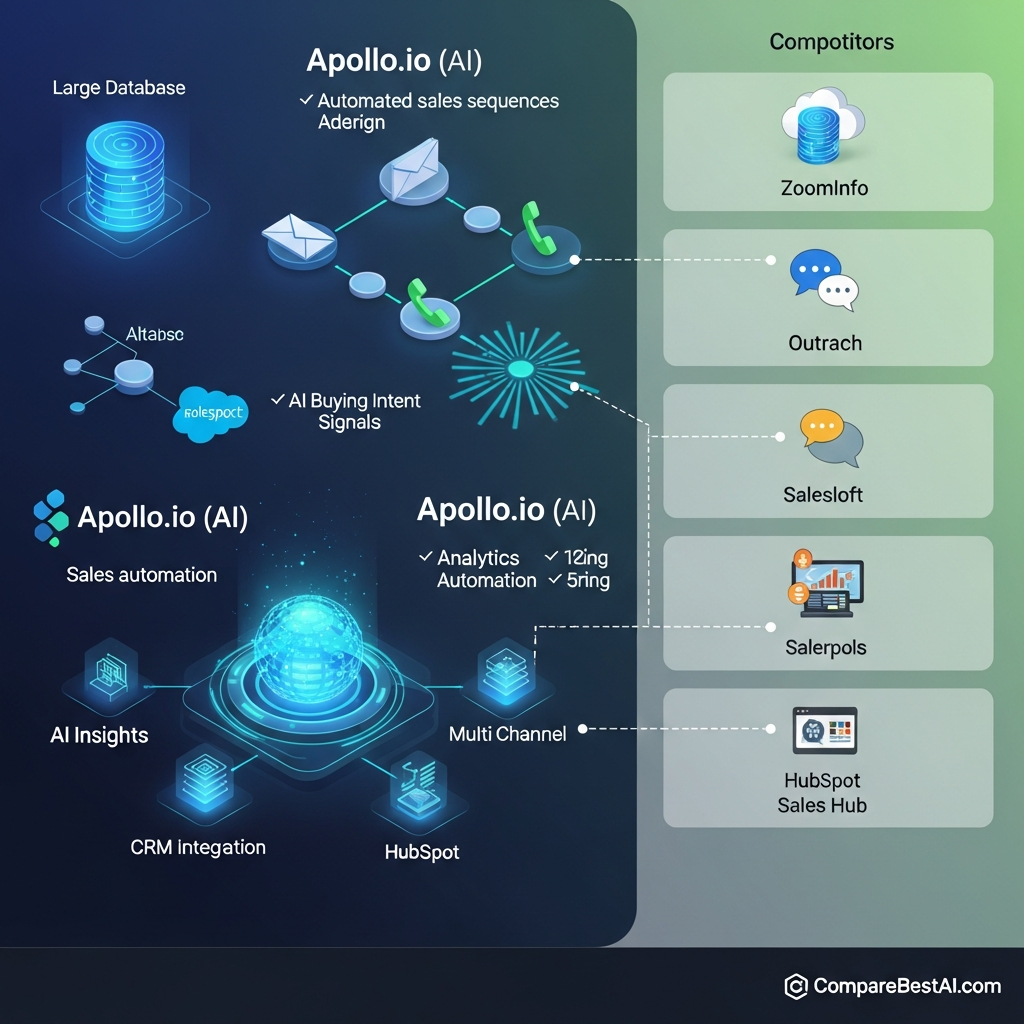
If you are comparing platforms primarily on data coverage, pricing, and sales intelligence, see our detailed ZoomInfo vs Apollo comparison.
AI Research and Lead Qualification
Apollo AI can perform research against prospects and accounts to help sales teams decide who deserves attention.
Apollo's AI sales automation product highlights custom AI research prompts that can surface prospect pain points, identify contacts likely to engage, and generate structured data that can be used for filtering and personalization.
The AI Assistant extends this further by allowing users to describe the type of prospect they need in natural language.
This matters because traditional prospecting systems require users to understand and combine dozens of filters.
A conversational interface potentially makes sophisticated targeting accessible to less technical sales reps.
Apollo also provides AI-powered lead scoring. The company says its models can use historical account activity and successful outcomes to identify high-potential prospects.
For managers, this can help prioritize sales effort rather than expecting representatives to evaluate every lead manually.
AI Email Personalization
Apollo also applies AI to sales messaging.
Its current AI functionality includes generating full emails, producing individual sections such as opening lines, incorporating company news and account insights, and adapting messaging to a brand's preferred tone.
This makes the feature most useful when paired with Apollo's data.
AI-generated text alone is increasingly commoditized. The more meaningful advantage is the ability to combine messaging generation with account data, prospect data, and research inside the same workflow.
Apollo's own documentation also references a recent Anthropic case study in which sales teams reportedly achieved a 35% increase in meetings booked when using Apollo AI-powered messaging. Again, this should be interpreted as cited case-study performance rather than an expectation for every account.
Sales Engagement and Automation
Apollo goes considerably beyond database access.
The platform can support automated engagement across email and phone, follow-ups triggered by prospect behavior, prioritized task lists, workflow automation, and multichannel sales campaigns.
This makes Apollo more relevant to teams looking to consolidate their outbound stack.
Instead of:
database → CSV export → enrichment tool → email tool → dialer → CRM → AI writer,
Apollo attempts to place much of that workflow in one environment.
That consolidation is also why Apollo should be evaluated against broader sales platforms rather than only against email finders.
Browse our Sales & CRM AI tools category if you want to compare this type of platform across a wider tool set.
Apollo.io Pricing in 2026
Apollo currently offers four primary plans: Free, Basic, Professional, and Organization.
The official pricing shown when checked in September 2026 is:
| Plan | Price when billed annually | Included annual credits |
|---|---|---|
| Free | $0 | 900 per seat, granted monthly |
| Basic | $49/user/month | 30,000 per seat, granted upfront |
| Professional | $79/user/month | 48,000 per seat, granted upfront |
| Organization | $119/user/month | 72,000 per seat, granted upfront |
The Organization plan currently requires a minimum of 3 seats.
These prices are specifically the rates displayed for annual billing. Teams considering monthly billing or add-ons should verify the live Apollo pricing page before purchasing because plan terms can change.
Is Apollo.io Free?
Yes.
Apollo maintains a $0 Free plan, making it possible to test the platform before upgrading.
Apollo also provides 14-day trials for select paid plans. Apollo's documentation says these trials allow users to test premium functionality, including sequences, automation tools, and eligible dialer features.
Apollo's current credit documentation says paid-plan trials receive 100 free trial credits. Unused trial credits expire when the trial ends.
For U.S. startups, founders, and small outbound teams, the Free plan is useful for determining whether Apollo's data quality and workflow match their ICP before committing to a paid seat.

How Apollo Credits Work
Apollo's pricing requires more attention than simply comparing monthly subscription prices.
Apollo uses credits as an internal currency for certain actions.
Activities that can consume credits include retrieving verified contact information, enrichment, AI research, some API activities, email warmup beyond included allowances, dialer usage, and other data-related actions.
Apollo states that credits renew according to the billing cycle and that unused credits generally do not roll over after the billing cycle ends.
This is one of the biggest issues buyers should evaluate before upgrading.
A $49 subscription is not automatically “cheap” if your team's workflow consumes significantly more credits than the included allowance.
Before purchasing, estimate how many contacts your team enriches, how frequently sales reps request phone numbers, how much AI research you plan to run, and whether API usage will consume additional credits.
Apollo API
Apollo provides an API for teams that want to integrate sales data and workflows into their own systems.
Apollo's current documentation says the API can be used to find and enrich people and companies, manage records, interact with sequences, build integrations, and automate activities in an Apollo workspace.
API access is currently available across Apollo plans, although rate limits differ by plan and endpoint. Certain endpoints also consume credits.
Apollo's developer documentation explains that enrichment, company search, news search, and AI-insight endpoints may consume credits when qualifying data is returned, while many record-management actions consume zero credits.
This makes Apollo relevant not only to SDR teams but also to revenue operations and developers building custom GTM workflows.
Apollo and ChatGPT
Apollo expanded its AI ecosystem further in April 2026 by launching an Apollo app in ChatGPT.
Apollo announced the beta on April 29, 2026, describing it as a way for GTM teams to research, enrich, act on, and analyze sales information through a ChatGPT conversation using Apollo's Model Context Protocol infrastructure.
For AI-first revenue teams, this is an important development.
It means Apollo's data and workflow layer can increasingly operate inside conversational AI environments rather than requiring every workflow to start inside the Apollo dashboard.
Apollo.io Pros and Cons
| Pros | Cons |
|---|---|
| Large B2B contact and company dataset | Credit model requires careful monitoring |
| Free plan available | Costs rise as seats and usage increase |
| Prospecting and sales engagement in one platform | More complex than a dedicated email-finder tool |
| Embedded AI research and personalization | Some advanced use cases require paid tiers or credits |
| AI Assistant supports natural-language workflows | AI output still requires human review |
| Built-in workflow automation | Database accuracy should still be verified before important outreach |
| API available | Heavy API/enrichment usage can increase credit consumption |
| Phone, email and multichannel capabilities | Some teams may not need the full platform |
| AI-assisted scoring and qualification | Learning curve is higher than simpler prospecting tools |
Who Is Apollo.io Best For?
Apollo is strongest for organizations that need both sales intelligence and execution.
Good-fit users include SDR teams running structured outbound campaigns, B2B founders prospecting decision-makers, sales agencies managing multiple campaigns, revenue operations teams building automated workflows, account executives researching prospects, and growth teams combining enrichment with outreach.
For teams evaluating several platforms rather than one named product, our best AI sales and CRM tools guide provides a broader comparison.
Who Should Consider an Apollo Alternative?
Apollo may be more platform than you need if your workflow is narrow.
If you mainly want to compare contact databases, prospecting systems, or email-focused tools, useful CompareBestAI alternatives to research include RocketReach AI, Snov.io AI, and Hunter Campaigns AI.
The correct alternative depends on whether your priority is contact data, email verification, outbound sequencing, CRM functionality, automation, API access, or full sales engagement.
Apollo.io Security and AI Data Considerations
Businesses evaluating any AI-enabled sales platform should review both standard security controls and how AI features process customer information.
Apollo's website currently displays compliance and security references including GDPR, SOC 2, CCPA, ISO/IEC 27001, CASA Tier 2, CPRA, and the EU-US Data Privacy Framework.
Apollo's AI policy also distinguishes between its internally developed AI models, third-party providers, and external AI integrations. According to Apollo, internally processed customer data remains subject to its standard data-protection commitments, while certain product features may use third-party AI providers.
Enterprise teams should still review Apollo's current privacy policy, subprocessors, data retention practices, and contract terms before sending sensitive customer information through AI-enabled workflows.
Is Apollo.io Easy to Use?
Apollo's strength is breadth, but breadth also creates complexity.
A user who only needs an email lookup tool may find Apollo unnecessarily extensive.
A sales organization, however, can potentially benefit from having prospecting, enrichment, sequences, calling, AI assistance, research, scoring, automation, and reporting within one platform.
Apollo has also been investing in making this complexity easier to manage through natural-language AI.
Its AI Assistant reduces dependence on manual filters by allowing users to describe desired prospects or workflows conversationally.
That should make Apollo more accessible to less technical sales users than earlier generations of sales intelligence software.
Is Apollo.io Worth It in 2026?
Apollo.io is worth considering if you regularly perform B2B prospecting and want to consolidate multiple stages of the outbound workflow.
The Free plan makes initial evaluation low-risk.
The strongest case for upgrading appears when your team needs several Apollo capabilities simultaneously: database access, enrichment, AI research, sequencing, automation, calling, scoring, and sales intelligence.
The value proposition becomes weaker when you only need one narrow feature.
A company that needs 100 email lookups per month should not evaluate Apollo in the same way as a 20-person SDR operation running thousands of prospecting and outreach actions.
The credit system therefore deserves almost as much attention as the headline subscription price.
Our Apollo.io AI Review Verdict
Apollo.io is one of the more complete AI-enabled B2B sales platforms available in 2026.
Its biggest advantage is not any individual AI feature. It is the combination of a large prospect database, enrichment, outreach, workflow automation, sales intelligence, and embedded AI inside one operating environment.
Apollo is best suited to teams that want to move from prospect discovery to engagement without constantly passing data between separate tools.
Its weaknesses are equally clear: credit economics require monitoring, the product can be overkill for simple workflows, and the increasing number of functions creates a steeper learning curve than lightweight sales tools.
For most B2B teams evaluating Apollo seriously, the sensible path is to start with the Free plan or eligible trial, test data quality against your actual target market, measure credit consumption, and only then choose a paid tier.
Verdict: Apollo is a strong choice for B2B outbound sales, prospecting, revenue operations, and AI-assisted GTM workflows—but teams should evaluate credit usage as carefully as the subscription price.
Frequently Asked Questions About Apollo.io
What is Apollo.io used for?
Apollo.io is used for B2B prospecting, contact and company research, data enrichment, outbound sales engagement, workflow automation, calling, AI-assisted research, lead scoring, and sales intelligence.
Is Apollo.io an AI tool?
Yes, but Apollo AI is not a separate standalone product. AI and machine-learning capabilities are embedded across prospecting, research, personalization, workflow creation, lead scoring, sales insights, and other Apollo functions.
How much does Apollo.io cost in 2026?
Apollo currently offers a Free plan at $0. When billed annually, Basic is $49 per user/month, Professional is $79, and Organization is $119 with a three-seat minimum. Pricing and plan limits can change.
Does Apollo.io have a free plan?
Yes. Apollo offers a $0 Free plan. It also provides 14-day trials for select paid plans so users can test premium functionality before upgrading.
How large is Apollo's database?
Apollo currently advertises more than 240 million contacts and 30 million companies in its business-data network.
Is Apollo.io better than ZoomInfo?
Neither platform is automatically better for every team. The right choice depends on database requirements, pricing, workflow automation, outreach needs, integrations, and sales-team size. See our ZoomInfo vs Apollo comparison for the dedicated comparison.