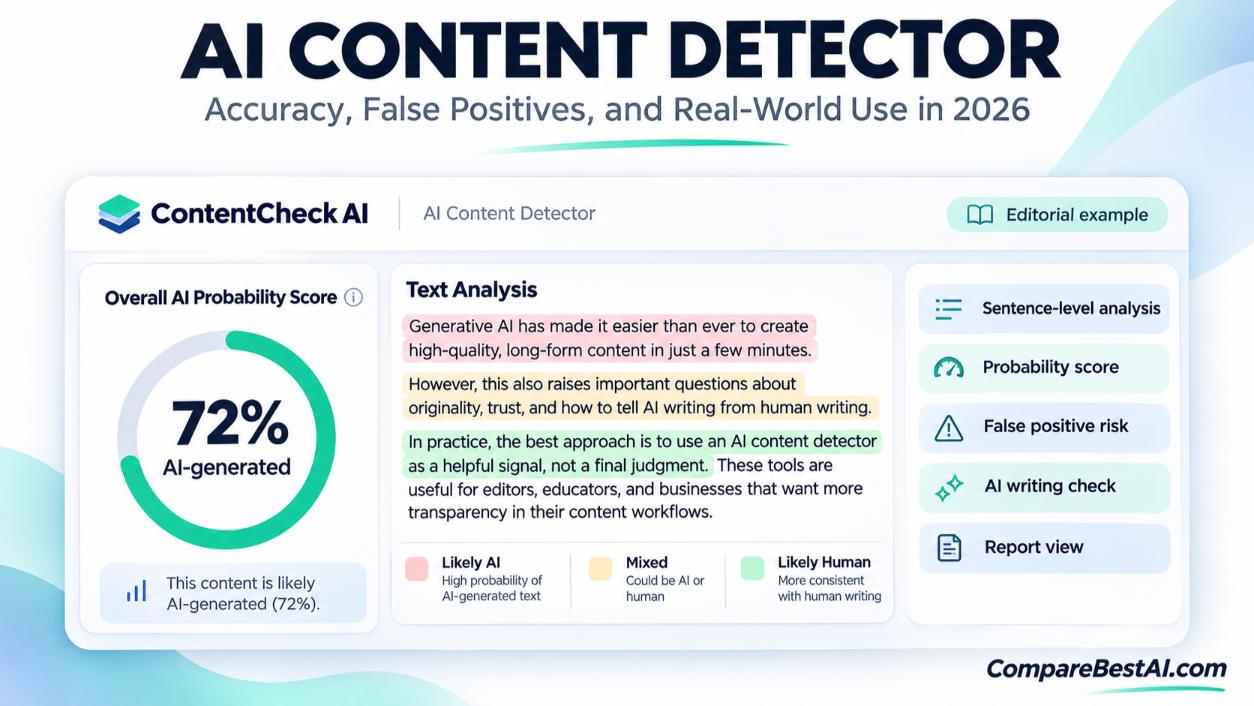

No AI content detector is accurate enough to prove that someone used AI. For publishers and SEO teams, Originality.ai is the most common paid choice. For teachers, GPTZero offers education features and a free tier, and many schools already have Turnitin. For quick free checks, ZeroGPT, Writer's AI detector, and Surfer's free detector work without a paid plan. Whichever you use, treat the score as a clue, never as proof, because every detector produces false positives.
This guide explains how AI detectors work, what published research says about their accuracy, how the main tools compare on price and limits, and what job seekers, teachers, and website owners should do with the results.
What Is an AI Content Detector?
An AI content detector is a tool that estimates the likelihood that text was written by an AI model such as ChatGPT, Claude, or Gemini. Most detectors measure how predictable the wording is. AI models tend to choose the most likely next word, so very predictable text gets a higher AI score.
That's also why detectors make mistakes. Clear, simple, formulaic human writing, such as a resume, a lab report, or an essay by a non-native English speaker, can look "predictable" too. Writer's own help page warns that its detector "won't be 100% accurate" and that human writing can be flagged if it resembles AI phrasing.
How Accurate Are AI Content Detectors?
AI content detectors are not reliable enough to use as the only evidence. Three well-documented findings show why:
- OpenAI shut down its own detector. OpenAI reported that its AI text classifier correctly identified only 26% of AI-written text and wrongly flagged human text 9% of the time. It discontinued the classifier in July 2023 due to its low rate of accuracy.
- Detectors are biased against non-native English writers. A Stanford study found that seven popular detectors labeled essays by non-native English speakers as AI-generated 61% of the time, as reported by The Markup.
- Low scores are the least reliable. Turnitin adds an asterisk to AI scores below 20% because false positives are more common at that level.
Detectors have improved since 2023, and vendors publish high accuracy figures. But those figures come from the vendors' own test sets. Independent results vary widely depending on text length, topic, writing style, and whether the AI text was edited.
What Is a False Positive in AI Detection?
A false positive happens when a detector labels human-written text as AI-generated. False positives are the biggest risk for students and job seekers, because the person flagged usually has no way to prove a negative.
What Does an AI Detection Percentage Mean?
Most tools show a probability, not a measure of how much text is AI-written. A 40% score usually means the tool is 40% confident the text is AI-generated. It does not mean 40% of the words came from AI. Scores in the middle range are essentially "unsure."
Best AI Content Detectors Compared (2026)
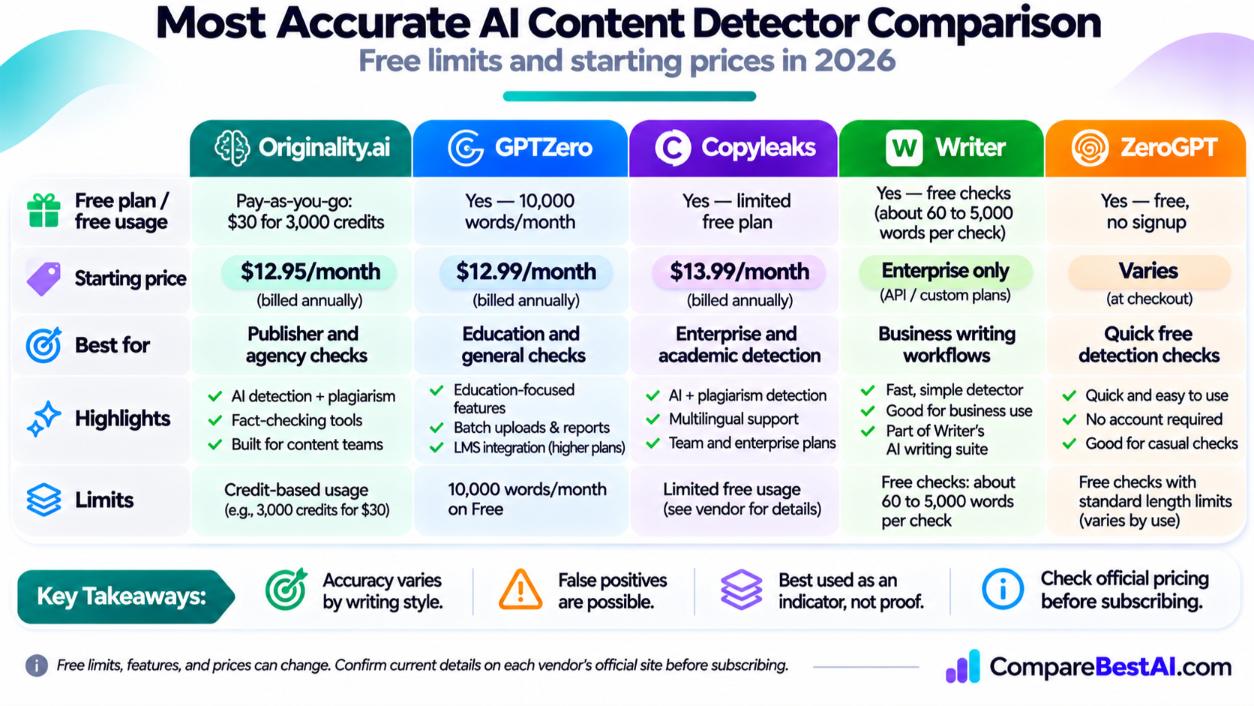
Tool | Best for | Free option | Paid plans from |
|---|---|---|---|
Publishers, SEO teams, content agencies | Pay-as-you-go: $30 for 3,000 credits | $12.95/month annual ($14.95 monthly) | |
GPTZero | Teachers and schools | 10,000 words/month | $12.99/month annual (Premium) |
Copyleaks | Businesses needing AI plus plagiarism checks | Limited | $13.99/month annual ($16.99 monthly) |
Educators and publishers wanting reports | 14-day trial (2,000 credits) | $10/month annual ($18 monthly) | |
Quick free checks | Free, no signup | Varies at checkout | |
Writer AI Content Detector | Free paragraph checks | Free, 60 to 5,000 words per check | API on Enterprise only |
Surfer AI Detector | SEO writers already using Surfer | Free online version | Included in Surfer's paid app |
Turnitin | Schools and universities | Not available to individuals | Institution licenses only |
Prices from vendor pages as reported by independent pricing trackers between June and November 2026. Confirm on each vendor's site before buying.
Originality.ai Detector Review
Originality.ai is built for publishers and content teams. It combines AI detection, plagiarism checking, and fact-checking tools, and it uses credits, so you pay for what you scan. It's a common choice for agencies checking freelance content.
GPTZero vs ZeroGPT
GPTZero is a dedicated detection company with education features such as batch file uploads, downloadable reports, LMS integration on higher plans, and a Chrome extension. ZeroGPT is a separate, simpler free tool for quick checks. Despite the similar names, they aren't related. For school or professional use, GPTZero offers more transparency and reporting.
Copyleaks vs GPTZero and Originality.ai
Copyleaks suits businesses and schools that want AI detection and plagiarism detection in one platform, with multilingual support. Originality.ai is more focused on web publishing workflows. GPTZero is more focused on education.
Will AI Detectors Reject Your Job Application?
Probably not by themselves. There's no evidence that most employers run resumes through AI detectors. Hiring managers are far more likely to judge whether your application sounds generic.
A TopResume survey of 600 U.S. hiring managers in May 2025 found:
- 52% accept AI for proofreading or drafting, as long as the final application sounds human.
- 19.6% said they would reject a candidate with an AI-generated resume or cover letter.
- Only 33.5% correctly spotted the AI-written resume in a test, which shows human "eye tests" are unreliable too.
How to Write an Application That Reads as Genuinely Yours
The goal isn't to trick a detector. It's to make sure your application reflects you.
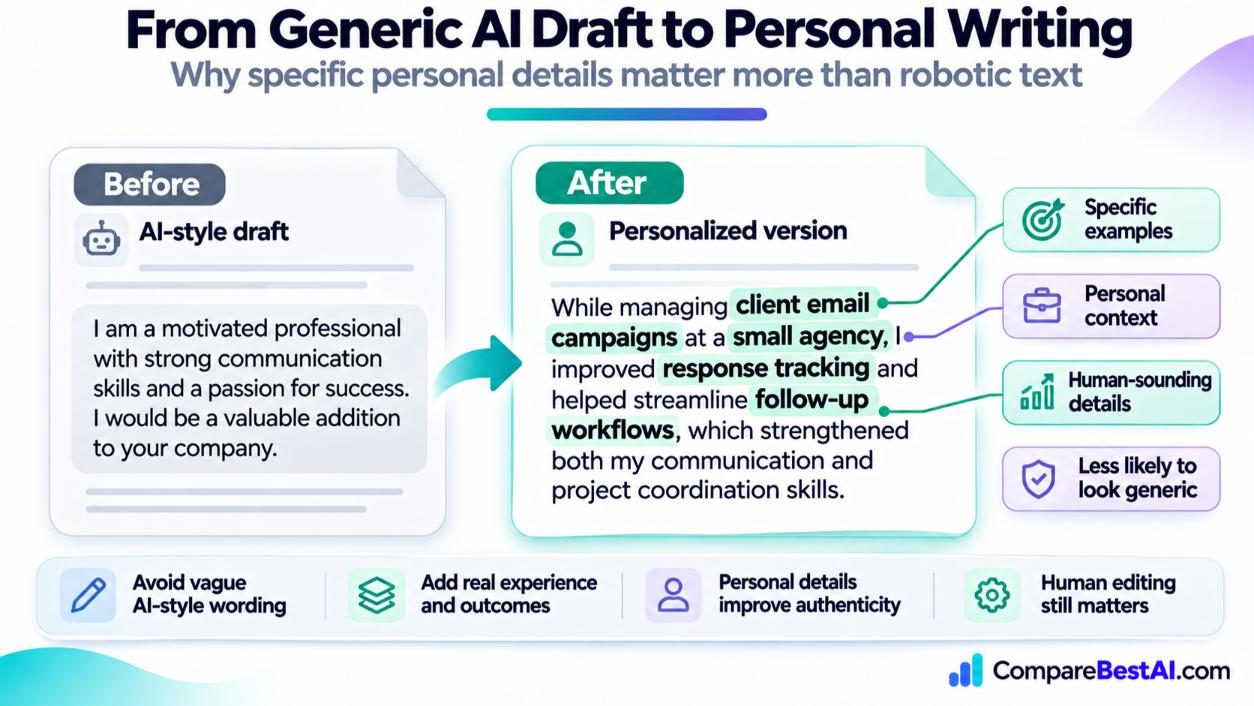
- Start with your own notes: your real jobs, results, numbers, and stories.
- Use AI to organize or polish, not invent: never let it add skills or experience you don't have.
- Add specifics only you know: project names, team sizes, outcomes, and why you want this job.
- Read it out loud: cut phrases you would never say, such as "dynamic, results-driven professional."
- Tailor every application: a cover letter written for one company rarely sounds generic.
Should You Run Your Resume Through an AI Detector?
You can, but don't panic over the score. Resumes are short and formulaic, so they often get mixed results. If your application is accurate and specific, a detector score matters far less than the content.
What Is the Best AI Detector for Teachers?
GPTZero is a popular choice for teachers, thanks to its free tier, classroom features, and LMS integration. If your school already licenses Turnitin, use that first. Copyleaks is another option for schools that also need plagiarism checks.
Use detectors responsibly in the classroom:
- Treat a high score as a reason to talk with the student, not as proof.
- Review the student's draft history, such as Google Docs version history.
- Ask the student to explain or extend their work in person.
- Be extra careful with English language learners, who face higher false positive rates.
- Set a clear AI policy at the start of the course.
For more on classroom AI use, see our guide to AI writing tools for students.
Do You Need an AI Content Detector for Your Website?
For SEO, the question isn't whether text was AI-assisted but whether it's helpful, accurate, and original. Google rewards helpful content however it's produced. Use a detector as one quality-control step, alongside fact-checking, plagiarism checks, and an editor's review. See our guide to AI and human writing for SEO in 2026 for a full workflow.
A simple publishing checklist:
- Check facts, numbers, and sources.
- Run a plagiarism check with a tool such as PlagiarismCheck.
- Add first-hand experience and original examples.
- Use an AI detector to spot overly generic sections, then rewrite them.
AI Content Detectors: Pros and Cons
Pros
- Fast first check for large volumes of content
- Highlights generic, predictable passages worth rewriting
- Many offer free tiers or trials
Cons
- False positives, especially for non-native English writers
- Easily confused by short or edited text
- Vendor accuracy claims are rarely independently verified
- A score can't prove who wrote something
Key Takeaways
- No AI content detector is accurate enough to be used as proof.
- OpenAI shut down its own detector in 2023 because of low accuracy.
- Detectors flag non-native English writing more often.
- Originality.ai suits publishers, GPTZero suits teachers, and ZeroGPT, Writer, and Surfer offer free checks.
- Job seekers should focus on accurate, specific applications rather than detector scores.
Frequently Asked Questions
What is the most accurate AI content detector?
No detector is reliably accurate in every situation. Originality.ai and GPTZero are among the most widely used, but accuracy varies by text length, topic, and editing.
Do AI detectors actually work?
They work as rough indicators, especially on long, unedited AI text. They're unreliable on short, edited, or formulaic writing and produce false positives.
Is a 40% AI detection score bad?
Not necessarily. A 40% score usually means the tool is uncertain. It doesn't mean 40% of your text was written by AI.
Do recruiters use AI detection software?
There's no evidence that most recruiters do. Hiring managers more often judge whether an application sounds generic or inaccurate.
Is there a free AI content detector with no word limit?
Not truly unlimited. GPTZero's free plan covers 10,000 words a month, Writer checks up to 5,000 words at a time, and ZeroGPT offers free checks without signup.
Is GPTZero better than ZeroGPT?
GPTZero offers more features for schools and professionals, including reports and integrations. ZeroGPT is simpler and works well for quick free checks.
Final Verdict: Which AI Content Detector Should You Use?
Pick the AI content detector that fits your role: Originality.ai for publishing teams, GPTZero or your school's Turnitin license for teachers, and a free tool like ZeroGPT or Writer for occasional checks. Whatever you choose, remember that detectors estimate probability. They can't prove authorship, and a human review should always have the final word.
At CompareBestAI, we review and compare AI tools side by side so you can choose with confidence. Read more about the future of AI content detection, discover detailed which AI writing tool produces the least AI-sounding output, or use the CompareBestAI comparison tool to put Originality.ai, Winston AI, and ZeroGPT side by side.