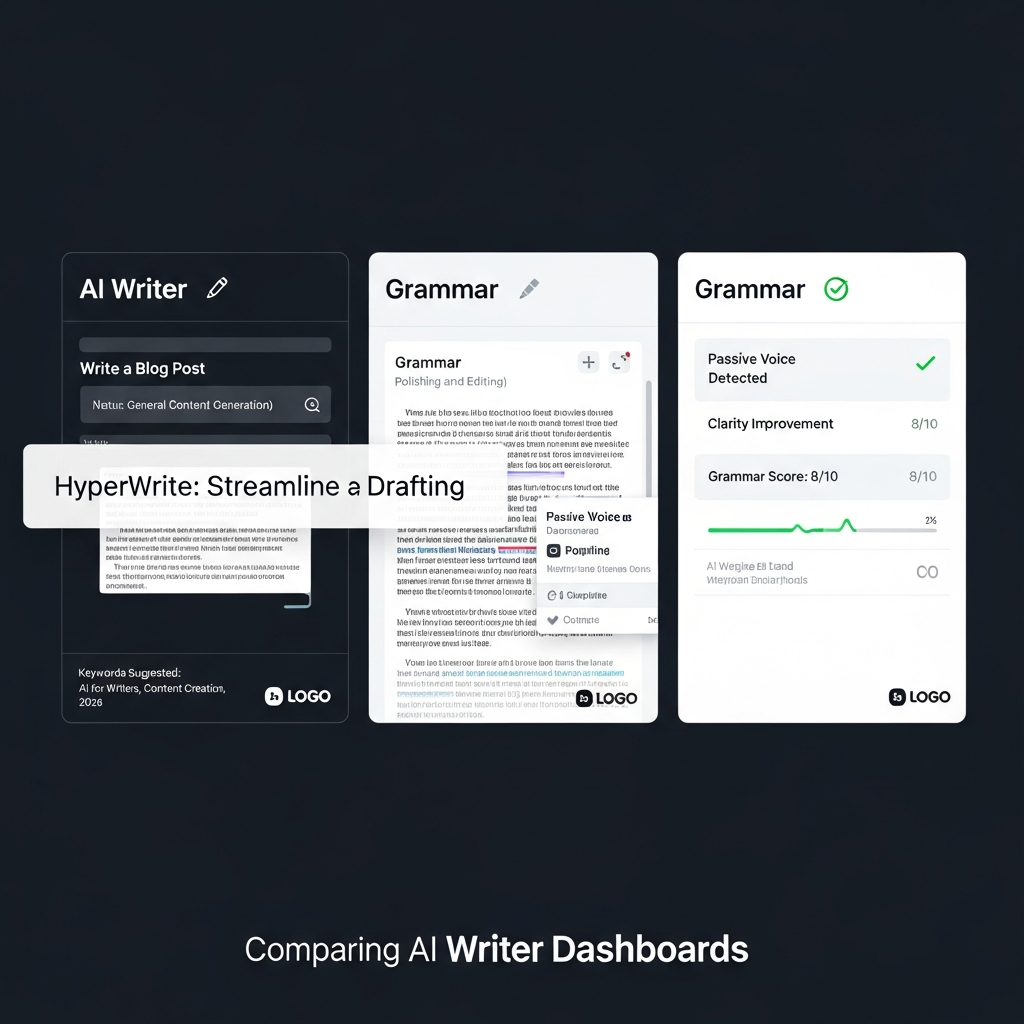

Answer First: The best AI tools for writers in 2026 are ChatGPT, Claude, Grammarly, Jasper, Sudowrite, and Rytr. ChatGPT is the strongest all-around choice for drafting, research, brainstorming, and revision; Claude is excellent for long-form writing and document-heavy projects; Grammarly is best for editing; Jasper is designed for marketing teams; Sudowrite specializes in fiction; and Rytr offers one of the most affordable ways to generate short-form content.
There is no single AI writing tool that is best for every writer.
A novelist needs different features from an SEO writer. A marketing team may care about brand voice and workflow governance, while a freelance writer may simply want an affordable way to brainstorm, draft, and polish content.
The better question is:
Which AI writing tool removes the biggest bottleneck in your workflow?
This guide compares six current free and paid options by writing use case, features, pricing, limitations, and overall fit.
For a broader directory, explore Content & Design AI tools.
Best AI for Writers: Quick Comparison
| Tool | Best for | Free option | Paid entry | Main strength |
|---|---|---|---|---|
| ChatGPT | Best overall | Yes | $20/mo Plus | Drafting + research + editing |
| Claude | Long-form writing | Yes | $20/mo Pro | Projects, documents, voice consistency |
| Grammarly | Editing | Yes | $12/mo annual | Grammar, clarity, tone, rewrites |
| Jasper | Marketing teams | Trial | $59/mo annual | Brand Voice + marketing workflows |
| Sudowrite | Fiction | Trial | $10/mo annual | Story development and creative writing |
| Rytr | Budget writing | Yes | $7.50/mo annual | Affordable short-form generation |
Current vendor pricing varies by region and can change, so verify the checkout page before subscribing.
1. ChatGPT — Best AI for Writers Overall
ChatGPT is the strongest starting point for writers who want one tool to cover multiple stages of the writing process.
Writers can use it for:
- brainstorming;
- outlining;
- first drafts;
- rewriting;
- summarization;
- research;
- document analysis;
- headline generation;
- tone changes;
- feedback;
- fact-finding with web search.
ChatGPT Projects are available across plans and can keep chats, uploaded documents, and project-specific instructions together. Projects also support tools such as Canvas and web search, while paid plans may include broader access to Deep Research and other advanced capabilities.
Why ChatGPT works well for writers
Its biggest advantage is flexibility.
A writer can upload source material, develop an outline, draft the article, revise individual sections, research recent facts, and request editorial feedback without changing software.
Canvas is particularly useful for longer writing because it provides an editing-oriented workspace rather than forcing every revision through a normal chat response.
ChatGPT pricing
ChatGPT has a free tier.
ChatGPT Plus currently costs $20/month and provides higher model limits and broader access to tools such as file analysis, image generation, voice, and Deep Research where available.
For dedicated CompareBestAI coverage, see ChatGPT AI assistant.
Best for
- bloggers;
- freelance writers;
- content strategists;
- business writers;
- students;
- researchers;
- general-purpose writing.
Main limitation
ChatGPT is intentionally broad.
A fiction author may prefer a writing environment built specifically around stories, while a marketing organization needing centrally controlled brand voice may find Jasper more purpose-built.
Best overall pick: ChatGPT.
2. Claude — Best for Long-Form Writing and Document Work
Claude is particularly useful when a writing project depends on lots of context.
Its Projects feature lets users create dedicated workspaces with project-specific chats, knowledge, files, and instructions.
Projects are available even on the free plan, with free accounts currently able to create up to five projects. Paid plans also support enhanced project knowledge using retrieval.
Why Claude works well for writers
You can create a project for:
- a book;
- a client;
- a content campaign;
- a research report;
- a technical document;
- a long-running editorial assignment.
Then upload relevant background material and define instructions for tone or style.
That makes Claude useful for writers who repeatedly need the assistant to understand the same source material rather than starting from scratch.
Claude also supports live web search on supported models and returns citations when search is used, which can improve research-heavy writing workflows.
Claude pricing
Claude currently offers:
Free: $0
Pro: $20/month or $200/year
Max 5x: $100/month
Max 20x: $200/month.
Most individual writers should start with Free or Pro rather than Max.
See Claude AI assistant for CompareBestAI's tool profile.
Best for
- long-form writers;
- researchers;
- book projects;
- analysts;
- technical writers;
- writers working with large reference libraries.
Main limitation
Claude still has usage limits, including session and weekly limits on paid plans. Anthropic also allows paid subscribers to purchase usage credits after included capacity is exhausted.
Best for long-form work: Claude.
3. Grammarly — Best AI Editing Tool
ChatGPT and Claude can create drafts.
Grammarly is better thought of as the tool that stays with you during the editing and revision stage.
Its current writing environment extends well beyond grammar checking.
Grammarly now provides specialized AI agents for tasks including:
- proofreading;
- paraphrasing;
- citation finding;
- reader-reaction analysis;
- argument feedback;
- tone adjustment;
- AI detection;
- plagiarism checking;
- rewriting.
Why Grammarly stands out
Grammarly works across a very large number of websites and applications rather than requiring writers to keep everything inside one chatbot.
Its current product also includes an AI writing surface called Docs, where writers can brainstorm, compose, edit, and work with specialized agents within the document itself.
Grammarly pricing
The current Free plan costs $0 and includes grammar support, tone detection, and 100 AI prompts.
Grammarly Pro costs $12/member/month when billed annually or $30/month when billed monthly and currently includes 2,000 AI prompts plus more advanced rewriting and tone features.
Read the Grammarly writing assistant profile or compare Grammarly alternatives.
Best for
- editing;
- grammar;
- clarity;
- professional communication;
- academic revision;
- tone consistency.
Main limitation
Grammarly is strongest when improving existing writing.
If you want deep ideation, research, narrative generation, or long-form drafting from scratch, ChatGPT or Claude will usually offer more flexibility.
Best editing pick: Grammarly.
4. Jasper — Best AI Writing Platform for Marketing Teams
Jasper has evolved into a marketing-focused AI platform rather than a generic article generator.
Its Pro plan currently includes:
- Canvas;
- AI agents for marketing workflows;
- two Brand Voices;
- five Knowledge assets;
- three Audiences.
Business adds deeper customization, complex agents, GEO workflows, translations, deep research, governance, and API access.
Why Jasper is useful for marketers
The strongest argument for Jasper is not raw text generation.
It is brand consistency.
Marketing departments often need dozens of writers, contractors, and campaign owners to produce copy that sounds like one brand.
Jasper's Brand Voice, Knowledge, and Audience features are designed around that problem.
Jasper pricing
Current pricing is:
Pro monthly: $69/month/seat
Pro annual: $59/month/seat
Business: custom pricing.
A 7-day Pro trial is available.
For a deeper analysis, see the Jasper AI review.
Best for
- marketing departments;
- agencies;
- campaign teams;
- copywriters managing multiple brands;
- teams that need governed brand voice.
Main limitation
At $59–$69 per month for Pro, Jasper costs considerably more than a general-purpose $20 chatbot subscription.
The additional cost makes more sense when brand governance and marketing workflows are genuinely valuable to your organization.
Best for marketing teams: Jasper.
5. Sudowrite — Best AI for Fiction and Creative Writing
General AI assistants can help with fiction, but Sudowrite is designed specifically around creative-writing workflows.
Its current product positions tools around stages such as:
- brainstorming;
- expanding ideas;
- drafting;
- overcoming writer's block;
- getting feedback;
- developing longer works such as novels and screenplays.
Why Sudowrite is different
A novelist's problem is rarely “write me a generic paragraph.”
Writers need help maintaining:
- character continuity;
- plot direction;
- scene development;
- pacing;
- descriptions;
- dialogue;
- narrative possibilities.
Sudowrite is designed specifically for that workflow rather than treating fiction as another copywriting template.
Sudowrite pricing
Sudowrite currently offers three plans:
Hobby & Student: $10/month annually or $19 monthly
Professional: $22/month annually or $29 monthly
Max: $44/month annually or $59 monthly.
All plans receive the same core feature access; the primary differences are credit allowances and rollover behavior. A free trial is available without requiring a credit card.
Best for
- novelists;
- fiction writers;
- screenwriters;
- story development;
- writers struggling with creative blocks.
Main limitation
Sudowrite is intentionally specialized.
A B2B content marketer, SEO writer, or corporate communications team may get more value from ChatGPT, Claude, Jasper, or Grammarly.
Best creative-writing pick: Sudowrite.

6. Rytr — Best Budget AI Writer
Rytr remains one of the lowest-cost dedicated writing tools in this comparison.
Its free plan currently provides 10,000 characters per month.
The annual pricing page shows:
Free: $0
Unlimited: $7.50/month
Premium: $24.16/month.
Rytr features
Depending on plan, current functionality includes:
- unlimited AI generation on paid tiers;
- tone matching;
- plagiarism checks;
- multiple predefined tones;
- browser extension;
- custom use cases;
- multilingual generation on Premium.
Why Rytr makes sense
Not everyone needs a $59 marketing platform or a high-powered research assistant.
Rytr is most attractive when you need to produce relatively straightforward material such as:
- social captions;
- short emails;
- product descriptions;
- short ad copy;
- basic outlines;
- quick content variations.
See the Rytr AI writing tool.
Main limitation
Rytr's simplicity is also its limitation.
For complex research, large projects, nuanced long-form writing, or advanced team workflows, the larger platforms offer more depth.
Best budget pick: Rytr.
Best AI Writing Tool by Use Case
| Writing task | Best pick |
|---|---|
| Best overall | ChatGPT |
| Long-form content | Claude |
| Grammar and editing | Grammarly |
| Marketing campaigns | Jasper |
| Fiction and novels | Sudowrite |
| Budget short-form writing | Rytr |
| Research-heavy writing | ChatGPT / Claude |
| Brand-controlled marketing | Jasper |
| Final proofreading | Grammarly |
| Writer's block | Sudowrite / ChatGPT |
These recommendations describe workflow fit, not an absolute ranking.
A specialist tool can outperform the “best overall” platform when its specialization matches your exact job.
Free vs Paid AI Writing Tools: Do You Need to Pay?
For casual writing, probably not immediately.
ChatGPT, Claude, Grammarly, and Rytr all offer meaningful free access.
Start with free tools if you mainly need:
- brainstorming;
- occasional drafts;
- grammar checks;
- headline ideas;
- short rewrites;
- light research.
Upgrade when a specific limitation starts interrupting your work.
Common reasons to pay include:
- higher usage limits;
- longer or more complex projects;
- advanced research;
- brand-voice controls;
- team collaboration;
- larger credit allowances;
- advanced rewriting;
- specialized fiction workflows.
The best subscription is not necessarily the tool with the most features.
It is the cheapest tool that consistently removes an expensive bottleneck.
For a broader buying framework, read Free vs paid AI tools.

HyperWrite appears in the previous version of this article and remains relevant as a writing assistant.
CompareBestAI has a dedicated HyperWrite AI profile.
I would keep it as an honorable mention rather than one of the six primary picks unless the article is expanded to compare its current pricing, free-plan limitations, personalization features, and workflow against ChatGPT and Claude.
That produces a cleaner buyer's guide than naming it as a leader without enough supporting detail.
Can AI-Written Content Rank on Google?
AI assistance itself is not the determining factor.
Google's current guidance says creators should focus on accuracy, quality, relevance, originality, and useful people-first content. Using generative AI to research or structure content can be useful; mass-producing low-value pages simply to manipulate rankings can violate Google's scaled content abuse policies.
Google's 2026 guidance for generative AI search also emphasizes creating valuable, unique, non-commodity content rather than simply recycling information that could easily be produced by a generic model.
For writers, that means AI should assist with:
- research;
- structure;
- brainstorming;
- editing;
- alternative wording;
- data organization.
Human editorial work should still handle:
- firsthand experience;
- judgment;
- original analysis;
- sourcing;
- factual verification;
- examples;
- perspective;
- final voice.
How to Use AI Without Losing Your Writing Voice
A useful AI workflow has three stages.
1. Give the AI real context
Provide:
- audience;
- purpose;
- examples of your writing;
- source material;
- desired tone;
- formatting requirements.
Generic prompts produce generic writing.
2. Treat the first output as raw material
Do not automatically publish the first answer.
Check:
- facts;
- citations;
- structure;
- transitions;
- repetition;
- unsupported claims;
- tone.
3. Add what the model cannot know
The most valuable parts of a piece often come from your:
- experience;
- opinion;
- customer conversations;
- experiments;
- original data;
- personal examples.
That is also what makes content more defensible and less interchangeable with thousands of AI-generated summaries.
How We Chose the Best AI Tools for Writers
This comparison prioritizes six factors:
Writing workflow fit — what type of writer benefits most?
Drafting capability — can the tool develop ideas and produce usable first drafts?
Editing capability — can it improve existing writing rather than merely regenerate it?
Research and context — can it work with source material and maintain project context?
Price and free access — is there a meaningful free tier or trial?
Specialization — does the tool solve a specific writing problem better than a general chatbot?
Pricing and feature information in this guide was checked against current first-party vendor documentation in September 2026.
For another CompareBestAI overview, see our AI writing assistants guide.
Frequently Asked Questions
What is the best AI for writers in 2026?
ChatGPT is the strongest overall choice for most writers because it can assist with brainstorming, research, drafting, rewriting, document analysis, and editing. Claude is particularly strong for long-form and document-heavy projects.
What is the best free AI writing tool?
ChatGPT and Claude both offer useful free plans. Grammarly Free is the better choice when your primary need is grammar, clarity, tone feedback, and editing rather than long-form generation.
Which AI is best for long-form writing?
Claude is one of the strongest options for long-form projects because its Projects system can maintain project-specific files, instructions, context, and knowledge across related conversations.
What is the best AI for fiction writers?
Sudowrite is the most specialized choice in this list for fiction, novels, screenplays, scene development, brainstorming, and overcoming writer's block.
Is Grammarly worth paying for?
Grammarly Pro is most useful for writers who repeatedly need advanced rewriting, tone adjustments, team consistency, and higher AI usage. Casual writers may find the Free plan sufficient.
Is Jasper better than ChatGPT for writing?
Not universally. ChatGPT is more flexible and significantly cheaper for an individual writer. Jasper makes a stronger case for marketing teams that need controlled Brand Voices, Knowledge assets, Audiences, and marketing-specific AI workflows.
Is AI-generated writing bad for SEO?
No. Google does not treat AI-assisted content as automatically bad. Quality, originality, usefulness, accuracy, and compliance with spam policies matter more than whether AI helped produce the content.
Should writers pay for more than one AI tool?
Usually not at first. Start with one general-purpose assistant and add a specialist tool only when you can identify a specific limitation—for example Grammarly for editing, Jasper for brand governance, or Sudowrite for fiction.
Final Verdict
If you want one AI writing tool, start with ChatGPT.
If your work involves very long documents or persistent project context, compare Claude.
If your draft is already written and you need to make it clearer and more polished, use Grammarly.
For a marketing team that needs consistent branded content, Jasper is the most specialized choice.
For fiction, Sudowrite deserves its own category.
For inexpensive short-form generation, Rytr offers the lowest-cost entry point in this list.
The key is not collecting six AI subscriptions.
It is identifying the part of your writing process that costs you the most time and choosing the tool that removes that bottleneck.