
By CompareBestAI Editorial Team
Answer First: Bookmap is worth considering if you actively trade futures, stocks, or crypto and need to see real-time liquidity and order flow rather than relying only on candlesticks. Its core advantage is a live order-book heatmap combined with executed-volume bubbles, market-depth tools, replay, and advanced order-flow indicators. Bookmap is less compelling for long-term investors, occasional swing traders, or beginners who do not use order flow in their trading decisions.
Bookmap is a specialized market-visualization platform rather than a conventional stock screener or general charting app. It shows where limit orders are resting, where transactions actually execute, and how liquidity changes over time.
That distinction is the foundation of this Bookmap review. Instead of asking whether Bookmap has more indicators than every competitor, the useful question is whether seeing the order book in this level of detail improves your trading process.
You can also view the Bookmap tool profile or explore other platforms in the Finance & Trading software category.
Bookmap Review: Key Takeaways
- Best for: active futures traders, order-flow traders, scalpers, short-term traders and technically experienced crypto traders.
- Main advantage: a real-time liquidity heatmap showing resting orders alongside executed volume.
- Main limitation: Bookmap has a meaningful learning curve and may provide more market-microstructure information than casual traders need.
- Current pricing: Digital is free, Digital+ costs $19/month, Global $49/month and Global+ $99/month before separate stock/futures market-data costs.
- Bottom line: Bookmap makes the most sense when order flow is already part of your decision-making process. It is not a shortcut to predicting markets.
Bookmap at a Glance
| Attribute | Bookmap |
|---|---|
| Product type | Order-flow and market-depth visualization platform |
| Best for | Futures, stocks and crypto traders using order flow |
| Core feature | Real-time liquidity heatmap |
| Executed-volume view | Volume bubbles |
| Order-book tools | Current order book, BBO, DOM-related tools |
| Replay | Available on eligible plans |
| Free plan | Yes — Digital |
| Paid plans | Digital+ $19/mo; Global $49/mo; Global+ $99/mo |
| Extra data cost | Real-time stocks/futures data may cost extra |
| Learning curve | Moderate to high |
| Our verdict | Strong specialist platform; unnecessary for many casual traders |
Current Bookmap pricing and plan limits were checked against Bookmap's official plan comparison and subscription pages in September 2026.
What Is Bookmap?
Bookmap is an order-flow visualization platform for traders who want to see more than historical price candles.
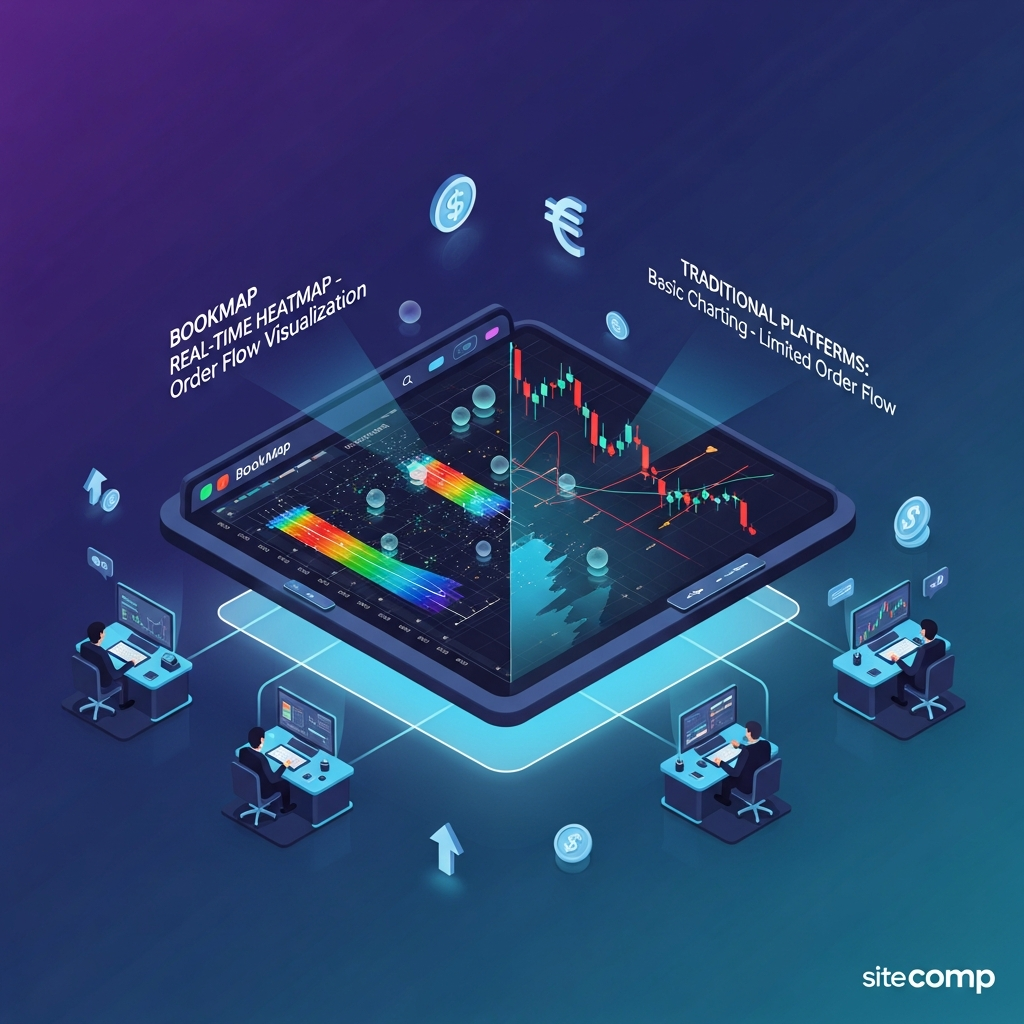
Its defining feature is a liquidity heatmap. According to Bookmap, the heatmap displays resting limit orders across price levels as they update. Brighter areas represent greater visible liquidity, allowing a trader to see where orders are being added, removed, or traded against.
Executed trades can then be displayed as volume bubbles on top of that liquidity information.
This gives traders three different layers of context:
Price shows where the market moved.
Executed volume shows where buyers and sellers actually traded.
Resting liquidity shows orders currently waiting in the book.
That does not mean liquidity automatically predicts future price direction. Limit orders can be changed or canceled, and order-book behavior needs interpretation. Bookmap is best treated as a visualization and decision-support tool rather than a signal generator that guarantees an outcome.
If you primarily need conventional charts and broad market analysis, compare it with our TradingView Premium review.
How Bookmap's Liquidity Heatmap Works
Bookmap's heatmap records how displayed liquidity changes through time.
Instead of seeing only the current depth-of-market snapshot, traders can visually follow where liquidity was previously available and how the order book changed as price approached specific levels.
Bookmap's official feature documentation says its liquidity heatmap can display limit orders across price levels in real time. The platform combines that with volume bubbles representing executed transactions.
For an order-flow trader, that can make several behaviors easier to study:
Liquidity Appearing
A larger resting order becomes visible near a price level.
That may be relevant because traders can monitor how price behaves when it approaches that liquidity.
Liquidity Being Pulled
Visible orders may disappear before price reaches them.
That change is information, but it should not automatically be interpreted as a trade signal.
Absorption
Heavy transaction volume can occur while price fails to move substantially through a level.
Order-flow traders often monitor this interaction between executed volume and resting liquidity.
Iceberg and Hidden-Liquidity Analysis
Bookmap offers specialized tools for identifying iceberg-order and stop-related behavior. Availability depends on the plan and add-ons being used.
This is where Bookmap differs materially from a standard candlestick-first platform.
Bookmap Features: What Actually Matters?
1. Liquidity Heatmap
The heatmap is the central reason to consider Bookmap.
Bookmap says it shows resting liquidity across the available order book and updates that information as orders change. That makes market depth easier to inspect visually than a conventional numeric DOM alone.
Best for: traders whose strategy incorporates liquidity behavior.
2. Volume Bubbles
Bookmap's volume bubbles display executed volume at different price levels.
They help separate orders waiting to trade from trades that actually happened.
This distinction matters because a large resting order and a large executed transaction represent different events.
3. Current Order Book and Best Bid/Offer
Bookmap also displays the current order book and Best Bid & Offer information.
The official feature set describes tools for monitoring the spread and observing how incoming volume interacts with available liquidity.
4. Record and Replay
Replay is one of Bookmap's more practical learning tools.
Bookmap records market-depth and volume information so users can revisit a session rather than trying to study every event while trading live.
That can be useful for reviewing:
- Entries and exits
- Liquidity changes before a trade
- Absorption
- Large-volume events
- Repeated order-flow setups
5. Advanced Indicators and Add-Ons
Bookmap's ecosystem includes specialized tools such as Stops & Icebergs, TraderMap and other marketplace add-ons. Some features are bundled with higher plans while others may be separately sold.
That flexibility is useful for experienced traders, but it also increases the importance of calculating the total cost, not just the subscription price.
Bookmap Pricing in 2026
This is the section where the previous version of this article needed the largest correction.
As of September 2026, Bookmap's official pricing is:
| Plan | Monthly | Annual billing | Best fit |
|---|---|---|---|
| Digital | Free | Free | Testing Bookmap and crypto visualization |
| Digital+ | $19/mo | $16/mo effective rate | Crypto traders needing more functionality |
| Global | $49/mo | $39/mo effective rate | Active futures and stock traders |
| Global+ | $99/mo | $79/mo effective rate | Advanced traders requiring the broadest Bookmap feature set |
Bookmap also currently advertises a $990 Global lifetime license and $1,990 Global+ lifetime license.
The Subscription Price Is Not Always the Total Price
Bookmap explicitly states that live stocks and futures data are not included with the core subscription.
Current examples on Bookmap's official pricing page include:
- BookmapData: $34–$79/month
- dxFeed Futures: $37/month per exchange
- U.S. equities: $34–$119/month
Those amounts can materially change the total monthly cost of a futures or equities setup.
For U.S. futures and stock traders, this is one of the most important details to understand before subscribing.
Crypto is different because Bookmap provides connections to multiple crypto exchanges without the same exchange-data structure shown for stocks and futures.
If the combination of heatmap visualization and order-flow analysis matches your trading process, review the current plans through the Bookmap profile on CompareBestAI before choosing a tier.
Bookmap Pros and Cons
| Pros | Cons |
|---|---|
| Detailed real-time liquidity visualization | Steeper learning curve than ordinary charting |
| Combines market depth and executed volume | Real-time stock/futures data can cost extra |
| Free Digital tier available | Advanced functionality can increase total cost |
| Record and replay support | Overkill for many swing or long-term traders |
| Supports stocks, futures and crypto workflows | Requires understanding of market microstructure |
| Add-ons and customization for advanced traders | More data does not automatically improve decisions |
The biggest advantage is specialization. Bookmap is built around order-flow visualization rather than trying to be every type of investing platform at once.
That specialization is also its biggest drawback.
If you do not actively use liquidity, market depth, aggressive volume, absorption or similar concepts, much of Bookmap's interface may add complexity without improving your process.
Who Should Use Bookmap?
Bookmap is most relevant for traders whose decisions happen on relatively short timeframes and depend on market microstructure.
Futures Day Traders
Futures traders are one of the clearest use cases because depth-of-market data and order-flow analysis can be part of intraday execution.
If you want a platform that combines brokerage, futures trading and order-flow tools differently, examine the NinjaTrader tool profile.
Scalpers
Scalpers working around short-term liquidity changes may get more value from Bookmap than longer-term traders because market-depth information is directly relevant to their execution horizon.
Crypto Traders
The free Digital tier makes Bookmap comparatively easy to test for crypto order-flow visualization before committing to a paid subscription.
Experienced Order-Flow Traders
If you already understand DOM, liquidity, absorption, aggressive volume and iceberg behavior, Bookmap provides a visual framework for concepts you may already use.
Who Should Probably Skip Bookmap?
Bookmap is less compelling if your strategy is primarily based on long-term fundamentals, portfolio allocation, infrequent swing trades, or broad equity screening.
For stock screening and fundamental filtering, our Finviz Elite review covers a very different workflow.
You can also view the Finviz Elite tool profile if screening and stock research matter more than order-book visualization.
Traders who prefer highly customizable stock charting and scanning can compare our TC2000 Gold review, while users evaluating another established analysis platform can read the MetaStock review.
Bookmap vs Alternatives
Bookmap's competitors are not all direct substitutes. Some focus on order flow; others focus on charting, brokerage, screening, or analysis.
| Platform | Primary strength | Current pricing example | Better choice when... |
|---|---|---|---|
| Bookmap | Liquidity heatmap + order flow | Free; $19 / $49 / $99 monthly paid tiers | Market depth is central to your strategy |
| NinjaTrader | Futures platform + brokerage + trading tools | Free plan; $99/mo; $1,499 lifetime | You want futures brokerage and execution in the same ecosystem |
| Finviz Elite | Equity screening + market research | $39.50/mo or $299.50/year | Screening stocks matters more than order flow |
| TC2000 | Stock charting + scanning | Paid plans currently start at $24.99/mo | You want stock scanning and technical charting |
NinjaTrader's official pricing currently lists a $0 monthly Free plan, $99/month Monthly tier and $1,499 Lifetime payment, while exchange and other trading fees can apply.
Finviz currently lists Elite at $39.50 monthly or $299.50 annually.
TC2000's current pricing page shows paid plans beginning at an effective $24.99 per month, with higher tiers and optional data services.
For a broader charting comparison, you can also explore the TradingView Premium tool page.
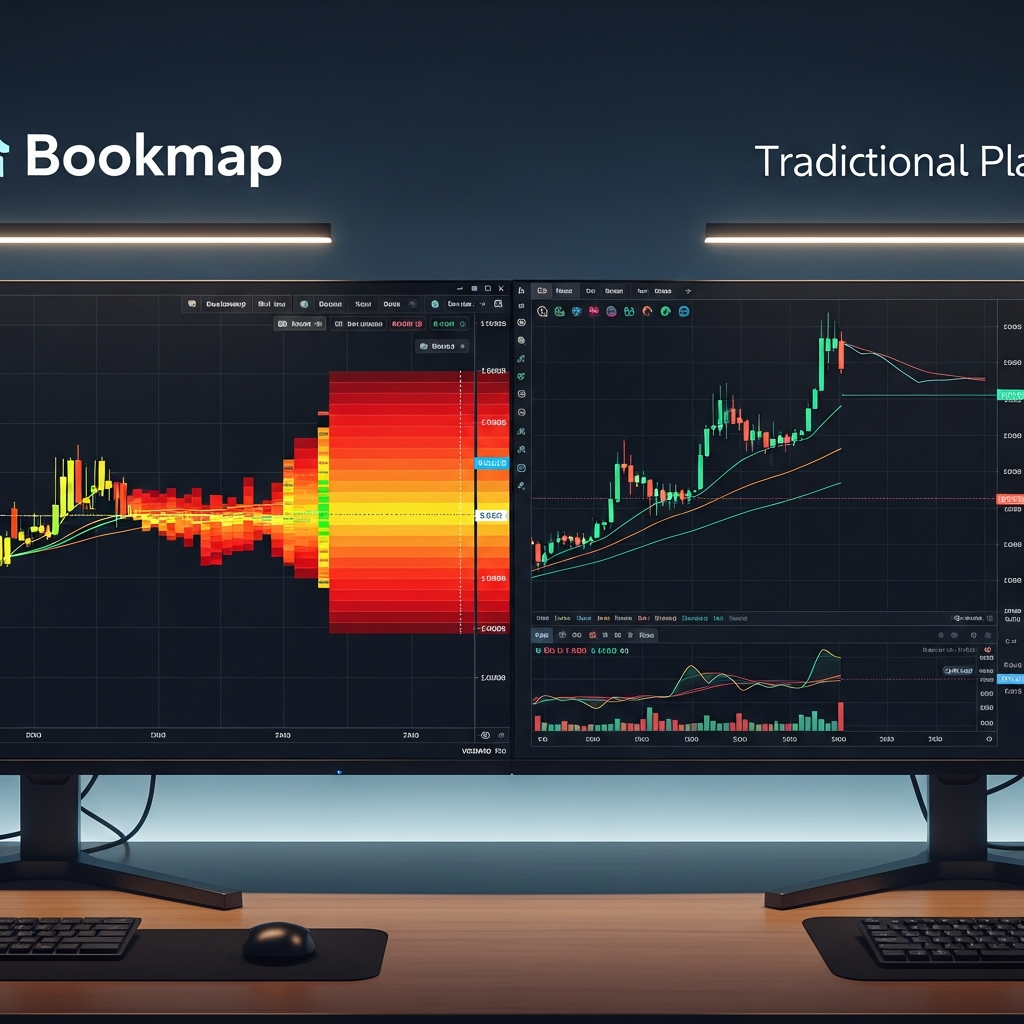
Is Bookmap Better Than TradingView?
They solve different problems.
TradingView is built around broad charting, indicators, screening, community tools and multi-market technical analysis. Bookmap is more specialized around market depth, liquidity and order flow.
Choose Bookmap when your question is:
Where is liquidity resting, how is it changing, and how is executed volume interacting with it?
Choose a conventional charting platform when your questions revolve more around technical indicators, higher-timeframe structure, screening, watchlists or broad market coverage.
That difference matters more than asking which platform is universally “better.”
How We Evaluated Bookmap
This review uses publicly available vendor documentation, current pricing information, product documentation and comparisons with other trading platforms.
We evaluated Bookmap on:
- Order-flow visualization
- Liquidity and market-depth tools
- Pricing and separate data costs
- Replay and analysis features
- Accessibility for different trader types
- Alternative-platform fit
- Overall workflow value
We have not presented simulated trading results, profitability claims or unsupported performance statistics as evidence.
That distinction matters. A trading visualization platform can provide more information without guaranteeing better trading outcomes.
Is Bookmap Worth It in 2026?
Bookmap is worth testing if order flow is already important to your strategy.
The free Digital plan lowers the barrier to exploring the interface, while Global and Global+ provide the connectivity and advanced functionality more relevant to active stock and futures traders.
The harder question is whether the information will change your decisions.
If you mainly trade from candlesticks, indicators, fundamentals or longer-term setups, buying more granular order-book data may not produce meaningful value.
If you regularly trade short-term futures, stocks or crypto and already understand market-depth concepts, Bookmap's visualization can make that information considerably easier to inspect.
That is the more useful decision criterion than the number of indicators included in a subscription.
FAQ About Bookmap
Is Bookmap good for beginners?
Bookmap offers a free entry point, but its order-flow focus creates a steeper learning curve than conventional charting platforms. Beginners should first understand liquidity, market depth, executed volume and basic order-flow concepts before relying on the platform for trading decisions.
How much does Bookmap cost in 2026?
Bookmap currently offers Digital for free, Digital+ at $19/month, Global at $49/month and Global+ at $99/month. Annual and lifetime options are also available. Real-time stocks and futures market-data subscriptions can cost extra.
Does Bookmap include real-time market data?
Real-time crypto connectivity is available within Bookmap's plan structure, but real-time stocks and futures data is not included with the core paid subscription and may require an additional market-data package.
What is Bookmap's main advantage?
Bookmap's main advantage is its liquidity heatmap, which combines historical and current order-book visualization with executed-volume information. This gives order-flow traders a visual way to study how liquidity and transactions interact.
Is Bookmap better than NinjaTrader?
Neither is universally better. Bookmap specializes in liquidity and order-flow visualization. NinjaTrader combines futures brokerage, charting, simulation, execution and order-flow functionality. The better choice depends on whether visualization or an integrated futures trading ecosystem is more important.
What are the best Bookmap alternatives?
Relevant alternatives include NinjaTrader for futures trading, TradingView for broad technical charting, Finviz Elite for equity screening, and TC2000 for stock charting and scanning. Traders focused specifically on market depth should compare each platform's order-flow capabilities rather than general feature counts.
Final Verdict: Bookmap Review
Bookmap is a specialist order-flow platform, and that is exactly how it should be evaluated.
Its liquidity heatmap, volume bubbles, order-book visualization and replay functionality provide a level of market-depth context that ordinary price charts do not emphasize. Bookmap's current Free, Digital+, Global and Global+ structure also lets traders enter at different levels, although stock and futures users need to budget for market-data costs separately.
For active futures traders, scalpers and experienced order-flow users, that specialization can make Bookmap a strong fit.
For long-term investors, occasional swing traders, or users primarily looking for screening and conventional technical analysis, a simpler platform may provide better value.
Compare Bookmap with other Finance & Trading tools, then choose based on the data and workflow you actually use, not the longest feature list.