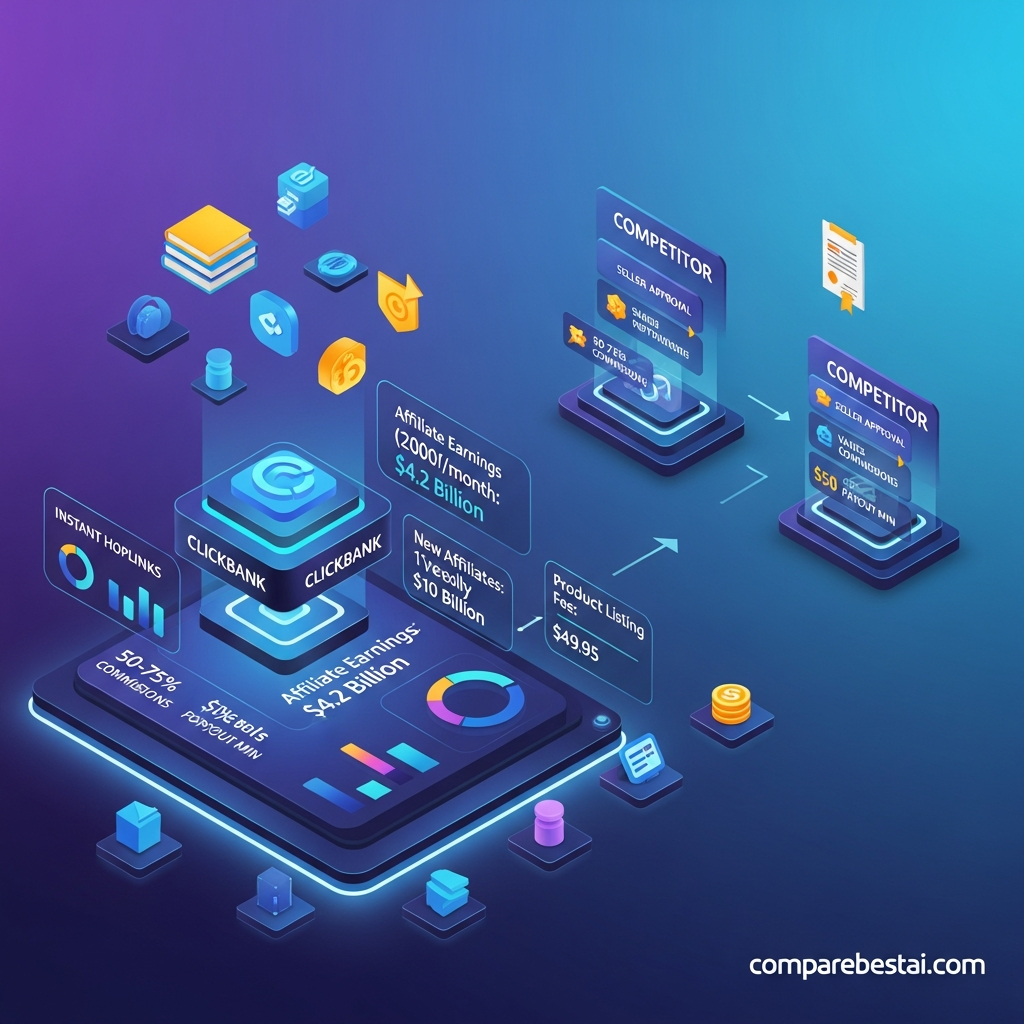

Answer First: ClickBank is an affiliate marketplace and ecommerce platform that connects sellers with affiliates while handling transactions, tracking, payouts, refunds, and applicable tax collection. Affiliates can join without a monthly subscription and earn either revenue-share or CPA commissions depending on the offer. Sellers pay no monthly platform fee, but the first approved product triggers a $49.95 activation charge, and standard sales generally carry a 7.5% + $1 platform cost. ClickBank is most attractive for performance-driven offers that benefit from affiliate distribution; it is less compelling when you need a fully custom checkout stack or tightly curated enterprise partnerships.
ClickBank is often described simply as an affiliate network, but that understates what the platform actually does.
It combines an affiliate marketplace with seller checkout, tracking, reporting, payments, refunds, recurring products, and customer-order infrastructure.
That makes the buying question different for two audiences:
Affiliates want to know whether ClickBank has worthwhile offers and reliable tracking.
Sellers want to know whether ClickBank's distribution, payment infrastructure, and affiliate network justify its transaction economics.
For the shorter product-level summary, see the CompareBestAI ClickBank tool profile. ClickBank tool profile
ClickBank Review: Quick Verdict
ClickBank makes the most sense for performance-focused affiliate marketers and sellers that want a platform where affiliate discovery, tracking, payments, and ecommerce operations are closely connected.
For affiliates, the principal advantages are marketplace access, performance metrics, tracking links, Revenue Share and CPA offers, and regular payout options.
For sellers, the appeal is broader. ClickBank can provide checkout infrastructure, affiliate distribution, tax handling, recurring sales support, reporting, and seller/affiliate payment management.
The main drawback is that offer quality varies.
The Marketplace gives you data for evaluating an offer, but it does not remove the need to inspect the product, landing page, refund risk, claims, audience fit, and seller reputation before sending traffic.
What Is ClickBank?
ClickBank is operated by Click Sales, Inc. and functions as an ecommerce platform with an affiliate marketplace.
ClickBank describes itself as the final retailer/reseller for products sold through its system. That is important because it means ClickBank handles parts of the transaction and tax process that a simple affiliate-tracking network may leave to the merchant.
Its ecosystem includes two core participant types:
Sellers create and sell offers.
Affiliates promote those offers and earn commissions when tracked customers convert.
The platform supports digital, physical, recurring, and hybrid products rather than only ebooks and courses. ClickBank's current documentation explicitly allows one-time and recurring digital products, physical products, and combinations of both.
How ClickBank Works for Affiliates
An affiliate starts by creating a ClickBank account, browsing the Affiliate Marketplace, selecting an offer, and generating an affiliate tracking link.
ClickBank calls these links HopLinks.
A HopLink identifies the affiliate responsible for referring the customer so ClickBank can attribute the sale and calculate commission. ClickBank's documentation currently states that if the customer purchases within 60 days of clicking the HopLink, the referring affiliate can receive credit for the sale.
Affiliates can also add tracking IDs and traffic-source parameters to distinguish between campaigns.
For example, an affiliate could use different tracking values for:
SEO content, email campaigns, social media, paid advertising, or individual landing pages.
That provides substantially better attribution than using one undifferentiated link everywhere.

ClickBank Marketplace Explained
The ClickBank Marketplace is where sellers expose offers to potential affiliates.
Affiliates can browse or search offers, filter results, review product information, inspect promotional resources, and generate tracking links when approval requirements allow it.
This is one of ClickBank's strongest differentiators compared with platforms that mainly provide tracking infrastructure without a discovery marketplace.
The Marketplace currently exposes several useful performance metrics.
Gravity
Gravity is an approximate relative measure based on how many affiliates have earned commission promoting an offer, with more recent activity weighted more heavily.
A high Gravity score indicates that multiple affiliates are converting the offer.
It does not automatically mean the offer is the best one for your audience.
Higher Gravity can also mean greater affiliate competition.
Average Dollars per Conversion
Avg $/Conversion estimates the average affiliate commission generated per conversion and can incorporate initial sales, upsells, and recurring rebills.
This is more useful than looking only at a headline commission percentage because two offers with the same percentage can produce very different actual earnings.
EPC and Conversion Rate
ClickBank also exposes Earnings Per Click (EPC) and Conversion Rate (CVR) based on recent performance data.
Those metrics help affiliates compare how effectively different offers turn traffic into commission.
ClickBank Affiliate Commissions
ClickBank supports two main commission models:
Revenue Share
Revenue Share pays an affiliate a percentage of the qualifying sale.
The seller controls the relevant commission rate and can create different rates for products or specific affiliate relationships.
If a Revenue Share sale is later refunded, the associated affiliate commission is generally reversed proportionally.
CPA
CPA stands for Cost Per Action.
On ClickBank, that action is the initial sale.
Instead of receiving a percentage, the affiliate receives an agreed flat payout for the conversion.
An important distinction is that CPA commission applies to the initial sale and does not normally generate additional commission on subsequent upsells or rebills. However, the affiliate generally keeps the CPA commission if the customer is later refunded.
This makes CPA particularly useful to performance marketers who value predictable acquisition economics.
Does ClickBank Really Pay 50–75% Commission?
Sometimes, but 50–75% is not a platform-wide guaranteed commission rate.
ClickBank allows sellers to determine commission structures and rates.
Its own seller guidance says affiliates may be more motivated when offers provide commission in the 50–75% range, but actual Marketplace offers vary.
A better affiliate evaluation process is to consider:
commission model + Avg $/Conversion + EPC + CVR + refund risk + product quality + audience fit.
The highest headline percentage is not automatically the highest-value offer.
ClickBank Pricing and Fees in 2026
ClickBank does not use the same pricing model for affiliates and sellers.
| Cost | Current structure |
|---|---|
| Create ClickBank account | Free |
| Affiliate monthly platform fee | $0 |
| Seller monthly platform fee | $0 |
| First approved seller product activation | $49.95 one time |
| Standard transaction economics | ClickBank retains 7.5% + $1 |
| Pay-period processing | $5 per issued payment |
| International wire | $45 per wire |
| Dormant-account charges | Can apply to positive inactive balances |
ClickBank's support documentation confirms the $49.95 seller activation charge, $5 payment processing fee, and standard 7.5% + $1 transaction structure.
This structure can be attractive to sellers that dislike recurring SaaS subscriptions.
However, the fixed $1 component matters for low-ticket products.
On a low-price transaction, one dollar represents a much larger share of revenue than it does on a $100+ offer.
ClickBank Seller Economics Example
Imagine a standard product sells for $100.
Under ClickBank's standard wholesale-pricing example, the platform keeps $8.50, leaving $91.50 before the seller/affiliate commission split.
If the seller then gives the affiliate a 50% Revenue Share commission, the remaining amount is divided according to that agreement.
This is why sellers should model profitability using the actual net amount after ClickBank's transaction economics, not simply the retail price.
How and When Does ClickBank Pay?
ClickBank's payout schedule is not instant.
Accounts receiving direct deposit or wire payments can generally choose weekly or once-every-two-weeks payments.
Check payments operate on an every-two-week schedule.
ClickBank also uses a Payment Threshold.
Its documentation says users can choose a threshold between $10 and $1,000,000, with $100 as the default.
Customer Distribution Requirement
Before receiving payment, ClickBank users must also satisfy its Customer Distribution Requirement.
The current policy requires at least five sales using at least two qualifying payment methods before payment can be issued.
For new affiliates, this is an important detail because earning a first commission does not necessarily mean that payment will immediately be released.
Dormant Account Fees
One less obvious ClickBank cost applies when an account has a positive balance but stops earning.
Current policy states that dormant sales accounts can incur:
$1 per pay period after 90 days without earnings,
$5 after 180 days,
and $50 per pay period after 365 days.
The charges stop when new earnings occur or the balance reaches zero.
This is important enough to include in a serious ClickBank review because small affiliates can otherwise leave a balance sitting in an inactive account without realizing the consequence.
ClickBank Refunds and Chargebacks
Refund mechanics differ depending on the affiliate commission type.
When a Revenue Share transaction is refunded, the associated seller and affiliate distributions are generally reversed.
With CPA, the affiliate normally retains the flat commission while the seller absorbs the return-related distribution impact.
ClickBank's standard customer refund period is commonly 60 days, although sellers can configure eligible product-level refund windows between 30 and 90 days, with longer periods requiring additional support configuration.
For affiliates evaluating Revenue Share offers, refund behavior matters because gross commissions and final retained earnings are not always the same number.
Can You Sell Physical Products on ClickBank?
Yes.
It is outdated to describe ClickBank as a digital-products-only marketplace.
ClickBank currently supports digital products, physical products, recurring products, and hybrid combinations.
Physical-product sellers have additional requirements around shipping, fulfillment, returns, and—in some categories—product compliance.
This makes ClickBank relevant beyond courses and ebooks, including categories such as supplements and other direct-response physical offers where platform rules are satisfied.
ClickBank for Sellers
The seller side of ClickBank is more compelling than many affiliate-only reviews acknowledge.
A seller can use the platform to combine ecommerce infrastructure with affiliate distribution.
That can include:
product approval, hosted transaction infrastructure, recurring billing, affiliate commissions, Marketplace exposure, reporting, refund handling, and tax administration.
ClickBank also says sellers can access a network of more than 100,000 active affiliates.
The relevant question for sellers is therefore not just “What does ClickBank cost?”
It is:
How much additional distribution and operational work does ClickBank replace?
For sellers primarily comparing broader marketing software rather than affiliate networks, browse CompareBestAI's Marketing tools category. Marketing tools category
ClickBank for Affiliates
Affiliates benefit most from ClickBank when they already understand audience acquisition.
The platform provides the offers, links, stats, and commission infrastructure.
It does not automatically generate profitable traffic.
Successful affiliate economics still depend on:
traffic cost, audience intent, conversion rate, offer quality, refund rate, funnel performance, and the commission structure.
This distinction matters because “join ClickBank and make money” content often ignores the actual acquisition side of affiliate marketing.
ClickBank Pros and Cons
| Pros | Cons |
|---|---|
| No monthly affiliate fee | Marketplace offer quality varies |
| No recurring monthly seller platform fee | Sellers pay transaction-based fees |
| RevShare and CPA commissions | Revenue Share can be reversed after refunds |
| Marketplace performance metrics | Payment requires threshold/CDR compliance |
| 60-day HopLink attribution window | Dormant positive balances can incur fees |
| Digital and physical products supported | Some sellers require affiliate approval |
| Weekly/biweekly payout options | Not instant payout |
| Seller tax/transaction infrastructure | Hosted platform rules reduce checkout freedom |
| Reporting and APIs | Not designed around high-touch enterprise sales |
ClickBank vs CJ Affiliate
CJ Affiliate has a stronger association with major retail and established-brand affiliate programs.
ClickBank has historically been more direct-response oriented and combines affiliate distribution with deeper seller transaction infrastructure.
If your goal is promoting recognized brands and conventional ecommerce advertisers, compare the CJ Affiliate profile. CJ Affiliate profile
If your goal is finding performance-focused offers and digital/direct-response funnels, ClickBank may be the more relevant ecosystem.
ClickBank vs Awin
Awin operates a broad affiliate network covering retailers, services, publishers, and international markets.
ClickBank is differentiated by its seller/checkout infrastructure and Marketplace economics.
For brands focused primarily on traditional affiliate partnerships, review the Awin profile. Awin profile
ClickBank vs Impact
Impact is more focused on partnership management infrastructure across affiliates, creators, referrals, and broader partner relationships.
ClickBank is closer to a combined affiliate marketplace + ecommerce transaction environment.
Businesses with sophisticated partner-program operations should compare the Impact platform profile. Impact profile
ClickBank vs PartnerStack
PartnerStack is particularly relevant to SaaS companies building partner and referral ecosystems.
ClickBank fits direct-response ecommerce and affiliate-driven product distribution more naturally.
For B2B/SaaS partner programs, see the PartnerStack profile. PartnerStack profile
ClickBank vs ShareASale
ShareASale is another established affiliate-network option with a large merchant/publisher ecosystem.
The right comparison should focus on:
merchant type, offer quality, tracking, commission structure, payout model, available brands, geographic reach, and the type of affiliate traffic you operate.
Compare the ShareASale profile before choosing based only on commission percentage. ShareASale profile
ClickBank vs JVZoo and WarriorPlus
JVZoo and WarriorPlus overlap more directly with ClickBank in internet-marketing and digital-offer use cases.
The major distinction is payout and platform structure.
ClickBank uses defined pay periods and payment requirements rather than positioning normal affiliate payments as instant.
For those narrower alternatives, review the JVZoo profile JVZoo profile and WarriorPlus profile. WarriorPlus profile
How CompareBestAI Evaluated ClickBank
CompareBestAI's current ClickBank product profile says the editorial team tested the platform for 7 days.
The documented evaluation included configuring a seller account, reviewing feature settings, building a sample recurring product and upsell workflow, querying Orders and Quickstats APIs, validating fee/payout rules, and comparing ClickBank against Digistore24 and JVZoo.
If those tests are backed by your actual editorial process, this methodology should appear prominently on the article page.
That adds considerably more trust than simply repeating the feature list.
Is ClickBank Legit?
ClickBank is an operating ecommerce and affiliate platform governed by a current client contract and formal seller, affiliate, refund, accounting, and product policies.
That does not mean every product in a marketplace deserves promotion.
Affiliate due diligence should still include:
product quality, sales-page claims, refund behavior, customer experience, seller responsiveness, compliance risk, and audience relevance.
The legitimacy of the platform and the quality of an individual offer are separate questions.
Who Should Use ClickBank?
ClickBank is particularly relevant for:
performance affiliates, information-product sellers, subscription offers, direct-response ecommerce businesses, course creators, physical-product sellers with affiliate-driven acquisition, and marketers who want a built-in offer marketplace.
It also makes sense when the seller wants transaction infrastructure and affiliate distribution in one platform rather than assembling every component separately.
For broader marketing technology beyond affiliate networks, see CompareBestAI's best AI marketing tools guide. Best AI marketing tools
Who Should Skip ClickBank?
ClickBank may be less suitable when your business requires:
a completely bespoke checkout stack, enterprise procurement workflows, tightly curated premium publishers only, extremely low-ticket economics, or a partner ecosystem centered primarily on SaaS referrals and account-based relationships.
In those scenarios, CJ, Awin, Impact, PartnerStack, or another specialist platform may align more closely with the business model.
Frequently Asked Questions
Is ClickBank free to join?
Creating a ClickBank account is free. Affiliates do not pay a monthly platform subscription to browse and promote eligible Marketplace offers. Sellers can also maintain an account without a monthly fee, but the first approved seller product triggers a $49.95 activation charge and sales incur platform economics.
How much commission do ClickBank affiliates earn?
There is no single ClickBank commission rate. Sellers choose Revenue Share percentages or negotiate CPA payouts. Marketplace listings provide commission and performance data that affiliates can use when evaluating offers.
How often does ClickBank pay affiliates?
Eligible direct-deposit and wire accounts can generally receive payments weekly or every two weeks. Checks are issued every two weeks. Payment is also subject to the account's threshold and Customer Distribution Requirement.
What is ClickBank Gravity?
Gravity is a relative performance metric reflecting how many affiliates have successfully generated commission for an offer, with recent activity weighted more heavily. A higher Gravity score indicates active affiliate conversions but may also signal stronger competition.
How long does a ClickBank affiliate link track customers?
ClickBank states that a HopLink can credit the referring affiliate when the customer purchases within 60 days of clicking the link.
Does ClickBank sell physical products?
Yes. ClickBank supports physical, digital, recurring, and hybrid products subject to its product and compliance requirements.
What happens to affiliate commission after a refund?
Revenue Share commission is generally reversed when the underlying sale is refunded. CPA affiliates normally keep the agreed CPA payout even if that initial sale is subsequently refunded.
What are the best ClickBank alternatives?
The most relevant alternatives depend on the business model. CJ Affiliate and Awin are strong traditional affiliate-network comparisons; Impact and PartnerStack focus more heavily on broader partnership infrastructure, while JVZoo and WarriorPlus overlap more closely with digital/direct-response affiliate offers.
Final Verdict
ClickBank remains relevant in 2026 because it does more than track affiliate links.
It combines offer discovery, attribution, commissions, ecommerce transactions, seller infrastructure, payouts, refunds, and marketplace distribution.
For affiliates, the real value is access to measurable offers with Revenue Share and CPA options.
For sellers, the value is the ability to combine checkout and payment operations with a large affiliate ecosystem without paying a recurring monthly platform subscription.
Its limitations are equally important.
Marketplace quality varies, refund economics matter, affiliates must meet payout requirements, and transaction costs can be unattractive for very low-ticket products.
So the best way to evaluate ClickBank is not to ask whether the platform is universally “good.”
Ask whether its offer marketplace, payment infrastructure, affiliate reach, and fee model match your acquisition strategy.