
In the rapidly evolving digital landscape of 2026, the barrier to entry for content creation has effectively vanished. With Generative AI reaching maturity, enterprises are flooding the web with automated articles, white papers, and technical documentation. However, quantity has ceased to be a competitive advantage. The new battleground for search engine dominance is authenticity. To stand out in an ocean of synthetically generated text, organizations must master the ability to humanize AI content while maintaining the scalability that artificial intelligence provides.
Search engines, now powered by neuro-symbolic AI, have become incredibly adept at distinguishing between purely algorithmic outputs and content that demonstrates genuine human experience. For digital marketing strategists, this shifts the focus from simple keyword optimization to "Experience Optimization." This article explores the sophisticated workflows, ethical frameworks, and editorial strategies required to elevate machine-generated drafts into authoritative, high-ranking assets.
The Shift to Authenticity: Why Algorithms Favor Emotional Intelligence
By 2026, Google’s core ranking systems have moved beyond basic semantic matching to analyzing the "emotional signature" of content. This evolution places a premium on emotional intelligence in AI usage. Algorithms now reward content that demonstrates empathy, nuance, and a distinct perspective—qualities that raw Large Language Model (LLM) outputs often lack.
The concept of E-E-A-T (Experience, Expertise, Authoritativeness, and Trustworthiness) remains central to SEO. However, the definition of "Experience" has tightened. Search engines look for signals that the author has actually engaged with the subject matter, rather than simply aggregating existing data. To rank for competitive queries, brands must infuse their AI-generated drafts with anecdotal evidence, case studies, and subjective analysis that an LLM cannot hallucinate convincingly. For a deeper dive into these ranking signals, review the documentation on Google Search Central regarding helpful content systems.
Developing a Hybrid Content Workflow for Authentic Brand Voice
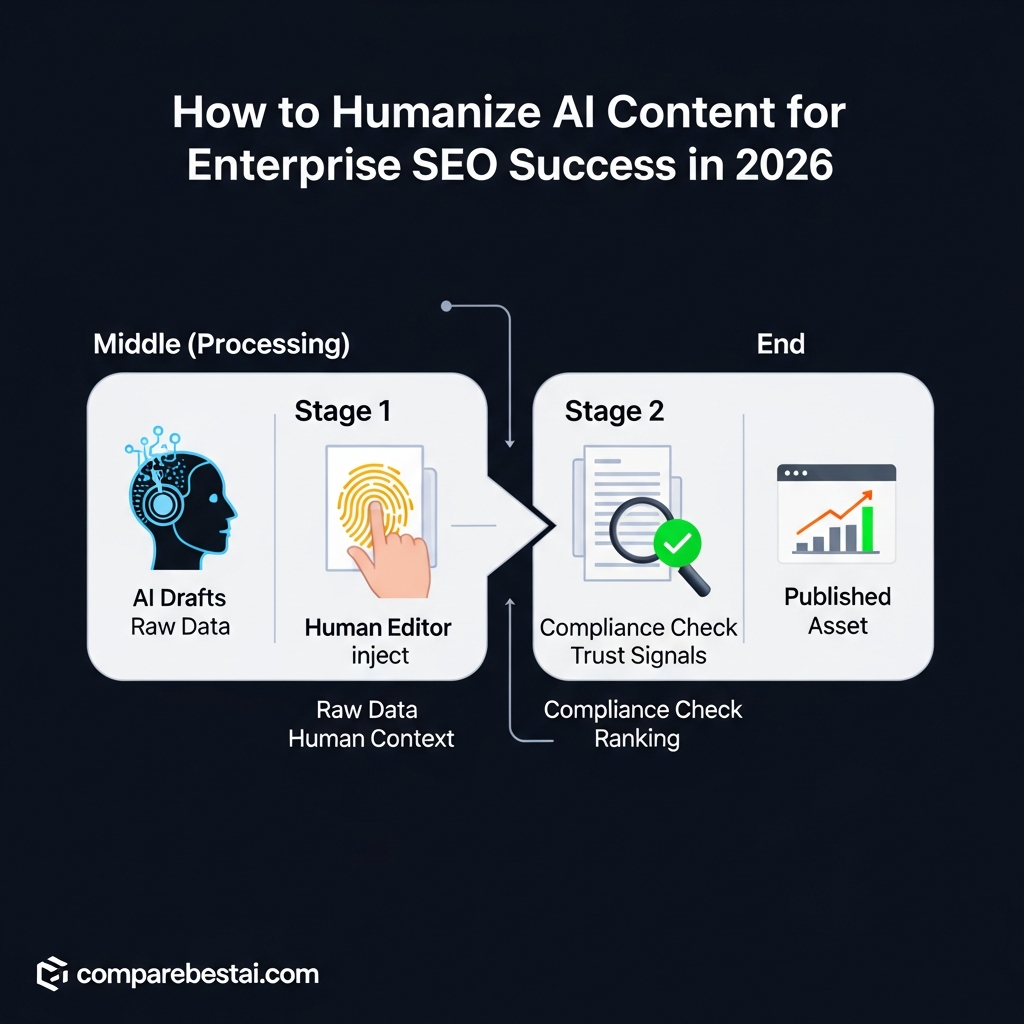
Successful enterprise SEO requires a departure from the "prompt-and-publish" methodology of the early 2020s. The most effective marketing teams now employ a hybrid content workflow. This approach treats AI as a junior researcher and drafter, while senior human editors act as the architects of tone and strategy.
The 80/20 Production Model
In 2026, the industry standard for high-performance content follows the 80/20 rule:
- 80% AI-Generated Foundation: Using advanced LLMs to structure the article, gather initial data points, and draft the skeleton of the content. This ensures speed and comprehensive coverage of the topic.
- 20% Human Contextualization: Expert editors inject authentic brand voice, proprietary data, and contrarian viewpoints. This 20% effort yields 80% of the SEO value by differentiating the content from competitors using the same AI models.
Strategic Prompt Engineering
Humanizing content starts at the prompt level. Instead of asking for a generic blog post, strategists must prime the AI with specific brand guidelines, tone descriptors (e.g., "authoritative yet conversational"), and restrictions against repetitive transition words often associated with robotic text.
Advanced Techniques to Bypass Detection and Engage Readers
While search engines state they do not penalize AI content simply for being AI, they do penalize low-quality, repetitive, and unhelpful content. Furthermore, AI text detection bypass remains a concern for enterprises aiming to avoid algorithmic flags associated with "spammy" automated content patterns.
To truly humanize the output, editors must disrupt the predictable patterns of AI:
- Variance in Sentence Structure: AI tends to produce sentences of uniform length and rhythm. Human writing is jagged and rhythmic. Editors should mix short, punchy sentences with longer, complex clauses.
- Idiomatic and Cultural Nuance: LLMs often struggle with current cultural references or industry-specific jargon used naturally by experts. Injecting these elements signals insider knowledge.
- First-Person Narrative: Where appropriate, switching to "I" or "We" and referencing specific company achievements or failures adds a layer of credibility that third-person objective text cannot achieve.
Navigating Enterprise AI Compliance and Ethical Usage
As AI adoption hits saturation, regulatory bodies and internal legal teams have tightened the rules around enterprise AI compliance. In 2026, "humanizing" content also means verifying its truthfulness. The risk of "hallucinations"—where AI invents facts—poses a significant threat to brand reputation and legal standing.
Organizations must adhere to strict ethical AI usage policies. This involves distinct transparency protocols. Readers in 2026 are savvy; they expect to know if they are interacting with a machine or a human. Best practices suggest adding a disclaimer such as "AI-assisted, Human-verified" to maintain trust. For insights on the capabilities and safety research behind these models, consult OpenAI Research.
Comparing Automated Refinement vs. Strategic Human Editing
There is a misconception that software tools alone can solve the humanization puzzle. While re-phrasing tools have improved, they cannot replace the strategic insight of a human editor. Below is a breakdown of how different AI editing strategies compare.
Automated Paraphrasing Tools
Software solutions that rewrite AI text to lower "perplexity" scores are useful for quick cleanup. They handle synonyms and syntax changes efficiently. However, they often fail to grasp the intent behind the search query, leading to text that is unique but potentially irrelevant or confusing.
The Human Editorial Layer
Human editors provide vertical depth. They ask, "Does this answer the user's pain point?" and "Is this advice actionable in the real world?" This level of scrutiny creates E-E-A-T signals that software cannot replicate. High-authority publications like Wired frequently discuss how the human element remains the premium differentiator in a tech-saturated market.
Future-Proofing Your Content Strategy for 2026 and Beyond
The convergence of SEO and AI has created a paradox: to win at the machine's game, you must become more human. The businesses that dominate the SERPs in 2026 are not those with the fastest generators, but those with the strongest editorial voices. By implementing rigorous AI editing strategies and prioritizing user empathy, brands can turn commodity content into high-value assets.
Ultimately, the goal is not to hide the use of AI, but to leverage it to free up human creativity for higher-level strategic thinking. When you successfully humanize AI content, you do more than just bypass detection filters; you build a bridge of trust with your audience. As we look toward 2027, the synergy between human insight and artificial intelligence will continue to define the standard for digital excellence.