
Quick Answer: Is Morphic Worth It in 2026?
Morphic is worth considering if you create AI films, animations, storyboards, advertising content, or other visual projects and want image, video, audio, editing, and workflow tools inside one creative platform.
Its strongest features are Canvas for visual creation, Copilot for prompt-driven creative work, Compose for assembling video sequences, reusable Workflows, custom visual Models, and support for multiple image and video generation models.
Morphic is particularly useful for filmmakers, animators, creative studios, marketers, and teams that need consistent characters and visual styles across multiple scenes.
It is less relevant if you are looking for a general business-automation platform for CRM updates, finance approvals, HR workflows, email management, or enterprise SaaS orchestration.

What Is Morphic?
Morphic is an AI creative-production and filmmaking platform designed to help creators generate, organize, edit, and assemble visual stories.
The platform combines three main creative environments:
- Canvas, where creators generate and organize images, video, and other assets
- Copilot, an AI assistant that can generate media, refine ideas, build creative workflows, and help organize assets
- Compose, a timeline-based environment for arranging and trimming generated video clips into finished sequences
Morphic can generate images, video, audio, music, speech, and dialogue. It also supports reusable creative Workflows and trained visual Models that help maintain consistent characters, products, objects, and styles across generations.
The platform runs in the browser, so creators do not need to install desktop software to start generating content.
Morphic Review: Key Features
Canvas
Canvas is Morphic's main visual workspace.
Creators can generate assets, arrange ideas spatially, iterate on individual shots, and keep related creative material inside the same project.
This makes it especially useful for story development, shot planning, visual exploration, advertising concepts, and longer creative projects where individual generations need to stay organized.
Copilot
Copilot is Morphic's prompt-based AI creative assistant.
Users can ask it to generate images, video, music, speech, dialogue, or other media using natural-language instructions.
Copilot can also refine previous generations, use attached media as references, build reusable Workflows, create scripts and shot lists, and organize generated assets.
Users can allow Copilot to select the appropriate model automatically or choose models and output settings manually.
Compose
Compose is Morphic's integrated video assembly tool.
It allows creators to arrange generated clips in sequence, trim clips, preview the sequence, and assemble AI-generated footage into a finished video without immediately moving everything into a separate editor.
Compose is designed primarily for AI-video assembly rather than replacing a complete professional post-production suite.
Creative Workflows
Morphic lets creators turn repeated creative processes into reusable Workflows.
A Workflow can be created from scratch or generated through Copilot based on a process the user describes.
For example, creators can build workflows for storyboards, short films, UGC-style advertisements, style transfer, character generation, visual effects, or other repeatable creative tasks.
Workflows can also be shared with other members of an organization.
Custom Visual Models
Morphic lets users train visual Models using reference images.
These Models can represent characters, products, objects, or visual styles and can then be reused across generations.
This is particularly useful for creators who need visual consistency across scenes rather than regenerating a character or style from scratch every time.
Image, Video and Audio Generation
Morphic combines several forms of generative media creation inside the same platform.
Depending on the selected model and workflow, creators can work with:
- text-to-image
- image editing
- text-to-video
- image-to-video
- reference-driven video
- video-to-video
- audio-driven generation
- voice
- dialogue
- music
- lip sync
- video upscaling
- motion transfer
- video style transfer
Available models, output resolutions, generation lengths, and credit costs vary by operation.
Try Morphic freeTeam Collaboration
Morphic also supports collaborative creative work.
Eligible team plans allow multiple users to work on a shared Canvas in real time, see each other's edits and cursors, generate content simultaneously, and follow another team member's view while working.
Teams can also share reusable Workflows so members follow the same creative process and settings.
Morphic Pricing in 2026
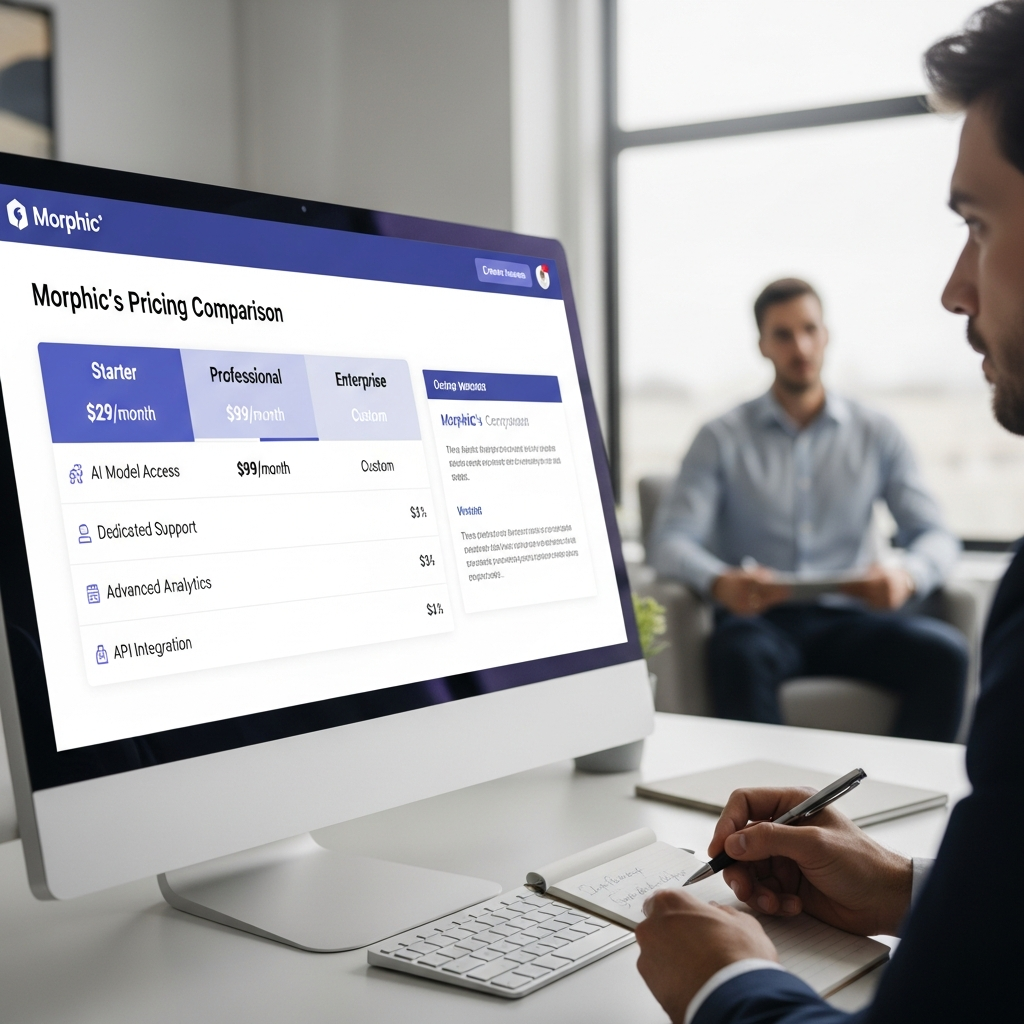
Morphic uses a credit-based subscription system.
Current plans are:
| Plan | Monthly Price | Annual Equivalent | Credits |
|---|---|---|---|
| Free | $0 | $0 | 20 one-time credits |
| Basic | $9/month | $9/month | 900/month |
| Standard | $29/month | $24/month | 3,200/month |
| Pro | $49/month | $45/month | 6,200/month |
| Pro Max | $185/month | $170/month | 24,000/month |
| Enterprise | Custom | Custom | High-volume/custom |
The Free plan is designed for testing Morphic and does not require a credit card.
Paid plans provide higher generation limits and broader access. Commercial-use and watermark-free benefits apply on eligible paid plans.
Pro supports additional team members for an extra monthly fee, while Pro Max supports larger teams. Enterprise is designed for organizations that need higher usage limits, custom seat limits, and tailored terms.
Credits are consumed differently depending on the model, resolution, generation type, and output length, so creators producing large amounts of AI video should estimate expected credit usage before selecting a plan.
Pricing verified August 17, 2026. Morphic can change pricing and credit requirements, so check the official pricing page before subscribing.
Explore Morphic pricing and features
Morphic Compared With Other AI Creative Platforms
Morphic is better compared with AI filmmaking and creative-generation platforms than with general productivity products such as Notion AI.
Its closest competitive set includes platforms that provide AI video generation, image generation, storyboarding, editing, model access, or creative-production workflows.
The most useful comparison criteria are:
- image and video model selection
- character and style consistency
- storyboarding
- editing and video assembly
- collaboration
- reusable workflows
- commercial-use rights
- credit costs
- output quality
- generation speed
Avoid comparing Morphic with business-productivity tools unless the article is specifically discussing a narrow overlapping feature.
Morphic Security and Team Controls
Morphic publicly identifies itself as AICPA SOC 2 Type 1 certified.
The platform also provides organization management features for team accounts, including member invitations and administrator or member roles.
However, businesses with specific requirements around SSO, data residency, HIPAA, ISO certifications, private deployment, encryption-key ownership, detailed audit logging, or industry-specific regulatory compliance should verify those capabilities directly with Morphic before purchasing.
Do not assume enterprise security features that are not explicitly documented in the current product or contract.
What Is Morphic Like to Use?
Morphic is built around a visual creative workflow rather than a traditional text-heavy SaaS dashboard.
Creators can begin on Canvas, generate media through prompts, use Copilot for conversational creation and refinement, and move finished clips into Compose when they are ready to assemble a sequence.
One of Morphic's main usability advantages is that several stages of AI content production can happen inside the same project rather than requiring users to constantly export assets between separate generation tools.
The tradeoff is that credit usage can become more complex when creators switch between different models, resolutions, video lengths, and generation methods.
New users should therefore test Morphic's Free plan first and pay attention to which models and workflows consume the most credits for their type of work.
Who Should Use Morphic?
Morphic is best suited to visual creators rather than general operations teams.
Filmmakers and Animators
Filmmakers and animators can use Morphic for story development, storyboards, character consistency, shot generation, animation, and assembling generated sequences.
Creative Studios
Studios can use shared projects, creative Workflows, visual Models, and live collaboration to keep recurring production processes more consistent across a team.
Marketers and Advertising Creators
Marketing teams can create product visuals, UGC-style ads, social videos, campaign concepts, storyboards, and other visual assets.
AI Artists
AI artists can experiment with different generation models while preserving characters, products, objects, or aesthetic styles through reusable visual Models and reference assets.
Social Content Creators
Creators producing short-form content can generate images and video, add sound, experiment with styles, and assemble clips without relying on several separate AI tools for each step.
Who Should Not Use Morphic?
Morphic is probably not the best fit if your primary need is:
- CRM automation
- email triage
- finance workflows
- HR automation
- project-management automation
- accounting integrations
- document approval routing
- general enterprise SaaS orchestration
Those are not the main problems Morphic is designed to solve.
If you're interested in exploring more ways to boost productivity with these 8 game-changing AI tools, check out our comprehensive guide of the top solutions for 2026.
Pros and Cons
Morphic Pros and Cons
Pros
- Combines image, video, audio, and creative workflows
- Visual Canvas for organizing complex projects
- AI Copilot for conversational media generation
- Integrated Compose video assembly tool
- Reusable creative Workflows
- Custom visual Models for consistent characters and styles
- Supports team collaboration on eligible plans
- Free plan available
- Multiple subscription tiers for different production volumes
Cons
- Credit usage varies significantly between models and operations
- Heavy video generation can require higher-priced plans
- Compose is not a complete replacement for a professional video editor
- Team functionality is limited by plan and seat allowances
- Enterprise security requirements should be verified directly rather than assumed
- May be excessive for users who only need occasional single-image generation
Who Is Morphic Best For?
Morphic is best for filmmakers, animators, AI artists, marketers, advertising creators, and creative teams that want to move from an idea to images, video, audio, and assembled visual sequences within one AI creative environment.
Choose Morphic if consistency across characters and styles, reusable creative workflows, visual planning, and multi-format AI generation matter to you.
Consider another platform if your main goal is business-process automation, CRM integration, HR workflows, finance operations, or general workplace productivity.
Is Morphic a Legitimate AI Creative Platform?
Yes. Morphic operates an active AI creative-production platform with public product documentation, pricing, workflows, model documentation, collaboration tools, and an official help center.
The platform is positioned around AI filmmaking, animation, creative production, advertising, and visual storytelling.
When evaluating Morphic, focus on its documented product capabilities and current pricing rather than unsupported customer counts, fundraising figures, analyst rankings, or executive claims.
Final Verdict: Is Morphic Worth It in 2026?
Morphic is a compelling option for creators who want more than a basic text-to-video generator.
Its combination of Canvas, Copilot, Compose, reusable Workflows, custom visual Models, team collaboration, and image, video, and audio generation gives creators a broader environment for developing complete visual projects.
Morphic is particularly attractive for filmmakers, animators, AI artists, creative studios, and marketers who need consistent visual assets across multiple scenes.
Its main limitation is cost predictability. Credits can be consumed quickly when working with advanced video models, higher resolutions, or repeated generations, so frequent users should evaluate expected usage before moving to a higher tier.
The Free plan makes it easy to test the workflow before paying.
If you want an AI platform focused on visual storytelling and creative production, Morphic is worth testing.
If you are looking for a general business-automation or enterprise productivity system, Morphic is not the product this article should recommend.
To compare with other top AI tools for business, don't miss our compare best AI tools in 2026 roundup for serious buyers.
Frequently Asked Questions About Morphic
What is Morphic?
Morphic is an AI filmmaking and creative-production platform for generating, editing, organizing, and assembling images, video, audio, and other visual storytelling assets.
How much does Morphic cost?
Morphic currently offers Free, Basic, Standard, Pro, Pro Max, and Enterprise plans. Monthly prices start at $9 for Basic, followed by $29 for Standard, $49 for Pro, and $185 for Pro Max. Annual billing reduces the effective monthly price of several tiers.
Does Morphic have a free plan?
Yes. Morphic currently offers a free plan with 20 one-time credits. No credit card is required to start.
What can you create with Morphic?
Morphic can be used to generate images, video, audio, music, speech, dialogue, storyboards, visual concepts, advertisements, animations, and short films. It also includes creative editing and assembly tools.
What is Morphic Canvas?
Canvas is Morphic's visual workspace for creating, organizing, editing, and connecting assets inside a project.
What is Morphic Copilot?
Copilot is Morphic's AI creative assistant. It can generate and refine media, use references, build creative Workflows, create documents such as scripts and shot lists, and help organize assets.
What is Morphic Compose?
Compose is Morphic's integrated video timeline and assembly tool for arranging and trimming generated clips into a finished sequence.
Can Morphic keep characters consistent?
Yes. Morphic lets creators train visual Models using reference images for characters, styles, products, or objects. Those Models can then be referenced across future generations.
Does Morphic support team collaboration?
Yes. Eligible team plans support live collaboration on shared Canvases. Team members can see edits and cursors in real time and generate or edit assets simultaneously.
Can Morphic create reusable workflows?
Yes. Users can create reusable creative Workflows through Copilot or turn an existing creative process into a saved Workflow.
Is Morphic a business automation tool?
Not primarily. Morphic is focused on visual storytelling, filmmaking, animation, AI media generation, and creative production rather than general CRM, HR, finance, or workplace automation.
Is Morphic worth it?
Morphic is worth testing if you regularly create AI images or video and want visual planning, consistent characters or styles, reusable creative workflows, collaboration, and video assembly in one platform. Casual users should begin with the free plan before deciding whether the credit-based paid tiers offer enough value.