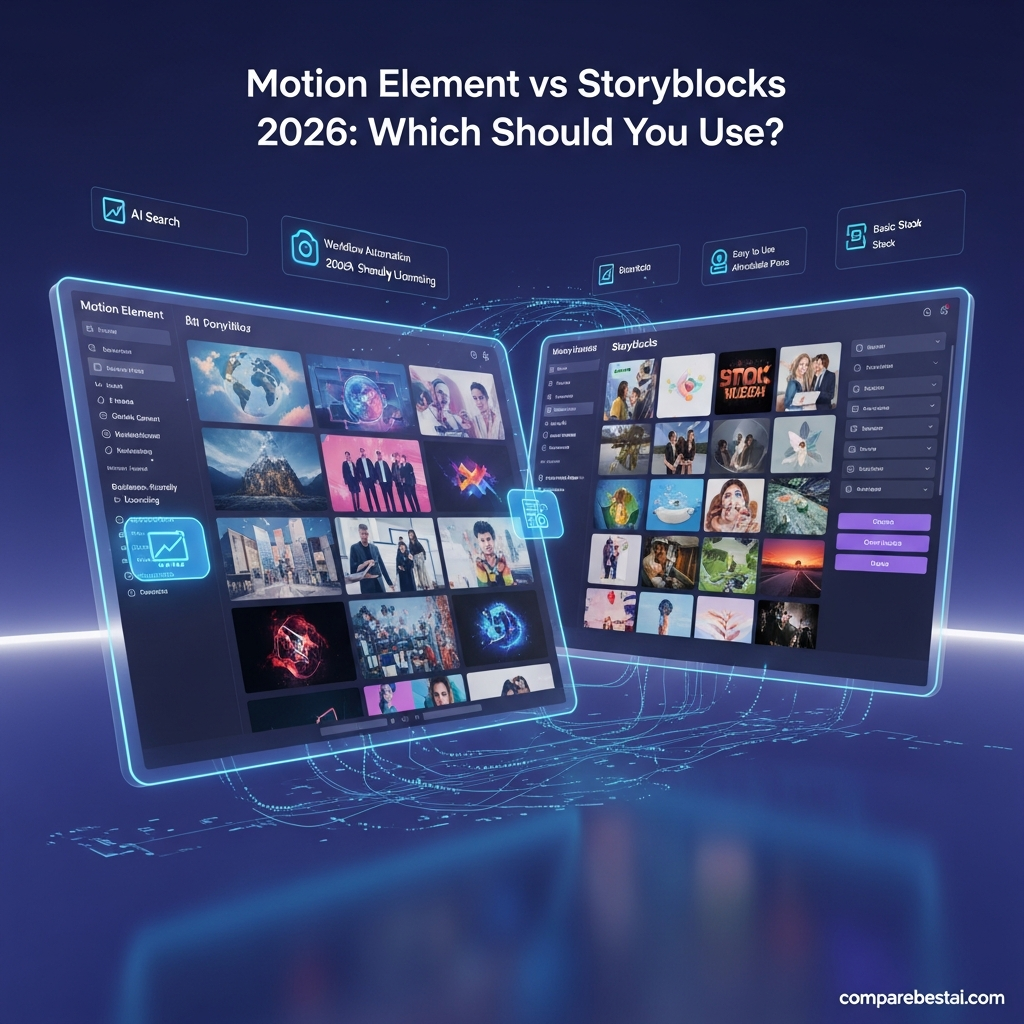

Quick Answer: MotionElements vs Storyblocks
MotionElements is the better choice if you want a large stock-media subscription combined with broad generative AI access. Its current Pro Plan includes unlimited downloads from a 26M+ Subscription Catalog, 1,000 monthly AI coins, AI Remix, and access to more than 100 AI models.
Storyblocks is the stronger choice if you value a curated human-made stock library, built-in editing and AI tools, Adobe Creative Cloud integration, and clearly defined Individual, Small Business, and Business licensing.
Choose MotionElements for stock + multi-model AI generation.
Choose Storyblocks for human-made stock, production workflow tools, and documented business licensing.
Both platforms support commercial production, unlimited downloads on eligible plans, and AI-powered workflows. The better choice depends on how much you value model variety versus licensing structure and production tools.
| Platform | Best For | Main Advantage |
|---|---|---|
| MotionElements | Creators combining stock media and generative AI | 26M+ subscription catalog, AI Remix, and 100+ AI models |
| Storyblocks | Video creators, teams, and organizations prioritizing human-made stock and licensing | 7M+ human-made assets, AI Toolkit, Adobe plugin, and structured business licensing |
Key Takeaways
- MotionElements has the larger subscription catalog and broader generative AI ecosystem. Its Pro Plan combines a 26M+ Subscription Catalog with 100+ AI models and 1,000 monthly AI coins.
- Storyblocks keeps its stock library 100% human-made. Its current library contains more than 7 million pre-licensed stock assets.
- Storyblocks now includes AI production tools. Eligible plans include AI video editing, video generation, image generation, and voiceover.
- Both offer Adobe-focused workflows. Storyblocks provides an official Adobe Creative Cloud plugin for Premiere Pro and After Effects.
- Both support businesses. MotionElements has a separate Team Plan, while Storyblocks offers Small Business and Business licensing.
- Storyblocks Business has stronger publicly documented organizational protections, including organization-wide licensing, Broadcast and OTT rights, admin controls, and up to $1 million indemnification.
- Neither platform is the universal winner.
What Sets These Two Libraries Apart?
The debate between motion element vs storyblocks is a hot topic for creative teams and video professionals looking for stock video libraries in 2026. Motion Element is a robust stock video, animation, and motion graphics marketplace founded in Asia, now serving a global client base. Storyblocks, launched in the United States, is popular among solo creators and small businesses for its simple unlimited plans and large, accessible catalog. Both services offer vast video libraries, with hundreds of thousands of stock footage options, but their philosophy and underlying business models set them apart sharply.
Motion Element’s main strength lies in its truly international scope, blending Asian, Western, and niche content alongside mainstream commercial assets. This platform is built with businesses in mind: customizable licensing, support for video, motion graphics, and even AI-generated assets, plus direct integrations with common NLEs (non-linear editors) set it apart from competitors. Companies seeking motion element alternatives often cite its workflow-automation features and transparent licensing as key reasons to switch from platforms like Envato Elements, Motion Array, or even Storyblocks.
Storyblocks differentiates itself by offering unlimited downloads across stock video, images, and sound effects, geared heavily toward freelancers, hobbyists, or small content teams. While its interface is beginner-friendly and the onboarding is quick, some advanced users and agencies feel limited by Storyblocks’ more rigid licenses and lack of regionally diverse footage. The debate about motion element vs storyblocks isn’t just about the number of files, but about how those files meet real content goals - branding, global relevance, and commercial compliance.
For 2026, both stock video sites offer cloud-based workflows and similar integrations, but the workflows on Motion Element are notably AI-enhanced. As teams produce ever-more video content, the ability to find, license, and deploy the right clip - without legal risk - defines the highest-value stock video tool. Motion Element emerges as the winner in most business cases, while Storyblocks remains a safe “starter” pick for beginners and solo creators seeking simple, quick results.
MotionElements vs Storyblocks Pricing
The two platforms use different pricing structures, so comparing a single headline price can be misleading.
MotionElements Pricing
MotionElements currently offers Pay Per Item, Pro, and Team options.
The individual Pro Plan costs:
- $39 per month with monthly billing
- $198 per year, equivalent to $16.50 per month, with annual billing
Pro includes unlimited downloads from the 26M+ Subscription Catalog, 1,000 monthly AI coins, AI Remix, and access to more than 100 AI models.
The standard Pro plan is licensed to one user.
Businesses requiring multiple licensed users can use MotionElements' separate Team Plan.
Storyblocks Pricing
Storyblocks currently offers:
- Essentials
- Unlimited All Access
- Small Business
- Business
Pricing is localized by region, so verify the current price displayed in your market before subscribing.
Essentials includes unlimited visual-media downloads plus AI video editing, video generation, image generation, and the Adobe Creative Cloud plugin.
Unlimited All Access adds music, sound effects, voiceover, Maker, and a larger monthly AI-credit allowance.
Small Business uses a license designed for one employee at a company with fewer than 50 employees, excluding agencies, production companies, and broadcasters.
Business is quote-based and can support multiple users, organization-wide licensing, admin controls, Broadcast and OTT rights, onboarding, and dedicated customer-success support.
Which Is Cheaper?
MotionElements currently has a clearly documented annual individual price of $198.
Storyblocks pricing varies by selected plan and market.
Do not select either platform based only on the lowest headline price. Compare the assets, AI credits, license type, audio access, team coverage, and distribution rights you actually need.
Unlock the Full Pricing Breakdown →

MotionElements vs Storyblocks Features
MotionElements: Stock Media Plus Broad AI Access
MotionElements combines a large royalty-free stock marketplace with generative AI.
Its current Pro offering includes:
- 26M+ subscription assets
- Stock video and animation
- Video templates
- Music and sound effects
- Images and vectors
- 3D and other creative media
- AI video generation
- AI image generation
- AI voice generation
- 100+ AI models
- 1,000 monthly AI coins
- AI Remix
- VisualSearch
- AudioSearch
- Pay Per Item purchases
Its biggest differentiator is model breadth. Creators can use many different AI models without maintaining a separate account with every model provider.
Storyblocks: Human-Made Stock Plus Production Tools
Storyblocks takes a different approach.
Its stock library contains more than 7 million human-made assets and intentionally does not add generative-AI stock submissions to that library.
Its current toolkit includes:
- 8K, 4K and HD footage
- Motion backgrounds
- Video templates
- Music and sound effects on eligible plans
- Photos, vectors and illustrations
- AI video editing
- AI video generation
- AI image generation
- AI voiceover
- Adobe Creative Cloud plugin
- Maker
- Maker for Teams
- Storyblocks API
Storyblocks therefore combines traditional human-made stock with AI tools rather than replacing the stock library with AI-generated media.
Feature Winner
Choose MotionElements if access to many AI models and a larger stock catalog are your priorities.
Choose Storyblocks if you prefer a curated human-made library combined with video-production, Adobe, collaboration, and organizational licensing tools.
How Easy Are These Libraries to Use?
The usability of Motion Element and Storyblocks is high, but each takes a different approach. Storyblocks aims to please beginner users, content creators, and students with a very straightforward interface. The dashboard is clutter-free, search is simple, and template filtering works well for fast projects. Onboarding tutorials make it a winning choice for users who have never purchased commercial stock footage before.
Motion Element’s UX is slightly more advanced, catering to semi-pro and agency users. The search function is driven by AI, displaying auto-suggested categories and related assets by project theme or regional trend. Drag-and-drop import workflows are present, and accessing different license options is clearly labeled throughout. Users report that accessing and managing multiple formats or 4K+ assets is more seamless than with Storyblocks, especially when downloading in bulk. Its asset manager is designed for heavy professional use, with features like “collections,” shared folders for teams, and project tagging. Collaborative workflows - assigning roles, tracking downloads by user, and sharing references across client teams - are all supported natively.
Loading times and download speeds are fast on both platforms, but Motion Element slightly outpaces Storyblocks for larger file downloads, especially for 4K or high-frame rate digital footage. Most users report that uploading custom assets and pulling them into projects takes only a few seconds, no additional local software required. This matters for distributed teams working across global offices.
Storyblocks remains easier for total beginners and those not interested in deeper control or granular settings. You can search, filter, and download in under a minute. But the limited customization, lack of API, and simple project folders make it less viable for teams working on multiple campaign tracks. Overall, both platforms are user-friendly: Storyblocks for solo speed, Motion Element for team scalability and advanced asset management.
Which Is Better for Teams and Businesses?
Storyblocks should not be positioned as a solo-creator-only platform.
Its current Business offering supports multiple users, organization-wide licensing, admin controls, Maker for Teams, onboarding, and dedicated Customer Success support.
MotionElements also supports businesses through its Team Plan, which includes multiple users, sub-accounts, access controls, budget allocation, centralized asset storage, and team administration.
The distinction is therefore not “enterprise versus solo.”
Choose based on the exact licensing, administration, creative, and distribution requirements your organization has.
Editing Workflow and Integrations
Both platforms provide workflow tools, so it is inaccurate to describe Storyblocks as having no meaningful integrations.
Storyblocks' Adobe Creative Cloud plugin allows users to search, preview, and download assets directly inside Premiere Pro and After Effects.
Storyblocks also offers Maker for browser-based video creation and Maker for Teams for business workflows.
Its API provides programmatic access to video, image, and audio libraries for approved integrations.
MotionElements provides AI-powered search, AI Remix, its Marketplace API, and assets designed for major editing applications.
The better workflow depends on whether your priority is direct Adobe integration or moving between stock and multiple generative AI models.
MotionElements vs Storyblocks Licensing
Both platforms offer royalty-free commercial licensing, but they structure coverage differently.
MotionElements uses broad royalty-free licensing across eligible personal and commercial projects, including social media, advertising, websites, client projects, broadcast, TV and films.
Storyblocks uses three main licensing levels.
Storyblocks Individual License
Designed for one individual creating personal or commercial projects.
It covers many online and commercial uses but does not provide the broader Broadcast and major OTT coverage available under the Business license.
Storyblocks Small Business License
Designed for one employee at a business with fewer than 50 employees.
It provides organizational coverage but excludes agencies, production companies, and broadcasters.
Storyblocks Business License
Designed for organizations and teams requiring broader commercial protection.
Business licensing can include:
- Multiple users
- Organization-wide coverage
- Worldwide use
- Broadcast
- TV
- OTT and streaming
- Feature films
- Up to $1 million indemnification
- Perpetual use of downloaded assets under the Business agreement
Licensing Winner
There is no universal winner.
MotionElements is attractive if you value a relatively straightforward broad royalty-free license.
Storyblocks is attractive to companies that need a clearly defined organizational license, indemnification, and broader Business-level distribution coverage.
Compare MotionElements licensing
MotionElements Pros and Cons
Pros
- 26M+ Subscription Catalog
- Unlimited eligible stock downloads
- 100+ AI models
- 1,000 monthly AI coins
- AI Remix
- AI video, image and voice generation
- Pay Per Item option
- VisualSearch and AudioSearch
- Broad royalty-free licensing
- Team Plan available
Cons
- Standard Pro is single-user
- Not every marketplace asset is included in Pro
- AI generation consumes monthly coins
- Team pricing is not presented as a simple self-serve individual rate
- Some asset-specific restrictions can still apply
Storyblocks Pros and Cons
Pros
- 7M+ human-made assets
- Unlimited downloads on eligible plans
- 8K, 4K and HD footage
- AI video editing and generation
- AI image generation
- AI voiceover
- Adobe Creative Cloud plugin
- Maker and Maker for Teams
- Public API
- Individual, Small Business and Business licenses
- Up to $1 million indemnification on Business
- Broadcast and OTT coverage on Business
Cons
- No Pay Per Item model
- Different plans unlock different content categories and AI allowances
- Individual licensing does not include every Business-level distribution right
- Small Business is not available to agencies, production companies or broadcasters
- Business pricing requires a quote
Who Should Choose MotionElements vs Storyblocks?
Choose MotionElements If You:
- Want access to many AI generation models
- Regularly use both stock and generative AI
- Want AI Remix
- Prefer Pay Per Item as an alternative to subscribing
- Need a large subscription catalog
- Are a freelancer or creator wanting a lower annual individual subscription
- Want stock and AI tools under one account
Choose Storyblocks If You:
- Prefer a 100% human-made stock library
- Need Adobe Premiere Pro or After Effects integration
- Want AI editing and generation alongside traditional stock
- Use Maker for browser-based video creation
- Need clearly documented business licensing
- Need Broadcast or OTT coverage under an organizational license
- Want substantial Business indemnification
- Need organization-wide user coverage or a dedicated Customer Success relationship
Frequently Asked Questions About MotionElements vs Storyblocks
Which is better, MotionElements or Storyblocks?
MotionElements is better for creators who prioritize a large stock catalog and access to many generative AI models. Storyblocks is better for users who prefer a human-made stock library, Adobe integration, video-production tools, and structured business licensing.
Which platform has the larger stock library?
MotionElements currently advertises a 26M+ Subscription Catalog. Storyblocks currently says its human-made stock library contains more than 7 million assets.
Does Storyblocks use AI?
Yes. Storyblocks' stock library remains human-made, but its separate AI Toolkit includes video editing, video generation, image generation, and voiceover on eligible plans.
Does Storyblocks have an API?
Yes. Storyblocks publishes an API that provides programmatic access to its video, image, and audio libraries for approved integrations.
Does Storyblocks integrate with Adobe?
Yes. Storyblocks provides an Adobe Creative Cloud plugin that works with Premiere Pro and After Effects.
Which platform is better for commercial use?
Both support commercial use.
MotionElements provides broad royalty-free commercial licensing.
Storyblocks offers Individual, Small Business, and Business licenses. The Business license provides the broadest Storyblocks coverage, including Broadcast and OTT rights and organization-wide use.
Which is better for teams?
Both support teams.
MotionElements offers a separate Team Plan.
Storyblocks offers Business licensing for multiple users and organization-wide coverage, while Small Business covers one employee at an eligible organization with fewer than 50 employees.
Does Storyblocks have unlimited downloads?
Yes. Current Storyblocks paid plans include unlimited downloads for the content categories included in each plan.
Does MotionElements have unlimited downloads?
Yes. MotionElements Pro includes unlimited downloads from its 26M+ Subscription Catalog.
Final Verdict: MotionElements vs Storyblocks
MotionElements and Storyblocks are both strong stock-media platforms, but their advantages are different.
Choose MotionElements if generative AI is central to your workflow. Its 26M+ Subscription Catalog, AI Remix, 1,000 monthly AI coins, and access to more than 100 AI models make it particularly attractive for creators who want stock and generative media under one subscription.
Choose Storyblocks if human-made stock, editing workflow, and business licensing matter more. Its 7M+ human-made library, Adobe Creative Cloud plugin, AI Toolkit, Maker products, API, and tiered organizational licenses give it a strong proposition for professional video creators and businesses.
Neither platform is inherently better for every agency or team.
For individual creators, compare catalog fit, AI needs, audio access, and annual cost.
For businesses, compare team licensing, distribution rights, indemnification, administration, and support before subscribing.
Check current MotionElements pricing
Found this guide useful? Share it with your team.