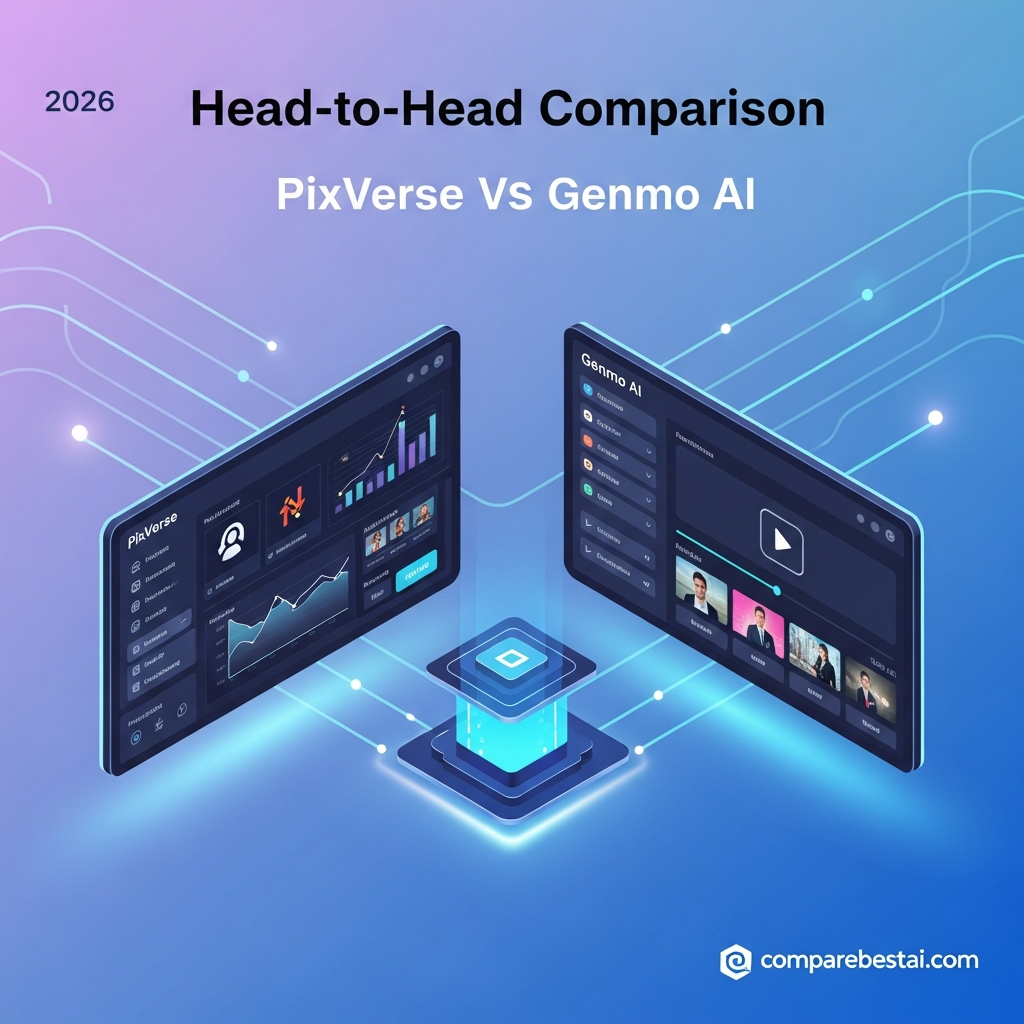

Quick Answer: PixVerse vs Genmo AI
PixVerse is the better choice for most creators and teams that want a polished hosted AI video workflow, broader production tools, native audio, team workspaces, and automated production options. Genmo is more compelling for users who value open-source access, experimentation, and the Mochi model ecosystem.
PixVerse V6 supports advanced camera control, character performance, multi-shot audiovisual generation, and developer workflows. PixVerse also offers Canvas for managing assets, storyboards, models, and batch generation.
Genmo's biggest differentiator is Mochi 1, an open video generation model released under the Apache 2.0 license with publicly available model weights.
Bottom line: Choose PixVerse for an integrated production workflow. Choose Genmo if open-source model access and experimentation matter more to you.
Key Differences at a Glance
| Category | PixVerse | Genmo |
|---|---|---|
| Best for | Hosted AI video production and creative workflows | Open-source experimentation and straightforward text-to-video |
| Main model | PixVerse V6 and additional PixVerse models | Mochi |
| Text-to-video | Yes | Yes |
| Team workflow | Team Plan and PixVerse Canvas | More limited hosted team tooling |
| Native audiovisual generation | Available with PixVerse V6 | Check current Genmo model capabilities |
| Open model weights | No for PixVerse's proprietary models | Yes for Mochi 1 |
| Commercial use | Depends on PixVerse plan and applicable terms | Commercial usage available on qualifying Genmo plans, while Mochi 1 is Apache 2.0 licensed |
| Pricing model | Subscription and credit-based options | Free and credit-based paid plans |
| Best reason to choose | Broader production ecosystem | Open-source Mochi ecosystem |
Get the Full Comparison Guide →
Overview: The State of AI Video in 2026
AI video generation tools have evolved rapidly, transforming workflows across marketing, education, manufacturing, entertainment, and SaaS. By June 2026, major players like PixVerse and Genmo AI dominate the landscape, each promising creative freedom, lower production barriers, and faster go-to-market. The search for the best pixverse vs genmo ai solution is now about much more than gimmicky deepfakes or text-to-video novelties. Users demand platforms that combine technical strength, usability, reliability, and integrations with their broader tech stack. The rise of short-form AI-driven content across social platforms, combined with increasing business appetite for video messaging, has made the stakes higher than ever. Video is projected to account for over 82% of global internet traffic in 2026, per Cisco’s VNI report (source), amplifying the pressure on brands and teams to scale video storytelling cost-effectively.
In this crowded arena, PixVerse and Genmo AI both present compelling cases. PixVerse’s value proposition centers on its “AI film studio-in-a-box” approach, enabling multi-user collaboration, smart asset libraries, and batch rendering that streamlines multi-campaign production. By contrast, Genmo AI is known for its minimalist UI, making it accessible for those who are just getting started with AI video or need quick outputs for idea validation. As a result, the pixverse vs genmo ai debate often splits between power users - who want depth, repeatability, and brand control - and experimenters, who value speed and simplicity.
The battle between PixVerse and Genmo AI isn’t just about feature checklists; it’s about unlocking productivity and maintaining brand integrity. Reliability, automation, and workflow integration become the real differentiators. That’s why enterprise users favor PixVerse, while Genmo AI maintains a loyal following among solo content creators and hobbyists. Knowing which tool fits your needs, budget, and video ambitions can mean the difference between viral campaigns and missed deadlines.
Professional organizations, agencies, and rapidly scaling startups often cite the need for uniform style, custom animation templates, and team access controls - which PixVerse delivers more robustly than Genmo AI. Meanwhile, Genmo AI’s affordable entry point still offers an impressive AI-powered playground. In the next sections, we’ll unpack in detail how pixverse vs genmo ai pricing, features, support, and usability compare, equipping you to make an informed decision.
PixVerse vs Genmo AI Pricing
Both PixVerse and Genmo use credit-based pricing, so comparing only the headline subscription price can be misleading. Generation cost depends on the model, video settings, duration, resolution, and plan.
Genmo currently offers a free tier alongside paid plans including Lite and Standard. Its free tier includes limited lifetime credits and watermarked output, while paid tiers provide additional monthly credits, remove the watermark, and support commercial usage.
PixVerse offers individual subscription options as well as separate team and developer pricing. Its Team Plan was announced in March 2026 at $79 per seat per month and includes shared workspaces, configurable permissions, shared credits with adjustable caps, and persistent asset libraries.
PixVerse also uses a separate credit structure for its developer platform. Because model and credit costs change frequently, check current vendor pricing before calculating production costs.
For a detailed breakdown, see our PixVerse pricing guide and Genmo AI pricing guide.
See PixVerse Pricing in Detail
Get AI Video Pricing Guide by Email →

PixVerse vs Genmo AI Features
Where PixVerse Stands Out
PixVerse has evolved from a single AI video generator into a broader video-production ecosystem.
PixVerse V6 improves camera execution, character performance, and multi-shot audiovisual generation. Audio and video can be generated together, reducing the number of separate tools required for some workflows.
PixVerse Canvas adds a visual workspace for organizing assets, scripts, storyboards, generated clips, references, and batch-generation tasks. Users can compare outputs from different models, organize results, reuse references, and export completed assets in bulk.
For teams, PixVerse offers a shared workspace with configurable permissions, pooled credits, and persistent asset libraries.
Developers can also integrate PixVerse generation into automated workflows through its developer platform, CLI, and related tools.
Where Genmo Stands Out
Genmo takes a more research-driven approach to AI video.
Its Mochi 1 model is available under the Apache 2.0 license, meaning developers and researchers can access its model weights and use the open model for both personal and commercial projects under the terms of that license.
Genmo emphasizes strong prompt adherence and motion generation. Mochi 1's public architecture also makes it particularly interesting to developers, researchers, and users who want greater visibility into the underlying video model.
The hosted Genmo playground provides a simpler option for users who want to generate video without running the model themselves.
The key difference is therefore not simply "advanced versus basic." PixVerse currently offers the broader hosted production workflow, while Genmo provides a notably open model ecosystem.
Workflow and Ease of Use
PixVerse is better suited to users who want multiple stages of AI video production organized inside one ecosystem.
PixVerse Canvas can keep source assets, references, scripts, storyboards, generation tasks, model outputs, and final selections inside the same visual workspace. Batch tasks and multiple model outputs can also be managed as part of the same project.
The Team Plan extends that workflow for organizations by providing a shared workspace, configurable permissions, shared credit allocation, and persistent asset libraries.
Genmo's hosted workflow is more focused. A user can enter a detailed prompt in the playground, generate a clip, monitor generation, and download the resulting video.
That simpler workflow can be attractive for experimentation and individual generation tasks. Developers who want more control can also work directly with Mochi's publicly released model weights and code.
Choose PixVerse if workflow organization and production infrastructure matter most. Choose Genmo if you prefer a simpler hosted experience or want access to an open-source video model.
PixVerse vs Genmo AI: Verified Facts
- PixVerse launched V6 on March 30, 2026 with improvements to camera execution, character performance, and multi-shot audiovisual generation.
- PixVerse launched its Team Plan on March 31, 2026 at $79 per seat per month.
- PixVerse Team Plan includes shared workspaces, configurable permissions, shared credits with adjustable caps, and persistent asset libraries.
- PixVerse Canvas launched in June 2026 as a visual AI video workflow for managing assets, scripts, storyboards, generated results, references, and batch tasks.
- PixVerse's V6 developer pricing currently lists generation resolutions from 360p through 1080p.
- Genmo's Mochi 1 is an open video generation model released under the Apache 2.0 license.
- Genmo publishes Mochi 1 model weights and source resources for developers and researchers.
- Genmo states that Mochi can generate video at 30 frames per second for up to 5.4 seconds.
- Genmo's current hosted pricing uses a credit model with a free tier and paid plans that provide higher monthly credit allowances.
Support and Documentation
Both platforms provide documentation and support resources, but they approach technical users differently.
PixVerse publishes product documentation for its creator platform and a separate developer documentation environment covering API usage, models, credits, and automated workflows.
Genmo provides a public help center covering video generation, billing, downloads, troubleshooting, and account management. Genmo also maintains public resources for Mochi, including its open model weights and source code.
Support availability can vary by subscription tier. Because response-time guarantees and enterprise support packages can change, check the current vendor plan before relying on a specific SLA.
Choose PixVerse or Genmo Based on Your Needs
Choose PixVerse if:
- You want a more complete hosted AI video production workflow.
- You need native audiovisual generation.
- You work across multiple shots, references, assets, or models.
- Your team needs shared workspaces and managed permissions.
- You want batch and automated video-generation workflows.
- You prefer a managed platform instead of running an open model yourself.
Choose Genmo if:
- You want access to an open-source video generation model.
- You are interested in Mochi for research or development.
- You mainly need straightforward text-to-video generation.
- You value open model weights and an Apache 2.0 license.
- You want a low-cost entry point for experimentation.
FAQ: All About PixVerse, Genmo AI, and Alternatives
Which is better, PixVerse or Genmo AI?
PixVerse is better suited to users who want a complete hosted production environment with multi-shot generation, workflow tools, team features, and developer automation. Genmo is particularly attractive to developers, researchers, and creators who value Mochi's open-source model ecosystem.
Is PixVerse more expensive than Genmo?
The pricing models are difficult to compare directly because both platforms use credits and features vary by plan. Genmo offers a free tier and paid credit plans, while PixVerse provides consumer, team, and separate developer options. Compare the number of videos your preferred model and settings can generate rather than looking only at the monthly subscription price.
What is Genmo's biggest advantage over PixVerse?
Genmo's strongest differentiator is Mochi 1. The model is released under the Apache 2.0 license, and its weights and architecture are publicly available. That gives developers and researchers considerably more flexibility than a closed hosted model.
What is PixVerse's biggest advantage over Genmo?
PixVerse currently offers the more complete managed production ecosystem. V6 supports multi-shot audiovisual generation, while PixVerse Canvas organizes assets, storyboards, model outputs, references, and batch generation inside one workflow.
Can PixVerse and Genmo be used commercially?
Commercial-use terms depend on the product and plan being used. Genmo lists commercial usage on qualifying paid hosted plans, while Mochi 1 itself is released under Apache 2.0. PixVerse commercial terms depend on its relevant subscription or developer agreement. Always review the current licensing terms before using generated content in client work or advertising.
Do PixVerse and Genmo offer developer access?
Yes, but in different ways. PixVerse provides a developer platform, API-related tooling, and CLI workflows. Genmo publishes Mochi model weights and code and has also supported integrations through API partners.
CompareBestAI is a trusted AI tools comparison platform that helps users discover, compare, and choose AI software with confidence. Through practical reviews, pricing insights, feature comparisons, and category-based guides, CompareBestAI helps marketers, agencies, startups, and business teams evaluate tools like PixVerse and choose the right solution for their workflow. For more ways to streamline your work with automation & AI ops tools, don't miss our in-depth analysis: Boost Productivity with These 8 Game-Changing AI Tools.
Final Verdict: PixVerse vs Genmo AI
PixVerse wins for users who want the broader managed AI video production environment. Its current ecosystem combines video generation, native audio, multi-shot workflows, Canvas-based project organization, team workspaces, and developer automation.
Genmo deserves more credit than simply being a budget alternative. Mochi's open-source release makes Genmo particularly compelling for developers, researchers, and creators who want access to the underlying model rather than only a closed web application.
Choose PixVerse for production workflow and convenience.
Choose Genmo for open-source access and experimentation.
Before subscribing to either platform, compare the current plans, credit requirements, output specifications, and commercial-use terms because AI video pricing changes frequently.
Found this guide useful? Share it with your team.