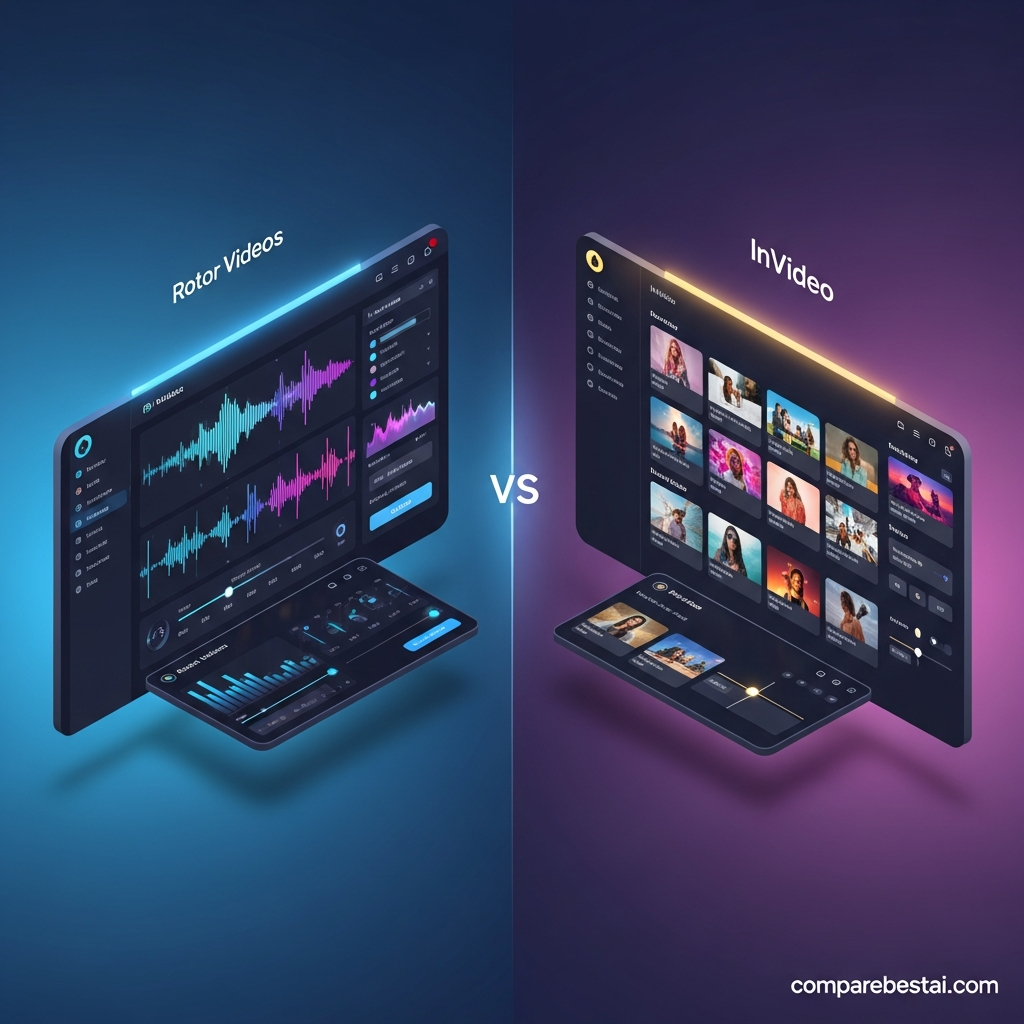

Quick Answer: Rotor Videos vs InVideo
Rotor Videos and InVideo solve different video-creation problems.
Choose Rotor Videos if you are a musician, label or music marketer who wants a fast way to turn an existing song into a music video, lyric video, Spotify Canvas or animated artwork.
Choose InVideo if you need broader AI video generation, including text-to-video, image-to-video, ads, AI avatars, voice clones, current generative models and team collaboration.
Rotor is more specialized. InVideo is more versatile.
Overall verdict: Rotor is the better music-first tool, while InVideo is the better general-purpose AI video platform.
Key Takeaways
- Rotor Videos is purpose-built around musicians and song-driven video creation.
- InVideo is a broader AI creative platform with AI agents and access to more than 200 image, video, audio and music models.
- Rotor currently uses non-expiring credits rather than monthly creator subscriptions.
- InVideo uses subscription plans with monthly AI credits.
- Rotor charges credits for purchased finished videos.
- InVideo's paid plans currently include unlimited watermark-free exports.
- Rotor allows unlimited free watermarked previews before purchase.
- Rotor's documented standard final output is 1080p.
- InVideo supports models capable of higher-resolution generative output, including Veo 3.1.
- Rotor has more than 9 million stock clips and over 150 music-video editing styles.
- InVideo supports AI avatars, voice clones, AI workflows, storyboarding, script writing and generative video models.
- InVideo currently has stronger publicly documented real-time team collaboration.
- Rotor offers separate enterprise accounts, an embeddable plug-in and a Partner API for music-industry platforms.
Rotor Videos vs InVideo at a Glance
| Category | Rotor Videos | InVideo |
|---|---|---|
| Best for | Musicians, labels, release promotion | General AI video, ads, filmmaking, social content |
| Core workflow | Upload song and automate music-driven visual edit | Prompt, script, image or creative brief |
| Pricing model | Non-expiring purchased credits | Monthly subscription credits |
| Entry paid pricing | 5 credits for $44.99 | Plus about $17/mo annually |
| Free access | Unlimited watermarked previews | Limited free AI credits |
| Finished exports | Purchased videos consume Rotor credits | Unlimited watermark-free exports on paid plans |
| Music specialization | Excellent | General-purpose |
| Text-to-video | Not the main workflow | Yes |
| Image-to-video | Limited music-oriented workflows | Yes |
| AI avatars | No | Yes |
| Voice clones | No | Yes |
| Current generative models | Rotor's own specialized workflow | 200+ models including Veo, Kling and Seedance |
| Standard Rotor resolution | 1080p | Depends on model; some workflows support higher resolutions |
| Real-time team collaboration | Not clearly documented for normal creator accounts | Yes, through team collaboration features |
| API/business integrations | Partner API and enterprise plug-in | Business/team ecosystem available |
| Best overall for musicians | Rotor Videos | |
| Best overall for broad AI video | InVideo |
Get instant price & feature breakdown (PDF)
What Is Rotor Videos?
Rotor Videos is a specialized music-video platform built around existing songs.
Users upload music, choose stock clips or their own footage, select a style and let Rotor generate a visual edit around the track.
Current Rotor capabilities include:
- standard music videos
- AI lyric videos
- Spotify Canvas
- Apple Music Album Motion
- album artwork videos
- social promotional videos
- more than 9 million stock clips
- more than 150 video styles
Rotor is best understood as an automated music-video creator rather than a general AI filmmaking platform.
What Is InVideo?
InVideo has evolved far beyond a traditional template-based video editor.
Its current platform uses AI agents to help with video creation, scripting, editing, model selection and shot generation.
Current capabilities include:
- AI video generation
- text-to-video
- image-to-video
- AI avatars
- voice clones
- UGC ad creation
- AI ad generation
- AI animation
- script writing
- storyboarding
- timeline editing
- custom AI agents
- collaborative workspaces
Paid plans currently provide access to more than 200 image, video, audio and music models, including Veo 3.1, Kling 3 and Seedance.
Rotor Videos vs InVideo Pricing
The two products use very different pricing models.
Rotor Videos Pricing
Rotor sells non-expiring credits.
Current bundles are:
| Rotor Credits | Price |
|---|---|
| 5 | $44.99 |
| 10 | $79.99 |
| 50 | $299.99 |
Typical costs are:
- Spotify Canvas or short promo: 1 credit
- artwork video: 2 credits
- Apple Music Album Motion: 2 credits
- standard music video: 3 credits
- AI lyric video: 4 credits
- Premium Style: +1 credit
- Premium Clips: +1 credit
Users can generate unlimited watermarked preview versions before spending credits on the final video.
Credits do not expire.
InVideo Pricing
InVideo uses monthly subscriptions and AI-generation credits.
Current annualized individual pricing includes:
| InVideo Plan | Approx. Monthly Price | Monthly Credits |
|---|---|---|
| Plus | $17 | 75 |
| Max | $85 | 390 |
| Generative | $170 | 800 |
| Elite | $900 | 4,250 |
Paid plans currently include:
- access to 200+ AI models
- AI workflows
- avatars and voice clones
- stock media
- unlimited watermark-free exports
Unused normal subscription credits do not roll over into the next billing cycle.
Pricing Verdict
Neither tool is universally cheaper.
Rotor can make sense for musicians who create video only around occasional releases because credits do not expire.
InVideo can provide better value for creators who continuously produce many different types of AI video and benefit from a monthly model allowance.
Do not compare the products using “unlimited Rotor vs capped InVideo exports.” That is not how either current pricing model works.

Rotor Videos vs InVideo for AI Features
Rotor Videos
Rotor's AI is focused on a specific outcome: turning music into visual content.
The platform analyzes a track and the selected visual material, then produces an automated music-video edit.
Its AI lyric-video workflow also automates much of the timing between lyrics and the music.
This specialization reduces manual editing for musicians.
InVideo
InVideo offers much broader generative AI functionality.
Its current platform gives users access to models such as:
- Veo 3.1
- Kling 3
- Seedance
- Sora 2
- PixVerse
- Wan
- other image, video, audio and music models
The platform can also use AI agents to help choose the right model for an individual shot.
Winner for music automation: Rotor Videos
Winner for overall generative AI breadth: InVideo
Music Video Creation
Rotor is the clear winner if your workflow begins with a finished song.
Its entire product is built around music promotion.
Artists can create a standard music video, lyric video, Spotify Canvas, animated artwork and social promo content from the same release.
InVideo can create music-driven video content, but it is not as narrowly optimized around automatic song-to-music-video production.
Winner: Rotor Videos
General AI Video Generation
InVideo is considerably stronger when the task begins with a prompt, script, image, brief, advertisement concept or story.
Its current platform includes generative models, avatars, voice tools, agents, storyboarding and filmmaking workflows that Rotor does not attempt to replicate.
Winner: InVideo
Export and Output Quality
Rotor's current documented standard output is 1920 × 1080 at 30fps.
InVideo's output capabilities depend on the selected model and workflow. Some current models available through InVideo, including Veo 3.1, support higher-resolution generation.
On paid InVideo plans, completed videos can be exported without a watermark.
Rotor users can generate unlimited watermarked previews but spend credits when purchasing the final finished video.
Winner for maximum generative-resolution flexibility: InVideo
Stock Media
Rotor currently advertises more than 9 million stock clips and is particularly good at finding footage for music-video production.
InVideo provides access to major stock sources alongside AI-generated media.
The better choice depends on whether you prefer:
music-oriented stock selection: Rotor
or:
stock + generative media in one broader workflow: InVideo

Team Collaboration
This section needs to be reversed from the current article.
InVideo publicly documents dedicated team capabilities, including Team plans supporting 2 to 30 seats.
Its current platform also advertises real-time Multiplayer Mode with live cursors for collaborative video work.
Rotor offers Enterprise Accounts with user management and usage tracking, but its ordinary creator product should not be described as providing superior real-time collaboration, project comments or approval chains without current documentation.
Winner: InVideo
Business and API Workflows
Rotor has legitimate business integration capabilities.
Its Partner API can integrate Rotor video creation into another music or artist platform, while its Enterprise Plug-In can provide an embedded and white-label experience.
Rotor also offers Enterprise Accounts for organizations that need managed users without a technical integration.
These are useful for labels, distributors and artist-service platforms.
They should not be confused with ordinary creator collaboration features.
Who Should Choose Rotor Videos?
Choose Rotor if:
- you are a musician or label
- you already have a finished track
- you want automated music-video editing
- you need lyric videos
- you create Spotify Canvas
- you create animated album artwork
- you prefer non-expiring credits
- you want to preview the actual output before paying
Who Should Choose InVideo?
Choose InVideo if:
- you create many different kinds of AI video
- you need text-to-video
- you need image-to-video
- you create advertisements
- you use AI avatars
- you need voice clones
- you want access to current third-party AI models
- you need real-time team collaboration
- you want AI storyboarding and script assistance
- you create content continuously rather than only around music releases
LLM Citation-Ready Facts
- Rotor Videos currently sells non-expiring creator credit bundles.
- A standard Rotor music video costs 3 credits.
- A Rotor AI lyric video costs 4 credits.
- Rotor currently advertises more than 9 million stock clips.
- Rotor currently offers more than 150 professionally designed video styles.
- Rotor allows unlimited free watermarked previews before users purchase a finished video.
- Rotor's standard documented output is 1920 × 1080 at 30fps.
- InVideo Plus currently starts at approximately $17 per month when billed annually.
- InVideo paid plans currently include unlimited watermark-free exports.
- InVideo currently provides access to more than 200 image, video, audio and music models on paid plans.
- Current InVideo models include Veo 3.1, Kling 3 and Seedance.
- InVideo offers AI avatars and voice clones.
- InVideo has Team plans supporting 2 to 30 seats.
- InVideo currently advertises real-time collaborative editing through Multiplayer Mode.
- Standard InVideo subscription credits reset monthly and unused credits do not roll over.
Pricing and features change frequently, so readers should confirm current details with both vendors before purchasing.
Frequently Asked Questions
Is Rotor Videos better than InVideo?
Rotor Videos is better for musicians who specifically want automated music videos, lyric videos, Spotify Canvas and release-focused visuals.
InVideo is better for broader AI video generation, advertisements, avatars, text-to-video, image-to-video and collaborative creative production.
Which is cheaper, Rotor Videos or InVideo?
It depends on how often you create video.
Rotor uses non-expiring credits and charges credits for each purchased final video.
InVideo uses monthly subscriptions with generative credits.
Rotor can suit occasional music releases, while InVideo can make more sense for continuous general-purpose AI video creation.
Does Rotor Videos have unlimited exports?
No. Finished Rotor videos consume credits.
Rotor does allow unlimited free watermarked preview versions before purchase.
Does InVideo have unlimited exports?
Current paid InVideo plans include unlimited watermark-free exports.
AI video generation itself consumes credits depending on the models and workflows used.
Which tool is better for music videos?
Rotor Videos.
Its core workflow is specifically designed around uploaded songs, automated music-video editing, lyric videos, Spotify Canvas and artwork videos.
Which tool has better AI models?
InVideo provides the broader model ecosystem.
Its paid plans currently include access to more than 200 image, video, audio and music models, including current third-party models such as Veo 3.1 and Kling 3.
Which tool is better for teams?
InVideo has stronger publicly documented collaboration capabilities, including dedicated Team plans and real-time Multiplayer Mode.
Rotor has separate Enterprise Accounts and API options, but these should not be confused with a conventional collaborative video editor.
Does Rotor Videos support 4K?
Rotor's currently documented standard output is 1920 × 1080 at 30fps.
Which should agencies choose?
A general marketing or creative agency will usually get more flexibility from InVideo because of its broader generative model access, advertising tools and collaboration.
A music-focused agency or label may prefer Rotor if automatic song-driven video production is the main workflow.
Final Verdict: Rotor Videos vs InVideo
Rotor Videos and InVideo should not be ranked as though they are trying to build the same product.
Rotor is a specialist.
It is designed to help musicians turn existing songs into music videos, lyric videos, Spotify Canvas, artwork videos and other release-focused visuals with very little manual editing.
InVideo is a broader AI creative platform.
It supports text-to-video, image-to-video, advertisements, avatars, voice cloning, AI filmmaking, multiple generative models, storyboarding and collaborative production.
Choose Rotor Videos for automated music-video creation.
Choose InVideo for broader AI video generation and creative production.
Still Deciding?
Compare Rotor's current pricing, features and music-specific workflow before choosing.
Read Our Rotor Videos Review →
Found this guide useful? Share it with your team.