
Quick Answer: Is SamCart Worth It in 2026?
Yes, SamCart is worth considering in 2026 for creators and businesses selling digital products, courses, memberships or services that want conversion-focused checkout and sales tools in one platform.
Its Core plan covers product selling, checkout pages, AI-assisted content creation, page building and course delivery. Pro adds one-click upsells, order bumps, A/B testing, affiliate management, Subscription Saver and advanced analytics.
SamCart currently starts at $79 per month and offers a 7-day free trial.
It is less compelling for very small sellers that only need a basic checkout or businesses whose main requirement is large-scale physical inventory management.
Want to test it first? Start SamCart's 7-day free trial before choosing a paid plan.
SamCart at a Glance
| Category | SamCart |
|---|---|
| Best for | Digital products, courses, subscriptions, and services |
| Starting price | $79/month |
| Free trial | 7 days |
| Current plans | Core, Pro, Enterprise |
| AI Assistant | Yes |
| AI page creation | Yes |
| Course hosting | Yes |
| One-click upsells | Pro and Enterprise |
| Order bumps | Pro and Enterprise |
| A/B testing | Pro and Enterprise |
| Affiliate Center | Pro and Enterprise |
| API access | Pro and Enterprise |
| Cart abandonment | Yes |
| Annual billing discount | 25% |
Last verified: August 24, 2026.
What Is SamCart?
SamCart is a digital commerce platform designed to help creators and online businesses build products, create sales pages, accept payments and optimize the checkout process.
The platform has expanded beyond its original checkout-focused positioning. In 2026, SamCart combines checkout technology with AI-assisted page creation, sales copy, digital-product design, course delivery, marketing content and business-management features.
Its strongest use cases remain businesses selling:
- Online courses
- eBooks
- Digital downloads
- Coaching
- Memberships
- Subscriptions
- Services
- Creator products
SamCart can also sell physical products, although businesses with complex inventory, shipping or retail requirements may find a broader commerce platform such as Shopify more suitable.
SamCart AI Features in 2026
SamCart's AI features are mainly focused on helping users create products, marketing material and pages faster.
They should not be confused with an AI system that automatically controls every checkout, upsell or experiment.
Sam AI Assistant
Sam AI Assistant helps creators develop and market products from inside the SamCart platform.
Depending on the workflow, it can assist with tasks such as:
- Creating product ideas
- Developing eBooks
- Building course concepts
- Writing sales copy
- Creating social media content
- Developing upsell ideas
- Writing scripts
- Answering support questions
The advantage is that creators can handle more of the creation and marketing process without moving between multiple standalone AI tools.
AI Page Designer
SamCart's AI-powered page tools can generate pages from a natural-language description.
Users can create:
- Sales pages
- Checkout pages
- Landing pages
- Opt-in pages
- Link-in-bio pages
- Microsites
When generating a page directly from a product, SamCart can use existing product information such as the name, description and price as context.
This makes the feature especially useful for creators who do not want to design every page manually.
AI Marketing Designer
SamCart's AI marketing tools can help create promotional assets such as social posts and advertisements.
This gives creators a way to move from product creation to promotion within the same ecosystem instead of relying on separate design and copywriting tools.
AI Document Designer
The AI document tools are designed for creating and formatting digital products including:
- eBooks
- Courses
- Lead magnets
- Slide decks
- Other downloadable content
For knowledge-based businesses, this expands SamCart beyond checkout into the product-creation stage itself.
AI Sales Copywriter
SamCart can also generate sales-oriented copy for landing pages and product pages.
This includes content such as:
- Headlines
- Product descriptions
- Body copy
- Calls to action
AI-generated copy should still be reviewed for accuracy, tone and brand consistency before publishing.
SamCart Checkout and Selling Features
AI is only one part of SamCart.
Its checkout and conversion tools remain the main reason many established sellers consider the platform.
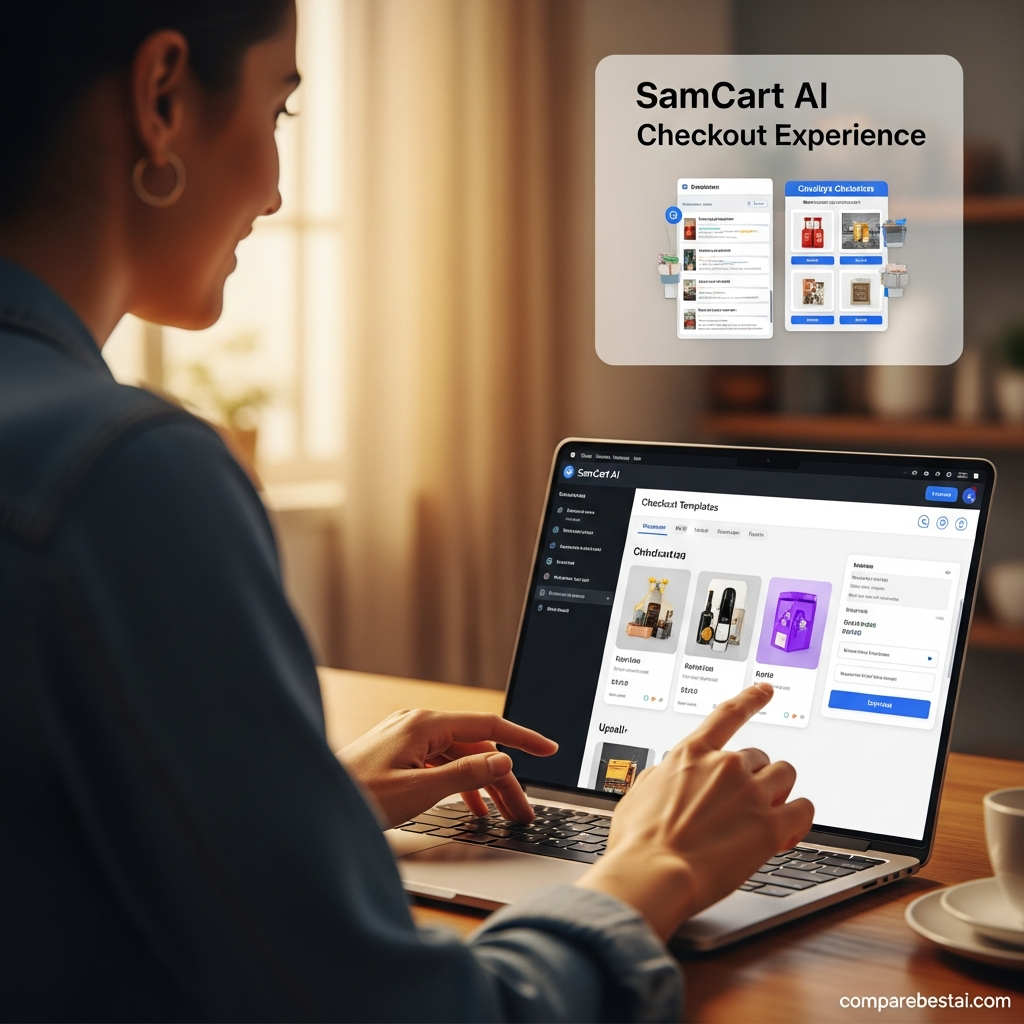
CheckoutOS
SamCart provides customizable checkout experiences designed for digital and online businesses.
Available payment options can include credit cards, PayPal, Apple Pay, Google Pay, Venmo and supported Buy Now Pay Later services depending on configuration and processor availability.
Sellers can also embed checkout experiences into existing websites rather than forcing every customer through a completely separate storefront.
Cart Abandonment
Cart abandonment tools are included on current SamCart plans.
These allow sellers to follow up with customers who begin checkout but do not complete a purchase.
For creators selling higher-value courses or services, recovering even a small percentage of abandoned transactions can make this feature useful.
One-Click Upsells
One-click upsells are available on Pro and Enterprise.
After a customer completes an initial purchase, sellers can present an additional offer without requiring the buyer to enter payment information again.
Examples include:
- An advanced course
- Coaching
- Templates
- Additional digital products
- Premium access
Order Bumps
Order bumps are also available on Pro and Enterprise.
They allow sellers to offer a complementary product during checkout.
A course creator, for example, could offer a workbook or template pack alongside the main course.
Subscription Saver
Subscription Saver is designed for recurring-payment businesses.
It helps recover revenue when subscription payments fail by retrying eligible transactions and supporting customer follow-up.
This is particularly relevant to memberships, subscriptions and recurring coaching programs.
A/B Testing
SamCart Pro includes A/B testing for comparing different pages, prices, headlines and offers.
Sellers can create variants, send traffic to different versions and use conversion data to determine which performs better.
Users should note that SamCart's documentation indicates some testing workflows differ between its older Content Builder and the newer Pages AI experience, so it is worth confirming availability for the specific page workflow you intend to use.
Affiliate Center
Pro and Enterprise customers can manage affiliate programs inside SamCart.
The Affiliate Center supports:
- Affiliate applications
- Manual or automatic approval
- Tracking links
- Percentage commissions
- Flat-rate commissions
- Recurring commissions
- Affiliate performance reporting
- Earnings-per-click reporting
- Payout-history exports
This can eliminate the need for a separate affiliate-management platform for many creator businesses.
SamCart Pricing in 2026
SamCart currently has three main tiers for new customers: Core, Pro and Enterprise.
SamCart Pricing in 2026
Annual billing currently saves 25%.
All current plans include a 7-day free trial.
Pricing last verified: August 24, 2026.
SamCart Core
Core costs $79 per month.
It includes:
- Unlimited products
- Unlimited checkout pages
- CheckoutOS
- Pages and sites
- Link-in-bio pages
- Opt-in pages
- Courses App and members area
- Coupons
- Cart abandonment
- Custom domains
- Payment options
- Integration Engine
- Basic analytics
- Sam AI Assistant
- AI Marketing Designer
- AI Docs Designer
- AI Page Designer
- One team seat
Core is best for creators who need the infrastructure to create and sell products but do not yet need advanced conversion features.
SamCart Pro
Pro costs $199 per month.
It includes everything in Core plus:
- One-click upsells
- Order bumps
- Upgrades
- Subscription Saver
- A/B testing
- Affiliate Center
- Customer Portal
- Advanced analytics
- API access
- Additional third-party payment processors
- Custom checkout branding
- 10 team seats
For sellers actively running funnels and trying to increase average order value or customer lifetime value, Pro is the more relevant plan.
SamCart Enterprise
Enterprise uses custom pricing.
It is intended for high-volume organizations requiring features such as:
- Dedicated account management
- Priority support
- Unlimited seats
- Multiple marketplaces
- Multi-tier affiliate capabilities
- Custom payment-processing arrangements
- White-glove services
Businesses considering Enterprise should request a tailored quote based on their sales volume and requirements.
Get full pricing by email – subscribe for hidden discounts and promotion alerts
How SamCart AI Usage Works
SamCart's public pricing comparison currently describes Core AI usage as limited and Pro usage as unlimited.
However, SamCart's current Help Center also states that customers are temporarily being allowed to use its AI tools without restrictions while the new pricing structure is being rolled out.
This may change in the future.
Businesses that expect heavy AI usage should therefore verify current limits before subscribing rather than assuming today's temporary usage policy will remain permanent.
SamCart Payment and Processing Fees
A SamCart subscription does not eliminate normal payment-processing costs.
SamCart currently lists a standard SamPay rate of 2.9% + $0.30 for Core and Pro.
The company currently says Core and Pro customers can use supported processors such as SamPay, Stripe and PayPal without an additional SamCart platform fee.
Third-party processor costs and payment-provider charges may still apply.
This distinction matters when comparing SamCart with platforms that charge a percentage-based platform fee on top of processing costs.

SamCart Pros and Cons
Pros
- Strong checkout functionality for digital products
- AI-assisted product and content creation
- AI-generated pages and sales copy
- Built-in course delivery
- Cart abandonment tools on Core
- One-click upsells on Pro
- Order bumps on Pro
- Native A/B testing
- Built-in Affiliate Center
- Subscription recovery tools
- API and integrations on higher plans
- 7-day free trial
- No extra SamCart platform fee on supported processors under the current plan structure
Cons
- $79 starting price is relatively high for very small sellers
- Important conversion features require the $199 Pro plan
- Core does not include one-click upsells or order bumps
- Core does not include the Affiliate Center
- AI usage policies are still evolving
- Some testing documentation differs between legacy and newer builders
- Businesses needing complex physical inventory may prefer Shopify
- Smaller sellers may find transaction-fee-based alternatives cheaper initially
Who Should Use SamCart?
Course Creators
SamCart is a strong fit for course creators because the platform combines product sales, checkout, course delivery and AI-assisted content creation.
Pro becomes more attractive when the business also needs upsells, affiliates or subscription recovery.
Coaches and Consultants
Coaches can use SamCart to sell:
- Coaching packages
- Memberships
- Workshops
- Courses
- Digital resources
Payment plans and recurring billing can also support higher-ticket services.
Digital Product Sellers
Creators selling eBooks, templates, downloads and other digital products can use SamCart for both product creation and checkout.
The AI document and page tools make it particularly relevant to creators who want to minimize the number of separate tools in their workflow.
Membership and Subscription Businesses
Businesses collecting recurring payments may benefit from Pro features such as Subscription Saver and advanced customer-management tools.
Marketing Teams
Marketing teams can use SamCart's Pages, AI copy tools, A/B testing, upsells and reporting to improve sales funnels without building a completely custom commerce stack.
Who Should Not Use SamCart?
SamCart may be unnecessary if you:
- Sell only a few low-priced products per year
- Want no fixed monthly subscription
- Need advanced warehouse or inventory management
- Primarily operate physical retail stores
- Need a huge third-party app ecosystem
- Do not need checkout optimization
- Do not need courses, upsells, subscriptions or affiliate functionality
In those cases, Gumroad, Shopify or another specialized platform may offer better economics or functionality.
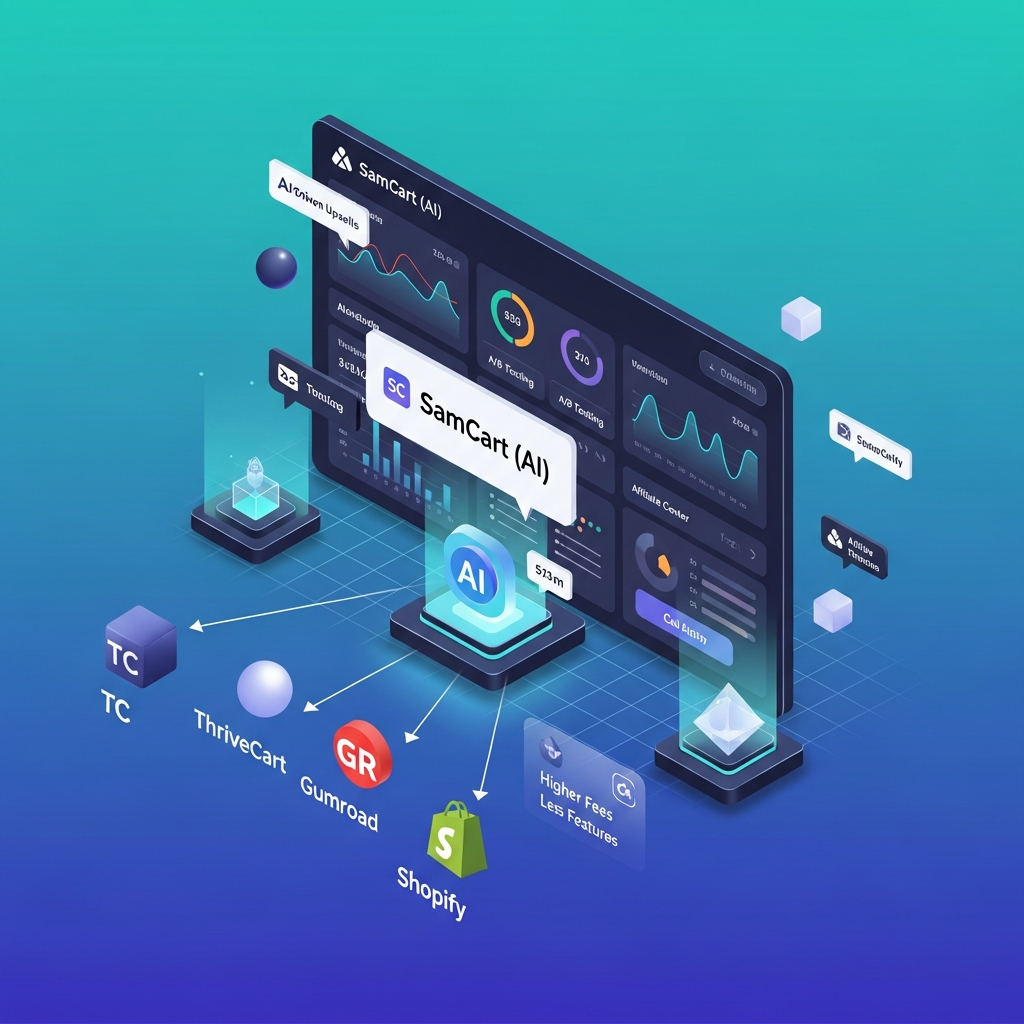
SamCart vs ThriveCart vs Gumroad vs Shopify
| Tool | Pricing Approach | Best For | Main Advantage |
|---|---|---|---|
| SamCart | From $79/month | Digital sellers focused on checkout and conversion | AI creation tools + checkout optimization |
| ThriveCart | From $47/month monthly or $37/month billed annually | Creators wanting checkout and funnel tools | Lower starting subscription cost |
| Gumroad | No monthly subscription; transaction fees | Small and independent creators | Low upfront commitment |
| Shopify | From $39/month in the US | Broader ecommerce and physical products | Inventory and ecommerce ecosystem |
SamCart vs ThriveCart
SamCart and ThriveCart compete most directly for digital creators, course sellers and online businesses that want specialized checkout tools.
ThriveCart introduced subscription pricing in 2026, with plans starting at $47 per month when paid monthly or $37 per month equivalent with annual billing.
That makes outdated comparisons based solely on ThriveCart's historical lifetime pricing less useful.
SamCart's current advantage is its broader combination of AI product creation, AI page design and checkout infrastructure.
ThriveCart may appeal more to price-sensitive users who primarily want checkout and funnel functionality.
SamCart vs Gumroad
Gumroad is much easier to enter because it does not charge a monthly subscription.
Instead, direct sales currently carry a 10% + $0.50 Gumroad fee, excluding additional payment-processing costs.
That can make Gumroad attractive for low-volume creators.
As sales volume increases, however, a fixed-price platform such as SamCart may become more attractive, particularly if the seller can benefit from A/B testing, upsells, subscriptions and affiliate tools.
SamCart vs Shopify
Shopify is the better choice for businesses whose main requirement is a complete ecommerce store with inventory management, shipping, retail integrations and a large app ecosystem.
SamCart is more specialized around creators, digital selling and checkout conversion.
A digital course business and a large physical-products retailer therefore have very different reasons for choosing between them.
How We Evaluated SamCart
We evaluated SamCart using its current public pricing, Help Center documentation and feature pages, with particular attention to:
- Current plan structure
- AI functionality
- Checkout capabilities
- Upsell features
- Affiliate management
- A/B testing
- Course functionality
- Payment-processing costs
- Integrations
- Suitability for different seller types
- Major alternatives
Pricing and product details were rechecked on August 24, 2026.
We avoid treating marketing claims as independent performance evidence and distinguish between documented platform functionality and vendor-reported conversion results.
SamCart Verified Facts for 2026
Last verified: August 24, 2026
- Current plans: Core, Pro and Enterprise.
- Core price: $79 per month.
- Pro price: $199 per month.
- Enterprise: Custom pricing.
- Annual billing discount: 25%.
- Free trial: 7 days.
- Core team seats: 1.
- Pro team seats: 10.
- Core includes: Unlimited products, CheckoutOS, Pages, Courses, Cart Abandonment and SamCart's AI tools.
- Pro adds: One-click upsells, order bumps, A/B testing, Subscription Saver, Affiliate Center, advanced analytics and API access.
- AI tools: Sam AI Assistant, AI Marketing Designer, AI Docs Designer and AI Page Designer.
- SamPay listed rate: 2.9% + $0.30 on Core and Pro.
- Affiliate Center: Available on Pro and Enterprise.
- Legacy plans: Launch, Grow and Scale are no longer offered to new customers.
Sources: SamCart Pricing and SamCart Knowledge Base.
Frequently Asked Questions
Is SamCart worth it in 2026?
SamCart can be worth it for digital product sellers, course creators, coaches and subscription businesses that need more than a basic checkout. Its strongest value appears when users take advantage of its AI creation tools, page builder, course delivery and, on Pro, conversion features such as upsells and A/B testing.
How much does SamCart cost in 2026?
SamCart Core costs $79 per month and Pro costs $199 per month. Enterprise pricing is customized. Annual billing currently saves 25%.
Does SamCart offer a free trial?
Yes. SamCart currently provides a 7-day free trial on its standard plans.
Does SamCart have AI features?
Yes. Current AI tools include Sam AI Assistant, AI Marketing Designer, AI Docs Designer and AI Page Designer. These tools can assist with creating products, pages, sales copy, marketing content and other digital assets.
Does SamCart Core include upsells?
No. Under SamCart's current pricing structure, one-click upsells and order bumps are available on Pro and Enterprise rather than Core.
Does SamCart include an affiliate program?
SamCart's Affiliate Center is available on Pro and Enterprise. Sellers can approve affiliates, generate tracking links, configure commission structures and monitor affiliate performance.
Is SamCart better than ThriveCart?
SamCart may be more attractive if you want integrated AI creation and page-generation tools alongside checkout functionality. ThriveCart currently starts at a lower subscription price, so it may appeal more to users focused primarily on checkout and funnel functionality.
Is SamCart better than Gumroad?
SamCart provides considerably more checkout optimization and business-management functionality, but it requires a monthly subscription. Gumroad has no monthly subscription and instead charges transaction-based fees, making it simpler for low-volume creators.
Final Verdict: Is SamCart Worth It in 2026?
SamCart is a strong option in 2026 for creators and digital businesses that want more than a basic payment page.
The platform now combines checkout functionality with AI product creation, AI page design, courses and business-management tools.
Core at $79 per month makes the most sense for newer sellers that want SamCart's creation, checkout and course functionality but do not yet require aggressive conversion optimization.
Pro at $199 per month is the plan that unlocks the features SamCart is historically best known for, including one-click upsells, order bumps, A/B testing, affiliate management and Subscription Saver.
That price difference matters.
A creator who only needs a straightforward checkout may find SamCart expensive. A growing digital business running multiple offers, subscriptions and affiliate campaigns has a much stronger case for paying for Pro.
SamCart is also not the obvious choice for inventory-heavy physical ecommerce, where Shopify remains more appropriate.
Overall, SamCart is worth testing if your revenue depends on digital selling and increasing the value of each customer rather than simply processing a transaction.
Because SamCart offers a 7-day free trial, the most practical approach is to build one real product and checkout workflow during the trial and determine whether its creation and conversion tools justify the monthly cost.
Start SamCart's 7-Day Free Trial
For another perspective, compare it with our SamCart tool profile and ThriveCart AI review before choosing.
Found this guide useful? Share it with your team.