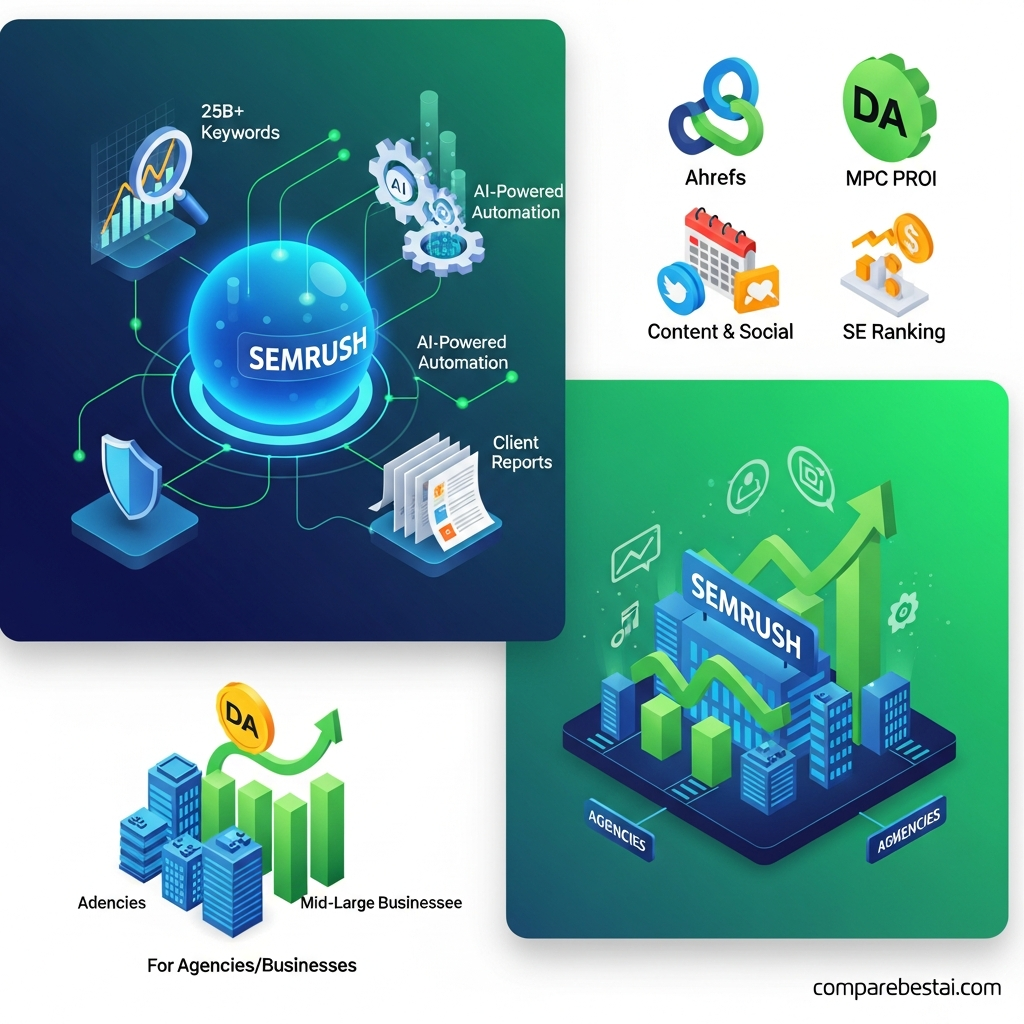

Quick Answer: Is Semrush Worth It for SEO in 2026?
Yes. Semrush is worth considering in 2026 for SEO professionals, agencies and businesses that need keyword research, competitor analysis, technical auditing, backlink analysis and rank tracking in one platform.
The SEO Toolkit starts at $139.95 per month. Higher plans increase the number of websites, tracked keywords, crawl limits and reporting capabilities available to users.
Semrush is particularly strong for teams managing competitive search campaigns or multiple websites. Smaller sites and beginners with basic SEO needs may find the platform more expensive and complex than necessary.
Want to test it first? Start the Semrush 7-day free trial and use it on your own website before committing to a paid plan.
Semrush at a Glance
| Category | Semrush |
|---|---|
| Best for | SEO professionals, agencies and marketing teams |
| SEO Toolkit starting price | $139.95/month |
| Free trial | 7 days |
| SEO plans | Pro, Guru and Business |
| Keyword research | Yes |
| Competitor research | Yes |
| Site Audit | Yes |
| Position Tracking | Yes |
| Backlink analysis | Yes |
| On-page SEO recommendations | Yes |
| Content optimization | Yes |
| AI search visibility | Available through Semrush's current AI-search products |
| Pro tracked keywords | 500 |
| Guru tracked keywords | 1,500 |
| Business tracked keywords | 5,000 |
| Keyword database | 28B+ |
| Backlink index | 43T+ |
Last verified: August 24, 2026.
What Is Semrush?
Semrush is an SEO and digital visibility platform used for keyword research, competitor analysis, technical SEO, backlink research, rank tracking, content optimization and broader marketing intelligence.
It started primarily as an SEO and competitive-research platform but has expanded into a collection of toolkits covering areas such as AI search visibility, local marketing, content, advertising, social media and market research.
For SEO users, the main value is having several workflows inside one ecosystem instead of paying for separate tools for keyword research, crawling, competitor analysis, rank tracking and backlink research.
Semrush is most relevant to:
SEO professionals
Agencies
In-house marketing teams
Content teams
Ecommerce businesses
SaaS companies
Publishers
Businesses operating multiple websites
It can also be used by beginners, although the number of tools, reports and metrics creates a steeper learning curve than simpler SEO platforms.

Best Semrush SEO Features
Keyword Research
Keyword research remains one of Semrush's core strengths.
The platform provides several tools for finding and evaluating search terms, including Keyword Overview, Keyword Magic Tool and Keyword Strategy Builder.
Users can research metrics such as:
Search volume
Keyword difficulty
Search intent
CPC
Competitive density
SERP features
Related keywords
Questions
Keyword variations
Semrush currently states that its search database contains more than 28 billion keywords across 142 geographic markets.
That makes the platform useful for both national and international keyword research.
Keyword Magic Tool
Keyword Magic Tool expands a seed keyword into related phrases and groups them into topical categories.
This helps users move beyond a single keyword and build broader content strategies.
The tool is useful for:
Blog planning
Landing-page research
Ecommerce categories
Long-tail discovery
Search-intent analysis
Topic clustering
PPC research
Keyword data should still be treated as third-party estimates rather than exact first-party search data.
Keyword Strategy Builder
Keyword Strategy Builder helps organize keyword research into structured groups and topics.
Instead of manually working through thousands of related terms, users can build lists and organize keywords around potential content opportunities.
Current limits depend on the SEO Toolkit plan.
Pro currently includes 10 clustering or structuring actions per month, Guru includes 30 and Business includes 50.
This can be useful for content teams building topic clusters or larger editorial strategies.
Competitor Research
Semrush allows users to research competitors without requiring access to their analytics accounts.
The platform can estimate:
Organic keywords
Ranking positions
Top-performing pages
Competitor traffic
Keyword overlaps
Keyword gaps
Backlink profiles
Paid-search activity
The main benefit is comparative research.
Instead of asking only, “Which keywords should we target?” teams can ask, “Which important topics are competitors ranking for that we are missing?”
That makes competitor research useful for content planning and strategic SEO decisions.
Semrush Site Audit
Site Audit crawls a website and identifies technical and on-page problems that may affect organic visibility.
Semrush currently documents more than 140 checks covering areas such as:
Crawlability
Indexability
HTTPS
Internal linking
Core Web Vitals
Structured markup
International SEO
Duplicate content
Broken links
Redirects
Page performance
Issues are divided into errors, warnings and notices so teams can prioritize the most important problems.
Site Audit Limits
Current SEO Toolkit limits are:
| Plan | Monthly Crawl Allowance |
|---|---|
| Pro | 100,000 pages |
| Guru | 300,000 pages |
| Business | 1,000,000 pages |
The amount that can be crawled in an individual audit can also depend on plan and project settings.
For agencies or large ecommerce websites, these limits are worth checking carefully before choosing a subscription.
AI Search Health
Semrush has expanded Site Audit beyond traditional technical SEO.
Its current AI Search Health functionality checks issues that may affect how AI-search crawlers and generative systems access a website.
That makes technical auditing increasingly relevant to both conventional search engines and AI-driven discovery.
However, these recommendations should complement normal technical SEO rather than replace fundamentals such as crawlability, indexing, internal linking and content quality.
Position Tracking
Position Tracking monitors how a website ranks for selected keywords over time.
Current total keyword allowances are:
Pro: 500 keywords across up to 5 monitored websites
Guru: 1,500 keywords across up to 15 monitored websites
Business: 5,000 keywords across up to 40 monitored websites
All SEO Toolkit levels can also monitor competitors within campaigns, although overall competitor limits differ by plan.
Position Tracking is useful for:
Measuring SEO progress
Tracking priority keywords
Monitoring competitors
Comparing devices
Tracking locations
Identifying ranking gains and losses
Rank tracking is particularly valuable when combined with Site Audit and content changes because it provides a way to monitor whether optimization work corresponds with improved visibility.
Backlink Analysis
Semrush provides Backlink Analytics for researching inbound links to your own website or competitors.
Semrush currently states that its backlink database contains more than 43 trillion backlinks across approximately 390 million referring domains.
The database is refreshed frequently, making it useful for monitoring new and lost links.
Backlink workflows include:
Referring-domain analysis
Competitor backlink research
Backlink gaps
New and lost links
Anchor-text research
Link-building opportunity discovery
Backlink data from any third-party platform should be treated as its own index rather than an exact representation of everything Google knows about a website.
On-Page SEO Checker
On-Page SEO Checker provides page-level optimization ideas based on a website's existing pages and competitive search environment.
Recommendations can cover areas such as:
Keyword usage
Content relevance
Internal linking
SERP competition
Page structure
Semantic terms
It can help prioritize optimization work, but recommendations should not be followed mechanically.
Search intent, usefulness and editorial quality should still take priority over reaching a software-generated score.
Content Optimization
Semrush also offers content-focused tools for planning and improving articles.
Current content capabilities vary by plan and toolkit.
The SEO Writing Assistant, Topic Research and related features can help teams evaluate relevance, readability and keyword coverage.
Semrush also sells a separate Content Toolkit for teams that want broader AI-assisted content workflows.
That product currently operates separately from the basic SEO Toolkit pricing.
For a deeper breakdown of individual SEO features, see our Semrush SEO tools guide.
Semrush and AI Search in 2026
Search visibility is no longer limited to ten blue links.
People increasingly discover products, companies and information through AI-powered search experiences and answer engines.
Semrush has responded by adding AI-search visibility capabilities alongside traditional SEO.
Its current ecosystem can help users examine areas such as:
AI brand mentions
AI citations
AI visibility
Prompt-level performance
Competitor visibility
Brand sentiment
Share of voice
Semrush One
Semrush One combines SEO functionality with broader AI Visibility tools.
It is aimed at businesses that want to track visibility across traditional search alongside AI discovery environments.
The important distinction is that not every AI-search function is identical across every Semrush subscription.
Businesses that specifically want deep prompt tracking, AI mentions, citations and AI competitive intelligence should compare Semrush One with the standard SEO Toolkit before subscribing.
For teams focused primarily on conventional keyword research, technical SEO and rankings, the SEO Toolkit remains the more straightforward comparison.
Semrush Pricing in 2026
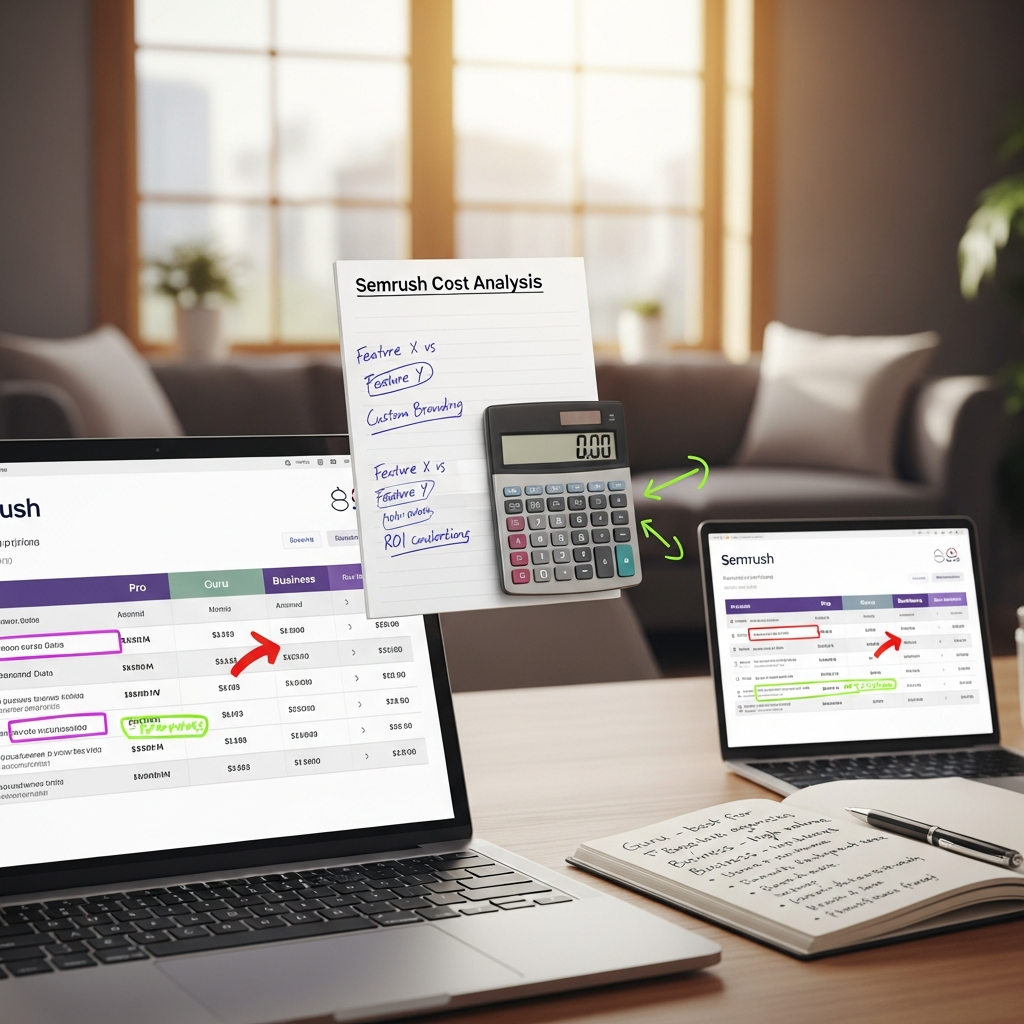
Semrush's SEO Toolkit currently offers three main paid tiers: Pro, Guru and Business.
| Plan | Monthly Price | Annual Equivalent | Best For |
|---|---|---|---|
| Pro | $139.95/month | $117.33/month | Freelancers, small businesses and SEO beginners |
| Guru | $249.95/month | $208.33/month | Growing agencies and teams |
| Business | $499.95/month | $416.66/month | Established agencies and larger businesses |
Annual subscriptions are billed upfront.
Pricing last verified: August 24, 2026.
SEO Toolkit Pro
Pro is the entry-level paid SEO Toolkit.
Current main limits include:
5 websites to monitor
500 tracked keywords
100,000 monthly crawl pages
10,000 results per report
250 keyword metric updates per month
500 SEO Ideas per month
Scheduled PDF reporting
It is best suited to freelancers, smaller companies and users managing a limited number of sites.
SEO Toolkit Guru
Guru increases the main usage limits and adds features needed by more established content and SEO teams.
Current limits include:
15 websites
1,500 tracked keywords
300,000 monthly crawl pages
30,000 results per report
1,000 keyword metric updates
Guru also adds capabilities such as historical data, SEO Writing Assistant, Topic Research, multi-targeting in Position Tracking and Looker Studio reporting integrations.
SEO Toolkit Business
Business is designed for heavier SEO workloads.
Current limits include:
40 websites
5,000 tracked keywords
1 million monthly crawl pages
50,000 results per report
5,000 keyword metric updates
Business also adds features including SEO Share of Voice tracking and API access.
Is Semrush Free?
Semrush provides limited free access to certain tools and currently offers a 7-day trial for users who want to test expanded functionality.
The free experience is suitable for occasional research but is not a replacement for a paid plan when you need sustained rank tracking, multiple projects, large exports or frequent keyword research.
Additional Costs
The base SEO subscription is not necessarily the final cost for every organization.
Semrush now offers separate products and toolkits for areas including:
AI visibility
Local marketing
Content
Social media
Advertising
Traffic and market intelligence
Agency workflows
Therefore, businesses should calculate the cost of the specific functions they need rather than assuming every Semrush feature is included in a single SEO subscription.
Semrush Pros and Cons
Pros
Large keyword database
Strong competitor research
More than 140 technical and on-page Site Audit checks
Daily position tracking
Large backlink index
Keyword gap and backlink gap analysis
Detailed project reporting
Strong support for agencies and multiple sites
On-page recommendations
International keyword research
Historical data on higher SEO plans
AI-search visibility products now available
API access on Business
Seven-day trial
Cons
Pro starts at $139.95 per month
Can feel overwhelming to new SEO users
Higher project and keyword limits require more expensive plans
Some marketing functions require separate toolkits or add-ons
Full AI-search workflows may require additional Semrush products
Third-party traffic and search-volume figures are estimates
Large agencies can encounter project and tracking limits
Teams should calculate total subscription costs before committing
Who Should Use Semrush?
SEO Agencies
Agencies can benefit from Semrush because one platform covers multiple client workflows.
Keyword research, competitive intelligence, technical auditing, ranking data and reporting can all be handled within the same ecosystem.
Guru and Business are particularly relevant when agencies require higher project and keyword limits.
In-House SEO Teams
In-house teams can use Semrush to monitor their own website while continuously comparing performance with competitors.
The combination of Site Audit, Position Tracking and keyword research creates a useful ongoing SEO workflow.
Content Teams
Content teams that publish frequently can use keyword research, competitive gaps, topic research and optimization tools to prioritize new pages and refresh existing ones.
Ecommerce Businesses
Ecommerce websites can benefit from technical auditing, competitor research, keyword analysis and rank tracking across large numbers of product and category pages.
Larger stores should review crawl limits before choosing a plan.
Businesses Tracking AI Visibility
Teams that want to understand how their brand appears across AI-powered discovery should examine Semrush's newer AI-search products in addition to its traditional SEO Toolkit.
Who Should Not Use Semrush?
Semrush may be excessive if you:
Operate one very small website
Only need occasional keyword research
Have a very limited SEO budget
Mainly need first-party performance data
Only need a simple rank tracker
Do not use competitive research
Will not use technical auditing
Need only one specialized SEO workflow
In those situations, a cheaper or more focused platform may provide better value.
See our guide to affordable SEO tools for small businesses if price is the main concern.
Semrush vs Ahrefs, SE Ranking and Moz
There is no universally best SEO platform.
The right choice depends on which workflows matter most.
| Tool | Best For | Main Strength |
|---|---|---|
| Semrush | Full SEO and marketing workflows | Breadth of SEO, competitor and reporting tools |
| Ahrefs | SEO research and backlinks | Link and competitive research |
| SE Ranking | Growing businesses and agencies | Flexible general-purpose SEO functionality |
| Moz Pro | Established SEO workflows | Keyword and link metrics |
Semrush vs Ahrefs
Semrush and Ahrefs overlap heavily in keyword research, competitor analysis, backlink analysis, technical auditing and rank tracking.
Semrush generally emphasizes a broader marketing ecosystem, while Ahrefs remains strongly centered around search, backlinks and competitive research.
Ahrefs' current pricing and plan structure have changed over time, so old comparisons based on $99 plans or seven-day trials should not be used.
The best approach is to identify the reports you use most frequently and test both platforms before committing.
Semrush vs SE Ranking
SE Ranking is another all-in-one SEO platform aimed at businesses and agencies.
It may appeal to teams seeking a different balance between pricing, project limits and functionality.
Semrush provides a broader overall ecosystem, while the better value depends on the number of websites, keywords and reports your team actually uses.
Semrush vs Moz Pro
Moz remains a long-established option for keyword and link research.
Users who prefer Moz's metrics and workflow may find it simpler, while teams requiring broader competitor research, marketing intelligence or Semrush's expanding AI-search ecosystem may prefer Semrush.
How We Evaluated Semrush
We evaluated Semrush based on current official product documentation and the capabilities most relevant to SEO buyers.
The review considers:
Keyword research
Keyword database coverage
Competitor analysis
Technical SEO
Rank tracking
Backlink research
On-page optimization
Content workflows
AI-search capabilities
Pricing
Usage limits
Reporting
Suitability for different team sizes
Alternatives
Pricing and plan limits were rechecked on August 24, 2026.
Third-party SEO metrics were treated as estimates rather than first-party analytics data, and vendor marketing claims were separated from documented product specifications.
Semrush Verified Facts for 2026
Last verified: August 24, 2026
SEO Toolkit Pro: $139.95 per month.
SEO Toolkit Guru: $249.95 per month.
SEO Toolkit Business: $499.95 per month.
Free trial: 7 days.
Pro websites: 5.
Guru websites: 15.
Business websites: 40.
Tracked keywords: 500 on Pro, 1,500 on Guru and 5,000 on Business.
Monthly crawl allowance: 100,000 pages on Pro, 300,000 on Guru and 1 million on Business.
Site Audit: More than 140 technical and on-page checks.
Keyword database: More than 28 billion keywords.
Geographic markets: 142.
Domain profiles: More than 808 million.
Backlink index: More than 43 trillion backlinks across approximately 390 million referring domains.
AI search: Semrush now offers AI visibility analysis in addition to traditional SEO.
Semrush One: Combines SEO functionality with broader AI Visibility capabilities.
Sources: Semrush official Pricing pages and Semrush Knowledge Base.
How much does Semrush cost in 2026?
Semrush's SEO Toolkit currently costs $139.95 per month for Pro, $249.95 for Guru and $499.95 for Business. Lower equivalent monthly rates are available with annual billing.
Does Semrush offer a free trial?
Yes. Semrush currently offers a 7-day free trial for its marketing toolkits.
What are the best Semrush features for SEO?
The most useful SEO features include Keyword Magic Tool, Site Audit, Position Tracking, Backlink Analytics, competitor research, Keyword Strategy Builder and On-Page SEO Checker.
How many keywords can Semrush track?
The current SEO Toolkit supports 500 tracked keywords on Pro, 1,500 on Guru and 5,000 on Business.
How large is the Semrush keyword database?
Semrush currently states that its database contains more than 28 billion keywords across 142 geographic markets.
Does Semrush track AI search visibility?
Yes. Semrush now offers AI-search visibility capabilities alongside its traditional SEO products. More advanced AI visibility functionality is available through products such as Semrush One.
Is Semrush better than Ahrefs?
Neither platform is universally better. Semrush provides a broad SEO and marketing ecosystem, while Ahrefs has a strong focus on SEO research and backlinks. The better choice depends on the workflows, limits and reporting your team requires.
Can Semrush improve Google rankings?
Semrush cannot guarantee rankings. It can identify keyword opportunities, technical SEO problems, competitor gaps, backlink opportunities and content weaknesses that can inform an SEO strategy.
How accurate is Semrush?
Semrush provides third-party estimates for metrics such as keyword volume, traffic and backlinks. These are useful for comparison and research but can differ from first-party information in Google Search Console and Google Analytics.
Is Semrush good for beginners?
Beginners can use Semrush, but the number of tools and reports creates a learning curve. Smaller websites should use the free trial to determine whether they need the platform's full depth before subscribing.
Final Verdict: Is Semrush Worth It for SEO in 2026?
Semrush remains a strong SEO platform in 2026 for professionals, agencies and marketing teams that regularly use keyword research, technical SEO, competitor intelligence, backlink analysis and rank tracking.
Its main advantage is breadth.
Rather than combining several disconnected SEO products, businesses can perform much of their research, auditing, tracking and reporting within the same ecosystem.
The trade-off is price.
At $139.95 per month, Pro is difficult to justify for someone who only needs occasional keyword research or manages one small website.
Guru makes more sense for teams that need historical data, larger limits and content features, while Business is aimed at agencies and organizations managing substantially larger SEO workloads.
Semrush's expansion into AI-search visibility also makes it more relevant in 2026 than a review focused only on traditional Google rankings would suggest.
However, buyers should distinguish between the standard SEO Toolkit and Semrush's broader AI Visibility and Semrush One offerings before choosing a plan.
Overall, Semrush is worth considering when SEO is an ongoing business function rather than an occasional task.
The best way to judge value is to test the platform against your real workflow.
Run a technical audit, research your priority keywords, analyze two or three competitors and set up Position Tracking during the free trial. If those workflows save enough time and improve your decision-making, the subscription becomes much easier to justify.
Start the Semrush 7-Day Free Trial
Still comparing options? Read our Semrush SEO tools guide, affordable SEO tools for small businesses, and cheap SEO tools for 2026 before choosing.
Found this guide useful? Share it with your team.