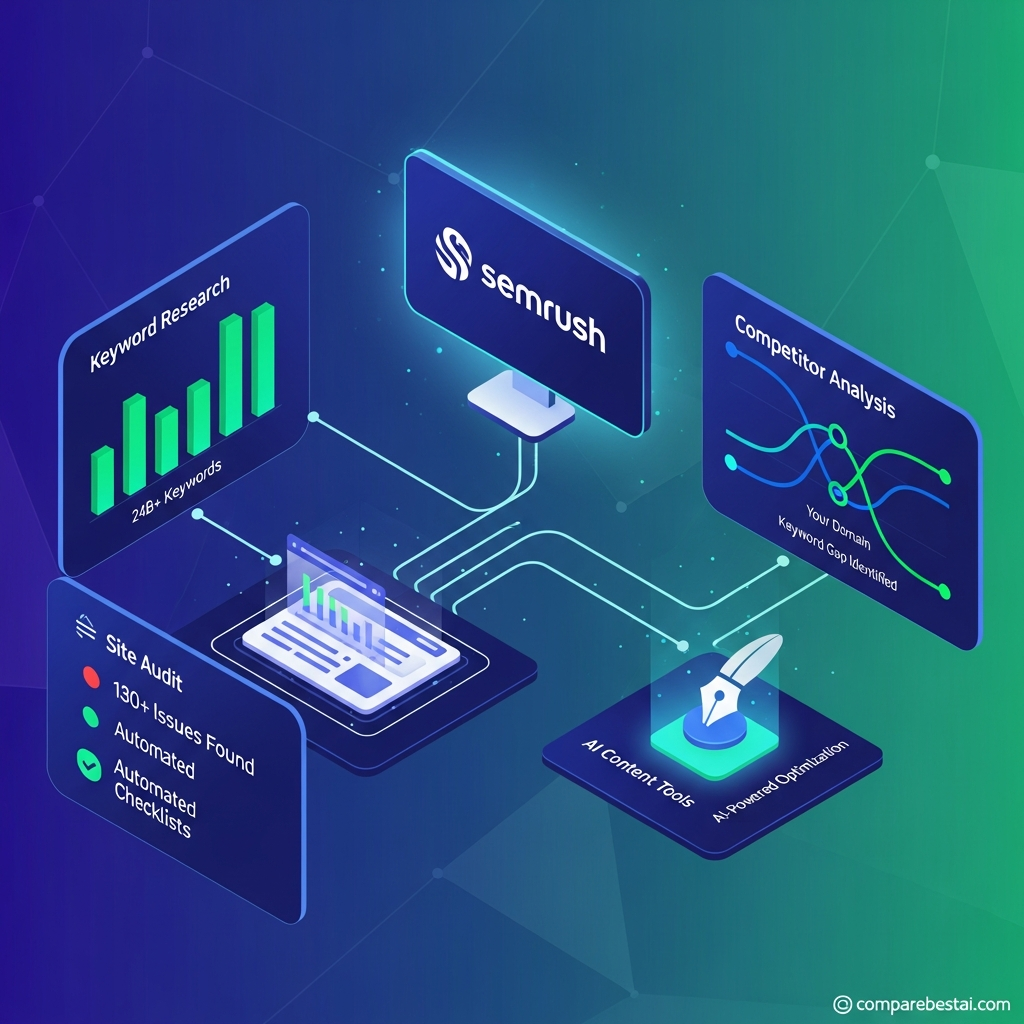

Quick Answer: Is the Semrush SEO Tool Worth It in 2026?
Yes. Semrush is worth considering in 2026 for SEO professionals, agencies and businesses that regularly need keyword research, technical audits, competitor analysis, backlink research and rank tracking.
The SEO Toolkit starts at $139.95 per month. Pro includes monitoring for 5 websites, 500 tracked keywords and up to 100,000 crawl pages per month.
Semrush is particularly useful when SEO is an ongoing part of the business rather than an occasional task. Smaller websites that only need basic keyword research or rank tracking may get better value from a cheaper platform.
Want to test it first? Use the 7-day free trial to evaluate Semrush with your own website before choosing a paid plan.
Semrush at a Glance
| Category | Semrush |
|---|---|
| Best for | SEO professionals, agencies and marketing teams |
| Starting SEO price | $139.95/month |
| Free trial | 7 days |
| Main SEO plans | Pro, Guru, Business |
| Keyword research | Yes |
| Site Audit | Yes |
| Position Tracking | Yes |
| Competitor research | Yes |
| Backlink analysis | Yes |
| On-page recommendations | Yes |
| AI search visibility | Yes, through current Semrush AI-search products |
| Pro websites | 5 |
| Pro tracked keywords | 500 |
| Keyword database | 28B+ |
| Backlink database | 43T+ |
| Geographic databases | 142 |
Last verified: August 24, 2026.
Unlock advanced Semrush features—get our latest insights
What Is Semrush?
Semrush is a digital visibility and SEO platform that helps businesses research keywords, analyze competitors, audit websites, monitor rankings and investigate backlinks.
The platform has expanded beyond conventional SEO into areas such as AI-search visibility, content, local marketing, advertising, social media and competitive intelligence.
For SEO users, its biggest appeal is that several important workflows are available in the same ecosystem.
Instead of using one platform for keywords, another for rank tracking and another for technical audits, a team can perform many of those tasks within Semrush.
That makes it especially relevant to:
SEO professionals
Marketing agencies
In-house SEO teams
Ecommerce companies
SaaS businesses
Publishers
Content teams
Multi-site organizations
The downside is complexity. Smaller websites may not use enough of the platform to justify the subscription cost.
Best Semrush SEO Features
Keyword Research
Keyword research remains one of the core parts of the Semrush SEO Toolkit.
Users can research metrics including:
Search volume
Keyword difficulty
Search intent
CPC
Competitive density
SERP features
Related keywords
Keyword variations
Questions
Semrush currently reports a database containing more than 28 billion keywords across 142 geographic databases.
These figures make the platform particularly useful for businesses researching multiple countries or large keyword sets.
As with any third-party SEO platform, search-volume and traffic figures should be treated as estimates rather than exact first-party measurements.
Keyword Magic Tool
Keyword Magic Tool expands a seed term into related queries.
Users can filter suggestions by:
Search intent
Volume
Keyword difficulty
Word count
SERP features
Included terms
Excluded terms
This makes it useful for building content plans, researching long-tail keywords and identifying related search themes.
A publisher, for example, can start with one broad topic and use Keyword Magic Tool to identify supporting subtopics for a content cluster.
Keyword Strategy Builder
Keyword Strategy Builder helps organize keyword research into structured groups rather than leaving users with a large spreadsheet of unrelated search terms.
It can help teams map keyword opportunities to:
Topic clusters
Pillar pages
Supporting articles
Commercial pages
Existing URLs
This is particularly useful for larger content strategies where deciding how keywords relate to one another is as important as finding them.
Site Audit
Semrush Site Audit crawls a website and identifies technical and on-page SEO problems.
Semrush currently documents more than 140 checks covering areas such as:
Crawlability
HTTPS
Internal linking
Page performance
Core Web Vitals
Structured markup
International SEO
Duplicate content
Broken links
Redirects
Problems are categorized so teams can prioritize issues instead of treating every warning as equally urgent.
Current monthly crawl allowances are:
| Plan | Monthly Crawl Pages |
|---|---|
| Pro | 100,000 |
| Guru | 300,000 |
| Business | 1,000,000 |
Large websites should compare those limits carefully before choosing a plan.
Position Tracking
Position Tracking monitors selected keywords over time.
Current total keyword allowances are:
Pro: 500
Guru: 1,500
Business: 5,000
Tracking is useful for:
Monitoring SEO campaigns
Measuring ranking changes
Comparing competitors
Tracking local search
Checking mobile and desktop visibility
Monitoring SERP features
Rank tracking becomes particularly useful when combined with Site Audit and content changes because teams can measure what happened after optimization work was completed.
Competitor Research
Semrush allows users to analyze competing domains without needing access to those companies' analytics accounts.
Depending on the tool, users can investigate:
Organic keywords
Ranking positions
Competitor pages
Keyword overlaps
Keyword gaps
Backlinks
Paid-search activity
SERP competitors
This is useful for identifying opportunities competitors have already validated.
Instead of relying entirely on brainstorming, a team can look for valuable topics competitors rank for but its own website does not.
Keyword Gap
Keyword Gap compares a domain against competitors to identify shared, missing and underperforming keywords.
This is one of the more practical competitive-research workflows because it turns competitor data into an actionable content list.
The output can help identify:
Missing topics
Weak existing pages
High-value commercial keywords
Content expansion opportunities
Teams should still review search intent before creating a page simply because a competitor ranks for a term.
Backlink Analytics
Semrush also provides backlink research.
Its current public materials report more than 43 trillion backlinks in its index.
Users can investigate:
Referring domains
New backlinks
Lost backlinks
Anchor text
Competitor links
Backlink gaps
Link-building prospects
Backlink databases vary between SEO platforms, so users should not expect every provider to discover exactly the same links.
The greatest value is usually in competitive research and trend analysis rather than assuming one third-party index perfectly represents Google's link graph.
On-Page SEO Checker
On-Page SEO Checker provides optimization ideas for existing pages.
Recommendations can cover areas such as:
Content relevance
Keyword usage
Internal links
SERP competition
Semantic terms
Page structure
These recommendations are useful as diagnostic inputs.
They should not override search intent or lead writers to force keywords into otherwise natural content simply to improve a software-generated score.
Content Optimization
Semrush offers additional content tools for research and optimization.
Its broader content ecosystem includes functions for:
Topic discovery
Content briefs
SEO Writing Assistant
Optimization
AI-assisted writing
Some newer content functionality is sold through a separate Content Toolkit rather than being identical across every SEO subscription.
Businesses should therefore check which tools are included before assuming every Semrush feature comes with the base SEO plan.
Semrush AI Search Visibility in 2026
AI search has become an increasingly important part of Semrush's positioning.
People now discover businesses through a mixture of traditional search results, AI-generated answers and recommendation systems.
Semrush has added tools designed to measure visibility in those environments.
Depending on the product and subscription, current AI-search functionality can help analyze:
Brand mentions in AI answers
Citations
Relevant prompts
Competitor visibility
Share of voice
Brand sentiment
AI-search visibility trends
Semrush One
Semrush One combines traditional SEO analysis with broader AI-search visibility.
That allows teams to monitor both conventional keyword rankings and visibility in AI-driven discovery from one environment.
This matters for brands that want to answer two different questions:
Are we ranking in Google?
Are AI systems mentioning or citing us when people research our category?
Businesses mainly focused on conventional SEO may not need every AI-search feature.
Teams actively investing in AI visibility should compare Semrush One with the standalone SEO Toolkit before purchasing.
Semrush Pricing in 2026
Semrush currently offers three primary SEO Toolkit tiers.
| Plan | Monthly Price | Main Limits | Best For |
|---|---|---|---|
| Pro | $139.95 | 5 websites, 500 tracked keywords | Freelancers and smaller businesses |
| Guru | $249.95 | 15 websites, 1,500 tracked keywords | Growing agencies and teams |
| Business | $499.95 | 40 websites, 5,000 tracked keywords | Established agencies and larger organizations |
Pricing last verified: August 24, 2026.
Semrush Pro
Pro costs $139.95 per month.
Key current limits include:
5 websites to monitor
500 tracked keywords
100,000 crawl pages per month
10,000 results per report
250 keyword metric updates per month
500 SEO Ideas per month
Pro is best suited to users managing a small number of active SEO projects.
Semrush Guru
Guru costs $249.95 per month.
Current limits include:
15 websites
1,500 tracked keywords
300,000 crawl pages per month
30,000 results per report
1,000 keyword metric updates
Guru also adds functionality such as historical data, Topic Research, SEO Writing Assistant, multi-targeting in Position Tracking and Looker Studio reporting integrations.
This makes it more appropriate for agencies and in-house teams running several campaigns.
Semrush Business
Business costs $499.95 per month.
Current main limits include:
40 monitored websites
5,000 tracked keywords
1 million monthly crawl pages
50,000 results per report
5,000 keyword metric updates
Business also adds features such as SEO Share of Voice tracking and API access.
Semrush Free Trial
Semrush currently offers a 7-day free trial for its SEO Toolkit.
The trial is useful for testing:
Keyword research
Site Audit
Competitor research
Position Tracking
Backlink workflows
Semrush currently restricts exporting during trial subscriptions.
Users who want to test the platform should therefore focus on evaluating the workflow and data rather than expecting to export large reports during the trial.
Additional Costs
The SEO Toolkit subscription is not necessarily the total Semrush cost for every organization.
Semrush now sells separate products and toolkits for areas such as:
AI visibility
Content
Local marketing
Social media
Advertising
Traffic and market intelligence
Additional users can also cost extra.
Teams should price the specific combination they require instead of assuming every Semrush feature is included in one subscription.
Semrush Pros and Cons
Pros
Large keyword database
Strong competitor research
More than 140 Site Audit checks
Built-in rank tracking
Large backlink database
Keyword Gap and backlink-gap research
On-page optimization recommendations
Multiple geographic databases
Higher-tier historical data
Agency reporting capabilities
AI-search visibility products
Seven-day SEO Toolkit trial
Cons
Pro starts at $139.95 per month
Can be overwhelming for beginners
Higher usage limits require expensive plans
Some functions are sold through separate toolkits
Additional users increase overall cost
Third-party search and traffic estimates are not first-party analytics
Smaller websites may not use enough functionality to justify the price
Who Should Use Semrush?
SEO Agencies
Agencies are one of the strongest use cases.
They can combine keyword research, auditing, competitor research, rank tracking and reporting in one platform.
Guru and Business are likely to be more practical for agencies managing many active clients because they offer larger project and keyword allowances.
In-House SEO Teams
In-house teams can use Semrush to monitor their own website while comparing performance with competitors.
A common workflow might involve:
Running Site Audit.
Researching keyword opportunities.
Finding competitor gaps.
Optimizing pages.
Tracking rankings.
Reviewing backlinks.
Content Teams
Content teams can use Semrush for keyword research, topic planning and optimization.
The platform is most useful when writers and SEO strategists work together rather than treating its recommendations as automated writing instructions.
Ecommerce Businesses
Large ecommerce websites can use Semrush for:
Category keyword research
Product-page auditing
Competitor analysis
Backlink research
Rank tracking
Large stores should pay close attention to crawl limits.
Businesses Tracking AI Visibility
Brands investing in visibility across both Google and AI-generated discovery may benefit from Semrush's newer AI-search products.
This is increasingly relevant when potential customers research products through AI assistants rather than traditional search alone.
Who Should Choose Another SEO Tool?
Semrush may be excessive if you:
Manage one small website
Need only a basic keyword tool
Need only rank tracking
Have a limited SEO budget
Do not use competitor analysis
Rarely perform technical audits
Only need first-party data from your own website
In those situations, a cheaper specialized tool combined with Google Search Console and Google Analytics may provide enough information.
Read our affordable SEO tools for small businesses guide if cost is your main concern.
Semrush vs Other SEO Tools
Semrush is not the only strong SEO platform.
The best alternative depends on what you need most.
| Tool | Best For | Primary Strength |
|---|---|---|
| Semrush | Broad SEO and visibility workflows | SEO, competitor intelligence and AI visibility |
| Ahrefs | Search and backlink research | Link and competitor analysis |
| Moz Pro | Traditional SEO teams | Keyword and link metrics |
| SE Ranking | Smaller teams and agencies | General-purpose SEO workflows |
| Screaming Frog | Technical SEO specialists | Deep website crawling |
Semrush vs Ahrefs
Semrush and Ahrefs overlap in areas such as:
Keyword research
Backlink research
Competitor analysis
Site auditing
Rank tracking
Semrush is particularly attractive to users who want a broad ecosystem extending into reporting, content, local marketing and AI visibility.
Ahrefs may appeal more to teams that prefer its research workflows and backlink-focused ecosystem.
Rather than relying on old price comparisons, buyers should compare the current plans and usage limits directly.
Semrush vs Moz Pro
Moz Pro provides many of the traditional SEO workflows businesses need, including keyword research, link analysis and site auditing.
Semrush offers a broader overall platform and a larger set of adjacent marketing and AI-visibility products.
The better choice depends on whether that additional breadth is actually useful to the organization.
Semrush vs SE Ranking
SE Ranking is often evaluated by freelancers, agencies and businesses looking for a general-purpose SEO platform.
Its appeal is different from Semrush's broader visibility ecosystem.
Businesses should compare:
Number of websites
Tracked keywords
Audit limits
Competitor data
Reporting
User seats
Total monthly cost
rather than making the decision based on starting price alone.
How We Evaluated Semrush
We evaluated the Semrush SEO Tool based on the workflows that matter most to SEO buyers.
The review considered:
Keyword research
Technical SEO
Rank tracking
Competitor analysis
Backlinks
On-page optimization
Content functionality
AI-search visibility
Pricing
Plan limits
Free-trial terms
Suitability for different business sizes
Pricing and product specifications were rechecked on August 24, 2026 using Semrush's current official website and Knowledge Base.
Vendor claims were separated from independently observable product specifications wherever possible.
Traffic, keyword-volume and competitive metrics from third-party SEO platforms should be treated as estimates rather than replacements for first-party Google Search Console or analytics data.
Semrush Verified Facts for 2026
Last verified: August 24, 2026
SEO Toolkit Pro: $139.95 per month.
SEO Toolkit Guru: $249.95 per month.
SEO Toolkit Business: $499.95 per month.
SEO Toolkit free trial: 7 days.
Pro websites: 5.
Guru websites: 15.
Business websites: 40.
Tracked keywords: 500 on Pro, 1,500 on Guru and 5,000 on Business.
Monthly crawl allowance: 100,000 pages on Pro, 300,000 on Guru and 1 million on Business.
Site Audit: More than 140 technical and on-page checks.
Keyword database: More than 28 billion keywords.
Geographic databases: 142.
Domain profiles: More than 808 million.
Backlink database: More than 43 trillion backlinks.
AI search: Semrush provides AI-search visibility functionality alongside traditional SEO.
Semrush One: Combines traditional search metrics with prompt-level AI visibility.
Sources: Semrush official website and Semrush Knowledge Base.
Frequently Asked Questions
What is the Semrush SEO Tool?
Semrush is an SEO and digital visibility platform for keyword research, competitor analysis, technical auditing, rank tracking, backlink research, content optimization and AI-search visibility.
How much does Semrush cost in 2026?
The current SEO Toolkit costs $139.95 per month for Pro, $249.95 for Guru and $499.95 for Business.
Does Semrush have a free trial?
Yes. Semrush currently offers a 7-day trial for the SEO Toolkit. Exporting data is restricted during trial subscriptions.
How many keywords can Semrush track?
Current limits are 500 tracked keywords on Pro, 1,500 on Guru and 5,000 on Business.
How many keywords are in Semrush's database?
Semrush currently reports more than 28 billion keywords across 142 geographic databases.
Does Semrush have AI search tools?
Yes. Semrush now provides AI-search visibility tools that can help track brand mentions, citations, prompts and competitor visibility in AI-generated discovery environments.
Is Semrush good for technical SEO?
Yes. Site Audit performs more than 140 technical and on-page checks and can help identify crawl, internal-linking, HTTPS, markup, performance and other site-health issues.
Is Semrush better than Ahrefs?
Neither platform is automatically better for every user. Semrush provides a broad SEO and visibility ecosystem, while Ahrefs has strong SEO research and backlink workflows. The right choice depends on your preferred workflow, project limits and budget.
Is Semrush worth it for small businesses?
It can be, particularly when SEO is an important customer-acquisition channel. Small businesses that only need occasional keyword research or basic rank tracking may find cheaper tools more economical.
Can Semrush guarantee better Google rankings?
No. Semrush can identify keyword opportunities, technical problems, competitor gaps and backlink opportunities, but no SEO platform can guarantee rankings.
Final Verdict: Is the Semrush SEO Tool Worth It in 2026?
Semrush remains a strong SEO platform for organizations that treat organic search as an ongoing business function.
Its main advantage is breadth.
Keyword research, competitor intelligence, technical auditing, backlink analysis and rank tracking can all be handled in one ecosystem.
Semrush has also become more relevant to 2026 search strategies by expanding into AI visibility and prompt-level discovery rather than focusing only on traditional Google rankings.
The biggest drawback is price.
At $139.95 per month, Pro is difficult to justify for a small website that needs only occasional keyword research.
Guru makes more sense for teams that require larger limits, historical data and content functionality.
Business is better suited to organizations that need substantially more tracking capacity or API access.
Overall, Semrush is worth considering for agencies, in-house SEO teams and businesses running ongoing competitive search campaigns.
The best way to evaluate it is to use the free trial on a real SEO workflow.
Audit your website, research your main keyword cluster, compare two competitors and set up Position Tracking. If those workflows save enough time or uncover useful opportunities, paying for Semrush becomes much easier to justify.
Start the Semrush 7-Day Free Trial
For deeper feature instructions, read our Semrush SEO tools guide. If the subscription is outside your budget, compare our affordable SEO tools for small businesses and cheap SEO tools for 2026.
Found this guide useful? Share it with your team.