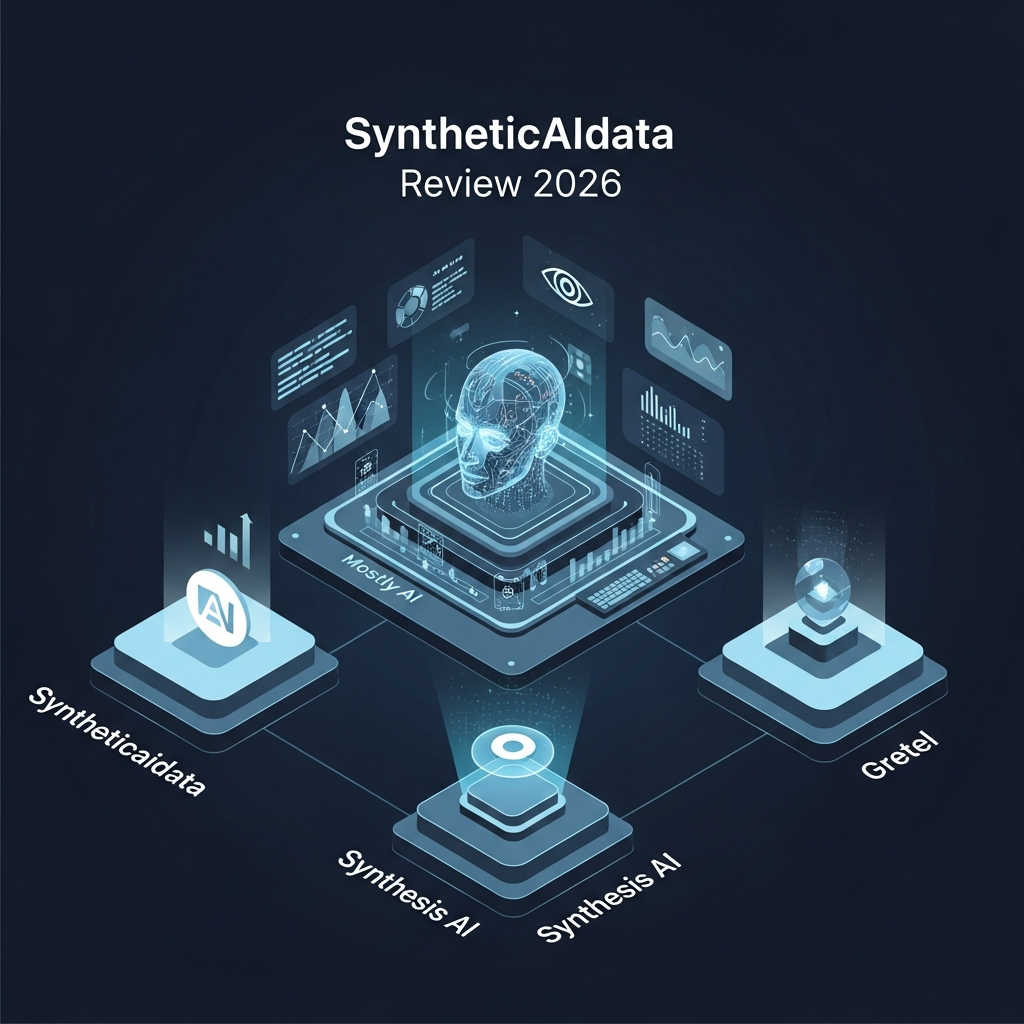

SyntheticAIdata Review 2026: Is It Worth It for Vision AI?
Quick Answer: syntheticAIdata is best suited to computer-vision teams that need controllable, automatically annotated synthetic images for model training. Its strongest use cases include manufacturing inspection, robotics, autonomous systems and other vision AI workloads where real-world data is difficult, expensive or incomplete.
The platform focuses on synthetic data for vision AI rather than broad tabular or business-data generation. Its current public documentation highlights no-code dataset creation, automatic annotations and cloud integrations. Enterprise pricing is not publicly listed on the pages reviewed, while the separate Developer product is still presented as preparing for a beta release.
SyntheticAIdata at a Glance
| Category | syntheticAIdata |
|---|---|
| Primary use | Synthetic data for computer vision |
| Best for | Manufacturing, robotics, autonomous systems, vision AI |
| Data focus | Synthetic images |
| No-code workflow | Yes |
| Object detection annotations | Yes |
| Semantic segmentation annotations | Yes |
| Image classification annotations | Yes |
| Cloud integrations | Yes |
| Named developer integrations | Azure Custom Vision, Edge Impulse |
| Enterprise pricing | Contact vendor |
| Developer access | Beta waitlist |
| Headquarters | Copenhagen, Denmark |
| Main limitation | Public pricing and technical documentation are limited |
syntheticAIdata is a Copenhagen-based company focused on helping organizations create synthetic training data for vision AI. The company says it is supported by Microsoft for Startups and participates in NVIDIA Inception.
What Is syntheticAIdata?
syntheticAIdata is a synthetic-data platform built around computer-vision model development.
Its core purpose is to help teams create labeled images without relying entirely on real-world image collection and manual annotation.
That matters because computer-vision projects often run into several practical data problems:
real examples may be difficult to collect, rare defects may appear too infrequently, some scenarios may be unsafe to reproduce, and manually labeling thousands of images can take significant time.
syntheticAIdata addresses those problems by allowing teams to create controlled synthetic scenes and generate labeled images for model training.
The official Enterprise documentation focuses on three common computer-vision tasks:
object detection
semantic segmentation
image classification.
This makes the platform fundamentally different from synthetic-data products focused on customer databases, structured tables or general analytics.
How syntheticAIdata Works
The Developer documentation describes a straightforward three-step workflow:
1. Upload a 3D model.
The model becomes the object or asset around which the synthetic scene is created.
2. Configure the environment.
Users can adjust settings such as backgrounds and lighting to introduce more variation.
3. Generate synthetic images.
The system creates synthetic image data and annotations that can then be downloaded or transferred into supported development workflows.
The main value of this approach is control.
A manufacturing team trying to detect a damaged component, for example, does not have to wait until enough defective items happen to appear on a production line.
It can create synthetic variations representing the types of conditions it wants the model to learn.
Key Features
No-Code Synthetic Data Generation
syntheticAIdata emphasizes a no-code workflow.
That can be useful when the person defining the visual scenario understands the manufacturing or engineering problem but does not want to build a complete rendering and annotation pipeline from scratch.
The vendor describes the workflow as a web-based process where users upload a 3D model, configure generation parameters and create synthetic data.
This does not mean computer-vision expertise is unnecessary.
Teams still need to understand what data their model requires, which visual variations matter and how synthetic data should be mixed with real validation data.
Automatic Image Annotations
One of syntheticAIdata's most useful documented features is automatic annotation.
The platform supports:
object detection
semantic segmentation
image classification.
This can remove a large amount of manual labeling work from a vision AI project.
When a scene is generated synthetically, the system already knows where the objects are and how they should be classified.
That makes annotation a natural output of the generation process rather than a separate manual task.
Dataset Customization
Synthetic data is most useful when it covers conditions that the real-world dataset does not.
syntheticAIdata allows teams to vary scene conditions such as backgrounds, lighting and other environmental properties. Its Enterprise documentation also discusses use cases involving different weather conditions, camera perspectives and defect variations.
That can help teams create data for difficult cases that might otherwise take months to collect naturally.
Examples could include:
a scratched component, a misplaced part, changing lighting conditions, unusual camera angles or a rare assembly error.
The quality of the final model will still depend on how well those synthetic conditions represent the production environment.
Cloud Integrations
The Enterprise platform supports cloud-based data transfer after generation.
The current Developer documentation specifically names Azure Custom Vision and Edge Impulse as examples of integrations.
The Edge Impulse integration allows synthetic datasets to be brought into an Edge Impulse project with labels already included. Edge Impulse has also published material describing the integration with syntheticAIdata-generated datasets.
Buyers should verify the current supported integrations before purchasing if their workflow depends on a particular cloud or MLOps platform.
Enterprise Dataset Generation
syntheticAIdata Enterprise is positioned for companies that need larger-scale and more tailored computer-vision datasets.
The vendor describes the Enterprise offering as customizable to industry requirements and supported by dedicated customer assistance.
The public Enterprise documentation discusses use cases including:
manufacturing inspection, defect detection, asset tracking, worker protection, autonomous driving, smart cities, robotics and retail smart-checkout applications.
That makes the product especially relevant to physical-world AI systems rather than general business analytics.
VisionDatasets
syntheticAIdata also launched VisionDatasets.com as a source of ready-made synthetic datasets for computer vision.
The company says the initial datasets are focused on manufacturing and include areas such as bottle-cap defects, screws and bolts, EU power sockets and laptop disassembly.
Those datasets are described as freely available under a community license and can be integrated into Edge Impulse workflows.
This can be useful for developers who want to experiment with synthetic computer-vision data before commissioning a custom Enterprise dataset.
syntheticAIdata Pricing in 2026
Pricing is one area where buyers should be cautious about third-party information.
The current public syntheticAIdata pages reviewed do not list standard monthly Starter or Business prices.
Enterprise Pricing
syntheticAIdata Enterprise is presented as a tailored solution.
The vendor directs prospective customers toward its contact and demo process rather than showing fixed public tiers on the Enterprise page.
For that reason, the safest pricing description is:
Enterprise: Contact syntheticAIdata for a custom quote.
Buyers should ask how pricing changes based on:
dataset volume, number of 3D assets, rendering requirements, custom scenario development, integration work and support.
Developer Access
The Developer product is not currently presented as a normal paid self-service plan.
Its public page says the company is preparing for a beta release and invites developers to join an early-access waitlist.
That means buyers should not assume there is currently a public Developer subscription with published API quotas or monthly pricing.
Pros and Cons
| Pros | Cons |
|---|---|
| Focused specifically on vision AI | Public pricing is not transparent |
| No-code generation workflow | Developer product is still presented as beta |
| Automatic image annotations | Public API documentation appears limited |
| Useful for rare defects and visual edge cases | Requires suitable 3D assets/workflows |
| Supports object detection, segmentation and classification | Not designed as a general tabular synthetic-data platform |
| Documented Edge Impulse and Azure Custom Vision integrations | Limited public information on broader integrations |
| Strong manufacturing and robotics fit | Synthetic-to-real domain gap still needs validation |
| Ready-made VisionDatasets available | Enterprise suitability may require direct vendor engagement |
Best Use Cases
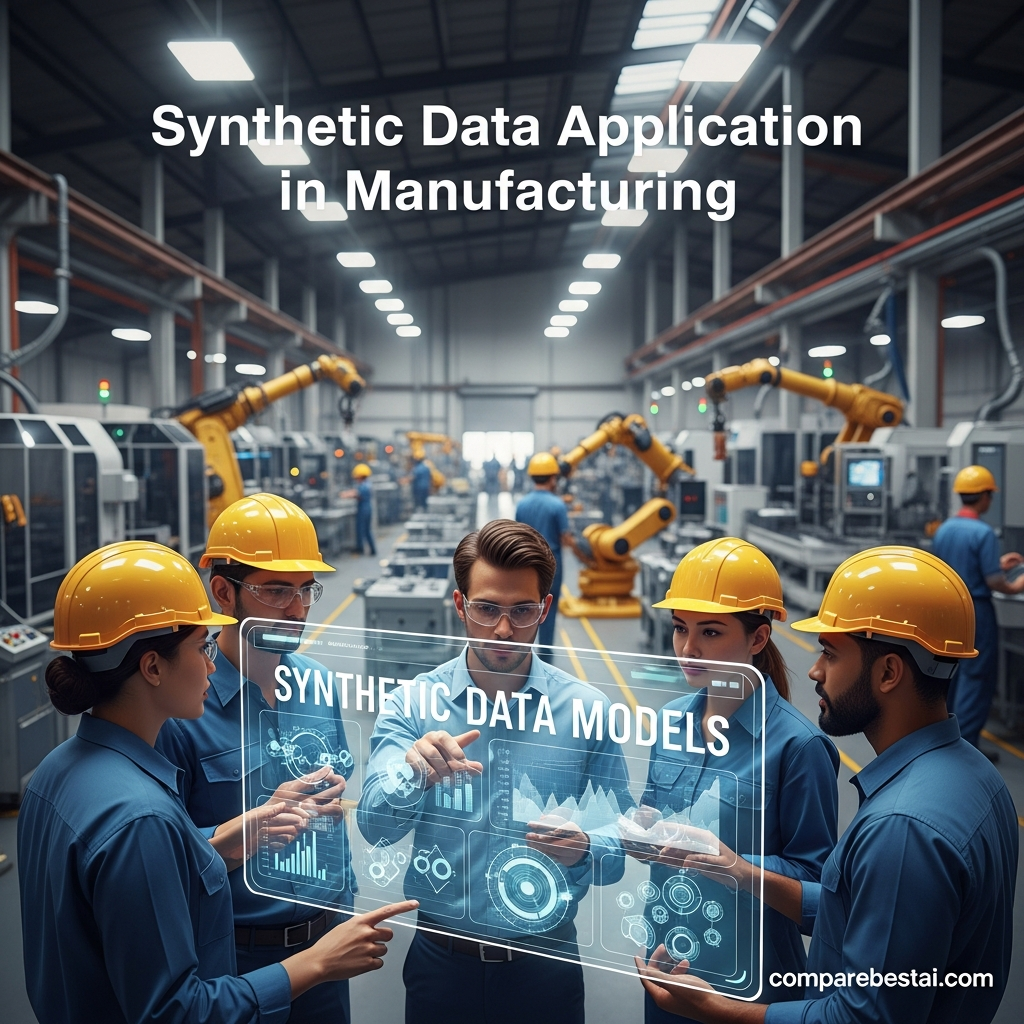
Manufacturing and Defect Detection
Manufacturing is one of the clearest syntheticAIdata use cases.
The Enterprise documentation describes generating synthetic examples of defects such as scratches, paint problems and misassembly.
This is useful because genuinely defective products may represent only a small percentage of production.
A model still needs enough examples to learn what those defects look like.
Synthetic data lets the team deliberately create more examples instead of waiting for them to occur naturally.
Robotics
Robots depend heavily on visual perception.
syntheticAIdata describes using synthetic datasets to train robotic vision systems for tasks such as sorting, quality control and autonomous navigation.
Synthetic environments can be especially useful when robots need exposure to many object positions, backgrounds or lighting conditions.
Autonomous Systems and Smart Cities
The Enterprise platform also targets smart-city and autonomous-driving scenarios.
The vendor describes generating data with changing lighting, weather conditions and camera perspectives to support visual detection tasks.
Teams working on highly advanced autonomy or multi-sensor simulation should still compare syntheticAIdata with platforms built specifically for full sensor simulation.
Retail Computer Vision
Retail use cases include visual systems supporting smart checkout and inventory-related applications.
For these projects, synthetic data may help create a wider variety of product positions, viewing angles and scene conditions before the model encounters real store environments.
Privacy and Compliance Considerations
Synthetic data can reduce the need to collect or process certain types of real-world data.
That can be useful in situations where image collection creates privacy, legal or operational concerns.
syntheticAIdata markets its approach as reducing privacy and regulatory burdens because the training examples are generated rather than captured from real people or customer records.
However, buyers should avoid interpreting that as automatic legal compliance.
Whether a project complies with GDPR, CCPA, sector-specific rules or contractual obligations depends on the entire workflow, not simply whether some of the training data is synthetic.
Organizations should review:
the source of the 3D assets, what real data is used for validation, whether real people appear in any source material, where data is stored and which legal requirements apply to the production system.
Limitations
The biggest limitation is transparency.
The current public site provides useful high-level product information but relatively limited detail on pricing, APIs, security architecture and deployment options.
That means Enterprise buyers will probably need a direct technical discussion before they can evaluate integration effort or total cost.
Another limitation is scope.
syntheticAIdata is primarily a vision AI platform.
That is a strength if you are building computer-vision models.
It is a weakness if you are actually looking for synthetic customer records, financial tables, text data or relational databases.
Finally, synthetic data does not eliminate the need for real-world evaluation.
Even a visually realistic synthetic dataset can differ from production camera data in ways that affect model performance.
Teams should validate trained models against representative real-world test data before deployment.
syntheticAIdata Alternatives
The right alternative depends heavily on the type of data you need.
Synthesis AI
Synthesis AI is another synthetic-data platform centered heavily on computer vision and simulation. Its published use cases include autonomy, human-focused vision systems and labeled 3D data.
It is worth comparing when photorealistic synthetic vision data is the main requirement.
Parallel Domain
Parallel Domain now focuses strongly on scene reconstruction and camera, lidar and radar simulation for physical AI and autonomy systems.
It is a more specialized comparison for autonomous vehicles, drones, robotics and advanced perception testing.
MOSTLY AI
MOSTLY AI, now operating as MOSTLY AI powered by Syntho, is a better comparison when the requirement is structured or text-based synthetic data rather than computer-vision images.
This distinction matters.
A buyer generating privacy-safe customer tables is solving a very different problem from a manufacturing team generating annotated images of defects.
Who Should Use syntheticAIdata?
syntheticAIdata is a strong shortlist candidate if your project involves:
computer vision, manufacturing inspection, defect detection, robotics, image classification, segmentation, object detection or other vision AI applications.
It is particularly interesting when real-world examples are expensive, rare, dangerous or time-consuming to collect.
The no-code workflow may also appeal to engineering teams that do not want to build an entire synthetic-rendering pipeline internally.
Who Should Skip It?
Look elsewhere if your primary requirement is:
synthetic tabular data, financial datasets, text datasets, relational databases, LLM fine-tuning data or general business analytics.
You should also compare alternatives if your project requires detailed lidar/radar sensor simulation, a mature public developer API, self-service pricing or a fully documented on-premises deployment before procurement.
How We Evaluated syntheticAIdata
This review was based primarily on current official syntheticAIdata documentation.
We reviewed:
the main syntheticAIdata product page, Enterprise documentation, Developer documentation, company information, VisionDatasets materials and the published Edge Impulse integration.
We treated vendor marketing claims as vendor claims rather than independent benchmarks.
Where pricing, deployment, API availability or compliance details could not be verified publicly, we have stated that limitation instead of estimating or inventing figures.
This matters because enterprise synthetic-data products are often customized around the customer's data, assets and infrastructure.
Frequently Asked Questions
What does syntheticAIdata do?
syntheticAIdata generates synthetic image data for training computer-vision models.
Its current documentation focuses on object detection, semantic segmentation and image classification across applications such as manufacturing, robotics, autonomous systems and retail.
How much does syntheticAIdata cost?
The current public pages reviewed do not list standard Enterprise monthly prices.
Prospective Enterprise customers are directed to contact syntheticAIdata for a tailored solution and quote.
Does syntheticAIdata have a free plan?
A conventional free Enterprise plan is not clearly documented on the current public pages reviewed.
However, syntheticAIdata's VisionDatasets project offers selected synthetic computer-vision datasets under a community license.
The separate Developer platform is currently described as preparing for beta release with an early-access waitlist.
What annotation types does syntheticAIdata support?
Current documentation lists three main annotation tasks:
object detection, semantic segmentation and image classification.
What integrations does syntheticAIdata support?
The Developer documentation specifically names Azure Custom Vision and Edge Impulse.
The Enterprise site also describes integration with leading cloud-based services, but buyers should confirm the full current integration list directly with syntheticAIdata.
Is syntheticAIdata only for computer vision?
Based on the current public product documentation reviewed, computer vision and vision AI are the platform's clear core focus.
Organizations seeking synthetic tabular or text data should compare products designed for those data types instead.
Final Verdict
syntheticAIdata is worth evaluating if your organization has a real computer-vision training-data problem.
Its strongest documented advantages are its no-code workflow, automatic annotations, configurable synthetic scenes and clear focus on vision AI.
It is particularly relevant for manufacturing, robotics and other physical-world applications where teams need examples of rare defects, different environmental conditions or scenarios that are difficult to collect reliably.
The main caveat is that buyers should ignore third-party claims about fixed $399 or $999 plans, broad tabular-data support, guaranteed regulatory compliance or large REST/Python ecosystems unless syntheticAIdata confirms those capabilities directly.
For 2026, the safest assessment is straightforward:
Choose syntheticAIdata for vision-focused synthetic datasets. Do not treat it as a general-purpose synthetic-data platform unless the vendor confirms additional capabilities for your project.
Found this guide useful? Share it with your team.