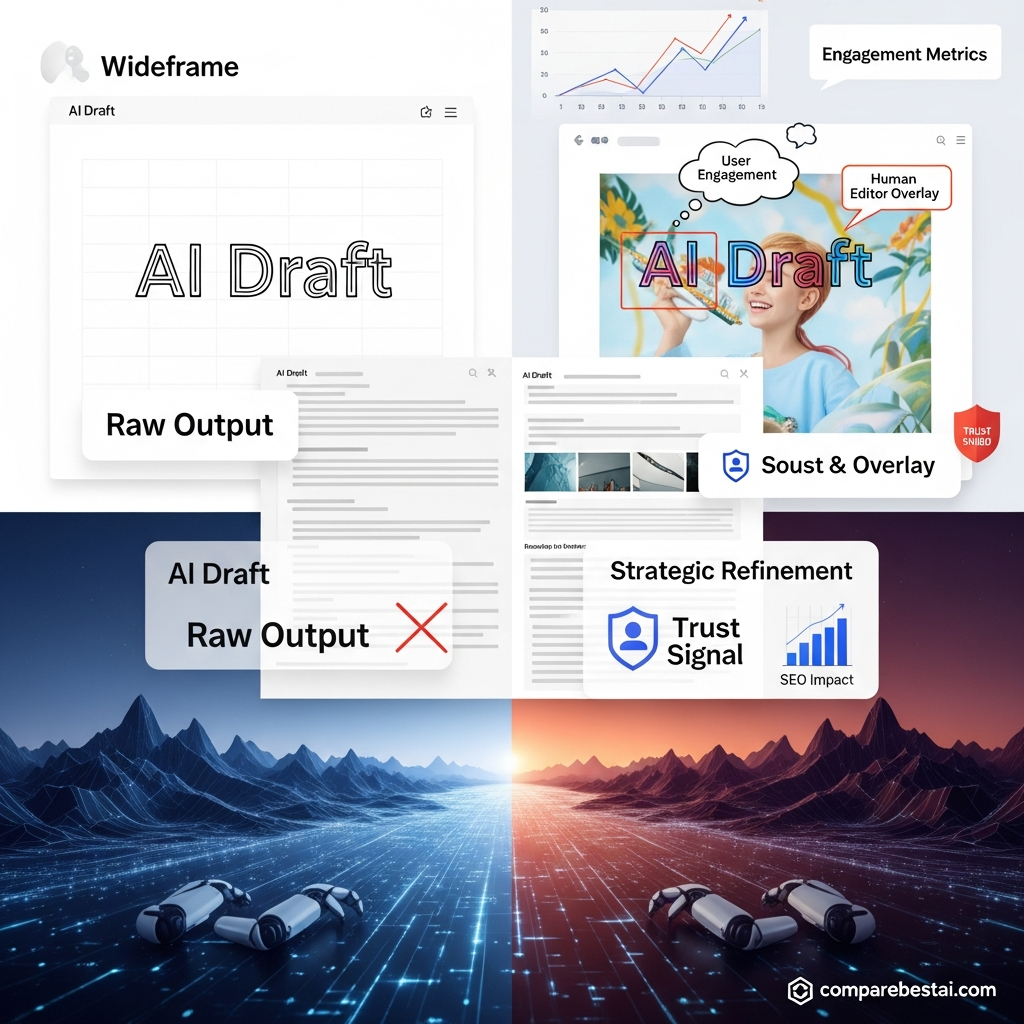

Quick Answer: How Do You Humanize AI Content for SEO?
Humanizing AI content means turning machine-assisted research or drafts into original, accurate, experience-backed content written for the reader rather than for an AI detector.
For enterprise SEO, the strongest workflow is straightforward: use AI for research, organization and first-pass drafting, then require human experts to verify facts, add first-hand knowledge, sharpen the argument, apply the brand voice, improve examples and approve the final page.
Google does not prohibit AI-generated content simply because AI was used. What matters is whether the final page is useful, original, accurate and created primarily to help people.
The goal is not to hide AI.
The goal is to publish something worth reading.
What Does “Humanizing AI Content” Actually Mean?
Humanizing AI content is often misunderstood as rewriting sentences until an AI detector labels them “human.”
That is the wrong objective for enterprise SEO.
A page can sound conversational and still be generic, inaccurate or unnecessary. Another page may contain AI-assisted drafting but provide original research, expert commentary, useful examples and reliable sourcing.
The second page is far more valuable.
A practical definition is:
Humanizing AI content is the editorial process of adding the expertise, evidence, context, judgment and brand perspective that a raw language-model output does not reliably provide on its own.
That process can involve:
correcting factual errors
replacing unsupported claims with primary sources
adding subject-matter expert commentary
including first-hand examples
removing repetitive or generic passages
strengthening the argument
adapting terminology to the audience
adding proprietary data
documenting tradeoffs
improving internal links
matching the brand voice
creating a clear next step for the reader
Sentence style matters, but it is only one small part of the job.
Does Google Penalize AI-Generated Content?
Not automatically.
Google's published guidance focuses on the quality and purpose of the content, not on banning content simply because generative AI contributed to its production.
Google has said that generative AI can be useful for activities such as research and structuring original content.
The risk appears when automation is used to create large numbers of pages that provide little additional value to users.
Google's spam policies describe this as scaled content abuse when pages are produced primarily to manipulate search rankings rather than help people.
For enterprise content teams, this creates an important distinction.
Appropriate use of AI
AI can support:
topic research
document summarization
content outlines
data organization
first-draft creation
headline variations
FAQ discovery
formatting
editing suggestions
content repurposing
High-risk use of AI
Problems begin when teams:
publish raw AI drafts without verification
manufacture statistics or quotations
create hundreds of near-identical pages
rewrite competitors without adding original value
create pages for every slight keyword variation
fabricate first-hand experience
add irrelevant sections purely for keyword coverage
publish content nobody has taken responsibility for
The safest enterprise principle is simple:
Automate production steps, not editorial accountability.
What Google Actually Wants From AI-Assisted Content
Google's current guidance consistently returns to a few fundamentals.
Content should be:
helpful
reliable
original
people-first
accurate
relevant to the user's needs
Google also discusses E-E-A-T: Experience, Expertise, Authoritativeness and Trustworthiness.
However, E-E-A-T should not be treated as a secret score or a checklist of ranking factors.
Google has explicitly explained that E-E-A-T itself is not a single ranking factor. Rather, its systems use many signals intended to identify content that displays qualities associated with strong experience, expertise, authority and trust.
For enterprise teams, that means the practical question is not:
“How many E-E-A-T signals can we insert?”
Ask instead:
“What would make a knowledgeable reader trust this page?”
That question usually leads to better editorial decisions.
Why Raw AI Content Often Underperforms
Modern language models can produce fluent writing quickly. Fluency is not the same thing as value.
Raw AI drafts commonly create five problems.
1. They summarize what already exists
Language models are excellent at producing the expected explanation of a topic.
That makes them useful for getting started.
It also means their first answer is often close to the informational average of what already exists.
Competitive enterprise content needs something more:
proprietary data
actual implementation experience
stronger examples
expert interpretation
new comparisons
original frameworks
evidence from the business
2. They can present uncertain information confidently
An AI-generated statement may look polished even when the source is missing, outdated or misunderstood.
That creates serious risk for enterprise websites, particularly in finance, healthcare, cybersecurity, legal, compliance and other high-consequence areas.
Every material external claim should have a verification path.
3. They often flatten brand voice
AI tends toward safe, broadly acceptable phrasing unless given strong context.
That can make ten companies sound almost identical.
A recognizable brand needs specific beliefs, preferred terminology, recurring points of view and clear boundaries around what it would never say.
4. They lack genuine first-hand experience
A model can describe what using a product might feel like.
It did not use the product.
It can describe how an enterprise migration usually works.
It did not sit through your migration.
That difference is crucial when experience is relevant to the query.
5. They make scaling bad content easy
Before generative AI, producing 500 mediocre articles required significant labor.
Now the same mistake can happen in days.
The operational efficiency of AI therefore makes editorial governance more important, not less.
The Enterprise AI Content Workflow
A scalable enterprise workflow should separate tasks AI can accelerate from decisions humans need to own.
Step 1: Start With Search Intent, Not the Prompt
Do not begin by asking an AI model to “write an article about X.”
First determine:
who is searching
what decision they are trying to make
what they likely already know
what information would satisfy the query
what competing pages fail to explain
what original information your organization can contribute
The content brief should exist before the first draft.
For example, someone searching:
“enterprise AI content governance”
needs a different page from someone searching:
“best AI writing software.”
The keyword overlap may be significant. The decision behind the query is not.
Step 2: Gather Trusted Source Material
Give the AI better material before asking it to generate anything.
For enterprise SEO, the source pack may include:
official documentation
internal subject-matter expert interviews
customer-support insights
product documentation
original research
analytics data
sales questions
compliance requirements
existing style guides
approved brand terminology
primary research from credible organizations
This reduces the likelihood that the first draft is built around generic assumptions.
Step 3: Decide What AI Is Allowed to Do
Different content types require different risk controls.
A low-risk glossary definition does not need the same approval process as a financial or medical article.
A practical model is to classify content into three levels.
Low-risk content
Examples:
basic definitions
navigational content
internal summaries
non-sensitive product formatting
AI may be allowed to perform more of the drafting.
Medium-risk content
Examples:
commercial comparison pages
thought leadership
product reviews
SEO guides
business recommendations
Require human editorial review and verification of material claims.
High-risk content
Examples:
financial guidance
medical information
legal interpretation
security advice
regulated industry content
material claims about competitors
Require qualified subject-matter review and formal approval.
The higher the potential consequence of an error, the less autonomous the content workflow should be.
Step 4: Use AI for Structure and First-Pass Analysis
Once the brief and sources exist, AI can accelerate useful production tasks.
For example, ask the model to:
organize source notes
identify repeated themes
propose an outline
surface unanswered questions
compare competing arguments
summarize long documents
generate alternative structures
create a first draft from approved information
At this stage, speed is valuable.
Perfection is not the goal.
Treat the output as working material.
Step 5: Add Information AI Could Not Know
This is where the page starts becoming defensible.
Ask the subject-matter expert:
What can we add that would not appear in a generic AI response?
Examples include:
what happened during implementation
what failed
what surprised the team
where the standard advice breaks down
cost or time tradeoffs
screenshots from actual use
proprietary data
customer questions
benchmark results
workflow examples
internal methodology
lessons from mistakes
This is information gain in a practical sense.
The goal is not simply to say something differently.
It is to contribute something useful.
Step 6: Verify Every Material Claim
AI-assisted content should have a source-verification pass before publication.
Create a simple rule:
If a statement can be checked externally and matters to the argument, verify it.
That includes:
statistics
prices
product features
dates
regulatory claims
quotes
market share
benchmark results
policy statements
technical specifications
Prefer primary sources wherever possible.
For example:
Use Google's documentation for Google Search policies.
Use the vendor's official pricing page for pricing.
Use regulatory bodies for regulatory requirements.
Use original research reports for statistics.
Do not cite a blog that cites another blog that cites the original report.
Go to the source.
Step 7: Rewrite for the Brand, Not for an AI Detector
Now edit the language.
But focus on readers, not “burstiness,” “perplexity” or trying to fool detection software.
Review whether the content:
sounds like your organization
uses terminology your audience understands
has a clear point of view
avoids generic introductions
eliminates repetitive transitions
varies sentence length naturally
removes unnecessary adjectives
states uncertainty where necessary
uses examples instead of vague claims
avoids pretending certainty where none exists
Good editorial rhythm should emerge from clear thinking.
Do not intentionally make sentences awkward just to appear “more human.”
Step 8: Strengthen the First 100 Words
Enterprise pages often waste their introduction.
A user should understand the core answer almost immediately.
A strong opening usually includes:
the direct answer
the important qualification
what the article will help them do
For this topic, the answer is:
Humanizing AI content is not about disguising AI authorship. It is about adding human expertise, evidence, verification and useful originality to an AI-assisted workflow.
The rest of the article should prove and expand that statement.
Step 9: Build Citation-Ready Sections
Content increasingly needs to work for both human readers and answer systems.
That does not require special “LLM markup.”
It requires clean information.
Make important facts easy to extract.
Use:
descriptive headings
concise definitions
short answer blocks
tables where comparisons are clearer
named sources
dates
exact statistics
explicit methodologies
direct conclusions
consistent entity names
For example, this sentence is weak:
“Research proves AI content is increasingly common.”
This is stronger:
“Google's Search Central guidance says generative AI can be useful for research and content structure, while warning that producing many low-value pages with automation can violate its scaled content abuse policy.”
The second version tells a reader or an answer engine exactly who said what.
Step 10: Add Contextual Internal Links
Internal links should help readers continue the task they are already performing.
Do not insert links simply because two pages share a keyword.
Useful anchor text is descriptive.
Better:
compare AI writing tools
learn how AI writing affects SEO
review enterprise SEO tools
compare AI content platforms by pricing
Weaker:
click here
learn more
read this
this article
Internal links also help search engines discover and understand related pages.
Step 11: Add the Right CTA for the Funnel Stage
This article is primarily informational.
Someone searching how to humanize AI content is trying to solve a content-quality problem, not necessarily buy software immediately.
That means the first half of the article should teach.
A commercial CTA becomes appropriate after the reader understands the workflow.
For example:
If your team already has an editorial process and the bottleneck is software, compare AI writing and SEO tools by governance, integrations, pricing and review features before adding another platform.
That transitions naturally from TOFU education into MOFU comparison.
Enterprise AI Content Governance Framework
Large organizations need more than a style guide.
They need ownership.
A simple governance model can look like this:
| Role | Responsibility |
|---|---|
| SEO strategist | Defines query intent, page role and internal linking |
| AI operator/writer | Uses approved tools and source material |
| Subject-matter expert | Verifies technical accuracy and adds experience |
| Editor | Improves logic, clarity, evidence and brand voice |
| Legal/compliance | Reviews regulated or high-risk claims when required |
| Publisher | Confirms metadata, links, schema and final QA |
| Content owner | Monitors performance and schedules updates |
This prevents the common enterprise problem where everybody touches the content but nobody truly owns it.
How to Measure Whether Humanization Is Working
Do not measure success by an AI detector score.
Measure what the content is supposed to accomplish.
Relevant metrics may include:
organic impressions
qualified organic traffic
conversions
assisted conversions
engagement
search-query coverage
branded searches
backlinks
citations
leads
trial signups
newsletter subscriptions
content-assisted pipeline
Also monitor qualitative signals.
Are sales teams using the article?
Are customers referencing it?
Are other publishers citing it?
Does it answer questions your support team repeatedly receives?
Those outcomes say far more about content quality than whether a detector assigns the text a particular percentage.
What About AI Overviews and AI Mode?
Enterprise SEO teams increasingly want content to appear in generative search experiences.
Google's current guidance is refreshingly simple: the fundamentals of SEO still apply.
There is no special AI Overview schema required.
Pages still need to be crawlable, indexable and eligible for normal Google Search.
Google recommends focusing on useful, original content, good internal linking, accessible text, relevant media and structured data that accurately matches the visible page.
That means “GEO” or “AEO” should not become an excuse to abandon SEO fundamentals.
The stronger strategy is to publish information worth retrieving.
Should You Disclose That AI Was Used?
Sometimes.
Google recommends considering additional context about how content was created when readers would reasonably expect that information.
That does not mean every AI-assisted comma needs a disclosure.
The appropriate level depends on the content.
Disclosure becomes more useful when:
content is heavily automated
methodology matters
users may reasonably question authorship
synthetic media is involved
editorial independence is important
the topic is sensitive
transparency adds meaningful context
Do not add an AI disclosure because you think it automatically improves rankings.
Add it when it helps the reader understand the production process.
Should Enterprises Use AI Humanizer Tools?
Use them carefully.
A rewriting tool can help with:
awkward sentences
repeated phrasing
tone consistency
readability
shortening
restructuring
It cannot reliably replace:
fact-checking
actual expertise
proprietary data
legal review
product experience
strategic judgment
source verification
A tool that promises to “bypass AI detection” solves the wrong problem for enterprise SEO.
Your objective should be higher-quality content, not undetectable content.
AI Content Humanization Checklist
Before publishing an AI-assisted enterprise page, confirm:
Search intent
Does the page answer the actual query?
Is the primary answer visible near the beginning?
Does this page deserve a separate URL?
Originality
Does it contain information competitors do not?
Is there first-hand experience, proprietary data or expert interpretation?
Have generic AI sections been removed?
Accuracy
Are material factual claims verified?
Are statistics traceable to original sources?
Are pricing, dates and product information current?
Expertise
Has an appropriate subject-matter expert reviewed the page?
Are technical claims expressed with the right level of certainty?
Brand voice
Does the article sound recognizably like the brand?
Have generic transitions and filler been removed?
Are opinions and recommendations clear?
SEO
Is the primary keyword naturally represented?
Is the heading hierarchy logical?
Are internal links genuinely useful?
Are title and meta description optimized?
Does structured data match visible content?
Conversion
Does the CTA match the reader's stage?
Is the next step obvious without interrupting the educational value?
Governance
Is there a named content owner?
Is the publication date accurate?
Is there an update schedule?
Can the team explain how important claims were verified?
If several of these answers are “no,” the page is not ready simply because the prose sounds natural.
Common Mistakes to Avoid
Trying to fool AI detectors
Detector scores are not an SEO strategy.
Focus on quality and usefulness.
Adding fake personal experience
Never ask AI to invent a first-person story, product test or customer result.
If the experience did not happen, do not present it as if it did.
Overusing anecdotes
Humanization does not mean turning every paragraph into a personal story.
Use experience where experience genuinely improves the answer.
Publishing every keyword variation
“Humanize AI content,” “humanizing AI content,” “how to make AI content human” and “humanize AI writing” may belong on one strong page rather than four near-duplicates.
Create another URL only when the search intent deserves one.
Confusing longer with better
Enterprise content does not need 4,000 words merely because the competing page has 3,500.
Answer the question completely.
Stop when additional sections no longer help the reader.
Citing weak secondary sources
For factual claims, move as close to the original source as possible.
That improves trust for readers and makes the content easier for downstream systems to interpret correctly.
Frequently Asked Questions
What does it mean to humanize AI content?
Humanizing AI content means improving AI-assisted material with human expertise, verification, original information, brand perspective, examples and editorial judgment. It is not simply rewriting sentences to fool an AI detector.
Does Google penalize AI-generated content?
Google does not prohibit content simply because AI was used. Its guidance focuses on whether content is helpful, reliable and created primarily for people. Producing many low-value pages primarily to manipulate search rankings can violate Google's scaled content abuse policy.
Does AI content need human editing for SEO?
Not every AI-assisted sentence requires rewriting, but important content should have appropriate human oversight. Human review is particularly valuable for factual accuracy, first-hand experience, brand positioning, regulated topics and high-impact recommendations.
Is AI detection important for SEO?
AI detector scores are not a documented Google ranking factor. Enterprises should focus on accuracy, originality, usefulness, trust and editorial accountability rather than trying to achieve a particular detector score.
What is the best way to humanize AI content at scale?
Use a documented workflow. Give AI approved source material, limit what it is allowed to generate, require fact verification, involve subject-matter experts where necessary, apply brand standards and assign a human owner to the final page.
Can AI-written content demonstrate E-E-A-T?
A final page can demonstrate qualities associated with experience, expertise, authority and trust even when AI contributed to parts of the production process. However, AI cannot truthfully manufacture first-hand experience. Genuine experience should come from real people, testing, research or organizational knowledge.
Do I need special schema for AI Overviews?
No. Google says there is no special schema required for AI Overviews or AI Mode. Normal technical SEO, crawlability, useful content, internal linking and accurate structured data remain relevant.
Should enterprises disclose AI-generated content?
Disclosure can be useful when readers would reasonably benefit from knowing how the content was created. It should be used for transparency, not because you assume an AI disclosure automatically improves rankings.
Final Verdict
The best way to humanize AI content in 2026 is not to make AI harder to detect.
It is to make the finished page harder to replace.
Use AI where it genuinely improves efficiency: research, organization, analysis, formatting and first-pass drafting.
Then add what automation cannot reliably supply on its own:
real experience, verified evidence, subject-matter judgment, proprietary information, brand perspective and accountable editorial decisions.
That is the difference between scalable content and scalable noise.
For enterprise SEO teams, the winning model is neither fully manual nor fully automated.
It is a governed hybrid workflow where AI accelerates production and people remain responsible for what gets published.
If your workflow is already mature and software is now the bottleneck, compare AI writing and SEO tools based on accuracy controls, integrations, governance, pricing and editorial workflow fit before adding another platform.