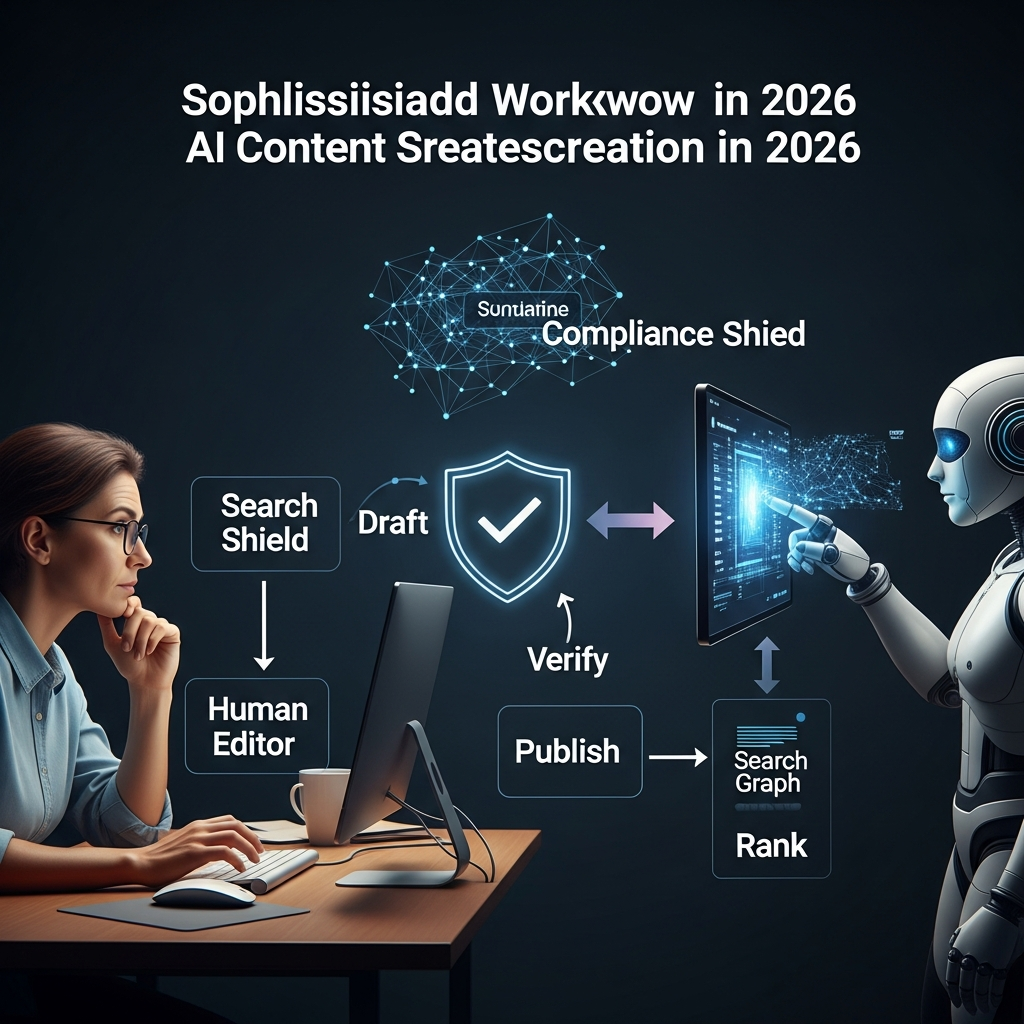

Quick Answer: How Should You Use AI for SEO Content in 2026?
The best AI content creation strategy in 2026 is a human-led, AI-assisted workflow.
Use AI for research support, organizing source material, outlining, first drafts, repurposing and repetitive editing. Keep humans responsible for search intent, factual verification, first-hand experience, original analysis, brand positioning and final publication.
Google does not prohibit content simply because generative AI helped create it. The bigger SEO risk is publishing large amounts of unoriginal, low-value content.
The goal is therefore not to make AI content “undetectable.”
The goal is to make the finished page useful enough that it deserves to rank, be referenced and be read.
What Is Human-Centric AI Content Creation?
Human-centric AI content creation is a workflow in which artificial intelligence improves production efficiency without replacing the people responsible for the content's meaning, accuracy and value.
AI can help produce material.
Humans determine whether that material should exist.
That distinction matters.
A language model can:
summarize documents
organize research
produce outlines
draft sections
generate headline alternatives
rewrite text
extract themes
create content variations
But it does not automatically know:
what your customers actually experience
which claims your company can defend
what happened during a real implementation
what your subject-matter experts disagree about
which recommendation creates business or legal risk
what your brand genuinely believes
Those are the ingredients that turn generated text into useful content.
Does Google Penalize AI-Generated Content?
Not simply because AI was used.
Google Search Central's guidance on generative AI says AI can be useful for researching topics and adding structure to original content.
The problem is using AI or other automation to create large numbers of pages without adding meaningful value.
Google treats large-scale production of unoriginal content intended primarily to manipulate rankings as a potential form of scaled content abuse.
This leads to a much more useful SEO rule:
Don't ask whether Google can detect AI. Ask whether the page provides enough original value to justify its existence.
That is the standard enterprise content teams should build around.
What Google's 2026 AI Search Guidance Actually Says
Google published expanded guidance for generative AI search in May 2026.
Several points are especially important.
Traditional SEO still matters
Google says its existing SEO best practices continue to apply to AI Overviews and AI Mode because those experiences remain connected to Google's core Search ranking and quality systems.
That means you should still care about:
crawlability
indexing
search intent
page quality
internal links
page experience
descriptive titles
useful headings
relevant media
technically accessible content
AI search did not erase SEO.
Original information matters more than commodity content
Google specifically recommends creating valuable, non-commodity content.
That can include:
first-hand experience
original research
proprietary data
unique analysis
original images
expert opinions
useful comparisons
evidence from actual product testing
Repeating information that dozens of other websites already summarize creates very little reason for a search engine or AI system to prefer your page.
There is no special AI-search schema
You do not need:
“GEO schema”
“AEO schema”
“AI Overview schema”
special AI markup
special Markdown versions of pages
Normal structured data can still help when it accurately represents the visible page, but there is no special schema required to appear in Google's generative AI experiences.
You do not need to rewrite everything for AI engines
Google also says publishers do not need to write in a special style purely for generative AI search.
Clear communication helps.
Artificially engineering every paragraph into tiny “LLM chunks” is not required.
Write for the person who needs the information.
The Human-Centric AI Content Workflow
A scalable AI content system can be divided into eight stages.
| Stage | AI's Role | Human Role |
|---|---|---|
| Search intent | Assist with query research | Decide what problem deserves a page |
| Research | Summarize and organize material | Choose and verify reliable sources |
| Brief | Suggest topics and questions | Define angle, audience and original value |
| Drafting | Produce working copy | Add expertise, examples and judgment |
| Fact-checking | Flag claims for verification | Verify material facts against sources |
| Editing | Improve clarity and consistency | Protect brand voice and editorial quality |
| SEO | Assist with headings and metadata | Make final search-intent decisions |
| Publication | Automate repeatable checks | Own final approval and accountability |
AI creates leverage at every stage.
It should not become the owner of any stage.
Step 1: Start With Search Intent, Not an AI Prompt
One of the weakest AI workflows starts like this:
Write a 2,000-word article about AI marketing.
The model has no meaningful reason to create anything beyond the most predictable summary of the subject.
Start instead with the reader.
Ask:
Who is searching?
What problem are they solving?
How much do they already know?
What decision comes after reading?
What evidence will they need?
What is missing from the current search results?
What can our organization contribute that others cannot?
That becomes the brief.
Only then should AI enter the process.
Step 2: Build a Source Pack Before Drafting
AI output improves when the underlying information improves.
Before generating a draft, collect reliable material.
Depending on the page, that may include:
official documentation
original research
expert interviews
product screenshots
customer questions
support tickets
analytics
survey data
pricing pages
technical documentation
internal subject-matter notes
regulatory guidance
Give the model approved information rather than expecting it to manufacture expertise.
Use primary sources whenever possible
If you're stating Google's policy, cite Google.
If you're discussing a product's price, check the official pricing page.
If you're quoting research, find the original report.
If you're discussing regulation, use the regulator or legislation itself.
That improves both factual reliability and citation quality.
Step 3: Define the Information Gain
Before drafting, answer one question:
What will this page add that a generic AI response cannot?
Possible answers include:
proprietary statistics
original tests
screenshots
internal benchmarks
expert commentary
implementation lessons
customer examples
mistakes your team made
original comparison criteria
real cost calculations
new interpretations of existing research
You do not need groundbreaking academic research on every page.
You do need a reason for readers to choose your explanation over an interchangeable summary.
Step 4: Use AI for the Work It Does Well
Once the research and angle are clear, AI becomes much more useful.
Research organization
AI can summarize long documents and organize notes into themes.
Outline development
It can help identify logical sections and unanswered questions.
First drafts
AI can transform approved source material into working copy quickly.
Alternative explanations
Ask for simpler explanations of difficult concepts.
Content repurposing
Turn an article into:
newsletter ideas
social posts
video scripts
FAQs
sales enablement
executive summaries
Editing assistance
AI can flag:
repeated information
awkward sentences
inconsistent terminology
overly long paragraphs
All of these save time.
None removes the need for editorial judgment.
Step 5: Add Real Experience and Expertise
This is the part AI cannot authentically manufacture.
Google's quality guidance discusses Experience, Expertise, Authoritativeness and Trustworthiness, commonly abbreviated as E-E-A-T.
Google also explicitly says E-E-A-T itself is not one specific ranking factor.
For writers, the practical interpretation is simpler:
Give readers a reason to trust the person or organization publishing the page.
Real experience might include:
actually testing the software
explaining what happened after implementation
providing original screenshots
comparing expected and actual costs
discussing a failed strategy
showing real workflow limitations
publishing your methodology
explaining why an expert disagrees with conventional advice
Do not ask AI to invent personal experience.
If the event did not happen, do not write as though it did.
Step 6: Fact-Check Material Claims
A fluent sentence can still be wrong.
Create a fact-checking standard for AI-assisted pages.
Verify:
prices
dates
statistics
product features
plan limits
legislation
benchmark scores
quotations
company claims
medical information
financial claims
technical specifications
A useful rule is:
If a reader could reasonably challenge the statement with evidence, make sure you know where your evidence came from.
Make facts citation-ready
Instead of:
“AI adoption is growing quickly.”
Prefer:
“Company X's 2026 survey of Y respondents found that Z% reported using AI for this workflow.”
Include:
source
date
population
number
relevant context
That makes the information more useful to human readers and easier for other systems to interpret accurately.
Step 7: Edit for the Brand, Not an AI Detector
Do not turn editorial review into a game of trying to trick AI-detection software.
Instead, ask whether the article sounds like your organization.
Remove generic language such as:
“In today's rapidly evolving digital landscape”
“It's important to note”
“In conclusion”
empty superlatives
repetitive transitions
unsupported claims about revolutions and transformations
Replace them with actual information.
Use natural sentence variation
Good writing naturally includes:
short sentences
longer explanations
occasional fragments when appropriate
specific nouns
concrete examples
direct statements
But do not deliberately add grammatical mistakes merely to make AI text appear more human.
Clarity still matters.
Step 8: Optimize the Finished Page for SEO
SEO should improve the article after the substance is strong.
Check:
Title tag
Include the primary topic while giving the searcher a reason to click.
Meta description
Summarize the benefit and give the reader a clear reason to visit.
H1
Use one H1 that accurately describes the page.
Heading hierarchy
Use H2s for primary sections and H3s for logical subsections.
Do not choose headings purely because they contain additional keywords.
Internal links
Link readers to useful next steps.
Good anchor text describes what they will find.
Examples:
best AI marketing tools in 2026
compare AI tool pricing
how to choose the right AI tool
free AI tools for marketers
Avoid:
click here
read more
this page
learn more
Images
Use original screenshots, diagrams or useful visuals when they improve understanding.
Add descriptive alt text where appropriate.
Structured data
Use structured data only when it accurately represents visible content.
For a guide like this, Article and BreadcrumbList are appropriate starting points.
AI Overviews and AI Mode: What Should Publishers Change?
The temptation is to create an entirely separate discipline for AI search.
Google's 2026 guidance suggests a more practical approach.
The core work remains SEO.
Pages should be:
crawlable
indexable
useful
clearly structured
original
internally connected
supported by relevant media
technically accessible
Generative search can retrieve specific information from pages that already participate in normal Search.
Don't create dozens of query-variation pages
Google specifically warns against creating separate content for every possible search variation when the purpose is manipulating rankings or generative AI responses.
This is particularly important with AI.
A content team can now create 50 nearly identical pages in one afternoon.
That does not mean it should.
One strong page covering a coherent search intent is usually a better long-term asset than multiple shallow variations.
When Should AI Content Be Heavily Automated?
Not every page needs the same workflow.
Lower-risk uses
More automation may be reasonable for:
standardized metadata
simple product-format conversions
internal summaries
structured descriptions from verified databases
repetitive documentation updates
content tagging
transcription cleanup
Even here, quality controls should exist.
Medium-risk content
Human review should be stronger for:
SEO articles
buying guides
software comparisons
marketing recommendations
thought leadership
product reviews
customer-facing educational content
High-risk content
Require qualified human oversight for:
medical information
legal information
financial guidance
cybersecurity recommendations
safety advice
employment decisions
regulated industries
consequential claims
The higher the cost of being wrong, the less autonomous the workflow should be.
AI Content Governance for Larger Teams
Enterprise AI content requires rules, not just prompts.
A basic governance framework should answer:
Which tools are approved?
Employees should know which AI platforms they can use.
What data can be uploaded?
Define rules for:
personal data
customer information
confidential documents
intellectual property
unreleased products
internal financial information
Which content requires expert review?
Establish risk tiers and approval requirements.
Who owns the final page?
Every published page needs a human owner.
AI cannot be accountable for an inaccurate claim.
How are corrections handled?
Document who updates the page when:
prices change
products change
research changes
regulations change
errors are discovered
How often is content reviewed?
Evergreen does not mean permanent.
Pages containing fast-changing information need a clear review schedule.
How to Measure AI Content Performance
Do not judge the workflow by how many words AI generated.
Measure whether it improved an outcome.
Efficiency metrics
Track:
drafting time
editing time
total production cost
number of manual steps
publication turnaround
SEO metrics
Track:
organic impressions
clicks
CTR
rankings
query coverage
indexed URLs
non-brand traffic
Engagement
Track:
meaningful engagement
return visits
newsletter subscriptions
downloads
content-assisted journeys
Commercial impact
Track:
qualified leads
trial starts
assisted conversions
pipeline
revenue
affiliate conversions where relevant
Faster publishing only matters if the content still creates value.
Human-Centric AI Content Checklist
Before publishing an AI-assisted page, confirm:
Intent
Does this page solve one clear reader problem?
Is the answer visible early?
Does the page deserve its own URL?
Originality
What information is unique?
Have we added expert knowledge or actual experience?
Are we publishing anything competitors could reproduce with one prompt?
Accuracy
Have material facts been verified?
Are statistics attributed?
Are pricing and product details current?
Editorial quality
Has a human read the entire page?
Does it sound like our brand?
Have generic AI phrases been removed?
Are limitations and tradeoffs explained honestly?
SEO
Is there one clear H1?
Is the heading hierarchy logical?
Are internal links useful?
Are title and meta description optimized?
Is structured data accurate?
Governance
Is a human responsible for the page?
Is the publication date correct?
Is there an update schedule?
Conversion
Does the CTA match the reader's funnel stage?
Is the next step helpful rather than intrusive?
If several answers are “no,” the page probably needs more work before publication.
Frequently Asked Questions
Is AI-generated content bad for SEO?
No. AI-assisted content is not inherently bad for SEO. Google's guidance focuses on whether content is useful, reliable, original and created to help users. Producing many low-value pages with automation can violate Google's spam policies.
Does Google detect AI-written content?
Google does not tell publishers to optimize around an AI-detection score. Its public guidance focuses on content quality and spam behavior rather than requiring publishers to make AI-generated writing undetectable.
What is human-centric SEO?
Human-centric SEO means creating and optimizing content around the needs of real users while maintaining sound search-engine fundamentals. It prioritizes usefulness, clarity, originality, evidence and a satisfying user experience rather than manipulating algorithms.
Does AI content need human editing?
Important public-facing content should receive appropriate human review. Humans are especially important for verifying facts, adding first-hand experience, protecting brand voice and approving consequential claims.
Is E-E-A-T a Google ranking factor?
Google says E-E-A-T itself is not a single specific ranking factor. Its systems use multiple signals designed to identify qualities associated with experience, expertise, authoritativeness and trustworthiness.
Do I need special schema for AI Overviews?
No. Google says there is no special structured data required for AI Overviews or AI Mode. Continue using normal structured data when it accurately describes visible page content.
Should I use AI humanizer tools for SEO?
A rewriting tool can help improve clarity or tone, but trying to bypass AI detectors is not a sound SEO strategy. Focus on factual accuracy, originality, experience and useful editing instead.
What is the best AI content workflow for SEO?
Start with search intent and reliable sources, use AI to organize research and produce a working draft, add original human expertise, verify material claims, edit for brand and clarity, optimize the final page for SEO, then measure and update it after publication.
Final Verdict
AI content creation in 2026 works best as a partnership between automation and accountable human expertise.
Use AI to remove mechanical work.
Let it organize research, structure drafts, create variations, summarize documents and accelerate repetitive editing.
But keep humans responsible for the parts that create trust:
strategy, evidence, original experience, expert judgment, brand positioning, fact-checking and final approval.
The objective is not to produce content that appears human.
It is to produce content that is genuinely useful to humans.
That distinction matters for readers, for brands and for search visibility.
If your content workflow is already strong and software is now the bottleneck, compare AI marketing tools by use case, pricing, integrations and editorial-review features before adding another platform.