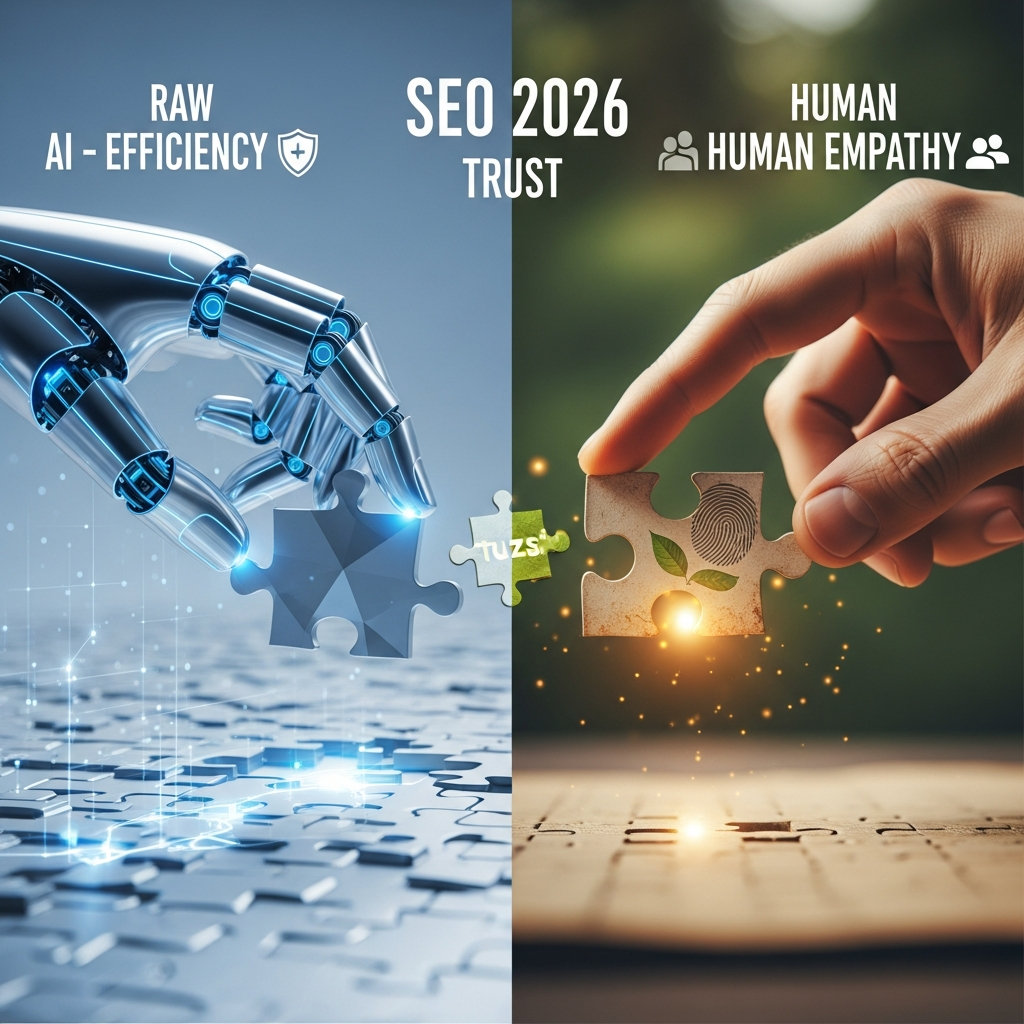

Quick Answer: How Do You Humanize AI Content for SEO in 2026?
AI content humanization means turning AI-assisted drafts into original, accurate and genuinely useful content through human research, experience, fact-checking, editing and judgment.
For SEO in 2026, the goal is not to make AI text “undetectable” or manipulate sentence patterns. Google's guidance focuses on helpful, reliable, people-first content and warns against producing large amounts of low-value material primarily to manipulate rankings.
A practical workflow is:
AI-assisted research and drafting → source verification → expert input → original insight → human editing → SEO QA → publication → performance review.
The finished page should offer something a reader could not get from a generic AI response.
What Is AI Content Humanization?
AI content humanization is the editorial process of improving machine-assisted content with information and judgment that automated generation cannot reliably provide on its own.
That can include:
first-hand experience
expert interpretation
original research
proprietary data
verified facts
relevant examples
product testing
customer insight
brand perspective
contextual nuance
clear recommendations
honest limitations
This is different from simply rewriting AI-generated sentences until they sound less robotic.
A polished sentence can still be generic.
A slightly imperfect sentence can still contain valuable insight.
The substance matters more than whether the text follows a particular linguistic pattern.
Does Google Penalize AI-Generated Content?
Not simply because AI was involved.
Google's published guidance says generative AI can be useful for research, organization and creating structure for original content.
The problem begins when automation is used to produce large amounts of content that provide little value or exist primarily to manipulate rankings.
Google's spam policies describe this as potential scaled content abuse.
That policy applies whether content is produced by:
generative AI
traditional automation
humans
a combination of methods
The relevant question is therefore not:
“Did AI write this?”
It is:
“Why was this page created, and does it substantially help the reader?”
That is a much stronger foundation for an SEO strategy.
What Google Actually Wants From Content
Google's current people-first guidance emphasizes content that is useful, reliable and created primarily for people.
Its self-assessment guidance asks questions such as:
Does the content provide original information, research or analysis?
Does it provide substantial and comprehensive coverage?
Does it demonstrate appropriate first-hand expertise where relevant?
Will the reader leave feeling they learned enough to accomplish their goal?
Would the site's existing audience find the content useful even if they reached it directly?
These questions are more useful than trying to reverse-engineer whether an algorithm thinks a paragraph “sounds human.”
What E-E-A-T Means for AI-Assisted Content
E-E-A-T stands for:
Experience, Expertise, Authoritativeness and Trustworthiness.
It is often misunderstood.
Google explicitly says E-E-A-T itself is not one specific ranking factor.
Instead, its ranking systems use multiple signals associated with qualities such as experience, expertise, authority and trust.
Trust is particularly important.
For AI-assisted publishing, this suggests several practical actions.
Show who created the content
Use accurate bylines where readers would reasonably expect them.
Give readers access to useful author information.
Explain methodology where it matters
For reviews, comparisons and research-driven articles, describe:
what was tested
what data was used
what criteria were applied
when information was checked
how conclusions were reached
Use first-hand experience when relevant
If you actually tested a tool, say what happened.
If your team implemented a workflow, explain what worked and what did not.
Do not ask AI to manufacture “personal experience.”
Make claims verifiable
Use primary sources for factual statements whenever possible.
Trust improves when readers can see where important information came from.
Humanization Is Not AI-Detector Optimization
A major misconception around AI content is that “humanization” means lowering an AI detector score.
That is the wrong objective for SEO.
SEO quality is not determined by:
perplexity
burstiness
random sentence fragments
artificial slang
intentional grammar mistakes
forcing unusual vocabulary
These techniques can change how text sounds.
They do not automatically make the information more useful.
A better humanization process asks:
What is missing from the AI draft that only informed human editorial work can add?
That may be evidence.
It may be experience.
It may be a clearer recommendation.
It may be an honest disagreement with common advice.
That is where real differentiation appears.
The 2026 AI Content Humanization Workflow
A strong workflow separates what machines can accelerate from what people need to own.
| Stage | AI Can Help With | Human Responsibility |
|---|---|---|
| Search intent | Query clustering and question discovery | Decide what the reader actually needs |
| Research | Summarization and organization | Select trustworthy sources |
| Content brief | Outline suggestions | Define angle and original value |
| Draft | First-pass writing | Add expertise and judgment |
| Fact-checking | Identify claims to verify | Verify material claims |
| Editing | Clarity and repetition checks | Protect brand voice and accuracy |
| SEO | Metadata and heading suggestions | Final intent and keyword decisions |
| Publication | Automated QA support | Final accountability |
| Updating | Flag potentially stale information | Decide what needs correction |
This model creates efficiency without outsourcing responsibility.
Step 1: Define the Search Intent Before Generating Content
Do not start with:
“Write an article about AI content marketing.”
That almost guarantees a generic result.
Start by defining:
the searcher's problem
their level of knowledge
the decision they need to make
the information required to make that decision
what competing results already cover
what your organization can add
For example, these queries may look similar but represent different intents:
how to humanize AI content
The reader needs a practical editing workflow.
best AI humanizer tools
The reader wants to compare products.
does Google penalize AI content
The reader wants an accurate policy explanation.
AI content governance for enterprises
The reader needs organizational controls.
They should not automatically become four near-identical articles.
Create a new URL only when the search intent genuinely deserves one.
Step 2: Build a Reliable Source Pack
AI produces stronger working material when it starts from better information.
Before drafting, collect relevant source material.
Depending on the topic, this may include:
official documentation
first-party research
customer interviews
internal data
product documentation
screenshots
expert interviews
pricing pages
regulatory sources
Search Console data
support questions
This reduces the temptation for the model to fill gaps with plausible but unsupported statements.
Prefer primary sources
If you are explaining Google's SEO policies, use Google Search Central.
If you are comparing a tool's pricing, check the official pricing page.
If you are discussing legislation, use the legislation or official regulator.
If you are citing a study, find the original publication.
Secondary sources can provide useful interpretation.
They should not replace the source when the source is readily available.
Step 3: Identify the Information Gain Before Drafting
Before asking AI for the article, answer:
What will this page provide that a generic model response will not?
Possible answers include:
proprietary statistics
original surveys
first-hand product tests
implementation experience
screenshots
unique cost calculations
expert interviews
customer observations
original frameworks
real failure cases
new comparisons
Google's current guidance for generative AI search specifically emphasizes valuable, non-commodity content.
That means content which merely restates information already available across the web has less strategic value.
The goal is not novelty for its own sake.
It is useful additional information.
Step 4: Use AI for Research Support and First Drafts
AI is useful for mechanical and organizational work.
It can help:
summarize documents
organize research notes
cluster themes
identify repeated questions
propose article structures
create a working draft
suggest examples
generate alternate headlines
simplify complicated explanations
repurpose completed content
This can save substantial editorial time.
But treat generated material as working copy.
Do not assume fluency equals accuracy.
Step 5: Add Human Expertise
Once the first draft exists, identify where a knowledgeable person can add meaningful value.
Ask your subject-matter expert:
What does the draft oversimplify?
What is technically wrong?
What happens differently in practice?
Which recommendation would you change?
What tradeoff is missing?
What real example would help?
What does a beginner usually misunderstand?
Where does conventional advice fail?
These answers usually create the most valuable paragraphs in the article.
AI can summarize known information.
Expertise helps interpret it.
Step 6: Verify Material Facts
Every factual statement does not need a footnote.
Important claims do need a verification path.
Check:
statistics
pricing
plan limits
release dates
features
regulations
quotations
benchmarks
technical specifications
company policies
market data
If the article says:
“Google requires special schema for AI Overviews.”
Verification should catch the mistake.
Google currently says the opposite: there are no additional technical requirements or special schema.org markup required specifically for AI Overviews or AI Mode.
That is why fact-checking cannot be replaced by stylistic editing.
Step 7: Edit for Clarity and Brand Voice
Now edit the prose.
Remove language that sounds generic because it says very little, such as:
“In today's rapidly evolving landscape”
“It is important to note”
“The future is here”
“This revolutionary technology”
“In conclusion”
exaggerated transformation claims
Replace filler with information.
Use specific nouns
Weak:
“Advanced solutions can significantly transform workflows.”
Better:
“A content team can use AI to summarize interview transcripts, organize recurring questions and create a first outline before an editor begins drafting.”
The second sentence sounds more human because it is more specific, not because its perplexity score is different.
Vary sentence length naturally
Good writing rarely uses identical sentence patterns for every paragraph.
Use short sentences where they help.
Use longer explanations where context is necessary.
Do not force variation purely to fool a detection tool.
Preserve uncertainty
If the evidence is mixed, say so.
Human editorial judgment often appears in the caveats.
Step 8: Add First-Hand Experience Where It Matters
Experience is particularly useful in content such as:
product reviews
tutorials
travel content
implementation guides
comparisons
case studies
For example, a software review becomes stronger when it includes:
screenshots from testing
setup time
problems encountered
features actually used
limitations discovered
who should and should not buy it
Do not manufacture first-person language merely to create an “experience signal.”
If your team did not test something, don't pretend that it did.
Step 9: Improve the First 100 Words
The opening should answer the reader's main question quickly.
Avoid spending three paragraphs explaining that AI is growing rapidly.
The reader already knows the context.
For an article about humanizing AI content, the first paragraph should say what humanization is and what the reader should actually do.
A useful formula is:
Answer → qualification → next step
For example:
Humanizing AI content means adding verified expertise, experience, original information and editorial judgment to AI-assisted drafts. Google does not require content to appear “human” to an AI detector. Focus on producing useful, reliable material that adds value beyond generic automation.
Then expand.
Step 10: Optimize for Search Without Over-Optimizing
After the content is useful, complete the SEO layer.
Meta title
Put the primary concept prominently in the title.
Keep the wording clear and compelling rather than stuffing variations.
Meta description
Explain what the reader will learn and give them a reason to click.
H1
Use one H1.
It should accurately describe the article.
H2 and H3 hierarchy
Use H2s for major topics.
Use H3s only for subsections within those topics.
Do not create headings simply because they contain another keyword.
Internal linking
Link readers toward useful next steps.
Good anchors include:
compare AI writing tools
best AI marketing tools
AI and human writing for SEO
compare AI tool pricing
AI content detection guide
Avoid:
click here
read more
this page
learn more
Descriptive anchors help both readers and search engines understand the destination.
Step 11: Optimize for AI Overviews and AI Mode Without Inventing New SEO Rules
Google says normal SEO fundamentals continue to apply to AI Overviews and AI Mode.
There are no additional technical requirements.
You do not need:
special AI schema
special GEO markup
AI-specific text files
unnatural “LLM formatting”
You should still make sure:
important information is available as readable text
internal links help discovery
pages are crawlable and indexable
structured data matches visible content
images and videos genuinely support the text
content provides unique and useful information
Google's newer generative-AI optimization guidance also emphasizes non-commodity content and genuine viewpoints.
This aligns closely with responsible content humanization.
What Makes Content LLM Citation-Ready?
There is no guaranteed formula that forces an AI system to cite your page.
You can, however, make facts easier to understand and verify.
Weak:
“AI content is increasingly common.”
Stronger:
“Google's Search Central guidance says generative AI can be useful for research and structuring original content, while warning that large-scale automation without added value may violate its spam policies.”
The stronger statement contains:
a named source
a specific claim
enough context to interpret it
Citation-ready sections benefit from:
clear headings
direct definitions
exact numbers
named sources
dates
methodology
concise conclusions
explicit comparisons
Do not manufacture statistics simply to make a page appear authoritative.
AI Content Humanization for YMYL Topics
YMYL means content that could substantially affect areas such as health, financial stability or safety.
The content standard should be higher when the cost of error is higher.
For these topics, AI should not independently determine:
medical advice
legal interpretation
financial recommendations
safety guidance
cybersecurity decisions
Use qualified experts.
Verify claims carefully.
Document sources.
Create formal review and approval processes where necessary.
Google says its systems give more weight to signals associated with strong E-E-A-T for topics that can significantly affect people's health, finances, safety or broader welfare.
Enterprise AI Content Governance
Large teams need clear publishing rules.
A practical governance framework should answer:
Which AI tools may employees use?
Maintain an approved-tool list.
What information may be uploaded?
Define rules for:
personal information
customer data
confidential material
financial information
intellectual property
unreleased products
What requires human review?
Set review requirements by content risk.
Who verifies claims?
Assign responsibility rather than assuming “the editor” will catch everything.
Who owns the page?
Every published article should have an accountable owner.
When must content be updated?
Define review cycles for:
pricing
product features
legislation
software
statistics
fast-changing AI information
A well-governed AI workflow usually creates more sustainable SEO value than chasing new humanization tricks every few months.
Humanization Strategies That Actually Improve Content
The most effective humanization strategies are surprisingly practical.
Add expert interpretation
Don't just state what happened.
Explain what it means.
Use real examples
Examples make abstract advice easier to understand.
Explain tradeoffs
Real decisions usually involve advantages and disadvantages.
Remove generic filler
AI drafts often become longer than necessary.
Delete sections that do not move the reader forward.
Add proprietary information
Your own data, research and testing are difficult for competitors to reproduce.
Make recommendations specific
Instead of saying:
“Choose the right approach for your needs.”
Explain which approach is appropriate for which situation.
Include limitations
Trust improves when a page acknowledges where its recommendation does not apply.
AI Content Humanization Mistakes to Avoid
Trying to bypass AI detectors
A lower detector score does not prove the content became more useful.
Manufacturing first-hand experience
Never create fake stories or product-use claims.
Rewriting competitors
Paraphrasing existing pages is not meaningful information gain.
Creating pages for every keyword variation
Multiple near-identical pages can compete with each other and create a weaker site architecture.
Overusing keywords
Google understands related language and synonyms.
Write naturally around the topic.
Overusing schema
Structured data should describe visible content accurately.
It is not an AI-search shortcut.
Treating longer as better
A 4,000-word page is not automatically more helpful than a 1,500-word page.
Cover the subject completely.
Stop when additional sections no longer add useful information.
How to Measure Whether AI Humanization Is Working
Do not measure success with an AI-detector score.
Measure the actual purpose of the page.
Search performance
Track:
impressions
clicks
CTR
rankings
query coverage
indexation
Engagement
Track:
engaged sessions
return visits
scroll depth
newsletter signups
downloads
Commercial impact
Track:
leads
trials
assisted conversions
affiliate clicks
sales
revenue
Editorial quality
Monitor:
factual corrections
outdated information
reviewer feedback
customer feedback
content reuse by sales or support teams
Humanization is successful when the content becomes more useful, more trusted and more effective.
Not simply when it sounds less robotic.
AI Content Humanization Checklist
Before publishing an AI-assisted page, verify:
Does the page satisfy one clear search intent?
Is the direct answer visible near the beginning?
Does it provide original information or analysis?
Have material facts been verified?
Are primary sources used where practical?
Is any first-hand experience genuine?
Has a knowledgeable human reviewed the content?
Does the page reflect the brand's real perspective?
Have generic AI phrases and filler been removed?
Are limitations and tradeoffs explained?
Are internal links useful and descriptive?
Is there one optimized H1?
Does structured data match visible content?
Does the CTA match the funnel stage?
Is a human accountable for the final publication?
Is there an update process?
If several answers are no, the article probably needs more editorial work.
Frequently Asked Questions
What is AI content humanization?
AI content humanization is the process of improving AI-assisted material with human expertise, factual verification, original information, experience, examples, brand perspective and editorial judgment.
Is AI-generated content bad for SEO?
No. Google does not prohibit content merely because generative AI was used. The bigger risk is publishing low-value or unoriginal content primarily to manipulate search rankings.
Does Google detect AI-generated content?
Publishers should not build their SEO strategy around AI-detection assumptions. Google's public guidance focuses on useful, reliable, people-first content and compliance with its spam policies.
Is E-E-A-T a ranking factor?
Google says E-E-A-T itself is not a single specific ranking factor. Its systems use multiple factors that can identify qualities associated with experience, expertise, authority and trust.
Should I use perplexity and burstiness to humanize AI writing?
Not as an SEO strategy. Google does not document perplexity or burstiness as ranking factors. Edit for clarity, specificity, originality and reader value instead.
How do I humanize AI content without rewriting everything manually?
Use AI for research organization, outlines and first drafts. Then concentrate human effort on verifying facts, adding expertise, inserting original examples, strengthening recommendations and ensuring the article reflects your brand.
Does AI content need special schema for AI Overviews?
No. Google says there are no additional technical requirements or special schema.org markup required specifically for AI Overviews or AI Mode.
What is the best AI content workflow for SEO?
Start with search intent and reliable sources, use AI to organize and draft, add original human expertise, fact-check material claims, edit for clarity and brand, complete SEO QA and measure the page after publication.
Final Verdict
AI content humanization in 2026 should not be treated as a competition between AI writers and AI detectors.
The stronger strategy is editorial.
Use AI where automation genuinely saves time:
research organization
outlining
working drafts
summarization
content repurposing
repetitive editing
Then use people where judgment creates the value:
strategy
source selection
first-hand experience
fact verification
original insight
recommendations
brand perspective
final approval
Google's direction is increasingly clear.
Create content primarily for people.
Provide information that is useful, original and trustworthy.
Do not create pages merely because automation makes them cheap to produce.
And do not waste editorial effort trying to make text statistically resemble a human writer.
The strongest AI-assisted content does not succeed because nobody can tell that AI was involved.
It succeeds because the reader gets an answer worth finding.
If your editorial workflow is already strong and software is now the bottleneck, compare AI writing and SEO tools by accuracy controls, integrations, pricing and human-review features before adding another platform.