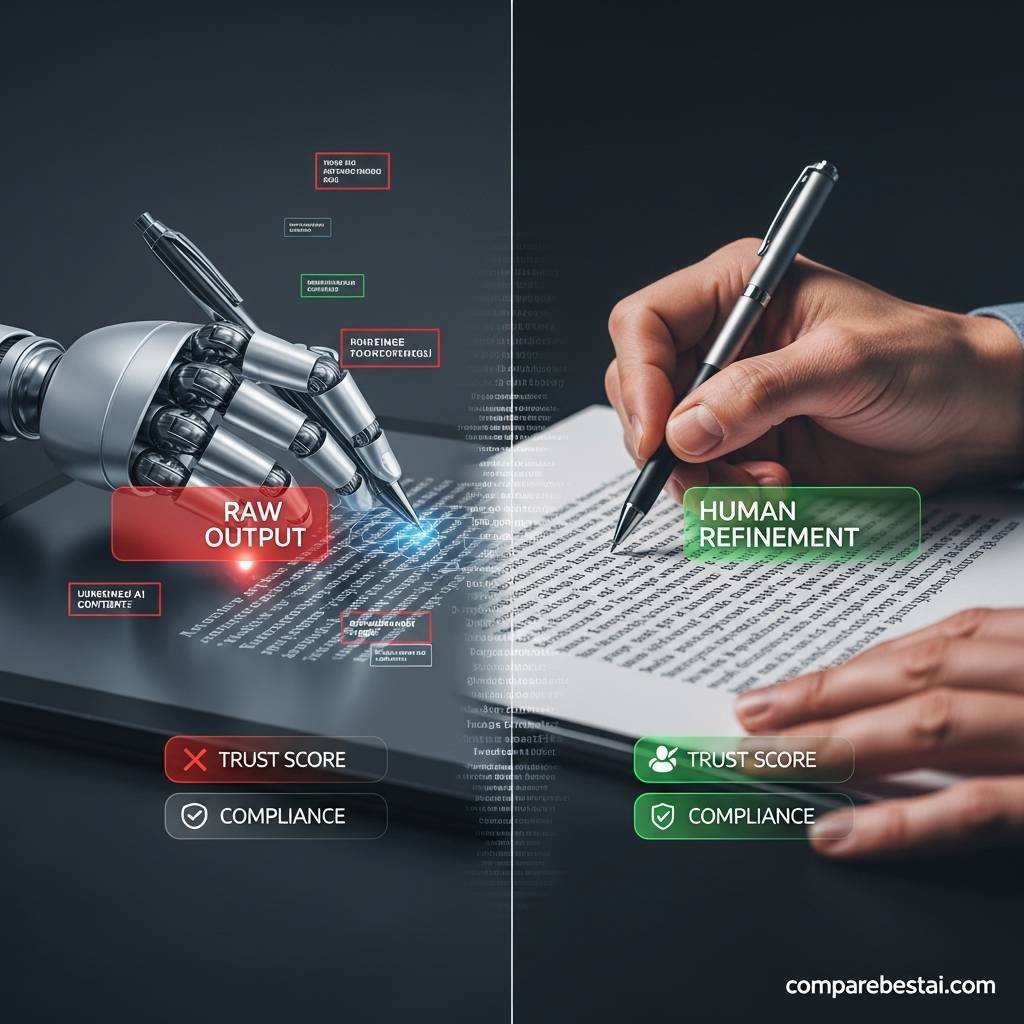

Quick Answer: How Should Enterprises Humanize AI Content for SEO?
Enterprise teams should humanize AI content by treating generative AI as a research, organization, and drafting layer, not as the final publisher.
A strong 2026 workflow is:
Search intent → approved sources → AI-assisted research → working draft → subject-matter review → fact-checking → original insight → brand editing → SEO QA → human approval → publication → monitoring.
Google does not require content to appear “human” to an AI detector. Its current guidance focuses on helpful, reliable, people-first content and warns against publishing large volumes of low-value material primarily to manipulate rankings.
For enterprises, the goal is therefore not to hide AI involvement.
The goal is to build a scalable content system in which automation increases efficiency without removing expertise, evidence, accountability, or editorial quality.
What Does It Mean to Humanize AI Content?
Humanizing AI content means adding the information and judgment that a language model cannot reliably supply on its own.
That can include:
proprietary data
genuine subject-matter expertise
first-hand experience where relevant
verified statistics
real customer questions
implementation lessons
original examples
brand perspective
useful recommendations
limitations and tradeoffs
accountable editorial approval
It does not mean intentionally manipulating sentence patterns so a detector labels the text “human.”
The strongest humanization changes the value of the page, not merely its linguistic appearance.
Does Google Penalize AI-Generated Content?
Not simply because AI was involved.
Google says generative AI can be useful for activities such as research and helping structure original content.
The risk appears when automation is used to produce many pages that add little value and exist primarily to manipulate Search.
Google's spam policies define scaled content abuse around creating large quantities of unoriginal or low-value content regardless of whether it was produced by AI, automation, humans, or a combination of methods.
For enterprise SEO teams, that means the critical question is not:
“Can Google tell this was written with AI?”
Ask:
“Does this page provide enough useful, original value to deserve a separate place in Search?”
That question should guide the entire workflow.
What Google's 2026 Guidance Means for Enterprise Content Teams
Google's 2026 guidance for generative AI Search emphasizes a relatively familiar principle:
Create content that is unique, useful, reliable, and non-commodity.
That matters because AI has lowered the cost of producing generic explanations.
A page that simply summarizes information already available across dozens of other sites has less strategic value than content containing:
proprietary evidence
genuine experience
expert interpretation
original research
distinctive comparisons
useful visual evidence
clear methodology
The more automation reduces production costs, the more enterprises need to invest in information that competitors cannot reproduce with one prompt.
E-E-A-T: Use It as a Quality Framework, Not a Formula
E-E-A-T stands for:
Experience, Expertise, Authoritativeness, and Trustworthiness.
Google explicitly says E-E-A-T itself is not one specific ranking factor.
Instead, Google's systems use many signals intended to identify content that demonstrates qualities associated with strong experience, expertise, authority, and trust.
For enterprise publishers, the practical implications are straightforward.
Show who is responsible for the content
Use accurate author information where readers would reasonably expect it.
For specialist topics, make relevant expertise easy to understand.
Explain how important content was produced
For product comparisons, research reports, benchmarks, or technical guides, explain:
what was reviewed
what was tested
when the information was checked
which criteria were used
who verified the result
Use first-hand experience when the query benefits from it
A product review becomes more useful when the reviewer actually used the product.
A migration guide becomes stronger when it incorporates lessons from a real migration.
But first-hand experience is not universally required for every informational query.
Use it where it genuinely improves the answer.
Make claims verifiable
Readers should be able to trace important facts back to reliable sources.
Trust is not created by sounding confident.
It is created by making confident statements defensible.
The Enterprise AI Content Operating Model
Large organizations need more than individual prompting skills.
They need a repeatable publishing system.
| Stage | AI Can Assist | Human Ownership |
|---|---|---|
| Search intent | Query clustering and question discovery | Decide page purpose |
| Research | Summarize approved materials | Select reliable sources |
| Brief | Organize topics and questions | Define angle and information gain |
| Drafting | Create working copy | Add expertise and interpretation |
| Verification | Flag claims | Verify facts against primary sources |
| Brand editing | Suggest tone improvements | Protect voice and positioning |
| SEO QA | Suggest metadata and headings | Final search-intent decisions |
| Compliance | Surface possible risk areas | Legal/compliance approval |
| Publication | Automate checks | Human sign-off |
| Updating | Flag potentially stale information | Decide corrections and revisions |
The enterprise advantage comes from making this process consistent.
Step 1: Decide Whether the Page Deserves to Exist
Before generating a brief, ask whether you need a new URL at all.
AI makes it cheap to create pages for slight keyword variations.
That can create serious site-architecture problems.
For example:
humanize AI content
humanizing AI writing
enterprise AI content humanization
AI content humanization strategies
humanize AI content for SEO
may represent one core intent rather than five separate pages.
Before approving a new article, check:
Does a similar URL already exist?
Is the search intent actually different?
Would the new page provide distinct information?
Should an existing article simply be expanded instead?
Could two weaker pages be consolidated?
Enterprise SEO teams should add content consolidation to the brief-approval process.
Creating less content can sometimes produce a stronger site.
Step 2: Define the Search Intent
Do not start with:
“Write a 2,000-word article about enterprise AI SEO.”
Start with the user.
Determine:
who is searching
what they are trying to accomplish
what they already know
what decision follows the page
which information is required
what competing pages fail to explain
A strong brief should contain a clear sentence such as:
This page helps enterprise content leaders design a governed AI-assisted editorial workflow without creating low-value or duplicative SEO content.
If the team cannot define that purpose, it should not generate the article yet.
Step 3: Build an Approved Source Pack
Enterprise AI content should not begin from an empty prompt.
Collect reliable source material first.
Depending on the subject, that might include:
official documentation
internal research
analyst reports
product documentation
customer interviews
subject-matter expert notes
proprietary data
original screenshots
regulatory guidance
Search Console data
support-ticket themes
sales objections
AI can then organize information that your organization has already deemed relevant.
This is much safer than asking a model to generate facts independently.
Prioritize primary sources
If you are explaining Google's Search policies, cite Google.
If you are publishing product pricing, check the vendor.
If you are discussing regulation, use the responsible regulator or legislation.
If you cite research, try to trace the statistic to the original study.
Enterprise content accumulates reputational risk when weak secondary sourcing gets copied across hundreds of pages.
Step 4: Define the Information Gain
Before drafting, write down what this page contributes beyond a generic AI answer.
Possible sources of original value include:
proprietary benchmarks
original survey data
actual product tests
client implementation lessons
expert interviews
internal process data
customer observations
original frameworks
side-by-side comparisons
documented failures
cost calculations
Google's 2026 generative-AI guidance explicitly emphasizes valuable, non-commodity content.
That should become an enterprise publishing requirement.
Every important article should answer:
What can someone learn here that they could not get from an average AI-generated summary?
Step 5: Use AI for Research and Working Drafts
AI performs well at mechanical tasks.
Use it to:
summarize approved documents
organize notes
cluster themes
identify repeated questions
suggest article structures
build first drafts
generate alternative explanations
repurpose approved content
flag possible gaps
The first draft should be treated as working material.
Do not confuse fluency with readiness to publish.
Step 6: Add Subject-Matter Expertise
This is where the humanization process becomes meaningful.
Give the AI draft to someone who genuinely understands the subject.
Ask:
What does this oversimplify?
What is technically wrong?
What important caveat is missing?
What happens differently in practice?
Which recommendation would you reject?
What example would make this useful?
What real data do we have?
Where does conventional advice fail?
These answers often create the highest-value paragraphs in the final article.
AI can synthesize information.
Subject-matter experts can interpret it.
Step 7: Fact-Check Material Claims
Enterprise content should have a formal verification step.
At minimum, check:
prices
statistics
dates
product capabilities
quotations
regulatory statements
market data
technical specifications
benchmark results
Do not rely on the AI model to verify itself.
If the article contains a claim that could influence a financial, legal, security, medical, or significant commercial decision, the review standard should be even higher.
Step 8: Edit for Brand Voice
Humanization should make the article sound like the organization.
That requires more than inserting contractions or changing sentence length.
Create an enterprise brand-language system covering:
preferred terminology
prohibited claims
tone
audience level
point of view
capitalization
product naming
evidence standards
words the brand avoids
examples of approved writing
Then evaluate the draft against those standards.
Remove generic AI filler
Examples include:
“In today's rapidly evolving landscape…”
“It is important to note…”
“This revolutionary solution…”
“The future is here…”
These phrases are not bad because they are “AI phrases.”
They are weak because they usually say nothing.
Replace generic framing with information.
Step 9: Don't Optimize for AI Detectors
Do not make burstiness, perplexity, or “undetectability” part of the SEO QA checklist.
A detector score does not tell you whether the article:
satisfies search intent
contains original research
is factually correct
demonstrates useful expertise
converts qualified users
deserves backlinks
creates revenue
Sentence variation can improve readability.
Use it for that reason.
Do not intentionally damage prose to create supposedly “human” statistical patterns.
Step 10: Perform SEO QA After Editorial QA
SEO optimization should refine a strong article rather than compensate for a weak one.
Check:
Meta title
Keep the core query prominent and make the value clear.
Meta description
Tell the searcher what the page delivers.
H1
Use one clear H1.
Heading hierarchy
H2s should represent the major logical sections.
H3s should sit under relevant H2s.
Internal links
Use descriptive anchors pointing to genuinely useful next steps.
Good examples include:
AI content detection and humanization
how to choose the right AI tool
compare AI tool pricing
AI productivity tools for work
Avoid:
click here
read more
learn more
this page
Technical accessibility
Confirm that:
page is indexable
canonical is correct
important text is rendered
images are accessible
internal links work
structured data matches visible content
Step 11: Optimize for AI Overviews Without Inventing New Rules
Google's current guidance says standard SEO fundamentals continue to apply to AI Overviews and AI Mode.
There is no special:
GEO schema
AEO schema
AI Overview schema
LLM schema
Google also says llms.txt is not required for Google Search and does not positively or negatively affect Search visibility.
For enterprises, the best generative-search strategy is therefore surprisingly familiar:
publish useful information
create distinctive content
maintain crawlability
use sensible internal links
support information with relevant media
use structured data accurately
update important facts
Do not build a technical project around markup Google has never asked for.
Enterprise AI Content Risk Tiers
Not every page requires the same level of review.
Low risk
Examples:
general definitions
basic glossary pages
internal summaries
simple formatting transformations
AI can perform more of the production process.
Medium risk
Examples:
SEO guides
product comparisons
software reviews
commercial recommendations
thought leadership
Require editorial fact-checking and appropriate expertise.
High risk
Examples:
medical information
legal guidance
financial recommendations
cybersecurity advice
regulated-industry content
consequential competitor claims
Require qualified subject-matter review and appropriate compliance oversight.
The higher the cost of an incorrect statement, the stronger the human control should be.
Enterprise AI Content Governance Checklist
Every AI-assisted publishing program should define:
Which AI tools are approved?
What company information can be uploaded?
Which sources are acceptable?
Which content categories require SMEs?
Which claims require fact-checking?
When is legal review necessary?
Who approves publication?
Who owns the URL after publication?
How are AI-assisted workflows documented?
When should automation be disclosed?
How are corrections handled?
How often is fast-changing content reviewed?
How are duplicate topics prevented?
How is performance measured?
Without clear ownership, “AI scale” easily becomes unmanaged content scale.
How to Measure Whether Humanization Is Working
Do not measure humanization with an AI-detector percentage.
Measure whether the content performs its intended job.
Search metrics
Track:
impressions
clicks
CTR
rankings
query coverage
indexation
User metrics
Track:
engaged sessions
return visits
conversions
downloads
subscriptions
Business metrics
Track:
qualified leads
pipeline
assisted conversions
revenue
affiliate conversions where appropriate
Editorial metrics
Track:
correction rate
SME review time
percentage of claims requiring fixes
outdated pages
duplicate-page creation
revision cycles
A successful human-AI workflow should increase efficiency without increasing factual errors or duplicate content.
When Should Enterprises Disclose AI Assistance?
Google recommends considering information about how content was created when readers would reasonably expect that context.
That does not mean every article using AI for brainstorming needs a disclosure.
Disclosure becomes more relevant when:
automation substantially generated the content
methodology matters
readers might reasonably question authorship
synthetic media is involved
the topic is sensitive
regulations require transparency
Do not add an AI disclosure because you believe it is an automatic ranking factor.
Use disclosure when it genuinely improves transparency or is legally required.
Common Enterprise AI Content Mistakes
Publishing every keyword variation
This creates cannibalization and unnecessary URLs.
Using AI to summarize other ranking pages
That produces commodity content rather than a differentiated resource.
Treating AI as the source
A language model should not become the citation for externally verifiable facts.
Manufacturing first-hand experience
Never invent product testing, customer stories, or personal experiences.
Over-automating high-risk content
Use stronger human review as consequences rise.
Buying more tools before fixing the workflow
Technology does not fix unclear ownership or weak editorial standards.
Measuring output instead of outcomes
Publishing 200 articles is not success if they do not generate meaningful visibility or business value.
Frequently Asked Questions
What does it mean to humanize AI content for enterprise SEO?
It means improving AI-assisted drafts with expert judgment, verified evidence, original information, brand perspective, useful examples, and accountable human review rather than simply rewriting text to appear less machine-generated.
Does Google penalize AI-generated content?
Google does not prohibit content simply because generative AI was used. Its spam policies focus on practices such as producing large amounts of unoriginal or low-value content primarily to manipulate rankings.
Is E-E-A-T a ranking factor?
Google says E-E-A-T itself is not a single ranking factor. Its systems use many signals that can identify qualities associated with experience, expertise, authoritativeness, and trustworthiness.
Should enterprises optimize AI content for burstiness and perplexity?
No. Google does not document either as a ranking factor. Edit content for clarity, usefulness, originality, and audience needs instead.
Does AI-assisted content need human review?
For important enterprise content, yes. Human review is particularly important for factual accuracy, brand positioning, technical claims, regulated topics, and high-consequence recommendations.
Do I need special schema for AI Overviews?
No. Google's current guidance says no special schema.org markup is required specifically for AI Overviews or AI Mode. Use normal structured data when it accurately represents visible page content.
How can enterprises prevent AI content cannibalization?
Maintain a central content inventory, check existing URLs before approving new briefs, map one primary search intent to one main page, consolidate substantially overlapping pages, and use redirects or canonicalization appropriately when duplicate content already exists.
What is the best enterprise AI content workflow?
Start with search intent and approved sources, use AI for research and working drafts, add subject-matter expertise, verify material claims, edit for brand voice, perform SEO and compliance QA, require human approval, and monitor the page after publication.
Final Verdict
The future of enterprise SEO is not about making AI content look human enough to escape detection.
It is about building a content operation in which automation can scale without scaling mediocrity.
AI is useful for:
organizing research
summarizing documents
producing working drafts
identifying questions
repurposing approved material
reducing repetitive editorial work
Humans remain responsible for:
search strategy
reliable sourcing
subject-matter expertise
original interpretation
factual verification
brand positioning
risk decisions
final publication
For enterprise organizations, that combination is the sustainable model.
The question is not:
“How much content can AI help us publish?”
It is:
“How much genuinely useful, differentiated content can our organization responsibly maintain?”
Answer that first.
Then use AI to make the process faster.
If software becomes the next bottleneck, compare AI writing and SEO tools by governance controls, security, integrations, pricing, and human-review features before expanding your stack.