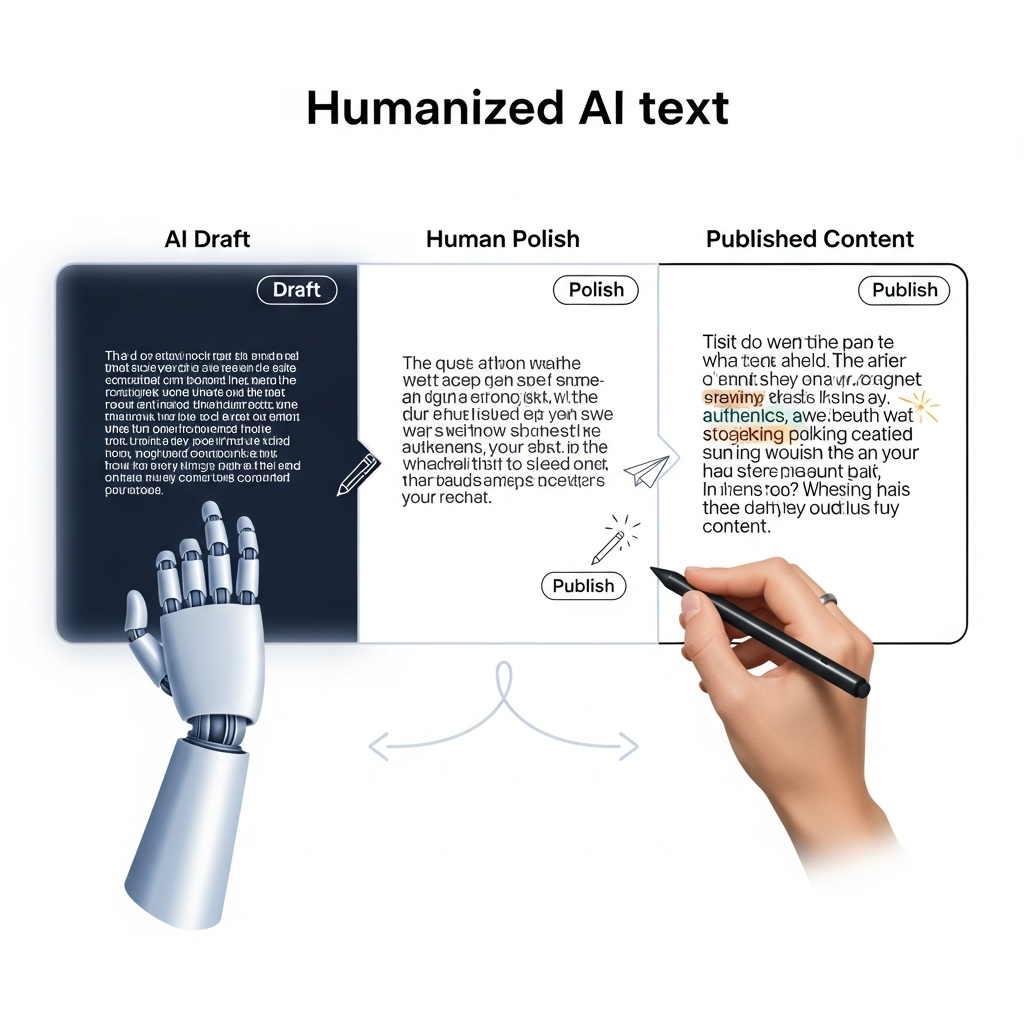

Quick Answer: How Do You Humanize AI Text for SEO?
To humanize AI text for SEO in 2026, use AI for research support, organization, outlining, first drafts, and repetitive editing, then use people for search intent, source selection, factual verification, first-hand experience, original analysis, brand voice, and final approval.
Google does not require AI-assisted content to appear “human” to a detector. Its current guidance focuses on whether content is helpful, reliable, accurate, relevant, and created primarily for people. Using generative AI is not inherently against Google’s guidelines, but generating large amounts of low-value content without adding meaningful value can violate its scaled content abuse policy.
The goal is therefore not to hide the use of AI.
The goal is to make the finished page good enough that the reader would value it regardless of how the first draft was created.
What Does It Mean to Humanize AI Text?
Humanizing AI text means improving AI-assisted material with information and judgment that automation cannot reliably provide by itself.
That can include:
expert interpretation
verified evidence
first-hand experience
original research
proprietary data
customer insight
useful examples
brand perspective
practical recommendations
limitations and tradeoffs
accountable editorial review
Humanization is not simply replacing certain words, adding slang, or deliberately creating grammatical imperfections.
A page can sound casual and still be generic.
It can sound polished and still be deeply original.
The most important difference is the information value.
Does Google Penalize AI-Generated Content?
No, not simply because AI helped create it.
Google says generative AI can be useful for researching a topic and adding structure to original content. Its current guidance tells publishers to focus on accuracy, quality, and relevance when using automation.
Google’s concern is the purpose and quality of the output.
Its scaled content abuse policy applies when large amounts of unoriginal content are created primarily to manipulate rankings rather than help users. That policy applies regardless of whether the content was produced by AI, humans, traditional automation, or a combination of methods.
That leads to a simple rule:
Do not optimize for whether Google can detect AI. Optimize for whether the page deserves to exist.
What Google’s 2026 AI Search Guidance Means for Writers
Google published expanded guidance for generative AI features in Search in May 2026.
The most important takeaway is that SEO fundamentals still apply.
Google says AI Overviews and AI Mode rely on its core Search ranking and quality systems. It also emphasizes valuable, unique, non-commodity content and warns against creating separate pages for every possible query variation.
Google also says you do not need to:
rewrite content specifically for AI systems
break every article into tiny “AI-readable” chunks
add special AI schema
add GEO or AEO markup
create an
llms.txtfile for Google Search
Google says llms.txt neither helps nor hurts visibility in Google Search, and no special schema.org markup is required for AI Overviews or AI Mode.
For writers and editors, this simplifies the strategy.
Create information that is genuinely useful.
Make it easy to understand.
Support important claims.
Give readers something they could not get from an interchangeable AI summary.
E-E-A-T: Use It as an Editorial Framework
E-E-A-T stands for:
Experience, Expertise, Authoritativeness, and Trustworthiness.
It is often described incorrectly as a direct ranking factor.
Google explicitly says E-E-A-T itself is not one specific ranking factor. Its systems use many different signals that can help identify qualities associated with experience, expertise, authority, and trust. Google also says trust is the most important element of the framework.
That makes E-E-A-T useful as an editorial checklist.
Experience
Where relevant, add genuine experience.
For example:
what happened when you tested a product
which step in a process failed
how long implementation took
what changed after deployment
which limitation surprised your team
Do not invent experience just because a page would sound stronger in first person.
Expertise
Have someone who understands the subject review important content.
Expertise becomes especially important when the page contains technical, financial, medical, legal, security, or other consequential information.
Authoritativeness
Authority usually develops across the site and the wider web.
Useful signals for readers include:
clear authorship
editorial standards
consistent coverage of a subject
original research
credible references
Trust
Trust begins with accuracy.
If the page contains incorrect statistics, fictional experience, outdated pricing, or misleading claims, no amount of stylistic humanization fixes the problem.
Why Raw AI Drafts Often Feel Generic
Large language models are designed to generate probable continuations based on patterns learned from large datasets.
That makes them excellent at producing:
conventional structures
common explanations
summaries
neutral introductions
predictable transitions
Those same strengths can create generic output.
A first draft may repeat familiar patterns such as:
“In today’s rapidly evolving digital landscape…”
“It is important to note…”
“Businesses must stay ahead of the curve…”
“These revolutionary tools are transforming the industry…”
The problem with these phrases is not that an AI detector may recognize them.
The problem is that they usually contribute almost no information.
Human editing should replace generic framing with specificity.
Weak:
AI tools are transforming modern marketing.
Better:
A content team can use AI to organize interview transcripts, build a first outline, identify repeated customer questions, and create several headline alternatives before an editor starts drafting.
Specificity does more for content quality than artificial attempts to manipulate sentence patterns.
The 8-Step Framework to Humanize AI Text for SEO
A strong AI-assisted workflow starts before the AI writes a sentence.
| Stage | AI Role | Human Role |
|---|---|---|
| 1. Search intent | Research assistance | Decide what problem the page solves |
| 2. Source pack | Summarize material | Select trustworthy sources |
| 3. Content brief | Organize themes | Define angle and information gain |
| 4. Draft | Create working copy | Add context and expertise |
| 5. Verification | Flag claims | Verify facts |
| 6. Humanization | Suggest edits | Add experience, examples and brand voice |
| 7. SEO QA | Suggest metadata/headings | Make final optimization decisions |
| 8. Publication | Automate checks | Approve and own the page |
The key principle is simple:
AI can accelerate execution. Humans remain responsible for meaning and accountability.
Step 1: Start With Search Intent
Do not begin with:
“Write 2,000 words about AI SEO.”
That gives the model almost no reason to produce anything beyond an average web summary.
Start with the searcher.
Ask:
Who is searching?
What are they trying to accomplish?
What do they already know?
What decision comes next?
What evidence will they need?
What is missing from existing results?
What unique information can we provide?
For this article, the intent might be:
A content marketer wants a practical workflow for improving AI-generated copy without relying on AI-detection tricks or unsupported SEO theories.
That intent should drive the entire page.
Step 2: Build a Source Pack Before Drafting
AI output becomes more useful when it works from reliable material.
Collect relevant sources first.
Depending on the topic, that might include:
official documentation
government sources
original research
product documentation
expert interviews
internal data
customer questions
screenshots
case studies
analytics
real test results
Prefer primary sources
If the claim is about Google Search, use Google Search Central.
If the claim is about software pricing, use the vendor’s pricing page.
If the claim concerns regulation, use the law or regulator.
If it cites research, find the original study.
This reduces the risk of an AI system repeating an inaccurate statement that has already been copied across several secondary websites.
Step 3: Define the Information Gain
Before drafting, answer:
What will this page contribute that a generic AI response probably will not?
That can be:
proprietary data
original tests
screenshots
interviews
expert disagreement
case-study evidence
unusual failure cases
cost calculations
real workflow observations
a genuinely useful framework
Google’s 2026 generative AI Search guidance specifically emphasizes unique, non-commodity content and examples such as first-hand reviews or distinctive perspectives rather than content that simply restates what is already available.
You do not need groundbreaking research on every page.
You do need a reason for the page to exist.
Step 4: Use AI for the First Draft, Not the Final Judgment
AI is particularly useful for:
organizing research notes
summarizing source material
creating outline options
explaining difficult concepts simply
drafting first-pass copy
suggesting examples
rewriting repetitive paragraphs
creating alternative headlines
repurposing completed content
Treat the result as working material.
Fluent writing is not proof of:
accuracy
originality
expertise
completeness
suitability for your audience
The draft is where editorial work begins.
Step 5: Verify Material Claims
This is one of the most important humanization steps because trust depends on factual accuracy.
Check:
statistics
dates
quotations
pricing
product features
plan limits
regulations
benchmark scores
technical claims
company announcements
Do not ask the same model that generated a statement to serve as the final authority on whether the statement is true.
Return to the source.
Make claims citation-ready
Weak:
Most marketers edit AI content before publishing.
Stronger:
HubSpot’s current AI content marketing research reports that only 7% of surveyed marketers publish AI-generated content without revising it, while 56% significantly revise or completely change the output.
The second version gives the reader:
an organization
a specific statistic
a clear finding
That is much easier to verify and reference.
Step 6: Add Human Expertise and Experience
This is where “humanization” starts adding real value.
Give the draft to someone who understands the subject and ask:
What is technically wrong?
What is missing?
What would a beginner misunderstand?
What does the draft oversimplify?
Which recommendation would you change?
What happens differently in the real world?
What example would help?
What limitation should be disclosed?
What does our organization know that competitors do not?
These answers usually create the sections competitors cannot reproduce easily.
Do not fabricate anecdotes
Avoid inserting invented lines such as:
“When I tested this myself…”
unless the person really tested it.
False experience destroys trust.
Step 7: Edit for Brand Voice
Brand voice should come from real editorial standards rather than attempts to make text look statistically human.
Create guidance around:
preferred terminology
sentence style
audience sophistication
formality
tone
point of view
phrases to avoid
product naming
claims the brand will not make
evidence standards
AI can work within those rules, but a human editor should still review the finished copy.
Remove generic transitions
Cut lines that simply announce the obvious.
Instead of:
“Now let’s dive into the exciting world of AI content optimization.”
Write:
“Start by checking every claim the model generated.”
The second sentence moves the reader forward.
Step 8: Optimize the Finished Content for SEO
SEO should improve strong content rather than rescue weak content.
Title tag
Use the primary topic prominently.
Give the searcher a clear reason to click.
Meta description
Explain what the reader will learn.
Avoid vague promises.
H1
Use one H1.
Make sure it accurately describes the page.
Heading hierarchy
Use H2s for main sections and H3s for logical subsections.
Do not create headings purely to add keyword variations.
Internal links
Use descriptive anchors.
Good:
AI and human writing for SEO
AI content detection and humanization
how to choose the right AI tool
best AI marketing tools
Weak:
click here
read more
learn more
this page
Images and examples
Add screenshots, diagrams, charts, or original visuals when they genuinely improve understanding.
Structured data
Use structured data that accurately represents what readers can see.
For a standard guide, Article and BreadcrumbList are sensible options.
Do not add invented “AI,” “GEO,” or “LLM” schema types.
What About AI Detectors?
Do not make an AI-detector score your SEO KPI.
Detector systems attempt to classify patterns in text.
That does not tell you whether the page:
answers the search query
contains accurate information
includes original research
demonstrates expertise
earns backlinks
generates leads
satisfies readers
A workflow such as:
Generate → run through humanizer → test detector → rewrite until score changes
may improve a detector result while doing nothing useful for the reader.
A stronger workflow is:
Generate → verify → add original insight → improve examples → edit for clarity → publish
The second process improves the content itself.
Should You Rewrite 70–80% of AI Content?
There is no universal percentage.
The right amount of editing depends on the quality of the draft.
A well-sourced draft built from approved research may need relatively little rewriting.
A generic draft created from a vague prompt may need to be rebuilt completely.
Instead of measuring percentage rewritten, evaluate:
factual accuracy
originality
search-intent fit
clarity
usefulness
brand alignment
expert contribution
If all seven are strong, the article is probably ready.
If several are weak, keep editing.
Humanization for Different Content Types
Not every page needs the same level of human involvement.
Basic informational content
Examples include simple definitions and straightforward product documentation.
AI can perform more of the drafting work if facts are controlled and reviewed.
SEO articles and marketing content
These usually require stronger editorial input because differentiation, accuracy, brand voice, and search intent matter.
Reviews and comparisons
First-hand testing is particularly valuable.
Include:
methodology
screenshots
limitations
actual experience
dates checked
pricing verification
YMYL content
Health, finance, legal, security, and other high-consequence subjects require much stronger expert review.
Google says its systems place more weight on signals associated with strong E-E-A-T for topics that could significantly affect health, financial stability, safety, or broader welfare.
How Much Human Editing Do Marketers Actually Use?
Human editing remains common even as AI adoption grows.
HubSpot’s July 2026 AI content marketing research reports that only 7% of surveyed marketers publish AI content without revising it. It reports that 56% significantly revise AI-generated text or completely change it, while 38% make smaller edits before publishing.
HubSpot also reports that 43% of marketers identify inaccurate information as an AI-content risk.
These figures do not prove that editing automatically improves rankings.
They do show that professional marketers generally do not treat raw AI output as finished editorial work.
AI Content and Google AI Overviews
The growth of AI Overviews and AI Mode does not require an entirely new writing system.
Google says its generative AI Search features continue to rely on its core ranking and quality systems.
It also says:
there is no special schema required
llms.txtdoes not improve Google Search visibilityyou do not need to rewrite pages into a special AI style
content does not need to be divided into tiny chunks for AI
normal SEO fundamentals remain relevant
The practical implication is simple.
Focus on information people would value and that systems can verify.
How to Make AI-Assisted Content Easier to Cite
No publisher can force an LLM or search system to cite a page.
You can make important information easier to understand and verify.
Use direct definitions
Example:
AI content humanization is the editorial process of improving AI-assisted material with verified evidence, original insight, experience, and accountable human judgment.
Use exact figures when available
Give the source and context.
Name the source
Do not write:
“Studies show…”
Write:
“Google Search Central says…”
or:
“HubSpot’s 2026 research found…”
State limitations
A citation-ready fact should not hide necessary context.
Keep important information in text
Do not put crucial facts only inside an infographic or video.
Ethical AI Content and Disclosure
Google recommends considering information about how content was created when readers would reasonably expect that context. It does not say AI disclosure itself is a general ranking factor.
A disclosure may be appropriate when:
automation generated a substantial portion of the content
methodology matters
readers would reasonably question how it was produced
synthetic media is involved
regulation requires it
Disclosure is about transparency.
It should not be treated as an SEO hack.
AI Content Humanization Checklist
Before publishing an AI-assisted article, confirm:
The page answers one clear search intent.
The direct answer appears early.
The page contributes something original.
Important claims are verified.
Primary sources are used where appropriate.
Expert input is genuine.
First-hand experience is not fabricated.
Generic AI filler has been removed.
Brand voice is consistent.
Limitations and tradeoffs are explained.
Internal links help the reader.
The title and meta description are optimized naturally.
There is one clear H1.
Structured data matches visible content.
A human is accountable for publication.
The article has an update process.
If several answers are no, the page needs more editorial work.
Frequently Asked Questions
How do you humanize AI text for SEO?
Use AI for research assistance, outlining, drafting, and repetitive editing. Then have a human verify facts, add original insights and experience, improve examples, protect brand voice, and complete the final SEO review.
Does Google penalize AI-generated content?
Not simply because AI was used. Google says appropriate AI use is not against its guidelines. The risk comes from low-value, unoriginal, misleading, or scaled content created primarily to manipulate rankings.
Does AI content need to pass an AI detector?
No. Google does not tell publishers to optimize around AI-detector scores. Focus on accuracy, usefulness, originality, and compliance with Search Essentials and spam policies.
Is E-E-A-T a Google ranking factor?
Google says E-E-A-T itself is not a specific ranking factor. Its systems use many factors that can identify qualities associated with experience, expertise, authority, and trust.
Should I rewrite most of an AI-generated article?
There is no fixed percentage. Rewrite as much as necessary to make the content accurate, original, useful, well-sourced, and consistent with your brand.
Is first-hand experience required for SEO?
Not for every query. It is particularly useful when the topic naturally benefits from real experience, such as product reviews, tutorials, case studies, travel content, and implementation guides.
Do I need special schema for AI Overviews?
No. Google says there is no special schema.org markup required for AI Overviews or AI Mode.
What is the best AI content workflow for SEO?
Start with search intent and reliable sources, use AI to organize and draft, add human expertise, verify material facts, edit for clarity and brand voice, complete SEO QA, publish, and monitor performance.
Final Verdict
Humanizing AI text for SEO in 2026 is not about fooling an algorithm.
It is about improving the content.
Use AI where it creates efficiency:
research organization
outline development
working drafts
summarization
editing support
repurposing
Use people where judgment creates the value:
search intent
source selection
fact-checking
original experience
expert interpretation
brand positioning
final approval
Google’s current guidance is much less mysterious than many AI SEO articles make it sound.
Create helpful, reliable content.
Add information people cannot get from an interchangeable summary.
Avoid producing large amounts of low-value content simply because AI makes it easy.
Make important claims accurate and verifiable.
And keep humans accountable for what gets published.
That is the practical framework for humanizing AI text for SEO.
If your editorial workflow is already working and software is now the bottleneck, compare AI writing and SEO tools by research capabilities, brand controls, integrations, pricing, and human-review features before adding another platform.