
Quick Answer: How Should Enterprises Humanize AI Content for SEO?
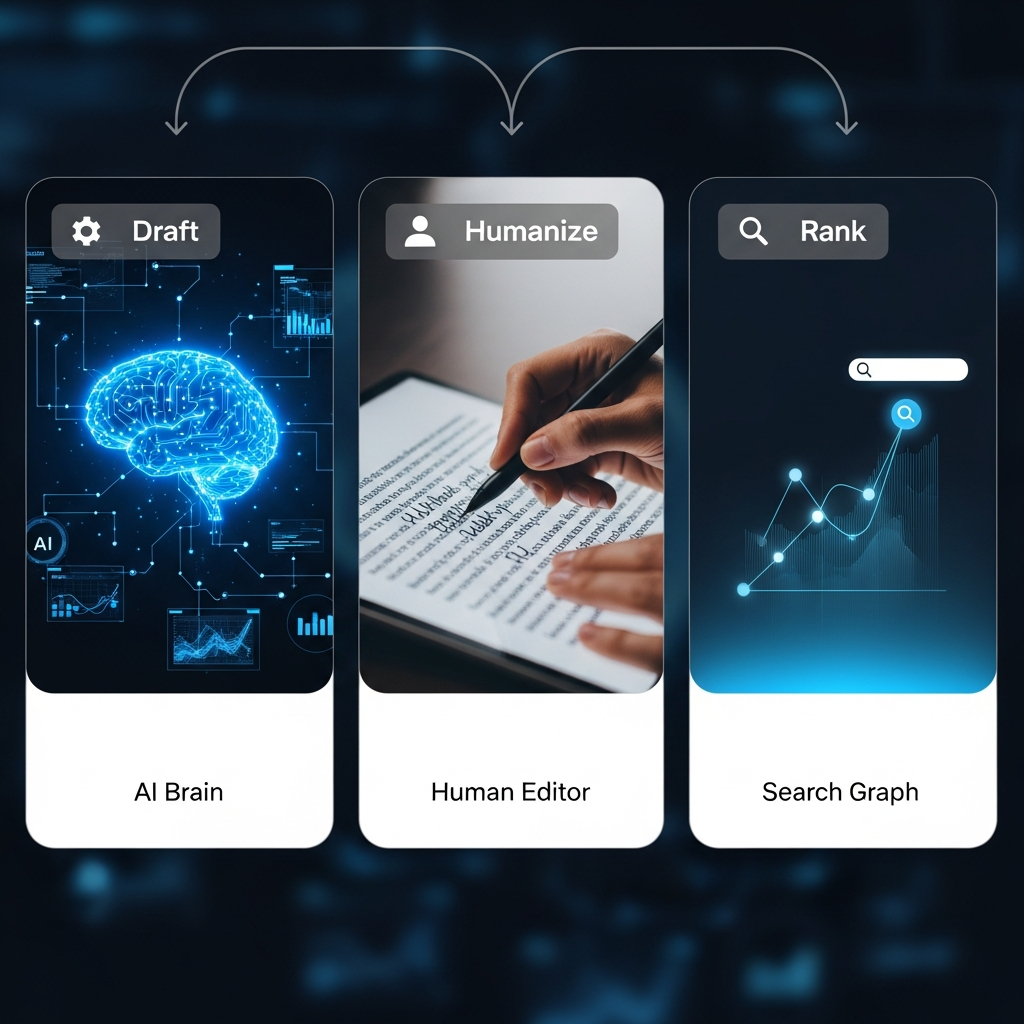
Enterprises should humanize AI content by using generative AI for research support, organization, outlining, drafting, summarization, and repetitive editing, while keeping people responsible for search intent, reliable sourcing, subject-matter expertise, factual verification, original insights, brand positioning, risk decisions, and final approval.
Google does not require AI-assisted content to appear human to an AI detector.
Its current guidance focuses on helpful, reliable, people-first content and warns against using automation to create large amounts of low-value or unoriginal material primarily to manipulate rankings.
A practical enterprise workflow is:
Search intent → approved source pack → AI-assisted draft → SME review → fact-checking → original insight → brand editing → SEO QA → compliance review → human approval → publication → monitoring.
The goal is not to hide AI involvement.
The goal is to ensure that automation increases efficiency without scaling weak content.
What Does Humanizing AI Content Mean?
Humanizing AI content means improving AI-assisted material with information and judgment that a model cannot reliably supply on its own.
That can include:
subject-matter expertise
proprietary data
first-hand experience where relevant
verified facts
expert interpretation
original examples
customer insights
implementation lessons
brand perspective
honest limitations
actionable recommendations
accountable human review
This is very different from simply changing sentence length or adding slang so text appears less machine-generated.
The strongest humanization changes the substance of the content.
Does Google Penalize AI-Generated Content?
Not simply because AI was used.
Google says generative AI can be helpful for research and for adding structure to original content.
The problem arises when AI, automation, humans, or a combination of methods are used to generate large amounts of unoriginal content primarily to manipulate rankings.
Google calls this scaled content abuse.
For enterprise teams, the practical question is therefore not:
“Can Google detect that AI wrote this?”
Ask:
“Does this page contain enough useful, accurate, original information to justify its existence?”
That is the stronger long-term SEO standard.
What Google’s 2026 AI Search Guidance Means for Enterprise SEO
Google expanded its guidance for generative AI Search in May 2026.
The central message is that established SEO fundamentals still matter.
AI Overviews and AI Mode rely on Google’s core Search ranking and quality systems.
Google also emphasizes creating valuable, unique, non-commodity content.
For enterprise publishers, this means investing in information that competitors cannot reproduce from a generic prompt.
Examples include:
proprietary research
internal benchmarks
original screenshots
customer insights
expert commentary
implementation lessons
real product testing
distinctive comparisons
new interpretations of reliable research
The easier AI makes generic content production, the more valuable differentiated information becomes.
E-E-A-T: Use It as a Quality Framework
E-E-A-T stands for:
Experience, Expertise, Authoritativeness, and Trustworthiness.
Google explicitly says E-E-A-T itself is not a single ranking factor.
Its systems use many factors that can help identify qualities associated with experience, expertise, authority, and trust.
For enterprise content teams, E-E-A-T is most useful as an editorial framework.
Experience
Use genuine first-hand experience when the query benefits from it.
For example:
product reviews
implementation guides
migration content
case studies
comparisons
Do not invent an anecdote simply because the page would sound more authentic in first person.
Expertise
Bring qualified subject-matter experts into the workflow when factual accuracy or technical nuance matters.
Authoritativeness
Build authority through consistent subject coverage, original information, accurate authorship, reputable sourcing, and useful resources.
Trustworthiness
Trust begins with factual accuracy.
If prices, statistics, product capabilities, legal statements, or technical recommendations are wrong, stylistic humanization cannot rescue the page.
Why Raw AI Content Often Feels Generic
Generative AI is very good at producing conventional explanations.
That makes it useful for:
summaries
outlines
first drafts
neutral explanations
But those same strengths can create predictable content.
Common symptoms include:
generic introductions
repeated conclusions
vague advice
excessive transitions
broad claims without evidence
identical sentence rhythms
recommendations with no tradeoffs
For example:
Weak
“AI is transforming the modern SEO landscape and businesses must adapt to stay competitive.”
Better
“An enterprise content team can use AI to organize SME interviews, summarize approved source material, identify repeated customer questions, and produce a working outline before an editor begins drafting.”
The second sentence is better because it contains information.
Not because it is mathematically more human.
The Enterprise Human-in-the-Loop Content Model
The most practical enterprise workflow separates automation from accountability.
| Stage | AI Can Assist | Human Ownership |
|---|---|---|
| Search intent | Query research and clustering | Decide what problem deserves a page |
| Research | Summarize documents | Select reliable sources |
| Brief | Organize topics and questions | Define angle and original value |
| Draft | Produce working copy | Add expertise and interpretation |
| Verification | Flag claims | Validate facts |
| Brand editing | Suggest rewrites | Protect brand voice |
| SEO QA | Suggest metadata and headings | Approve optimization |
| Compliance | Flag potential risk | Make legal/risk decisions |
| Publication | Automate checks | Human sign-off |
| Updating | Flag stale information | Decide revisions |
The important principle is simple:
AI can perform work. People remain accountable for the result.
Step 1: Decide Whether a New Page Is Needed
Enterprise teams often create too many pages before they create better pages.
AI makes this problem worse because production is cheap.
Before approving a new URL, ask:
Does an existing article already answer this intent?
Is the search intent genuinely different?
Will the new page contain unique information?
Should an existing page simply be updated?
Should two weak pages be consolidated?
For example:
humanize AI content
enterprise AI content humanization
AI content humanization for SEO
humanize AI writing
AI content authenticity
may represent one primary intent rather than five separate pages.
Content governance should therefore begin before writing.
Step 2: Define the Reader and Search Intent
Do not start with:
“Write 2,500 words about enterprise AI SEO.”
Define the reader first.
Ask:
Who is searching?
What problem are they solving?
What do they already know?
What decision comes next?
What evidence will they require?
Which current results are incomplete?
What can our organization contribute?
For this page, the intent might be:
An enterprise SEO or content leader wants a scalable AI-assisted workflow that protects accuracy, originality, brand quality, and compliance.
That intent should guide the article.
Step 3: Build an Approved Source Pack
Enterprise content should not begin from an empty prompt.
Collect relevant sources first.
Depending on the topic, that may include:
official documentation
government sources
internal research
product documentation
customer interviews
expert notes
proprietary data
original screenshots
analytics
regulations
support tickets
sales objections
Then let AI organize approved material.
Prioritize primary sources
If the article discusses Google Search, use Google Search Central.
If it discusses pricing, use the provider’s pricing page.
If it discusses regulation, use official legal or regulatory sources.
If it cites a study, trace the number back to the original research.
This prevents weak secondary-source claims from spreading across hundreds of enterprise pages.
Step 4: Define the Page’s Original Value
Before drafting, answer:
What does this article contain that a generic AI response probably would not?
Possible answers include:
internal data
first-party research
original testing
SME interviews
customer evidence
implementation failures
workflow benchmarks
cost calculations
screenshots
unique comparisons
a proprietary framework
Google’s current AI Search guidance emphasizes non-commodity content.
That should become an enterprise publishing requirement.
Every important page should have a clear information advantage.
Step 5: Use AI for Research and Drafting
AI is useful for high-volume mechanical work.
Use it to:
summarize source material
organize notes
cluster recurring questions
identify gaps
create outlines
produce a working draft
generate alternative explanations
repurpose approved content
suggest metadata
Treat the output as a draft.
A fluent paragraph can still be:
wrong
generic
outdated
incomplete
unsuitable for your audience
Step 6: Add Subject-Matter Expertise
Give the draft to someone who genuinely understands the topic.
Ask:
What is incorrect?
What is oversimplified?
Which caveat is missing?
What happens differently in practice?
What example would help?
Which recommendation should change?
What does the market commonly misunderstand?
What does our organization know that others may not?
Those answers often create the most valuable parts of the final article.
AI can summarize existing patterns.
Experts can interpret them.
Step 7: Verify Material Claims
Enterprise content needs a formal fact-checking step.
Verify:
statistics
dates
prices
product features
plan limits
regulations
quotations
benchmarks
technical specifications
company policies
Do not ask the same model that invented a claim to serve as the final source for verifying it.
Return to the primary evidence.
Make important claims citation-ready
Weak:
“Google prefers human-written content.”
Better:
“Google says its focus is on content quality rather than how the content was produced and warns against scaled content created primarily to manipulate Search.”
The second statement is specific enough to verify.
Step 8: Edit for Brand Voice
Humanization is partly about ensuring the content sounds like the organization rather than the average of the internet.
Enterprise teams should maintain documented standards for:
tone
terminology
point of view
capitalization
product naming
claims
preferred vocabulary
prohibited phrases
evidence standards
legal language
AI can follow those standards.
A human editor should still decide whether the result actually represents the brand.
Remove generic filler
Cut lines such as:
“In today’s rapidly evolving landscape”
“It is important to note”
“The future is here”
“This revolutionary approach”
“Businesses must stay ahead of the curve”
Replace them with useful information.
Step 9: Do Not Optimize for AI Detectors
AI-detector scores should not become enterprise SEO KPIs.
Do not build the workflow around:
perplexity
burstiness
deliberate grammar errors
random slang
forced sentence fragments
“undetectable” writing
These may alter the style.
They do not prove that the article has become more useful.
A better workflow is:
AI draft → verify → add expertise → add original information → edit → optimize → publish
That improves the actual page.
Step 10: Add Compliance and Risk Review
Enterprise content needs different review standards depending on risk.
Lower-risk content
Examples:
glossaries
basic definitions
non-consequential informational pages
AI can perform more of the production work.
Medium-risk content
Examples:
SEO guides
software comparisons
thought leadership
business recommendations
product reviews
Require strong editorial review and factual verification.
High-risk content
Examples:
healthcare
finance
legal guidance
cybersecurity
safety
regulated industries
Require qualified expertise and appropriate compliance review.
The more costly an error could be, the stronger human oversight should become.
Step 11: Complete SEO QA
Once the content itself is strong, complete the SEO layer.
Meta title
Keep the main topic prominent.
Give the searcher a reason to click.
Meta description
Explain exactly what the reader will get.
H1
Use one H1.
Heading hierarchy
Use H2s for primary sections and H3s for logical subsections.
Internal linking
Use descriptive anchors that help readers continue their task.
Good examples:
AI content detection and humanization
AI and human writing for SEO
compare AI writing tools
how to choose the right AI tool
compare AI tool pricing
Avoid:
click here
read more
learn more
this page
Structured data
Use structured data when it accurately represents the visible page.
For an informational guide, Article and BreadcrumbList are appropriate starting points.
Structured data is useful.
It is not mandatory for every page and is not a special AI-search shortcut.
What About AI Overviews and AI Mode?
Google says standard SEO fundamentals remain relevant for AI Overviews and AI Mode.
There is no special:
AI Overview schema
GEO schema
AEO schema
LLM schema
You also do not need to rewrite every page specifically for AI systems.
Google’s systems can understand synonyms and multiple concepts on a page.
The stronger approach remains:
helpful content
crawlable pages
original information
useful internal links
relevant media
accurate structured data where appropriate
strong technical SEO
Do not build an enterprise SEO roadmap around invented markup requirements.
Enterprise Content and Search Generative AI Measurement
Google began testing dedicated Search Generative AI performance reports in Search Console in June 2026 for a subset of websites.
Where available, these reports can help teams understand visibility in experiences such as AI Overviews and AI Mode.
But generative-AI visibility should not replace normal SEO measurement.
Track:
Search performance
impressions
clicks
CTR
rankings
query coverage
indexation
Generative AI visibility
Where available:
AI Overview impressions
AI Mode visibility
Discover generative AI visibility
User behavior
Use your own analytics to understand:
engaged sessions
scroll depth
conversions
return visits
form completion
Treat those as product and audience insights rather than claiming they are direct ranking factors.
Business value
Measure:
leads
pipeline
revenue
assisted conversions
trial starts
qualified traffic
An enterprise content strategy ultimately needs to produce business value, not merely published URLs.
Enterprise AI Content Governance Framework
Every enterprise AI publishing program should document:
Which AI tools are approved?
What data can employees upload?
Which sources are acceptable?
Which topics require SME review?
Which claims require verification?
Which pages require legal or compliance review?
Who approves publication?
Who owns the page after publication?
When should AI involvement be disclosed?
How are errors corrected?
How often is content reviewed?
How are duplicate topics prevented?
What metrics determine success?
When should a page be consolidated or retired?
Governance prevents AI scale from becoming content sprawl.
Common Enterprise AI Content Mistakes
Publishing every keyword variation
This creates duplication and cannibalization.
Treating AI as the source
Language models are tools, not primary evidence.
Manufacturing experience
Never invent first-person testing or customer stories.
Assuming longer means better
There is no ideal SEO word count.
Cover the topic thoroughly and stop when more words no longer add value.
Over-automating high-risk content
Increase expert involvement as consequences rise.
Using engagement metrics as confirmed ranking factors
Use them to improve your own user experience.
Do not present them as documented Google ranking rules.
Overusing schema
Structured data should describe visible content accurately.
It is not required simply because AI Search exists.
AI Content Humanization Checklist for Enterprise Teams
Before publication, confirm:
Does the page satisfy one clear intent?
Is the direct answer visible early?
Does the page provide original value?
Are important claims verified?
Are primary sources used where practical?
Has an appropriate SME reviewed the content?
Is first-hand experience genuine?
Does the article match brand standards?
Have generic AI phrases been removed?
Are limitations and tradeoffs explained?
Are internal links useful?
Is there one optimized H1?
Is the heading structure logical?
Does structured data match visible content?
Has risk/compliance review happened where needed?
Is a human accountable for publication?
Is there an update schedule?
Was cannibalization checked before publishing?
If several answers are no, the content probably needs more work.
Frequently Asked Questions
How do enterprises humanize AI content for SEO?
Use AI for research, structure, drafting, summarization, and repetitive editing. Keep humans responsible for source selection, subject-matter expertise, fact-checking, original insights, brand voice, compliance, and final approval.
Does Google penalize AI-generated content?
Google does not prohibit content simply because AI was used. Its guidance focuses on content quality and warns against scaled, low-value, unoriginal content created primarily to manipulate Search.
Is E-E-A-T a ranking factor?
Google says E-E-A-T itself is not a specific ranking factor. Its systems use multiple factors that may identify qualities associated with experience, expertise, authority, and trust.
Is first-hand experience required for every enterprise article?
No. It is especially valuable for topics where actual use or experience helps answer the question, such as reviews, case studies, implementations, and tutorials.
Should enterprises use AI humanizer tools to bypass detection?
Bypassing detectors is not a sound SEO objective. Evaluate tools according to whether they improve clarity, accuracy, consistency, editing speed, and brand alignment.
Do AI Overviews require special schema?
No. Google says no special schema.org markup is required specifically for AI Overviews or AI Mode.
How can enterprises prevent AI content cannibalization?
Maintain a central content inventory, check existing URLs before new briefs are approved, map one primary intent to one main page, consolidate substantially overlapping content, and use appropriate redirects or canonicalization.
What is the best enterprise AI content workflow?
Start with search intent and approved sources, use AI to organize and draft, add SME expertise, verify material claims, edit for brand, run SEO and compliance QA, obtain human approval, then monitor and update the page.
Final Verdict
Humanizing AI content for enterprise SEO in 2026 is not about making machine-generated text appear statistically human.
It is about creating a publishing system where automation improves efficiency without removing:
expertise
evidence
originality
accountability
brand judgment
editorial quality
AI can accelerate:
research organization
outlining
working drafts
summarization
editing assistance
repurposing
Humans should continue to own:
search strategy
source selection
fact-checking
original interpretation
brand positioning
risk decisions
final approval
The enterprise advantage is not producing the largest number of AI-assisted pages.
It is producing fewer pages that contain information competitors cannot easily replicate.
That means stronger research.
Better experts.
Better governance.
And a much stricter answer to one question before every new brief:
Does this page genuinely deserve to exist?
If your editorial system is already strong and technology is now the bottleneck, compare AI writing and SEO tools by governance controls, integrations, research capabilities, pricing, security, and human-review workflows before expanding your stack.