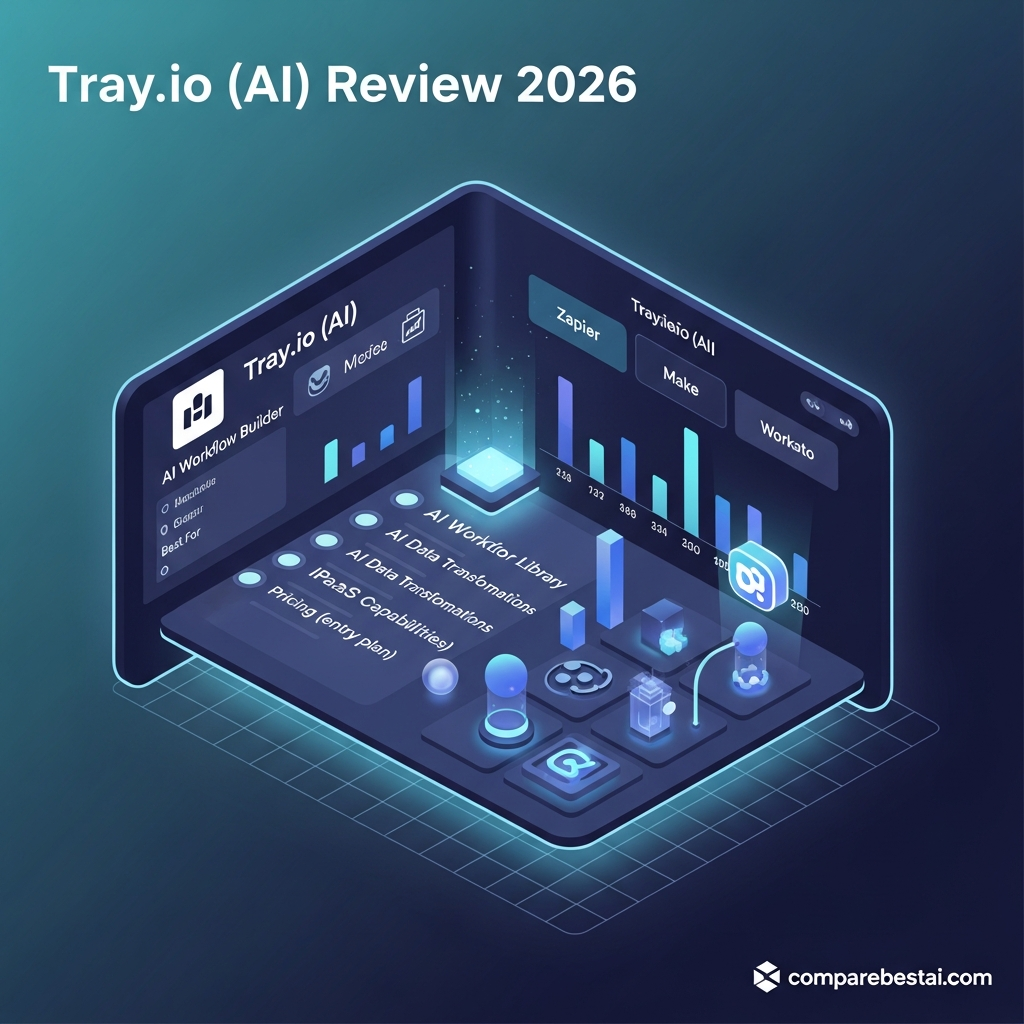

Quick Verdict: Tray.ai is a strong fit for mid-market and enterprise teams that need complex integrations, AI agents, workflow automation and centralized governance across many business systems. Its biggest strengths are 700+ connectors, low-code and developer tooling, Merlin Agent Builder, MCP governance, and enterprise controls. Its biggest drawbacks are custom sales-led pricing, a steeper learning curve than lightweight automation tools, and additional usage considerations for tasks and AI models. Smaller teams with simple workflows will usually find Zapier, Make or n8n easier to justify.
Tray.ai Review 2026: At a Glance
| Category | Tray.ai |
|---|---|
| Best for | Mid-market and enterprise integration, automation and AI orchestration |
| Former name | Tray.io |
| Product type | AI-ready iPaaS and enterprise orchestration platform |
| Pricing | Custom quote |
| Current plans | Pro, Team, Enterprise |
| Free plan | No permanent free plan advertised |
| Free trial | Available through sales |
| Connectors | 700+ |
| Low-code builder | Yes |
| AI-assisted workflow building | Yes |
| AI agent builder | Merlin Agent Builder |
| MCP support | Agent Gateway for MCP |
| BYO AI models | Supported |
| SOC 2 Type 2 | Yes |
| HIPAA | Supported under applicable configuration/terms |
| Best alternative for beginners | Zapier |
| Best visual SMB alternative | Make |
| Best self-hosting-oriented alternative | n8n |
| Closest enterprise alternative | Workato |
| Overall verdict | Powerful but best justified for complex, governed automation |
Tray.io rebranded as Tray.ai, so older searches and technical URLs may still contain the Tray.io name. This review focuses on the current Tray.ai platform and its 2026 capabilities.
What Is Tray.ai?
Tray.ai is an enterprise platform for integrating applications, automating processes and adding AI capabilities across business systems.
The company currently describes Tray.ai as an enterprise orchestration platform for data and AI.
Its iPaaS combines integration, process automation, API management, AI development and governance across more than 700 connectors.
The platform is aimed less at creating a few personal trigger-action automations and more at coordinating larger business processes across systems such as CRMs, support platforms, databases, data warehouses, collaboration tools and AI services.
That distinction matters when comparing Tray.ai with products such as Zapier or Make.
Tray can handle conventional workflow automation, but its current positioning increasingly centers on enterprise integration, AI agents and governed access to business systems.
Who Is Tray.ai Best For?
Tray.ai makes the most sense for organizations where integration has become infrastructure rather than an occasional productivity task.
IT and platform teams
IT teams can use Tray to standardize integrations, manage authentication, monitor execution and expose approved capabilities across the organization.
Revenue operations
RevOps teams can orchestrate processes across CRM, marketing automation, enrichment, support and data systems.
Examples include:
Lead enrichment
Lead routing
CRM synchronization
Account updates
Customer onboarding
Sales notifications
Customer operations
Support and customer-success teams can connect service platforms with CRM, billing, knowledge and internal systems.
Data and integration teams
Tray supports data integration, API management and workflows that move or transform information across multiple platforms.
Enterprise AI teams
This is increasingly important in 2026.
Tray can provide AI agents with controlled access to approved tools and data while applying authentication, permissions, logging and governance.
That makes the platform relevant to organizations that have moved beyond experimenting with chatbots and now need AI systems to take actions inside production business systems.

Who Probably Does Not Need Tray.ai?
Tray.ai can be excessive for a solo user or small company that only needs a handful of straightforward automations.
If your workflow is:
“When somebody submits this form, add a row to Google Sheets and send me an email,”
a lighter product may be easier and cheaper to operate.
Tray becomes easier to justify when you need:
Complex branching
Multiple systems
Reusable integration logic
Enterprise security controls
Large workflow portfolios
AI-agent governance
API management
Multiple workspaces
Centralized monitoring
Custom connectors
Enterprise support
The key question is therefore not simply:
Can Tray automate this?
It is:
Does your organization need enough integration depth and governance to justify an enterprise platform?
Tray.ai's Core Platform in 2026
Tray.ai now combines several capabilities under its wider iPaaS offering.
Intelligent Integration
Tray's integration platform supports process automation, data integration and API management.
These capabilities are available alongside a connector ecosystem spanning more than 700 systems.
Tray Build
Tray Build is the platform's visual low-code development environment.
Current plans include:
Drag-and-drop workflow development
Pre-built templates
Connector development
AI-assisted development
This is the core environment for users who want to construct business logic visually rather than writing an integration from scratch.
Tray Headless
Tray also provides developer-oriented capabilities through Tray Headless.
The current pricing page lists:
Claude Code and Codex plugins
Headless MCP
Full API access
That means Tray is increasingly designed for both visual builders and development teams working through code and AI coding tools.
Tray Build Powered by Merlin
Tray Build can use Merlin AI to help create workflows from natural-language instructions.
A user can describe a desired process and Merlin can generate a sequence of workflow steps.
For example, instead of manually deciding which connectors and logic blocks are needed, a user might describe a workflow involving Salesforce and Google Sheets and let Merlin build an initial structure.
Merlin can also help explain an existing workflow or suggest how to configure particular steps.
This feature is best viewed as AI-assisted integration development, not as a replacement for understanding the underlying business process.
For complex integrations, users still need to verify authentication, field mapping, error handling and production behavior.
Merlin Agent Builder
Merlin Agent Builder addresses a different problem.
Instead of helping a user construct a normal workflow, it lets organizations build AI agents that can understand context, use knowledge and take actions.
A Tray agent can contain:
An agent scope
Connected data sources
Workflows exposed as tools
An AI model
An agent workflow that orchestrates the overall process
For example, a support agent could search internal documentation, inspect a customer record and then run an approved workflow to create or update a ticket.
That is materially different from a simple chatbot.
The agent can take controlled actions across business systems.
AI Models and Bring-Your-Own-Model Support
Tray's Agent Builder supports Tray-native AI as well as external model providers.
Current documentation lists options including:
OpenAI
AWS Bedrock
Azure AI
Google Gemini
Depending on the setup, organizations can connect their own API credentials and choose specific model configurations.
This gives organizations flexibility when they already have preferred AI providers or enterprise agreements.
However, BYO-model usage may create a second bill from the AI provider in addition to Tray's own platform charges.
Agent Gateway for MCP
Agent Gateway is one of Tray.ai's most important enterprise AI features in 2026.
MCP, or Model Context Protocol, gives AI systems a standardized way to connect with external tools and information.
The problem for enterprises is governance.
Giving an AI assistant unrestricted access to dozens of business systems can create significant security and operational risks.
Tray Agent Gateway is designed to sit between AI clients and business systems.
Organizations can expose selected Tray workflows or connector operations as MCP tools while controlling how those tools are authenticated and used.
Current capabilities include:
OAuth or API-token authentication
Role-based access controls
User access management
Execution monitoring
Auditability
Workflow tools
Individual connector-operation tools
User-specific authentication
Agent Gateway can expose operations from Tray's 700+ connectors rather than requiring teams to build every tool interface from scratch.
Workflow Tools vs Connector Tools
Tray's MCP architecture supports two useful approaches.
Workflow Tools
A complete multi-step Tray workflow becomes a single tool an AI agent can call.
This is useful for controlled business processes involving:
Multiple systems
Validation
Transformation
Approval logic
Notifications
Connector Tools
Organizations can instead expose an individual connector operation.
For example, an AI assistant might be allowed to:
Look up a Salesforce account
Run a read-only query
Retrieve an opportunity
while being blocked from creating or deleting records.
Tray explicitly supports controlling which connector operations are exposed.
For enterprise AI deployments, that fine-grained control can be more important than simply having a large number of integrations.
AI Connectors
Tray also provides connectors for external AI services.
Its current AI connector directory includes providers and services such as:
Anthropic
AWS Bedrock
Cohere
DeepSeek
Gemini
Grok
Mistral AI
OpenAI
Pinecone
Google Vision
along with Tray's own Merlin AI capabilities.
This means teams can build AI into conventional automation workflows without making Merlin Agent Builder the center of every project.
Data and AI Workflows
Tray supports AI-enhanced integration patterns such as:
Classification
Extraction
Summarization
Translation
Retrieval-augmented generation
Knowledge search
AI-assisted decision routing
Tray's documentation also shows workflows using vector storage and RAG patterns to ground AI systems in business data.
This is one of the reasons Tray.ai now sits between traditional iPaaS and enterprise AI orchestration.
Tray.ai Integrations
Tray.ai currently advertises more than 700 connectors.
The platform is designed to connect SaaS applications, APIs, databases and enterprise systems.
When a native connector does not provide the exact operation required, developer-oriented tools and API access can extend the integration.
The total number of connectors should not be your only buying criterion.
For an enterprise platform, what matters more is whether the connectors you need support the required operations, authentication methods, triggers and data models.
Before buying, create a list of your critical systems and test the exact operations your workflows require.
Low-Code Does Not Mean No Complexity
Tray provides a visual builder, but buyers should not interpret “low-code” as meaning every integration is simple.
A complex enterprise workflow may still require knowledge of:
APIs
JSON
Authentication
Data mapping
Pagination
Rate limits
Error handling
Webhooks
Business rules
Deployment controls
The visual interface reduces the amount of custom integration code required.
It does not remove integration architecture.
This is one reason Tray.ai tends to be a better fit for organizations with technically capable operations or integration teams than for first-time automation users.
Tray.ai Pricing in 2026
Tray.ai currently does not publish fixed dollar prices for its core iPaaS plans.
Instead, the company lists three plan levels:
Pro
Team
Enterprise
and says pricing depends on usage and required features.
Customers must contact Tray for a customized quote.
This is important because older pricing figures circulating online should not be treated as current official pricing.
Tray.ai Pro vs Team vs Enterprise
| Feature | Pro | Team | Enterprise |
|---|---|---|---|
| Positioning | Specific use cases | Multiple departmental use cases | Multiple departments and partner integrations |
| Workspaces | 3 | 20 | Unlimited |
| Insights | 7 days | 30 days | 180 days |
| Base log retention | 7 days | 7-day expandable | Enterprise controls |
| 700+ connectors | Yes | Yes | Yes |
| Guardian Log Masking | — | Yes | Yes |
| SSO | Add-on/plan dependent | Available via add-ons | Included/listed Enterprise capability |
| HIPAA | Add-on/plan dependent | Available | Listed Enterprise capability |
| Regional hosting | Add-on | Available | Listed Enterprise capability |
| Log streaming | Add-on | Available | Included/listed |
| Advanced on-premise | — | — | Yes |
| Data engineering | Add-on | Add-on | Yes |
Tray's current pricing page should be treated as the authoritative source because plan packaging can change.
What's Included Across Current Plans?
Tray currently lists several core capabilities across all iPaaS plans.
Automation and integration
Process automation
Data integration
API management
Connectors and development
700+ connectors
Connector development
AI-assisted development
AI capabilities
AI Palette
Vector Tables
Built-in AI tools
Governance
Observability
Audit trails
Data Tables
Development
Tray Build
Drag-and-drop low-code development
Templates
Tray Headless
API access
Agent-development capabilities should be evaluated separately because Tray currently presents Agent Gateway and Merlin Agent Builder together as an Agent Development add-on.

How Tray.ai Usage Billing Works
Tray says pricing depends on the features required and how the platform is used.
Tasks form an important part of the usage model.
For AI workflows, billing can become more nuanced.
Tray's current documentation says native AI-model token use counts toward task entitlement according to the customer's token-to-task conversion ratio.
Data sources and tools used by agents can also consume normal workflow tasks.
If you connect a third-party model using your own API key, you may also pay that AI provider separately.
That means prospective buyers should ask sales for a cost model based on their real workloads rather than comparing plans by workspace count alone.
Questions to Ask Tray.ai Sales Before Signing
Ask for written answers to these questions:
What is our included task entitlement?
How are AI tokens converted into tasks?
What is the cost of exceeding our usage allowance?
Is Agent Development included or priced separately?
Which connectors or capabilities require add-ons?
Is SSO included in our selected tier?
What log-retention period do we receive?
Do we require regional hosting?
Which support SLA is included?
What happens to pricing as usage increases?
Are implementation services included?
Do BYO models create additional external costs?
Those questions will produce a more meaningful pricing comparison than an outdated fixed monthly figure.
Does Tray.ai Have a Free Trial?
Yes.
Tray.ai's current pricing page says a free trial is available and directs prospective customers to sales to get started.
The public page does not currently state a universal trial duration.
Therefore, do not assume every customer receives a 14-day trial.
Confirm:
Trial length
Feature access
Task allowance
Connector access
AI-agent access
with the sales team before evaluation.
Tray.ai Security and Compliance
Tray has a stronger enterprise-security story than many lightweight automation products, but compliance claims should be stated precisely.
Tray's current security documentation states that it undergoes:
SOC 1 Type 2 audits
SOC 2 Type 2 audits
It also states that Tray supports HIPAA requirements as a Business Associate and maintains controls designed around GDPR and CCPA obligations.
Tray also supports security and governance capabilities such as:
Audit logs
Access controls
Authentication management
Data masking
Regional hosting
Log controls
SSO
Enterprise access management
depending on plan and configuration.
For highly regulated organizations, confirm that the specific features you require are included in the commercial agreement rather than assuming every compliance feature is available on Pro.
Does Tray.ai Have ISO Certification?
Be careful with this wording.
Tray's security statement says its data-center partners maintain certifications including ISO 27001, ISO 27017 and ISO 27018.
That should not automatically be rewritten as:
“Tray.ai is ISO 27001 certified.”
If ISO certification is a procurement requirement, request the relevant Trust Center documentation directly from Tray.
Data Residency
Tray supports separate infrastructure regions.
Current API documentation lists segregated AWS regions in:
United States
European Union
APAC/Sydney
Enterprise pricing also lists regional hosting as an enterprise capability.
Organizations with residency requirements should still confirm where each relevant data type, log and subprocessor operates before signing.
Tray.ai Support
All current plans include Tray Advantage support.
The base support offering includes:
Business-hours support
Knowledge base
Community access
Tray Academy
Live workshops
Tray's current pricing page also lists Tray Advantage Plus with:
24/7/365 support
Enhanced SLAs
Dedicated Slack channel
and says Team and Enterprise receive the enhanced offering.
Professional services are also available for implementation, training, architecture guidance and certified partner support.
Tray.ai Pros and Cons
| Pros | Cons |
|---|---|
| 700+ connectors | No public dollar pricing |
| Strong enterprise integration capabilities | Sales process required for a quote |
| Low-code and developer workflows | Steeper learning curve than simple automation tools |
| Merlin-assisted workflow development | Complex workflows still require integration knowledge |
| Merlin Agent Builder | Agent Development may require additional entitlement |
| MCP governance through Agent Gateway | AI workloads can complicate task usage |
| BYO-model support | External model providers can create additional costs |
| SOC 2 Type 2 | Compliance capabilities vary by plan/configuration |
| Enterprise access and audit controls | Overkill for basic personal workflows |
| Regional deployment options | No permanent free plan advertised |
| Local workflow governance and observability | Trial terms are sales-assisted |
| Strong API/developer tooling | True cost depends heavily on usage |
What We Like About Tray.ai
Tray.ai's strongest advantage is that integration, automation and AI governance live on the same underlying platform.
A company can create traditional workflows, use AI inside those workflows, build AI agents and expose controlled business operations to external AI clients through MCP.
That is a more coherent architecture than stitching together separate integration, agent and governance systems.
The 700+ connector ecosystem also gives enterprise teams a large foundation for connecting their existing stack.
What We Don't Like
Pricing transparency is the clearest weakness.
A buyer cannot visit the public pricing page and calculate an exact yearly budget.
Task allowances, AI-token conversion, add-ons, support and agent-development requirements can all affect the final contract.
This makes Tray harder to compare quickly against self-service automation products.
The learning curve is another tradeoff.
Tray's depth is useful precisely because the platform handles more sophisticated integration problems, but that depth means a complex project still benefits from people who understand APIs, data and workflow architecture.
Tray.ai vs Zapier
Zapier is usually the easier starting point for individuals and smaller teams that prioritize fast setup and a large consumer/SaaS automation ecosystem.
Tray.ai becomes more compelling when integration is being managed centrally across a larger organization and requirements include deeper governance, AI-agent tooling, reusable business logic or enterprise controls.
If you only need straightforward application automation, start by comparing a simpler platform before committing to an enterprise iPaaS.
Tray.ai vs Make
Make is a strong option for users who like visual workflow design and need more branching or transformation flexibility than basic trigger-action automation.
Tray.ai goes further toward enterprise integration, governance, AI agents and MCP control.
For an agency or technically capable small business, Make may be easier to justify.
For an enterprise platform team managing integrations as infrastructure, Tray is the more natural comparison.
Tray.ai vs Workato
Workato is one of Tray.ai's closest comparisons because both target complex enterprise automation and integration.
The choice should come down to factors such as:
Required connectors
Governance model
AI-agent strategy
Pricing proposal
Developer tooling
Embedded integration needs
Support requirements
Existing technical skills
Do not choose between them solely by the advertised number of connectors.
Run the same representative workflows in both platforms and compare implementation effort, governance and long-term operating cost.
Tray.ai vs n8n
n8n is especially attractive to technical teams that value workflow flexibility and self-hosting options.
Tray.ai is more oriented toward a managed enterprise environment with formal governance, workspace controls, support and an integrated commercial iPaaS model.
Choose based on whether control over infrastructure or managed enterprise governance matters more.
Best Tray.ai Alternatives
Consider:
Zapier when ease of use and self-service automation matter most.
Make when visual workflow building and lower-friction experimentation are priorities.
Workato when comparing high-end enterprise iPaaS platforms.
n8n when technical flexibility and self-hosting are important.
Microsoft Power Automate when your organization is heavily invested in the Microsoft ecosystem.
Pipedream when developer-centric event workflows and APIs are the main requirement.
The best alternative depends on the integration problem rather than a generic feature score.
Realistic Tray.ai Use Cases
Lead routing
Enrich a new lead, apply routing rules, create or update CRM records and notify the correct sales team.
Customer onboarding
Coordinate CRM, billing, support, product and communication systems after a customer signs.
IT service management
Allow an AI agent to retrieve information, classify requests and run approved IT workflows.
AI knowledge agent
Connect enterprise knowledge sources, retrieve relevant context and generate grounded answers.
Governed AI actions
Expose approved Salesforce, Jira, Slack or other operations to AI clients through MCP while enforcing authentication and access controls.
Data synchronization
Keep customer, product or operational records synchronized across multiple systems.
Embedded integrations
Software companies can use Tray's integration capabilities to offer connected experiences inside their own products.
Is Tray.ai Easy to Use?
The basic visual builder reduces the amount of custom code needed.
However, Tray.ai should not be described as effortless no-code automation.
Simple workflows can be approachable.
Enterprise integrations can still require technical understanding of APIs, business data and system behavior.
Merlin's AI-assisted workflow capabilities can accelerate the building process, but users should still validate generated logic before putting it into production.
Is Tray.ai Worth It in 2026?
Tray.ai can be worth it when integration and AI orchestration are important enough to justify an enterprise platform.
The strongest fit is an organization that needs several of these capabilities simultaneously:
Complex cross-system automation
Large connector portfolio
AI agents
MCP governance
Enterprise authentication
Multiple teams or workspaces
Centralized auditability
Integration development
API management
Professional support
It is much harder to justify when the organization only needs a few simple automations.
Because Tray does not publish fixed pricing, value should be measured against the actual quote and projected usage rather than a generic monthly-price benchmark.
How We Evaluated Tray.ai
This review is based on current Tray.ai product pages, pricing information, developer documentation, AI-agent documentation, security documentation and public platform materials reviewed in September 2026.
We evaluated:
Core integration capabilities
Connector breadth
Low-code and developer tools
AI-assisted development
Merlin Agent Builder
Agent Gateway for MCP
Pricing structure
Task and AI usage considerations
Security and compliance
Support
Alternatives
Suitability by organization type
Unless CompareBestAI has separately performed and documented hands-on testing, feature descriptions should be treated as documentation-based evaluation rather than proprietary benchmark results.
Frequently Asked Questions
Is Tray.io now Tray.ai?
Yes. Tray.io rebranded to Tray.ai. Some technical URLs and older references still use Tray.io, but the current company and platform branding is Tray.ai.
How much does Tray.ai cost in 2026?
Tray.ai does not currently publish fixed dollar pricing for its core iPaaS. It offers Pro, Team and Enterprise plans and says pricing depends on usage and required features. Buyers must contact sales for a customized quote.
What are the current Tray.ai plans?
The current core plans are Pro, Team and Enterprise. Pro supports three workspaces, Team supports 20 and Enterprise supports unlimited workspaces. Feature and governance allowances increase at the higher tiers.
Does Tray.ai have a free plan?
Tray.ai does not currently advertise a permanent free core iPaaS plan. Its pricing page says a free trial is available through the sales team.
How long is the Tray.ai free trial?
Tray.ai's current public pricing page confirms that a free trial is available but does not specify one universal trial duration. Confirm the trial length and included capabilities with sales.
How many integrations does Tray.ai have?
Tray.ai currently advertises more than 700 connectors across its integration platform.
What is Merlin Agent Builder?
Merlin Agent Builder is Tray.ai's environment for creating AI agents that can use knowledge sources, models and Tray workflows as tools to take controlled actions across connected systems.
What is Tray Agent Gateway?
Agent Gateway is Tray.ai's MCP governance capability. It lets organizations expose selected workflows and connector operations as tools for AI clients while applying authentication, permissions, access controls and execution monitoring.
Can Tray.ai use OpenAI or other external AI models?
Yes. Tray supports external AI providers and bring-your-own-model configurations. Depending on the setup, those external providers can create separate usage costs in addition to Tray's own task consumption.
Is Tray.ai SOC 2 compliant?
Tray's current security documentation states that it undergoes SOC 2 Type 2 audits. It also lists SOC 1 Type 2 and support for HIPAA, GDPR and CCPA requirements.
Is Tray.ai better than Zapier?
It depends on the use case. Zapier is generally easier to adopt for straightforward self-service automation. Tray.ai is better aligned with complex enterprise integration, AI agents, governance and multi-system orchestration.
Who should use Tray.ai?
Tray.ai is best suited to mid-market and enterprise organizations, integration teams, IT teams, RevOps teams and AI platform teams that need governed automation across many systems.
Final Verdict
Tray.ai is significantly more than the “enterprise Zapier” description sometimes applied to it.
Its current platform combines traditional integration and automation with AI-assisted development, AI agents and governed MCP access across more than 700 connectors.
That makes Tray particularly relevant to organizations trying to move AI from isolated experiments into real business processes.
Its biggest advantage is architectural depth.
Organizations can build workflows, expose approved actions to AI agents, connect different model providers and apply centralized governance without stitching together a completely separate integration layer.
Its biggest disadvantage is commercial complexity.
Pricing is not publicly listed, AI usage can affect task consumption, additional features can require add-ons and a sales conversation is necessary before you can calculate the real cost.
For a solo operator or small company with simple automations, Tray.ai is probably more platform than you need.
For a mid-market or enterprise organization managing integration, automation and AI across multiple departments, it deserves serious consideration.
Bottom line: Choose Tray.ai when governance, integration depth and enterprise AI orchestration matter more than self-service simplicity or a low entry price.
Next step: Request a Tray.ai demo using one of your actual integration or agent workflows, then compare the resulting quote and implementation effort with Workato, Make, Zapier or n8n before committing.
Found this guide useful? Share it with your team.