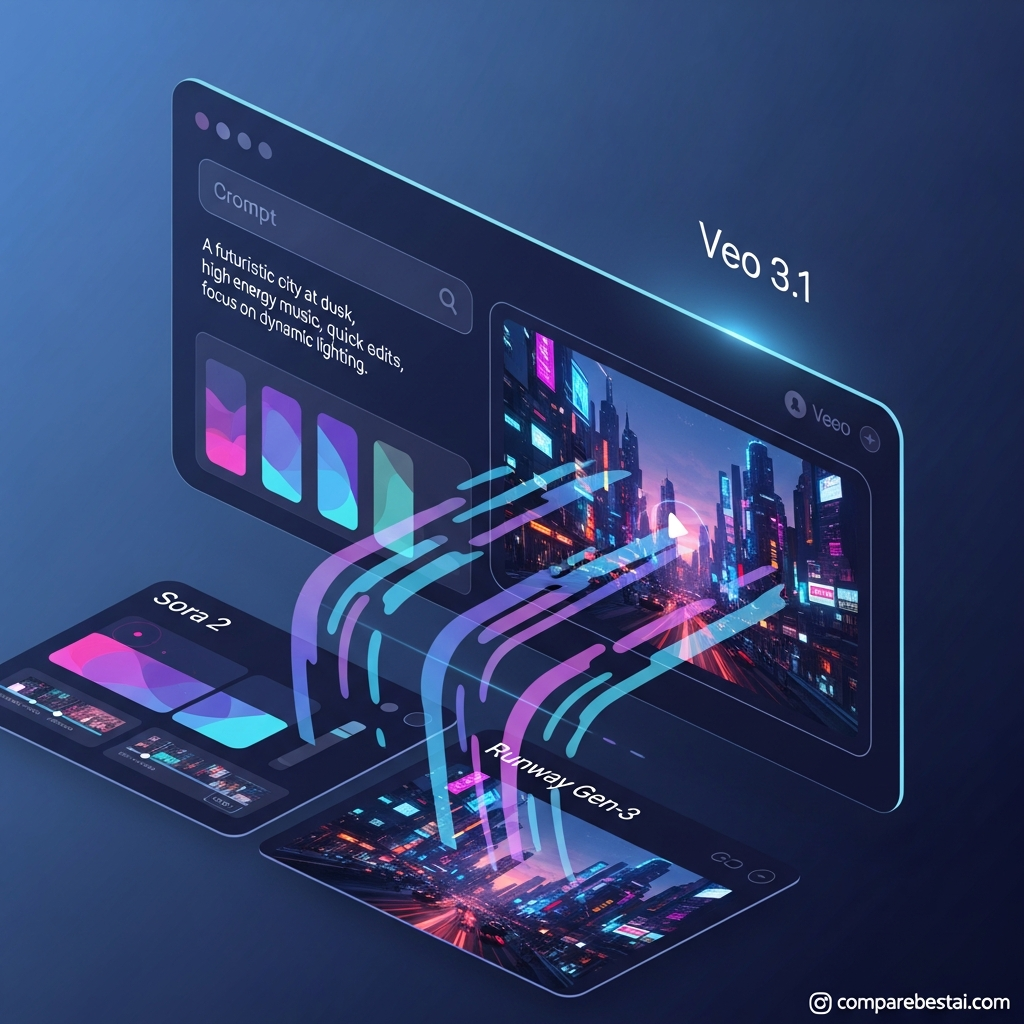

Quick Verdict: Veo 3.1 remains a strong AI video model in 2026 for creators who need native audio, reference-guided generation, first and last frame control, video extension, portrait output and up to 4K resolution. Google Flow currently gives eligible non-subscribers 50 free credits per day, while developers can access Veo 3.1 through the paid Gemini API from $0.05 per generated second.
There is one important 2026 caveat: Google now recommends Gemini Omni Flash as the default model for many new Gemini API video-generation workflows. Veo 3.1 remains relevant when you specifically need features such as scene extension, last-frame control, reference-guided generation or compatibility with existing Veo pipelines.
Veo 3.1 Review: At a Glance
| Category | Veo 3.1 |
|---|---|
| Developer | Google DeepMind |
| Product type | AI video-generation model |
| Introduced | October 15, 2025 |
| Main creative interface | Google Flow |
| Other access | Google Vids, Gemini API, Vertex AI |
| Text to video | Yes |
| Image to video | Yes |
| Native audio | Yes |
| Video length | 4, 6 or 8 seconds in current core workflows |
| Aspect ratios | 16:9 and 9:16 |
| Frame rate | 24 fps |
| Reference images | Up to 3 in supported API workflows |
| First + last frame | Yes |
| Video extension | Yes |
| Resolution | 720p, 1080p and up to 4K on supported models |
| Free Flow access | 50 credits/day for eligible non-subscribers |
| Gemini API starting price | $0.05/sec for Lite 720p |
| Biggest strength | Audio + reference/control workflows |
| Biggest limitation | Short base clips and high rerender cost |
| 2026 verdict | Strong specialist Veo model, but no longer Google's universal default for new API video projects |
What Is Veo 3.1?
Veo 3.1 is Google's generative video model for creating short audiovisual clips from text, images and other visual guidance.
Google introduced Veo 3.1 in October 2025 as an upgrade to Veo 3, with improvements in prompt adherence, realism, audio and creative control.
It should not be confused with a complete project-management or traditional video-editing SaaS platform.
Veo itself generates video.
Google then exposes that model through products and development environments such as:
Google Flow
Google Vids
Gemini API
Vertex AI
That distinction matters because some features associated with Google Flow or Google Vids belong to those applications rather than to the Veo model itself.
Veo 3.1's Main Features
Text-to-Video Generation
Veo 3.1 can create video from a natural-language prompt.
A strong prompt can describe:
subject
setting
action
camera movement
lighting
visual style
dialogue
ambience
sound effects
This makes Veo suitable for concept shots, short narrative scenes, product concepts and creative previsualization.
Current core workflows support 4-, 6- and 8-second videos.
Native Audio
One of Veo 3.1's strongest features is native audiovisual generation.
The model can generate audio together with the visual output rather than requiring every sound element to be added afterward.
Prompts can describe:
spoken dialogue
environmental ambience
sound effects
general audio mood
This can make generated scenes feel more complete than silent video models.
Native audio still needs human review.
Check pronunciation, dialogue timing, lip synchronization and unwanted background sound before publishing important content.
Image-to-Video
Veo can animate an existing image.
The source image defines the visual starting point while the prompt describes how the scene should move.
This is useful for:
product photography
concept art
characters
landscapes
marketing stills
storyboard frames
Image-to-video can also provide more visual control than generating every element entirely from text.
Reference Images and Ingredients
Veo 3.1 supports reference-guided generation.
In supported Gemini API workflows, users can provide up to three reference images.
Those references can help guide:
characters
products
objects
clothing
locations
visual style
Google's Flow interface describes a similar workflow as Ingredients to Video.
This is one of Veo's strongest practical features because consistency is a major problem in generative video.
Reference images do not guarantee perfect identity or product consistency, but they give creators more control than text prompting alone.
First-Frame Control
Creators can define the image where the video begins.
Veo then generates motion from that starting state.
This is useful when you already have:
a storyboard frame
product image
approved concept
character illustration
generated keyframe
First and Last Frame
Veo can also generate the motion between a specified beginning and ending image.
This gives creators greater control over where a shot starts and finishes.
Potential uses include:
product transformations
camera transitions
character movement
scene changes
motion-design concepts
Video Extension
Veo 3.1 can extend qualifying previously generated Veo footage.
This is useful because the base clips are short.
Extension lets creators continue an existing scene rather than regenerating every shot from zero.
However, extension has technical restrictions and is not equivalent to a conventional unlimited video timeline.
Portrait and Landscape Video
Veo 3.1 supports:
16:9 landscape
and:
9:16 portrait
This makes it relevant to both cinematic/widescreen projects and vertical formats such as Shorts and other mobile video.
Up to 4K Output
Current Veo 3.1 Standard and Fast API workflows support:
720p
1080p
4K
Higher-resolution generations have stricter duration requirements.
Veo 3.1 Lite currently supports:
720p
1080p
but not 4K.
Creators using Flow should also remember that resolution availability and credit costs differ from the Gemini API.
Veo 3.1 Lite vs Fast vs Standard/Quality
Google uses slightly different naming depending on where Veo is accessed.
Gemini API
Current developer variants include:
Veo 3.1 Standard
Veo 3.1 Fast
Veo 3.1 Lite
Google Flow
Current labels include:
Veo 3.1 Lite
Veo 3.1 Fast
Veo 3.1 Quality
Not every feature works identically across every model.
That is why users should check the selected model before generating rather than assuming every Veo feature is universally available.
Google Flow: The Best Way to Try Veo 3.1
For most creators, Google Flow is the easiest way to evaluate Veo without building an application.
Flow is Google's AI filmmaking environment.
It provides a creative interface around models such as Veo and supports workflows including:
Text to Video
Frames to Video
References/Ingredients
First and last frames
Extension
scene-building tools
Eligible users without a Google AI subscription currently receive 50 Flow credits per day.
Those free credits can be spent on Veo 3.1 Lite, Fast and Quality.
Veo 3.1 Flow Pricing
Current generation costs are:
| Model | Standard User Cost | Ultra Cost |
|---|---|---|
| Veo 3.1 Lite | 10 credits | 5 credits |
| Veo 3.1 Fast | 20 credits | 10 credits |
| Veo 3.1 Quality | 100 credits | 100 credits |
Non-subscribers currently receive 50 free credits per day.
That means, theoretically, a free user could generate:
up to 5 Lite generations per day
up to 2 Fast generations per day with credits left over
assuming each request produces one generation.
Google charges credits per generation, not necessarily per prompt. Some actions can generate more than one result.
Unused free daily credits do not roll over.
Veo 3.1 Gemini API Pricing
Developers pay per successfully generated second.
| Model | 720p | 1080p | 4K |
|---|---|---|---|
| Veo 3.1 Standard | $0.40/sec | $0.40/sec | $0.60/sec |
| Veo 3.1 Fast | $0.10/sec | $0.12/sec | $0.30/sec |
| Veo 3.1 Lite | $0.05/sec | $0.08/sec | Not supported |
The Gemini API currently has no free Veo 3.1 tier.
Example: 8-second 1080p video
Standard:
8 × $0.40 = $3.20
Fast:
8 × $0.12 = $0.96
Lite:
8 × $0.08 = $0.64
Example: 8-second 4K video
Standard:
8 × $0.60 = $4.80
Fast:
8 × $0.30 = $2.40
These prices matter because a usable production shot may require multiple generations.
The Real Cost of Veo 3.1: Rerenders
The advertised cost of one generation is not necessarily the cost of one finished shot.
If you need five attempts before getting an acceptable eight-second 1080p result:
| Model | One Generation | Five Attempts |
|---|---|---|
| Standard | $3.20 | $16.00 |
| Fast | $0.96 | $4.80 |
| Lite | $0.64 | $3.20 |
That makes cost per usable clip a better metric than cost per generation.
A more expensive model can still be better value if it produces acceptable results in fewer attempts.
Veo 3.1 in Google Vids
Google Vids also provides Veo-powered video creation for eligible Workspace and Google AI users.
Current Vids workflows include AI-generated clips, image animation and reference-based creation.
Vids currently generates supported AI clips at:
24 fps
720p
16:9 or 9:16
Most eligible users have monthly generation limits.
The advantage of Google Vids is that Veo-generated footage becomes part of a broader workplace video project rather than remaining an isolated generated clip.
Is Veo 3.1 Still Google's Best Video Model?
This question changed during 2026.
Google's current Gemini API documentation recommends Gemini Omni Flash as the default model for general video generation.
Google highlights Omni Flash for:
video coherence
multimodal reasoning
character consistency
factual accuracy
conversational editing
Veo 3.1 remains recommended when users specifically need capabilities such as:
scene extension
last-frame control
reference-guided direction
existing Veo pipeline compatibility
That does not make Veo obsolete.
It changes how it should be evaluated.
In September 2026, Veo 3.1 is better understood as a powerful specialist model inside Google's expanding video stack rather than the automatic default for every new use case.
Veo 3.1 Pros and Cons
| Pros | Cons |
|---|---|
| Native generated audio | Base clips are short |
| Strong first/last-frame control | Production often requires rerenders |
| Reference-image support | Some features require 8-second generations |
| Portrait and landscape output | Flow and API features differ |
| 1080p and 4K support on selected variants | 4K increases cost |
| Google Flow access | Gemini API has no free Veo tier |
| Free daily Flow credits | Free credits do not roll over |
| Gemini API and Vertex AI | API variants are still labeled preview in current docs |
| Strong Google ecosystem | Omni Flash is now Google's general default recommendation |
| Useful scene-extension workflow | Not a replacement for a full video editor |
What We Like About Veo 3.1
Creative control
The combination of references, frames and extension gives Veo more control than a basic prompt-only generator.
Native audio
Generating sound and visuals together can reduce the amount of separate audio work required during concept development.
Flow
Google Flow gives non-developers a practical way to use Veo without building software.
Reference consistency
The ability to guide scenes with visual ingredients is particularly useful for recurring characters and products.
High-resolution options
1080p and selected 4K workflows make Veo more suitable for professional experimentation than systems limited to low-resolution previews.
What We Don't Like
Short base duration
Four to eight seconds is restrictive compared with newer models offering longer single generations.
Cost can scale quickly
API costs look reasonable per clip, but rerenders change the economics substantially.
Google's video stack is becoming complicated
Users now have:
Veo 3.1
Veo Lite/Fast/Quality
Gemini Omni Flash
Flow
Vids
Gemini API
Vertex AI
The best route is not always obvious.
Feature availability differs
A feature available in one Google product may not be available in another.
It is not a complete editing suite
Veo generates and extends media, but serious productions will still need editing, compositing, sound, color and finishing tools.
Who Should Use Veo 3.1?
Veo 3.1 is a strong fit for:
Filmmakers and creative teams
Especially for concept shots, previsualization and controlled AI-generated scenes.
Marketers
For short product, campaign and social-video concepts.
Product teams
Reference images can help maintain the appearance of specific products and objects.
Developers
Gemini API and Vertex AI make Veo useful inside custom video-generation applications.
Google ecosystem users
Flow and Google Vids reduce the friction of adopting Veo when your workflow already uses Google's tools.
Who Should Look Elsewhere?
Consider another option if you need:
Longer single generations
Seedance 2.5 currently supports up to 30 seconds in one generation.
Up to 15 seconds plus native multimodal storytelling
Kling 3.0 is a strong current competitor.
A broader creative production platform
Runway provides its own models plus access to external models inside one environment.
Avatar-led corporate videos
A dedicated avatar platform such as Synthesia serves a different use case and may be more appropriate.
Simple drag-and-drop business video
Google Vids or other conventional editors may be easier than building a workflow around raw model generation.
Veo 3.1 vs Runway Gen-4.5
Runway is a platform.
Veo 3.1 is primarily a model accessed through Google's products and APIs.
That distinction matters.
Runway currently provides:
Gen-4.5
other AI video models
editing tools
audio tools
asset storage
higher-tier production formats
Its Standard plan starts at $12 per month when billed annually.
Veo is stronger when you specifically want Google's native audio, references, frames or Google ecosystem.
Runway is stronger when you want one broader production interface with access to several models.
Veo 3.1 vs Kling 3.0
Kling 3.0 is one of the strongest current direct competitors.
It supports:
text
images
audio
video inputs
native audio
multi-shot storytelling
multilingual dialogue
up to 15-second clips
Choose Veo when Google's reference/frame controls and ecosystem matter.
Choose Kling when longer native sequences and multimodal narrative workflows matter more.
Veo 3.1 vs Seedance 2.5
Seedance 2.5 has a significant duration advantage.
It can generate up to 30 seconds of audio-video content in one generation and supports multiple extension rounds.
That makes it especially interesting for longer narrative work.
Veo remains compelling for its specific control tools and Google integration.
What About Sora 2?
Sora 2 is no longer a sensible recommendation for a new video workflow.
OpenAI discontinued the Sora web and app experience on April 26, 2026.
Its API is scheduled to shut down on September 24, 2026.
Older Veo 3.1 vs Sora comparisons should therefore be treated as historical rather than current buyer guidance.
How We Evaluated Veo 3.1
This review is based on current documentation reviewed in September 2026 from:
Google DeepMind
Google Flow Help
Gemini API documentation
Gemini API pricing
Google Vids documentation
official competitor documentation
The review distinguishes between:
Veo 3.1 model capabilities
and:
features provided by products around the model, such as Flow and Google Vids.
Unless CompareBestAI has separately conducted and documented hands-on testing, this page should not claim proprietary benchmark results, customer interviews or side-by-side testing.
Is Veo 3.1 Worth It in 2026?
Yes, for the right use case.
Veo 3.1 is still worth considering when you need:
native audiovisual generation
strong visual references
first and last frames
scene extension
portrait video
high-resolution output
integration with Google's creative and developer ecosystem
It is particularly easy to evaluate through Flow because eligible users can currently start with free daily credits.
However, the answer is less straightforward for developers starting a new product.
Google now recommends Gemini Omni Flash as its default model for general video generation and positions Veo 3.1 around specific specialist capabilities.
So a new development team should test both.
And creators should also compare Veo against modern alternatives such as Runway Gen-4.5, Kling 3.0 and Seedance 2.5 rather than older products such as Sora 2 or Runway Gen-3.
Frequently Asked Questions
What is Veo 3.1?
Veo 3.1 is Google's AI video-generation model for creating short video clips with native audio from text, images and visual references.
When was Veo 3.1 released?
Google introduced Veo 3.1 on October 15, 2025 and expanded its access and capabilities throughout 2026.
Is Veo 3.1 free?
Google Flow currently gives eligible non-subscribers 50 free Flow credits per day. The Gemini API does not currently offer a free Veo 3.1 tier.
How much does Veo 3.1 cost?
In Flow, Veo 3.1 uses credits. Lite currently costs 10 credits for non-Ultra users, Fast costs 20 and Quality costs 100. Gemini API pricing starts at $0.05 per generated second for Lite 720p.
Does Veo 3.1 generate audio?
Yes. Current Veo 3.1 API models generate audio natively with video.
Does Veo 3.1 support 4K?
Yes. Standard and Fast support 4K in selected Gemini API workflows. Higher-resolution generations currently require an eight-second clip. Lite does not support 4K.
How long are Veo 3.1 videos?
Core current workflows support 4-, 6- and 8-second clips. Veo can extend qualifying previously generated footage.
Can Veo 3.1 use reference images?
Yes. Supported Gemini API workflows currently allow up to three reference images.
Is Veo 3.1 better than Gemini Omni Flash?
Not universally. Google's current documentation recommends Omni Flash as the general default for new video generation. Veo 3.1 remains useful for specific features such as scene extension, last-frame control and reference-guided workflows.
What are the best Veo 3.1 alternatives?
Current alternatives include Runway Gen-4.5, Kling 3.0 and Seedance 2.5. The best option depends on duration, editing, audio, workflow and pricing requirements.
Final Verdict
Veo 3.1 is still one of the more capable specialist AI video models available in Google's ecosystem, but it should be reviewed for what it actually is.
It is not a $69-per-month marketing platform.
It does not come with Slack plugins, brand kits, project approvals, white-labeling or unlimited video projects.
Its real strengths are much more specific:
native audio
text and image generation
visual references
first and last frame control
video extension
portrait video
1080p and 4K workflows
Google Flow
developer API access
For creators using Flow, the current free daily credits make Veo 3.1 easy to test.
For developers, Lite and Fast provide relatively inexpensive entry points, but rerenders can increase total cost quickly.
And for new applications, Veo 3.1 now needs to be evaluated alongside Google's newer Omni video model rather than automatically treated as the default.
Bottom line: Veo 3.1 is worth using when its reference, frame, extension and Google ecosystem capabilities match your workflow. It is not automatically the best AI video model for every creator or developer in 2026.
Next step: Test the same eight-second prompt in Veo 3.1 Lite, Fast and one current competitor, then compare usable output, audio quality, rerender count and total cost before committing.
Download the Free Buyers Guide →
Found this guide useful? Share it with your team.