
Quick Answer: Businesses choose Amplitude for AI analytics because it combines product behavior data, AI-assisted analysis, experimentation, session replay, customer feedback, and enterprise data controls in one platform. In 2026, Amplitude's AI capabilities include Global Agent for natural-language analysis, Specialized and Custom Agents for recurring investigations, Agent Analytics for measuring AI-agent quality and business impact, AI Feedback for analyzing customer voice, and MCP access for using Amplitude data inside external AI tools. It is strongest for product-led SaaS, growth, digital-product and enterprise teams.
Pricing and product capabilities in this guide were checked against official Amplitude information in September 2026.
Why Businesses Choose Amplitude: At a Glance
| Area | Why It Matters |
|---|---|
| Product analytics | Understand funnels, retention, cohorts and user behavior |
| AI Agents | Automate analysis and recurring investigations |
| Agent Analytics | Measure whether AI agents actually help users and business outcomes |
| AI Feedback | Connect customer feedback with behavioral data |
| Session Replay | See the behavior behind quantitative metrics |
| Experimentation | Test product and web changes |
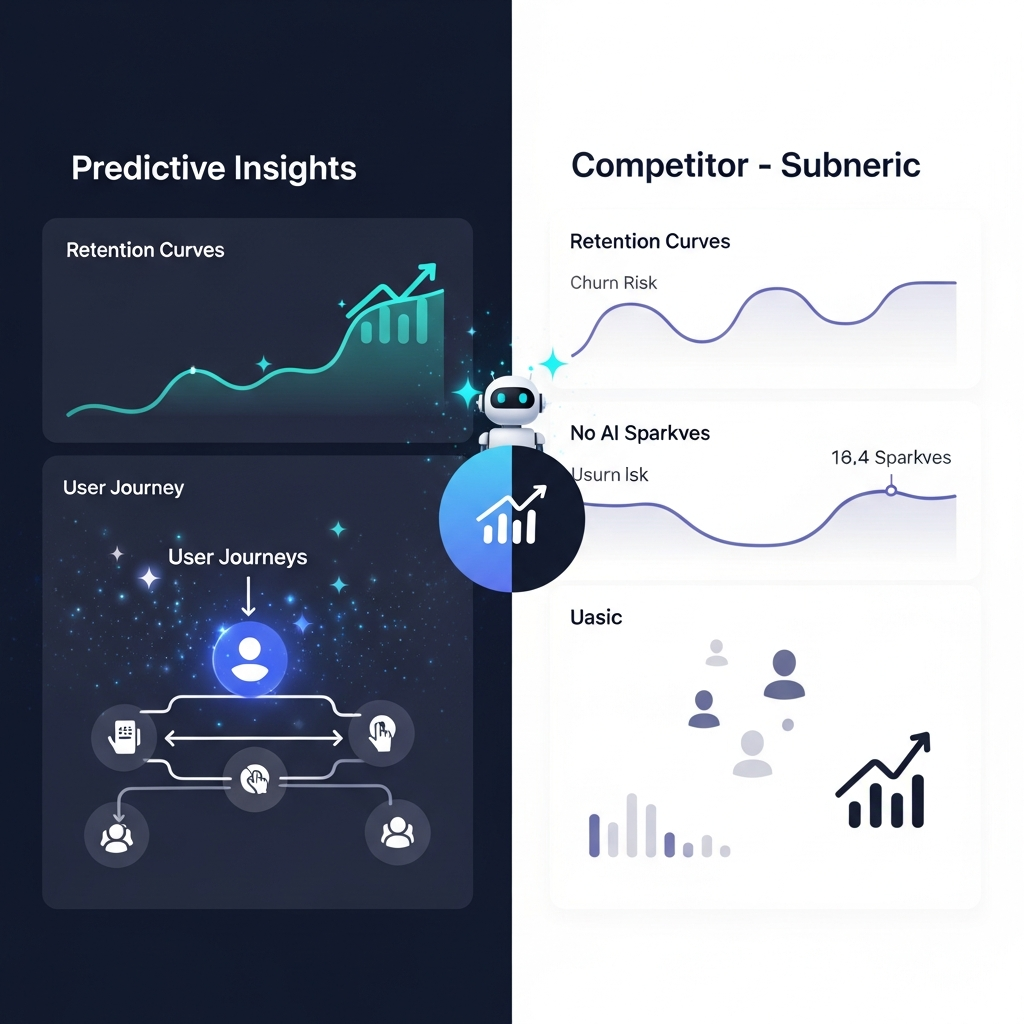
| Predictive analytics | Identify likely future behaviors such as conversion or churn |
| MCP | Use Amplitude data from compatible AI tools |
| Governance | Control data, permissions and AI access |
| Free plan | 2 million events per month with no time limit |
Amplitude's current Free plan includes AI functionality, product analytics, Agent Analytics and session replay, while higher plans expand analytics, governance and usage limits.
What Is Amplitude AI Analytics?
Amplitude is a digital analytics platform built around understanding what users do inside products and digital experiences.
Traditional reporting tools can tell a business that signups fell, conversions increased or traffic changed.
Product analytics asks deeper questions:
Which behaviors lead to retention?
Where do users abandon onboarding?
Which features are associated with conversion?
Which customer groups behave differently?
What changed after a release?
Which product experiences create friction?
Amplitude combines that behavioral data with AI-assisted analysis, experimentation, session replay, feedback analysis and data activation.
The result is less about generating another dashboard and more about helping teams understand what happened, why it may have happened and what they should investigate next.
Internal link: Read our full Amplitude AI review.
1. AI Agents Reduce Manual Analytics Work
One of the biggest reasons Amplitude looks different in 2026 is its shift toward agent-based analytics.
Global Agent
Global Agent is Amplitude's general-purpose analytics agent.
Users can ask product questions in natural language and have the agent:
query product data
build charts
edit charts
create cohorts
investigate follow-up questions
perform multi-step analysis
This makes analytics more accessible to product managers, marketers and other stakeholders who may not want to manually build every analysis from scratch.
Specialized Agents
Amplitude also provides Specialized Agents designed around recurring jobs.
Current examples include:
Dashboard Agent
Session Replay Agent
Website Conversion Agent
Customer Feedback Agent
These agents can run on a schedule and surface findings through Amplitude, email or Slack.
A Dashboard Agent, for example, can continuously monitor important charts and investigate meaningful changes rather than requiring an analyst to manually inspect the same dashboard every morning.
Custom Agents
Teams can also create Custom Agents for repeatable workflows not covered by the built-in agents.
A custom agent can be given instructions, access to Amplitude data and connected tools, then scheduled to perform recurring analysis.
This is one of the clearest reasons businesses may choose Amplitude over a dashboard-only analytics product.
2. Agent Analytics Connects AI Quality to Business Outcomes
Companies are increasingly building AI agents into their own products.
That creates a new analytics problem.
Traditional LLM observability can show things such as latency, prompts, model calls or technical failures.
Businesses also need to know:
Did the agent actually solve the user's problem?
Do successful agent sessions improve retention?
Which customer segments struggle?
Where do agent sessions fail?
How much does each agent or model cost?
Does AI usage improve conversion or revenue?
Amplitude's Agent Analytics is designed around that gap.
It connects agent sessions with the product behavior already tracked in Amplitude, allowing companies to evaluate AI quality alongside outcomes such as retention, conversion and revenue.
Agent Analytics can analyze sessions at multiple levels, including individual sessions, turns and spans.
For companies building AI-native products, that is a substantially different value proposition from ordinary product analytics.
3. AI Feedback Connects What Customers Say With What They Do
Quantitative analytics tells you what users did.
Qualitative feedback tells you what they thought.
Amplitude's AI Feedback brings those two types of information closer together.
It can ingest feedback from sources including:
support tickets
app reviews
customer calls
surveys
social platforms
feedback tools
The system groups feedback into themes such as:
feature requests
complaints
bugs
loved features
pain points
Those insights can then connect with Amplitude cohorts, session replays and experiments.
For example, a product team could identify a recurring complaint and then investigate whether customers making that complaint also experience lower retention.
That is far more useful than keeping support feedback and behavioral analytics in separate systems.
4. Behavioral and Predictive Cohorts Help Teams Understand Users
Cohort analysis has long been one of Amplitude's core strengths.
Amplitude currently supports both behavioral and predictive approaches.
Behavioral Cohorts
Behavioral cohorts group users based on actions they have already taken.
Examples include:
users who completed onboarding
customers who used a feature three times
shoppers who abandoned a cart
users who activated notifications
These cohorts can then be reused across charts and analyses.
Predictive Cohorts
Predictive analytics looks forward instead of only describing previous behavior.
Amplitude can model the likelihood that users will perform future actions such as:
converting
subscribing
churning
completing a purchase
That allows teams to segment users according to modeled probabilities rather than only historical actions.
This can be particularly useful for lifecycle marketing, retention campaigns and personalization.
5. Root Cause Analysis Helps Investigate Metric Changes
Knowing that conversion fell is not enough.
The next question is why.
Amplitude's Root Cause Analysis examines properties and user segments associated with anomalous chart changes.
For example, an unexpected conversion decline might be concentrated among:
one operating system
one geographic market
one device category
one user segment
Instead of manually testing every possible breakdown, Root Cause Analysis can surface the segments most associated with the anomaly.
Amplitude also supports anomaly and forecasting functionality, while its newer Specialized Agents can monitor dashboards and conversion flows proactively.
This does not mean the platform can definitively explain every business change.
Human interpretation still matters.
But it can reduce the amount of manual exploration required to find where the change occurred.
6. Session Replay Adds Context to Product Analytics
Numbers can show that users abandon a funnel.
Session replay can help explain what those users experienced.
Amplitude includes Session Replay across its current platform, with usage limits and advanced functionality varying by plan.
The Session Replay Agent can analyze large numbers of sessions and identify patterns such as friction, rage clicks and dead clicks.
That combination is useful because teams do not have to choose between quantitative and qualitative product analysis.
They can start with a funnel problem, inspect the relevant users and then review behavioral evidence.
7. Experimentation Turns Insights Into Tests
Analytics is more valuable when teams can act on what they learn.
Amplitude's current platform includes experimentation alongside analytics, session replay, guides and surveys.
A typical workflow may look like:
Observe → investigate → create hypothesis → experiment → measure outcome
For example:
Funnel analysis identifies an onboarding drop-off.
Session Replay shows where users struggle.
Root Cause Analysis identifies the most affected segment.
The team develops a new onboarding variation.
An experiment measures whether the change improves activation.
This integrated workflow is one reason product-led businesses may prefer a broader platform over separate point solutions.
8. Amplitude MCP Brings Product Data Into Other AI Tools
Amplitude no longer requires every AI interaction to happen inside its own interface.
Its MCP server can expose Amplitude analytics and content to compatible AI clients using the user's existing permissions.
Amplitude currently documents MCP use with tools including Claude, Cursor, ChatGPT and other compatible systems.
Teams can use MCP to work with:
charts
dashboards
experiments
cohorts
events
properties
from natural-language workflows.
For technical teams already using AI coding or productivity environments, this reduces context switching.
9. Amplitude Pricing in 2026
Amplitude currently offers four main pricing levels.
| Plan | Current Pricing | Best For |
|---|---|---|
| Free | $0 | Individuals and teams getting started |
| Plus | Starts at $0 | Growing small teams |
| Growth | Custom | Scaling businesses |
| Enterprise | Custom | Large organizations and complex governance |
Free
Amplitude's Free plan currently includes:
2 million events per month
unlimited seats
AI Agents
MCP
product analytics
Agent Analytics
10,000 monthly session replays
limited experiments, guides and surveys
The plan has no time limit and requires no credit card.
Plus
Plus also starts at $0 for the first 2 million monthly events and scales with event volume.
Current Plus capabilities include features such as:
custom events and formulas
behavioral cohorts
alerts
heatmaps
expanded usage
two-year data retention
Growth
Growth uses custom event-based pricing.
It adds more advanced behavioral analysis, monitoring and alerts, higher usage allowances, SSO and project permissions.
Enterprise
Enterprise is also custom priced.
It adds capabilities for larger organizations such as:
data access controls
expanded permissions
advanced security and governance
unlimited projects per portfolio
larger session-replay allowances
higher AI usage limits
Startup Program
Qualifying startups with fewer than 20 employees and less than $10 million in funding can currently apply for one free year of the Growth plan.
CTA: Compare Amplitude's Current Plans
Internal link: See our Amplitude pricing analysis.
10. Governance Matters for Enterprise Analytics
Enterprise analytics often contains sensitive information.
That makes permissions and data governance a purchasing criterion rather than an optional feature.
Amplitude supports role-based access controls for managing which users can access products, projects and actions.
Enterprise organizations can also use Data Access Control to restrict access to sensitive data categories such as:
personally identifiable information
revenue information
other classified event or property data
This matters when product analytics becomes accessible to large groups of employees.
Making analytics easier to use should not mean giving every user unrestricted access to every piece of customer information.
11. Amplitude Integrates With Existing Data Stacks
Large organizations rarely keep all customer data in one place.
Amplitude supports data integrations with platforms such as Snowflake and Salesforce.
Its Snowflake integration can import warehouse data into Amplitude, while export workflows can send Amplitude event data back to Snowflake.
Amplitude also supports Salesforce account-level data imports for B2B analytics.
One important qualification is that Amplitude now describes its older Warehouse-Native Amplitude offering as a legacy feature that is not available to new customers.
New buyers should therefore evaluate current warehouse import, export and data-integration capabilities rather than relying on older descriptions of Warehouse Native.
Why SaaS and Product-Led Companies Choose Amplitude
Amplitude is particularly well matched to digital products because product usage itself creates the behavioral data needed for analysis.
A SaaS company can investigate questions such as:
What do retained users do differently?
Which onboarding actions predict activation?
Which features correlate with upgrades?
Where do trial users drop out?
Which product changes improve conversion?
Which customer groups are showing signs of churn?
How does an AI assistant affect retention?
These questions are more closely aligned with product analytics than traditional traffic reporting.
That is why Amplitude tends to make the most sense when the product itself is an important part of the customer journey.
Why Marketing Teams Use Amplitude
Amplitude is not limited to product managers.
Marketing teams can use behavioral data to understand what happens after acquisition.
Instead of evaluating a channel only by signup volume, they can investigate whether users from a campaign:
activate
adopt key features
retain
upgrade
generate revenue
That can improve channel evaluation because a campaign producing fewer signups may still produce more valuable customers.
Amplitude's cohort and activation functionality can also help teams send behavioral audiences into downstream campaigns and systems.
Why Companies Building AI Products May Choose Amplitude
This is one of the biggest new use cases in 2026.
An AI application needs more than basic usage analytics.
Teams may need to know:
whether an agent solves a task
which sessions create friction
which agent versions improve outcomes
which customers adopt AI features
how AI usage affects retention
how model cost relates to successful sessions
Amplitude's combination of traditional product analytics and Agent Analytics is designed to connect these questions.
For companies building AI assistants, copilots or autonomous agents, that can make Amplitude materially more relevant than an analytics platform focused only on page views or conventional events.
Amplitude vs Mixpanel
Amplitude and Mixpanel both compete in product and behavioral analytics.
The decision should not be reduced to a simplistic “Amplitude is advanced, Mixpanel is easy” rule.
Instead, evaluate:
event volume
behavioral analysis requirements
experimentation
session replay
data governance
AI functionality
integrations
team workflows
pricing at your actual scale
Amplitude becomes particularly compelling when a company wants product analytics, AI-assisted investigation, experimentation, qualitative feedback and enterprise controls within the same broader platform.
Internal link: Compare Amplitude alternatives and analytics platforms.
Amplitude vs Google Analytics 4
GA4 and Amplitude overlap, but they are often used for different primary questions.
GA4 is commonly used to understand website and acquisition performance.
Amplitude is more strongly centered on product behavior and digital-product journeys.
A company may therefore use both rather than treating the choice as strictly either/or.
For example:
GA4: Where did visitors come from?
Amplitude: What did users do after entering the product, and which behaviors correlate with retention or conversion?
That distinction is more useful than claiming one platform universally replaces the other.
Who Should Choose Amplitude?
Strong Fit
Amplitude is particularly well suited to:
SaaS companies
product-led businesses
digital-product teams
growth teams
enterprise product organizations
companies running frequent product experiments
businesses building AI-powered products or agents
Less Ideal
Amplitude may be excessive when:
you only need basic website traffic reporting
your digital product generates little behavioral data
nobody owns analytics implementation
your team has no recurring product-analysis workflow
you are unwilling to define events and maintain data quality
A powerful analytics platform cannot compensate for poor instrumentation.
The business still needs a clear tracking strategy.
What Are the Main Limitations of Amplitude?
Amplitude has several tradeoffs.
Implementation Effort
Strong product analytics depends on good event data.
Teams need to decide what to track and maintain useful event and property definitions.
Learning Curve
AI Agents reduce some analytical friction, but the broader platform remains deep.
Teams using only basic dashboards may not take advantage of enough functionality to justify complexity.
Custom Pricing at Scale
Growth and Enterprise plans use custom pricing.
Large organizations should evaluate real event volumes, add-ons and governance requirements before signing a contract.
Not a Replacement for Every Analytics Tool
Amplitude is strongest around product and behavioral analytics.
A company may still use separate systems for:
financial analytics
ad-platform reporting
enterprise BI
infrastructure monitoring
attribution
data science
The goal is not necessarily to replace every tool.
It is to determine whether Amplitude should become the behavioral intelligence layer around the product.
Is Amplitude Worth It for Startups?
For many startups, the Free plan changes the economics significantly.
Two million monthly events, AI Agents, product analytics and other included capabilities allow smaller teams to test the platform without immediately signing an enterprise contract.
The question becomes more important when event volumes grow.
A startup should upgrade only when advanced analytics, additional usage, experimentation, retention, security or business impact justify the additional cost.
Qualifying startups should also review the current Startup Scholarship.
Is Amplitude Worth It for Enterprise Teams?
Amplitude makes the strongest enterprise case when behavioral analytics is already strategically important.
Large teams can benefit from:
centralized product analytics
permissions
sensitive-data controls
AI Agents
experimentation
customer-feedback analysis
session replay
predictive analytics
data integrations
The enterprise case is weaker when analytics remains an occasional reporting activity with little operational impact.
Enterprise buyers should therefore evaluate how many teams will actually use the data and which decisions Amplitude will improve.
Frequently Asked Questions
What is Amplitude AI analytics?
Amplitude AI combines behavioral product analytics with AI Agents, Agent Analytics, customer-feedback analysis and other AI-assisted workflows. Teams can ask questions in natural language, automate recurring investigations and connect user behavior with business outcomes.
Does Amplitude have a free plan?
Yes. Amplitude currently offers a permanent Free plan with up to 2 million events per month, unlimited seats and access to product analytics, AI Agents, MCP, Agent Analytics and other platform capabilities with plan-specific limits.
What are Amplitude AI Agents?
Amplitude's AI Agents perform analytics tasks using product data. Global Agent handles ad-hoc questions, while Specialized and Custom Agents can automate recurring workflows such as dashboard monitoring, replay analysis, customer-feedback analysis and conversion investigation.
What is Amplitude Agent Analytics?
Agent Analytics measures how AI agents perform and connects their quality with business outcomes such as conversion, retention and revenue. It can analyze session quality, failures, costs and user behavior.
Does Amplitude support predictive analytics?
Yes. Amplitude supports predictive analytics that can estimate the likelihood of future user actions such as conversion, churn or purchase and use those results to create predictive cohorts.
Can Amplitude analyze customer feedback?
Yes. AI Feedback can organize feedback from sources such as support tickets, reviews, calls and social channels into themes such as complaints, bugs and feature requests, then connect those insights to product behavior.
Can Amplitude connect to ChatGPT, Claude or other AI tools?
Amplitude's MCP server can expose Amplitude analytics and content to compatible AI clients using existing account permissions. Current documentation includes ChatGPT, Claude, Cursor and other MCP-capable environments.
Is Amplitude better for product analytics than website analytics?
Amplitude is primarily designed around behavioral and digital-product analytics. Businesses focused only on basic traffic and acquisition reporting may not need its full platform, while SaaS and product-led companies can benefit from deeper funnel, retention, cohort and experimentation workflows.
Why Businesses Choose Amplitude for AI Analytics: Final Verdict
Businesses choose Amplitude because it combines several layers of digital intelligence that used to require separate workflows.
The platform can help teams:
analyze product behavior
investigate unusual changes
understand cohorts
forecast likely future actions
analyze customer feedback
review user sessions
run experiments
evaluate AI-agent performance
automate recurring analysis
bring product data into external AI tools
Its 2026 AI strategy is particularly important.
Amplitude is no longer simply adding a chatbot on top of dashboards. Global Agent, Specialized Agents, Custom Agents, Agent Analytics, AI Feedback and MCP increasingly make AI part of how teams investigate and act on product data.
That does not make Amplitude the right analytics platform for every business.
Companies that only need basic web reporting may not need its depth.
But for SaaS, product-led and AI-native businesses where user behavior directly influences product strategy, retention and revenue, Amplitude deserves serious consideration.
CTA: Explore Amplitude's Free Plan and Current AI Analytics Features
How We Evaluated Amplitude
CompareBestAI evaluated Amplitude using current product information and official Amplitude documentation.
We focused on:
AI analytics capabilities
product analytics
Agent Analytics
AI Agents
AI Feedback
MCP
behavioral cohorts
predictive analytics
session replay
experimentation
governance
data integrations
current pricing
startup suitability
enterprise suitability
Product features and pricing were checked in September 2026.
Because analytics platforms change frequently, buyers should confirm current limits and contract terms directly with Amplitude before purchasing.