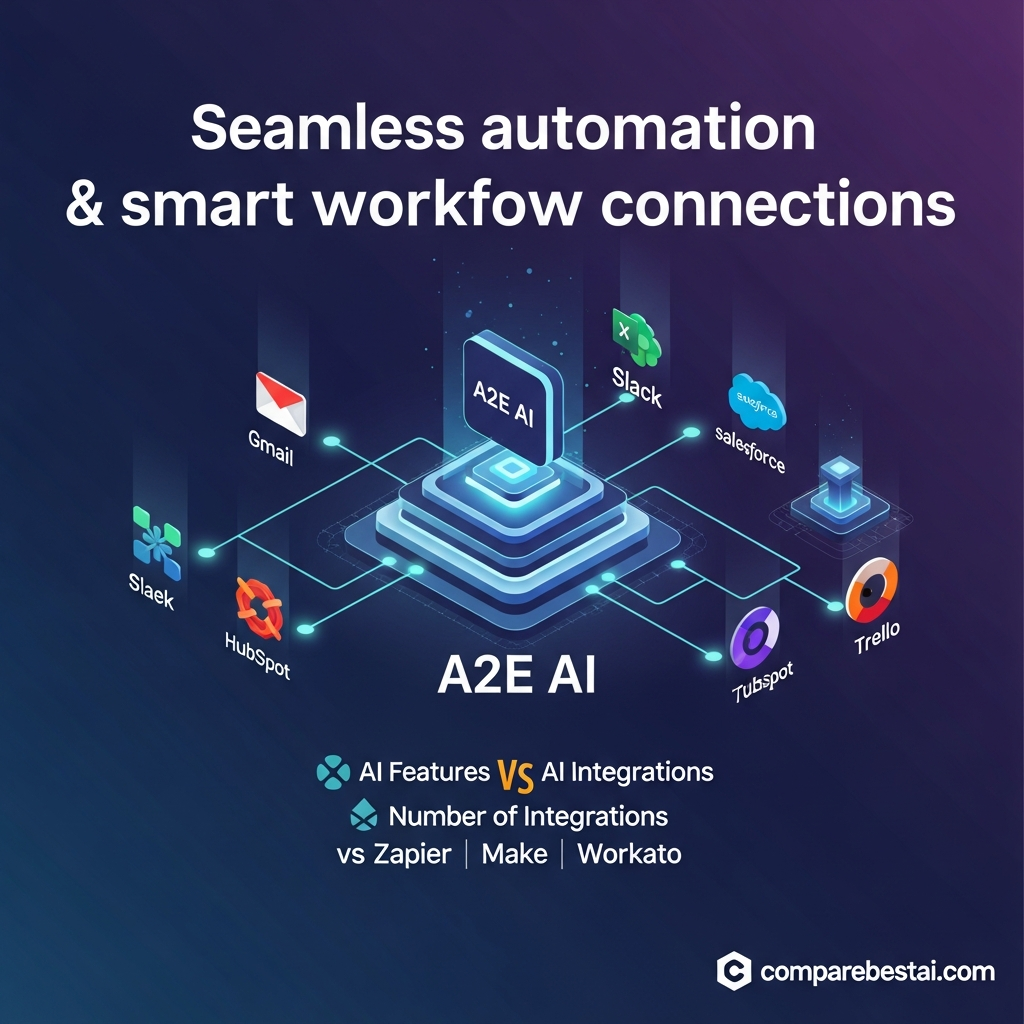

A2E AI integrations are primarily developer-focused connections built through A2E's REST APIs, OpenAPI specification, AI-agent resources, and webhook-enabled media-generation endpoints. A2E does not currently appear to provide a verified directory of hundreds of native Gmail, Slack, HubSpot, Salesforce, or similar business-app connectors.
Instead, A2E lets developers integrate AI avatar video, voice cloning, text-to-speech, text-to-image, image-to-video, lip-sync, face swap, talking video, image editing, and other generative-media capabilities into applications and automated workflows.
Quick Answer: What Integrations Does A2E AI Support?
A2E AI supports integrations through four main paths:
| Integration option | What it does | Best for |
|---|---|---|
| REST API | Lets applications send media-generation requests to A2E | SaaS products, apps, custom workflows |
| OpenAPI specification | Provides a machine-readable description of A2E's API | Developers, code generation, API clients |
| AI-agent / MCP resources | A2E provides a generated SKILL.md intended for Cursor, MCP clients and other AI agents | Agentic development and AI workflows |
| Webhooks | Certain endpoints can send task-completion or task-failure notifications to your application | Automated production pipelines |
A2E's developer documentation currently covers APIs for avatar video, text-to-speech, voice cloning, face swap, image generation, image-to-video, talking photo/video, virtual try-on, product avatars and multiple third-party video-generation models.
That distinction is important. A2E AI is better understood as an AI media API platform than as a Zapier-style app-integration marketplace.
How Do A2E AI Integrations Work?
A2E integrations generally work by allowing another application to send a request to an A2E API endpoint.
A typical workflow looks like this:
- Your application collects an input such as text, an image, video or audio.
- Your backend sends the required data to an A2E API endpoint.
- A2E creates a generation or processing task.
- Your application receives a task or record identifier.
- Your system checks the task status or receives a webhook notification.
- When processing is complete, your application retrieves and uses the generated result.
This structure makes A2E useful for developers who want AI media generation inside an existing application rather than manually creating every asset through A2E's web interface.
For example, an e-commerce application could send a product image to an image-to-video endpoint, while a training platform could combine a digital avatar with generated speech to create educational videos automatically.
A2E REST API Integration
REST API access is the core integration method.
A2E describes its developer platform as a collection of RESTful APIs for generating and modifying multimedia. Its official developer documentation includes individual guides for authentication, task creation, status checking and retrieving results.
Developers can therefore use A2E as part of:
- SaaS applications
- Internal content-production systems
- Marketing automation pipelines
- E-commerce creative workflows
- AI-agent workflows
- Batch media-generation systems
- Creator tools
- Training platforms
- Localization workflows
The important point is that the API connects your software to A2E's generation capabilities.
It should not be described as proof that A2E has a native integration with every third-party SaaS platform.
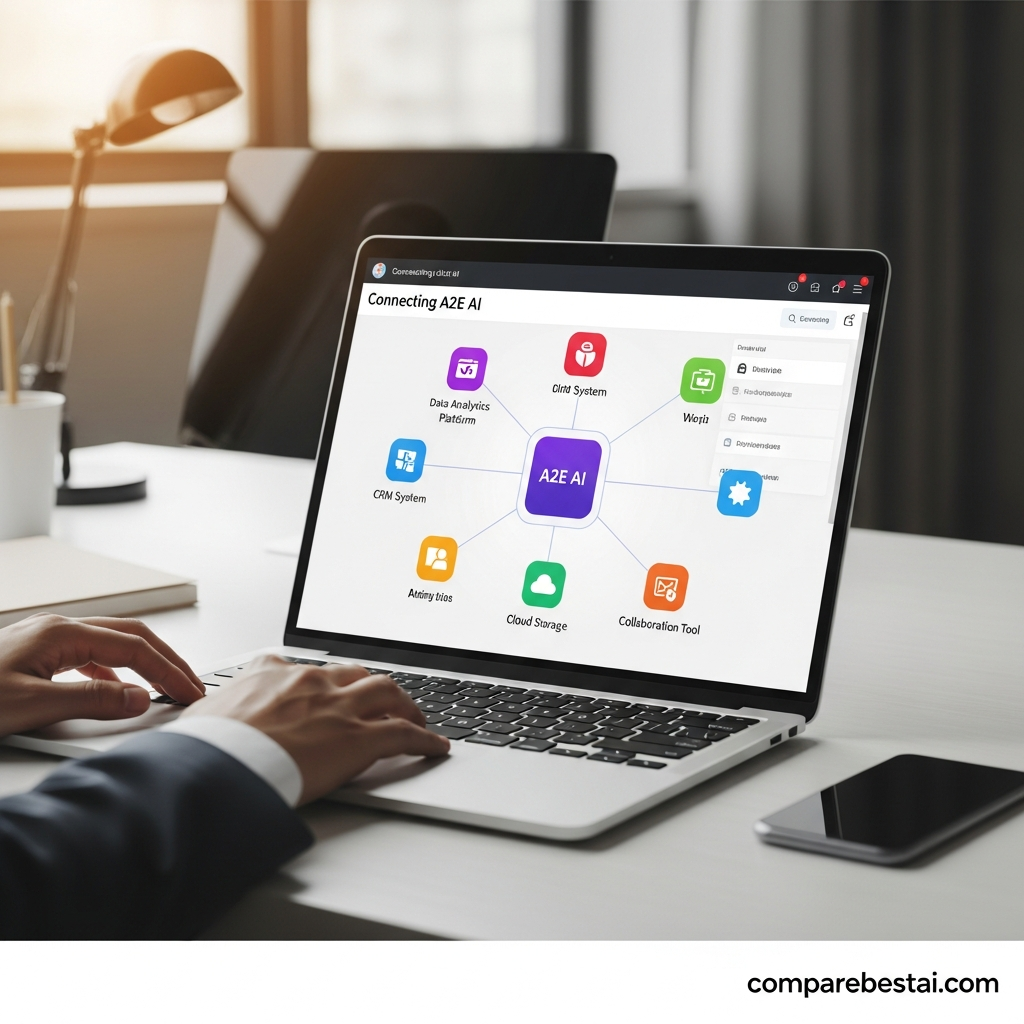
A2E OpenAPI and AI-Agent Integration
A particularly useful capability for developers in 2026 is A2E's machine-readable API documentation.
A2E provides an OpenAPI JSON specification and also offers a generated SKILL.md for Cursor, MCP clients and other AI agents.
This makes A2E easier to introduce into AI-assisted development environments.
An AI coding agent can use structured API documentation to understand available endpoints, required parameters and expected responses rather than relying entirely on manually written integration instructions.
For teams building agentic systems, this is a more meaningful integration capability than a traditional directory of app icons.
Does A2E AI support MCP?
A2E's developer documentation explicitly references resources for MCP clients and other AI agents.
However, it is safer to describe this as MCP/AI-agent integration support through A2E's developer resources rather than claiming that every A2E feature has a dedicated standalone MCP connector.
A2E Webhook Integration
Webhooks can help make A2E workflows more automated.
For example, A2E's Voice Clone API documentation includes webhook_url and webhook_token parameters. Its Image-to-Video and Talking Video documentation also describes webhook-based task notifications.
This allows an external application to receive events when a generation task finishes or fails.
That can create a workflow such as:
User uploads image → application sends image to A2E → A2E generates video → webhook reports completion → finished video appears inside the application
A2E notes in some API documentation that webhook delivery is best-effort and that the API's task-detail endpoint should remain the source of truth.
For production applications, developers should therefore support both webhook notifications and status checking where appropriate.
What Can You Integrate Through the A2E API?
A2E's developer documentation covers a broad collection of media-generation APIs.
AI Avatar Video
Developers can build workflows that create videos using AI avatars.
This may be useful for:
- Training videos
- Product explainers
- Personalized messages
- Educational videos
- Marketing creatives
Text-to-Speech
A2E exposes text-to-speech capabilities for applications that need automated narration or spoken content.
Voice Clone
The Voice Clone API can create a custom voice from supplied audio samples and can then be used as part of voice-generation workflows.
A2E's current developer documentation lists A2E, Cartesia, MiniMax and ElevenLabs among available voice-model options for relevant voice workflows.
Text-to-Image
Developers can integrate image generation rather than requiring users to leave their application and manually use a separate image generator.
A2E currently references multiple supported image-generation models across its platform.
Image-to-Video
The Image-to-Video API converts a still image into an AI-generated video.
Its documented controls include source images, prompts and several generation parameters.
This is particularly relevant for:
- Product marketing
- Social media creatives
- Character animation
- Advertising
- Creator platforms
Face Swap and Head Swap
A2E documents APIs for face and head manipulation as part of its media-processing platform.
Any product using these features should establish appropriate consent and usage policies for uploaded media.
Talking Photo and Talking Video
Talking-media APIs can animate or re-lip-sync existing media using generated or supplied audio.
A2E's Talking Video API, for example, lets developers provide source video and audio-related inputs and create new talking-video output.
Video Generation Models
A2E's current developer documentation includes API guides for several generation families and models, including Wan, Kling, Grok, Hailuo, Seedance, Sora-related options and others.
Because model availability can change quickly, developers should verify the current API documentation before designing a workflow around a specific model.
Product and Commerce Media
A2E also documents functionality such as Product Avatar and Virtual Try-On APIs.
These can be relevant for businesses creating product imagery, UGC-style assets or e-commerce marketing content.
Does A2E Integrate With Zapier, Make, Gmail or Slack?
This is where the term A2E AI integrations can become misleading.
Based on the current official A2E developer documentation reviewed for this guide, we could not verify a native marketplace of prebuilt integrations for:
- Gmail
- Slack
- HubSpot
- Salesforce
- Trello
- Asana
- Notion
- Zapier
- Make
That does not mean these services can never be used alongside A2E.
A developer could potentially connect A2E's REST API to another automation system that supports HTTP requests or custom APIs.
For example, a technically configured workflow might take information from another platform, send a request to A2E and then send the generated result somewhere else.
But that is different from saying:
“A2E has a native Gmail integration.”
Unless A2E officially documents that connector, CompareBestAI should describe it as a custom API workflow, not a native integration.
Example A2E AI Integration Workflows
Product Image to Marketing Video
An e-commerce application could send an existing product image to A2E's image-to-video functionality.
The application could then retrieve the generated clip and place it into a product-media library.
Workflow:
Product image → A2E Image-to-Video API → generation task → status/webhook → finished video
Automated Talking Avatar
A learning platform could combine a custom avatar with narration to create short training videos.
Workflow:
Training text → TTS → avatar-video generation → completed video → course library
Voice-Cloned Narration
A creator application could allow an authorized user to train a voice model from their own recordings.
New scripts could then be converted into narration without recording every line manually.
AI Content Production Pipeline
A marketing application could combine multiple A2E endpoints.
For example:
Product image → image editing → image-to-video → voice generation → talking video → upscale
The exact workflow depends on the APIs and models being used.
A2E AI Integrations for Developers vs Non-Technical Users
A2E's integration capabilities are strongest for developers.
Developers
A2E is particularly relevant if you need to:
- Embed AI generation into your own product
- Automate repeated media requests
- Connect generation to an existing backend
- Build asynchronous workflows
- Use task IDs and webhooks
- Integrate multiple media-processing stages
- Give AI coding agents structured API documentation
Non-Technical Users
Users who simply want to create media manually may not need API integration at all.
A2E also provides a web application where creators can access many of the platform's generation features directly.
Therefore, API access makes the most sense when the goal is automation, embedding or scale, rather than occasional manual generation.
A2E AI Integration Pricing and API Access
A2E currently offers a Free tier and paid creator plans.
Its pricing page states that API access is supported on its paid Pro and Ultra options, while the Free tier does not include API access in the comparison table.
A2E also uses a credit-based system for many generation tasks, meaning your true integration cost depends on which features and models your application uses.
That matters for developers.
A workflow generating a few talking-avatar videos each week may have very different costs from a high-volume application producing thousands of AI video assets.
A2E's pricing page can change and currently contains different figures in separate sections of the same page. For that reason, always verify the latest vendor pricing and checkout details before calculating production costs.
For a broader breakdown, see our A2E AI review and pricing analysis.
A2E AI Security and Data Considerations
AI media integrations can involve sensitive images, video, audio and facial information, so developers should review A2E's current privacy documentation before using it in production.
A2E's privacy policy says uploaded multimedia may be processed to provide its features and states that avatar-related data can be stored on Amazon Web Services infrastructure in the United States. It also states that A2E does not use personal data to generally train or create separate AI products beyond the user's own results.
However, businesses with strict regulatory requirements should perform their own compliance review.
We did not find a public claim in the reviewed vendor materials confirming certifications such as SOC 2 or HIPAA compliance, so these should not be assumed or stated as verified facts.
A2E AI Integrations vs Traditional Automation Platforms
A2E AI and platforms such as Zapier or Make solve different problems.
| Platform type | Main purpose |
|---|---|
| A2E AI | AI media generation and processing through APIs |
| Zapier-style platform | Connecting business SaaS applications and triggering actions between them |
| Make-style automation | Visual multi-step automation across apps and APIs |
| Custom backend | Full control over how A2E and other services interact |
A company may use both types of technology.
For example, an automation system could detect a business event while A2E handles the actual video, avatar, voice or image generation.
The integration layer would then be built through APIs rather than assuming A2E itself replaces an automation platform.
Who Should Use A2E AI Integrations?
A2E API integration makes the most sense for:
AI SaaS Developers
Developers who want to add video, image, avatar or audio generation without building generative-media infrastructure from scratch.
Marketing Technology Teams
Teams that need repeated content generation connected to internal systems.
E-commerce Platforms
Applications that generate product videos, model imagery or creative variations from existing product assets.
Creator Platforms
Products that provide avatar generation, talking media, image-to-video or voice functionality to creators.
Agencies With Automated Production Systems
Agencies producing large volumes of client media can use APIs to reduce repeated manual steps.
Limitations to Know Before Integrating A2E
A2E provides a wide range of media APIs, but that does not automatically make it the right integration platform for every project.
Consider the following before implementation:
- API access may require a paid plan.
- Credit consumption differs by feature and model.
- Generation is asynchronous for many workflows.
- Some workflows should use both status checks and webhooks.
- Model availability and pricing can change.
- A2E is not a replacement for a traditional SaaS integration platform.
- Businesses processing sensitive media should independently review privacy and compliance requirements.
- Developers should test output consistency before relying on a model for production workloads.
Frequently Asked Questions About A2E AI Integrations
Does A2E AI have an API?
Yes. A2E provides RESTful APIs for AI media generation and processing. Its developer documentation covers avatar video, voice, image, video and other media workflows.
Does A2E AI support MCP?
A2E's developer documentation provides a generated SKILL.md intended for Cursor, MCP clients and other AI agents. This makes its API easier to incorporate into agentic development workflows.
Does A2E integrate directly with Zapier?
We could not verify an official native Zapier connector in A2E's current developer documentation. A custom workflow may still be possible using A2E's API and an automation platform capable of making HTTP/API requests.
Does A2E integrate with Gmail, Slack or HubSpot?
We could not verify native Gmail, Slack or HubSpot integrations from A2E's official documentation reviewed for this article. These should therefore not be presented as confirmed native integrations.
What can developers generate through the A2E API?
A2E documents APIs for avatar videos, text-to-speech, voice cloning, image generation, image-to-video, talking photo/video, face swap, image editing, video generation and several other AI-media functions.
Does A2E support webhooks?
Yes, several documented A2E API workflows include webhook parameters for task-completion and task-failure notifications. Developers should check the documentation for the specific endpoint they plan to use.
Is A2E API access free?
A2E's current pricing page indicates that its Free tier does not include API access while paid Pro and Ultra options support the API. Pricing and plan details can change, so verify the latest vendor information before purchasing.
Can A2E be integrated into a commercial application?
A2E's terms allow paid API users to generate AI multimedia assets through its official API and describe commercial reuse of generated results, subject to the platform's terms and applicable rights. Developers should still review the latest terms for their specific use case.
Final Verdict: Are A2E AI Integrations Good?
A2E AI offers a strong integration layer for developers who need AI-powered video, avatar, voice, image and media-processing capabilities inside another application.
Its biggest integration strengths are its REST APIs, broad media endpoint coverage, OpenAPI documentation, AI-agent resources and webhook-supported workflows.
However, A2E should not be positioned as a direct alternative to Zapier or Make. We could not verify claims that it provides hundreds of native Gmail, Slack, Salesforce, HubSpot or similar SaaS connectors.
For developers, creators, e-commerce platforms and AI SaaS products, the more relevant question is:
Can A2E's media APIs provide the generation capability your application needs at the quality, cost and scale you require?
If the answer is yes, A2E can be an attractive integration option.
For current pricing, hands-on findings, limitations and feature scores, read our full A2E AI review before choosing a plan.