
By CompareBestAI
Quick Answer: The best SEO tools for startups in 2026 depend on your stage. Google Search Console is the essential free foundation, Screaming Frog is best for technical audits, Ubersuggest is our budget all-in-one pick, Mangools is ideal for beginner-friendly keyword research and rank tracking, Ahrefs Starter is strong for affordable competitor and backlink research, Frase is best for content-led startups, and SE Ranking fits startups that have grown into a more structured SEO and AI-search workflow.
Most startups do not need an enterprise SEO stack.
A pre-seed founder validating search demand has very different requirements from a funded startup publishing 30 articles a month.
The right question is therefore not:
“What is the most powerful SEO platform?”
It is:
“What is the cheapest tool that solves our current SEO bottleneck without exhausting runway?”
For a broader price-first comparison, see CompareBestAI's affordable SEO tools guide
Internal target: /articles/affordable-seo-tools
Best SEO Tools for Startups at a Glance
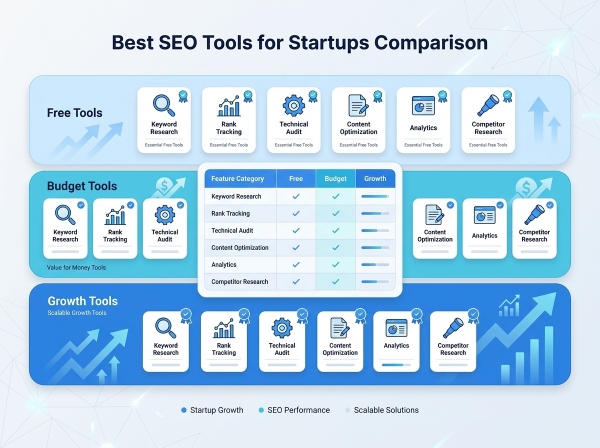
| Rank | Tool | Best For | Startup Stage | Starting Cost |
|---|---|---|---|---|
| 1 | Google Search Console | First-party Google performance data | Pre-seed → all stages | Free |
| 2 | Screaming Frog | Technical SEO audits | Pre-seed → growth | Free; paid $279/year |
| 3 | Ubersuggest | Budget all-in-one SEO | Pre-seed → seed | $29/month |
| 4 | Mangools | Keywords + rank tracking | Seed | $49 monthly; $29.90/mo annual equivalent |
| 5 | Ahrefs Starter | Competitors + backlinks | Seed → growth | $29/month |
| 6 | Frase | Content optimization + GEO | Content-led seed/growth | $49 monthly; $39/mo annually |
| 7 | SE Ranking | Structured SEO + AI visibility | Growth stage | $129 monthly; $103.20/mo annually |
Pricing checked September 7, 2026. Pricing, limits and features can change; verify the provider's current plan before subscribing.
Google Search Console is free and gives website owners Google Search performance and indexing information. Screaming Frog's free version crawls up to 500 URLs, while its current US paid licence costs $279/year. Ubersuggest currently starts at $29/month.
Mangools' current Basic pricing is $49 monthly or $358.80 annually, equivalent to $29.90/month. Ahrefs Starter is $29/month. Frase Starter is $49 month-to-month or $39/month when billed yearly. SE Ranking Core currently costs $129/month or $103.20/month on annual billing.
How We Evaluated SEO Tools for Startups
Startup SEO software should not be evaluated like agency or enterprise software.
We used seven startup-specific criteria.
1. Time to Value
Can a founder or small growth team get useful information quickly?
2. Cost Relative to Stage
A $150 monthly subscription may be reasonable for a funded growth team and irrational for a pre-revenue startup.
3. Core SEO Coverage
We looked at whether the tool helps with one or more of:
- search performance,
- keyword research,
- technical auditing,
- competitor research,
- backlinks,
- rank tracking,
- content optimization,
- AI-search visibility.
4. Usage Limits
Startup-friendly pricing can become expensive if useful data is hidden behind severe project, credit, crawl or keyword limits.
5. Ease of Use
Complexity has a cost.
A founder who spends six hours learning a dashboard has already paid more than the subscription price.
6. Scalability
The right tool should either grow with the startup or have a clear point where upgrading makes sense.
7. Actionability
We favor tools that answer:
“What should we do next?”
not merely:
“How many charts can we show?”
 1. Google Search Console — Best Free SEO Tool for Every Startup
Best for: Search performance, indexing, clicks, impressions and first-party Google data.
Stage: Pre-seed onward.
Price: Free.
Google Search Console should usually be installed before a startup pays for SEO software.
Google describes Search Console as a free service for monitoring, maintaining and troubleshooting a site's presence in Google Search. It can show search traffic, queries, clicks, indexing issues and links.
Its Performance report includes:
- clicks,
- impressions,
- CTR,
- average position,
- queries,
- pages,
- countries.
Why This Matters for Startups
Early-stage sites often have too little traffic for sophisticated modeling.
But impressions can reveal opportunities before meaningful traffic arrives.
For example, if a new startup page receives thousands of impressions but very few clicks, the team can investigate:
- title positioning,
- search intent,
- snippet relevance,
- page usefulness.
Google explicitly suggests investigating high-impression, low-CTR queries and improving titles, descriptions or page alignment where appropriate.
What Search Console Does Not Do
It does not replace:
- broad competitor keyword research,
- full backlink databases,
- market-wide traffic estimates,
- dedicated rank tracking,
- deep technical crawling.
Verdict: Start here. Do not buy SEO research software before you understand your own first-party search data.
2. Screaming Frog — Best Technical SEO Tool for Lean Startup Sites
Best for: Technical audits, crawls, migrations and site architecture.
Stage: Pre-seed → growth.
Price: Free up to 500 URLs; $279/year for the paid US licence.
Screaming Frog SEO Spider is a specialist crawler rather than an all-in-one search database.
The free version can crawl up to 500 URLs, which is enough for many early startup sites. Paid access removes that limit and adds functionality such as scheduling, JavaScript rendering, crawl comparisons, structured-data validation, custom extraction and integrations.
What It Helps Find
- Broken links.
- Redirect chains.
- Missing titles.
- Duplicate metadata.
- Canonical problems.
- Hreflang issues.
- Duplicate content.
- Internal-linking problems.
- Structured-data problems.
- JavaScript-related crawling issues.
Why It's Startup-Friendly
A 40-page SaaS website does not need a massive cloud crawler simply because enterprise brands use one.
The free 500-URL allowance can cover substantial early-stage technical work.
Main Limitation
Screaming Frog is not primarily a keyword or backlink research platform.
Pair it with Search Console and one research tool.
Explore Screaming Frog SEO Spider
Internal target: /tools/screaming-frog-seo-ai
Verdict: One of the highest-value free/low-cost additions to a technical startup SEO stack.
3. Ubersuggest — Best Budget All-in-One SEO Tool
Best for: Keywords, basic competitor research, rank tracking and site audits.
Stage: Pre-seed → seed.
Price: Individual plan starts at $29/month.
Ubersuggest is useful when a startup has outgrown purely free tools but cannot justify premium-suite pricing.
Its current pricing begins at $29/month, with plans providing SEO reports, project tracking, keyword research and AI-search visibility functionality.
Why It Fits Early Startups
One subscription can cover several common founder questions:
- What keywords should we target?
- Who are our search competitors?
- What content could we create?
- Are rankings moving?
- Does the website have obvious SEO problems?
Where Ubersuggest Wins
Cost and simplicity.
A startup rarely needs the world's largest SEO dataset during its first months of content production.
Main Limitation
Lower-priced tools usually provide lower limits and shallower datasets than premium platforms.
A startup producing content at scale may eventually outgrow it.
Explore Ubersuggest
Internal target: /tools/ubersuggest-ai
Verdict: A strong first paid SEO subscription for a lean startup that wants broad functionality.
4. Mangools — Best for Beginner-Friendly Keyword Research and Rank Tracking
Best for: Founders, solo marketers and small startup content teams.
Stage: Seed.
Price: Basic $49/month, or $29.90/month equivalent on annual billing.
Mangools bundles several focused products, including keyword research, SERP analysis, rank tracking, backlinks and site analysis.
Its official affiliate pricing page currently lists Basic at $49/month, or $358.80 annually.
Why Startups May Prefer Mangools
SEO suites can overwhelm non-specialists.
Mangools is particularly useful when the team mainly needs:
- keyword discovery,
- SERP analysis,
- position tracking,
- lightweight backlink analysis,
- competitor snapshots.
Best Startup Scenario
Imagine a SaaS startup publishing two articles per week.
The team does not yet need enterprise reporting or API access.
It needs to:
- find realistic keywords,
- inspect competing SERPs,
- publish,
- track ranking movement.
Mangools fits that workflow well.
Explore Mangools
Internal target: /tools/mangools-ai
Verdict: Choose Mangools when ease of use matters more than maximum data depth.
5. Ahrefs Starter — Best for Affordable Competitor and Backlink Research
Best for: Startups beginning serious competitor analysis.
Stage: Seed → growth.
Price: $29/month.
Ahrefs' Starter plan is significant for startups because it gives lower-cost access to core research workflows without requiring the $129 Lite plan.
The current Starter plan costs $29/month and includes access to Site Explorer, Keywords Explorer, Site Audit and Rank Tracker. It has 200 monthly credits for general research, plus additional allowances for verified projects.
Where Ahrefs Starter Adds Value
It becomes useful when a startup needs to answer questions such as:
- Which competitor pages attract search traffic?
- What keywords do competitors rank for?
- Which domains link to them?
- What keyword opportunities exist?
- How is our backlink profile developing?
Starter vs Lite
Starter is not simply a discounted full Ahrefs plan.
Its limits are substantially tighter.
Ahrefs currently lists Lite at $129/month, with larger report limits, exports, more tracked keywords and more project capacity.
Who Should Buy Starter
Choose Starter if you need periodic competitor and keyword research but do not yet require heavy exports or agency-level usage.
Explore Ahrefs
Internal target: /tools/ahrefs
Verdict: One of the strongest upgrades for a startup moving from basic SEO into real competitive intelligence.
6. Frase — Best for Content-Led Startups
Best for: SEO content briefs, optimization, content refreshes and AI-search visibility.
Stage: Seed → growth.
Price: Starter $49 month-to-month or $39/month annually.
Frase is useful for startups where organic growth depends primarily on publishing and improving content.
Its current Starter plan supports one site and one seat, with monthly article and audit allowances. It also includes SEO/GEO scoring and AI Visibility for ChatGPT and Google AI.
Where Frase Helps
- Content briefs.
- Existing-page audits.
- Topic coverage.
- Search-intent analysis.
- SEO content optimization.
- Content decay monitoring.
- AI-search visibility.
Important Limitation
A content optimization score is not a ranking guarantee.
It should help editorial decisions—not determine them automatically.
Use search data to identify what users need, then add:
- original expertise,
- real product experience,
- first-party examples,
- useful comparisons,
- unique data where available.
Explore Frase
Internal target: /tools/frase
Verdict: Frase makes the most sense when content production is already an established startup growth motion.
7. SE Ranking — Best for Startups Scaling Into a Real SEO Operation
Best for: Growing marketing teams, multiple projects, daily rank tracking, audits and AI-search monitoring.
Stage: Growth.
Price: Core $129/month or $103.20/month equivalent annually.
SE Ranking should not be positioned as an ultra-cheap beginner tool anymore.
Its current Core plan costs $129/month or $103.20/month on annual billing, and includes 10 projects, 2,000 daily tracked keywords, 100 AI prompts, five GEO research domains and 250,000 audited pages per month.
Why This Matters
Those limits are unnecessary for many pre-seed businesses.
But they become useful once a startup has:
- dozens or hundreds of landing pages,
- regular content publishing,
- multiple markets,
- a dedicated marketer,
- structured reporting,
- search + AI visibility requirements.
SEO + GEO
SE Ranking's current positioning combines conventional SEO tracking with generative-search monitoring.
That makes it more relevant for growth-stage teams that want one operational environment for both.
Explore SE Ranking
Internal target: /tools/se-ranking-ai
Verdict: Upgrade to SE Ranking when SEO has become an operating process rather than an occasional founder task.
Best SEO Tool by Startup Stage
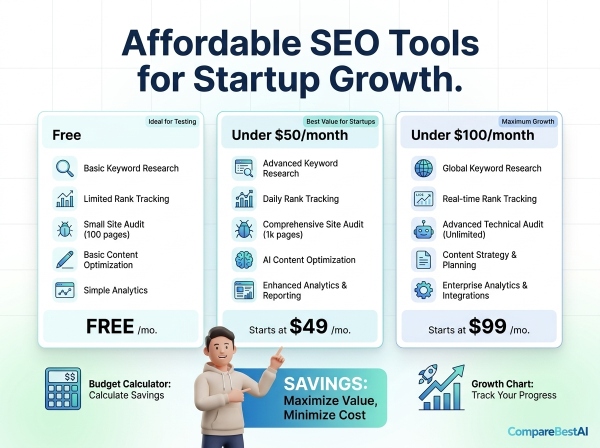
| Stage | Recommended Stack |
|---|---|
| Pre-seed | Search Console + Screaming Frog Free |
| Early seed | Search Console + Ubersuggest or Mangools |
| Content-led seed | Search Console + Mangools/Ahrefs Starter + Frase |
| Growth stage | Search Console + Ahrefs or SE Ranking + Screaming Frog |
| Dedicated SEO team | SE Ranking or premium Ahrefs/Semrush + specialist tools |
This is the key differentiation this article should own.
Startups should buy SEO tools by stage—not popularity.
The $0 Pre-Seed SEO Stack
Before product-market fit, spend as little as possible.
A strong free setup can include:
- Google Search Console.
- Google Analytics 4.
- PageSpeed Insights.
- Google Trends.
- Screaming Frog Free.
The objective at this stage is not sophisticated reporting.
It is validating:
- whether Google can crawl the site,
- whether pages are indexed,
- whether impressions are appearing,
- what topics attract demand,
- whether technical problems exist.
The Under-$50 Seed-Stage Stack
Once content production becomes regular, add one research tool.
Good options include:
- Ubersuggest.
- Mangools Basic on annual billing.
- Ahrefs Starter.
- LowFruits for specialized low-competition research.
CompareBestAI has an existing LowFruits tool profile
Internal target: /tools/lowfruits-ai
A realistic seed-stage stack might be:
Search Console + Ahrefs Starter + Screaming Frog Free
or:
Search Console + Ubersuggest + Screaming Frog Free
Avoid paying for three overlapping keyword databases.
When Should a Startup Upgrade to Semrush?
Semrush becomes more rational when SEO is already producing meaningful business value and someone uses the platform every week.
Its current SEO plan costs $139/month and includes monitoring for five websites, 500 daily tracked keywords, keyword/competitor research, Position Tracking, Site Audit and AI-search monitoring.
For a pre-revenue startup, that may be unnecessary.
For a funded startup with:
- active content production,
- multiple competitors,
- regular rank tracking,
- several website projects,
- an in-house growth marketer,
it can make sense.
Read the Semrush SEO review
Internal target: /articles/semrush-review-for-seo
Best Startup SEO Stack by Bottleneck
| Bottleneck | Tool |
|---|---|
| “We don't know what Google already shows us for” | Search Console |
| “We have technical problems” | Screaming Frog |
| “We need affordable broad SEO research” | Ubersuggest |
| “Keyword research feels too complicated” | Mangools |
| “We need competitor and backlink intelligence” | Ahrefs Starter |
| “We publish lots of content” | Frase |
| “We need structured rank + AI monitoring” | SE Ranking |
How to Choose SEO Tools Without Burning Startup Runway
Step 1: Identify the Bottleneck
Write one sentence:
“Our biggest SEO problem is ______.”
Do not subscribe until you can fill that blank.
Step 2: Use Free Data First
Start with Search Console.
Third-party data is more useful after you know what your own site is already doing.
Step 3: Buy One Research Tool
Choose one:
- Ubersuggest,
- Mangools,
- Ahrefs Starter.
Do not buy all three.
Step 4: Add a Specialist Only When Needed
Examples:
Technical problem: Screaming Frog.
Content-production bottleneck: Frase.
Low-competition keyword strategy: LowFruits.
Step 5: Compare Limits
Look beyond monthly price.
Check:
- projects,
- keyword credits,
- tracked keywords,
- crawl limits,
- exports,
- seats,
- AI prompts,
- historical data.
Step 6: Run a Real Test
Give two competing products the same job.
For example:
Find five realistic non-branded content opportunities for our domain and explain why each one is achievable.
Compare usefulness—not dashboard size.
Step 7: Measure Business Value
The final metrics are not keyword counts.
Track:
- organic clicks,
- qualified leads,
- signups,
- demos,
- trials,
- revenue,
- customer acquisition cost.
Common SEO Tool Mistakes Startups Make
Buying Enterprise Software Too Early
More features do not create more growth if nobody uses them.
Paying for Duplicate Data
Maintaining Ahrefs, Semrush, SE Ranking and multiple keyword tools simultaneously is often unnecessary for a small team.
Tracking Rankings Without Conversions
A keyword moving from position eight to four matters only if that visibility supports a business objective.
Ignoring Technical SEO
Publishing more content will not fix severe crawling, indexing or internal-linking problems.
Letting Content Scores Become Strategy
Optimization tools should support judgment, not replace product knowledge or customer understanding.
FAQs About SEO Tools for Startups
What are the best SEO tools for startups?
The strongest startup SEO stack depends on stage. Google Search Console is the essential free foundation, Screaming Frog is excellent for technical audits, Ubersuggest and Mangools are affordable research options, Ahrefs Starter adds competitor and backlink intelligence, Frase suits content-led teams, and SE Ranking fits more structured growth-stage SEO operations.
What is the best free SEO tool for a startup?
Google Search Console is the best free starting point because it provides first-party information about how a verified website performs in Google Search, including impressions, clicks, CTR, queries and indexing information.
What is the cheapest useful paid SEO tool for startups?
Ubersuggest and Ahrefs Starter both currently begin at $29/month. Mangools Basic costs $49 monthly but has a lower monthly equivalent with annual billing. The best option depends on whether you need broad research, deeper competitor data or beginner-friendly keyword workflows.
Is Ahrefs worth it for startups?
Ahrefs Starter can be worthwhile for seed-stage startups that need competitor, backlink and keyword research without paying for the full Lite plan. The Starter plan is currently $29/month, but its usage and export limits are much tighter than Lite.
Does a startup need Semrush?
Not necessarily. Semrush becomes more appropriate when SEO is a recurring growth function and its keyword, competitor, audit, rank-tracking and AI-visibility capabilities will be used consistently. Its current SEO plan starts at $139/month.
How much should a startup spend on SEO tools?
A pre-seed startup can operate with a $0 stack. Seed-stage teams can often stay around $29–$50/month by adding one research platform. Higher spending becomes easier to justify only after organic search is an active customer-acquisition channel.
Final Verdict
The best SEO stack for a startup should grow with the company.
At pre-seed:
Google Search Console + Screaming Frog Free
is enough to establish visibility, indexing and technical health.
At seed:
add Ubersuggest, Mangools or Ahrefs Starter depending on whether you need broad research, easier keyword workflows or deeper competitive intelligence.
For content-led growth:
add Frase when publishing and refreshing pages becomes a real operational bottleneck.
At growth stage:
SE Ranking, Ahrefs Lite or Semrush can make sense when a dedicated team needs more data, tracking and reporting.
The principle is simple:
Do not build a $500/month SEO stack to solve a $29/month problem.
Start free → identify the bottleneck → add one tool → measure whether it changes decisions → upgrade only when the current stack runs out of capacity.