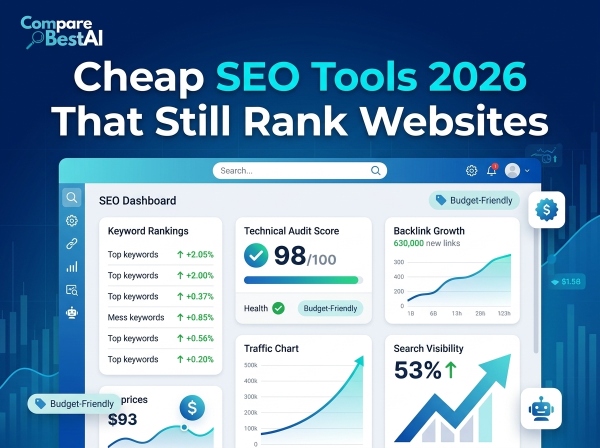

Answer First: You do not need a $100+ SEO subscription to start improving organic search performance. A practical low-cost stack can combine Google Search Console and Bing Webmaster Tools for first-party search data, Screaming Frog for technical audits, and one affordable paid platform such as KeySearch, Ubersuggest, Ahrefs Starter or SpyFu. The right choice depends on whether your biggest problem is keywords, technical SEO, competitor research, backlinks or rank tracking.
Cheap SEO software cannot rank a website by itself.
What it can do is help you make better decisions about keywords, technical problems, content, competitors, links and search performance.
For bloggers, freelancers, startups and small websites, that often means you can delay an expensive enterprise platform until your SEO program is large enough to justify it.
If your requirements are specifically small-business focused, see our separate guide to affordable SEO tools for small businesses.
Best Cheap SEO Tools in 2026 at a Glance
| Tool | Starting cost | Best for | Main limitation |
|---|---|---|---|
| Google Search Console | Free | Google clicks, impressions, queries and indexing | Your site only |
| Bing Webmaster Tools | Free | Bing SEO/GEO, crawl diagnostics and backlinks | Smaller ecosystem than Google |
| Google Analytics 4 | Free | Organic user behavior and conversions | Not a keyword research tool |
| Screaming Frog | Free | Technical SEO crawling | Free tier capped at 500 URLs |
| KeySearch | $24/mo | Budget keyword research | Smaller dataset than enterprise suites |
| Ubersuggest | $29/mo | Low-cost all-in-one SEO | Lower limits than premium suites |
| Ahrefs Starter | $29/mo | Competitors, keywords and backlinks | Credit/usage limits |
| SpyFu | From $33/mo | SEO/PPC competitor research | More competitor-focused |
| Mangools | Free + paid plans | Beginner keyword and SERP research | Lower scale than agency platforms |
Prices and plan limits can change, so verify current checkout pricing before purchasing.
What Counts as a Cheap SEO Tool in 2026?
For this guide, “cheap” means one of three things:
- Completely free
- Offers a useful permanent free tier
- Has a meaningful entry plan around $35/month or less
That matters because several platforms historically described as “affordable” have moved well beyond that price range.
For example, SE Ranking's Core plan is now $129/month on monthly billing, while Semrush's SEO plan starts around $139/month.
Those tools can still be valuable.
They simply belong in a premium upgrade section rather than a list of genuinely cheap SEO software.
1. Google Search Console — Best Free SEO Tool
Google Search Console should be the first SEO tool installed on almost every website.
Google's Performance report shows:
- clicks
- impressions
- CTR
- average position
- search queries
- pages
- countries
- devices
Google specifically notes that the report can help identify queries generating traffic and pages with weak CTR.
Best for
- finding keywords where you already appear
- monitoring organic clicks
- diagnosing indexing issues
- spotting pages with high impressions but weak CTR
- measuring changes after SEO updates
Biggest limitation
Search Console primarily tells you what is happening to your own website in Google.
It is not a deep competitor-research database.
Recommended workflow
Start by finding pages with significant impressions but weak clicks.
Then improve the title, description, intent alignment and content on those pages before purchasing another keyword tool.
2. Bing Webmaster Tools — Best Free Secondary Search Tool
Bing Webmaster Tools has become much more useful for SEO and GEO work.
Microsoft currently provides reporting, keyword research, backlink information, Site Scan, diagnostic tools and SEO/GEO features.
Best for
- Bing search visibility
- additional backlink information
- keyword research
- technical diagnostics
- URL and sitemap submission
- secondary search-engine data
Microsoft describes the platform as free and includes Site Scan for common technical SEO/GEO problems.
For a zero-cost SEO stack, use Bing Webmaster Tools alongside Search Console rather than choosing between them.
3. Google Analytics 4 — Best Free Tool for Organic User Behavior
GA4 is not an SEO keyword platform.
Its job starts after someone reaches your website.
Google's standard GA4 properties are available as a free version.
Use GA4 to measure:
- engaged sessions
- landing-page behavior
- conversions
- events
- user journeys
- organic traffic quality
The strongest workflow is:
Search Console → how users found you
plus:
GA4 → what those users did afterwards
Do not treat GA4 as a replacement for Search Console or keyword software.
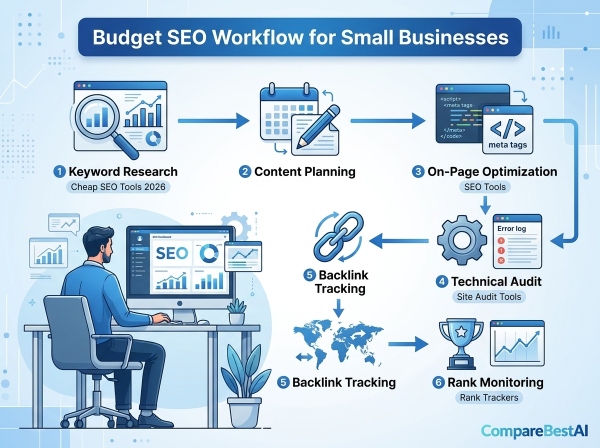
4. Screaming Frog SEO Spider — Best Cheap Technical SEO Tool
Screaming Frog is one of the strongest technical tools available without a monthly SEO subscription.
Its free version can crawl up to 500 URLs at a time.
You can use it to inspect:
- broken links
- redirects
- title tags
- meta descriptions
- canonicals
- duplicate pages
- robots directives
- hreflang
- structured data
- internal linking
For deeper audits, the paid licence removes the 500-URL restriction and adds advanced configuration, JavaScript rendering, crawl saving and integrations. Current UK pricing lists the licence at £199/year.
For a CompareBestAI product-level overview, see the Screaming Frog SEO tool profile.
Best fit
Choose Screaming Frog when your question is:
“What is technically wrong with this website?”
Do not choose it as your primary keyword-research platform.
5. KeySearch — Best SEO Suite Under $25
KeySearch is one of the clearest low-cost options in this market.
Its current Starter plan costs $24/month and includes:
- 200 keyword searches per day
- 80 tracked keywords
- 2,000 audited pages per month
- competitor analysis
- backlink analysis
- rank tracking
- SEO auditing
- AI content assistance
It also offers a 7-day free trial.
Best for
- bloggers
- niche publishers
- solo website owners
- small content teams
- keyword-driven SEO strategies
Main limitation
It does not provide the scale or data depth of premium enterprise platforms.
But that is precisely why it fits a cheap SEO tools comparison.
6. Ubersuggest — Best Budget All-in-One SEO Tool
Ubersuggest is one of the better choices when you want several SEO functions under one subscription.
Its Individual plan currently costs $29/month and supports:
- one project
- 125 tracked keywords
- 1,000 page scans
- five competitors
- keyword research
- rank tracking
- site audits
- competitor analysis
- AI-search features
Read the Ubersuggest tool profile if you want a shorter product-level overview.
Best for
- one-site businesses
- freelancers
- beginner SEOs
- content marketers
- smaller ecommerce websites
Main limitation
Usage limits are lower than Ahrefs, Semrush and larger agency-oriented platforms.
For many single-site users, that trade-off is reasonable.
7. Ahrefs Starter — Best Budget Option for Competitor Data
Ahrefs Starter currently costs $29/month.
It includes access to:
- Site Explorer
- Keywords Explorer
- Site Audit
- Rank Tracker
- SEO Toolbar
The Starter tier currently provides 200 monthly credits, one unverified project and 50 Rank Tracker keywords.
The next major Ahrefs tier, Lite, jumps to $129/month.
That makes Starter useful when you specifically want access to the Ahrefs ecosystem without paying for a full professional subscription.
See the Ahrefs review and tool profile for a deeper look at its strengths and limits.
Best for
- backlink research
- competitor pages
- competitor keywords
- keyword discovery
- small-site audits
Main limitation
Starter is intentionally restricted.
If you conduct high-volume research every day, you may outgrow the credit and report limits quickly.
8. SpyFu — Best Cheap Competitor Research Tool
SpyFu focuses heavily on competitor SEO and PPC intelligence.
Its current homepage says membership starts at $33/month.
That makes it one of the more accessible paid platforms when your biggest question is:
“What keywords and ads are my competitors already using?”
Its core use cases include:
- competitor keywords
- ranking history
- PPC research
- backlink research
- keyword tracking
- competitor-domain analysis
You can also review the SpyFu tool profile inside CompareBestAI.
Best fit
Choose SpyFu if competitor intelligence is more important than having the deepest technical crawler or content optimizer.
9. Mangools — Best Beginner-Friendly SEO Toolkit
Mangools bundles several focused SEO applications:
- KWFinder
- SERPChecker
- SERPWatcher
- LinkMiner
- SiteProfiler
Its official site currently offers a permanent free plan plus Basic, Premium and Agency paid tiers.
The platform is especially approachable for users who mainly need:
- keyword research
- SERP analysis
- rank tracking
- backlinks
- basic domain analysis
See the Mangools tool profile for additional CompareBestAI coverage.
Main limitation
Mangools is easier to use than many enterprise suites, but agencies needing very high query volume or deep technical workflows can outgrow it.
Which Cheap SEO Tool Should You Choose?
The best choice depends on the SEO problem you need to solve.
| Your problem | Start with |
|---|---|
| “I don't know which queries already show my site” | Google Search Console |
| “I need technical SEO diagnostics” | Screaming Frog |
| “I need low-cost keyword research” | KeySearch |
| “I want one affordable all-in-one platform” | Ubersuggest |
| “I need competitor/backlink research” | Ahrefs Starter |
| “I mainly research competitors” | SpyFu |
| “I want a simple beginner toolkit” | Mangools |
| “I want Bing + AI-search ecosystem data” | Bing Webmaster Tools |
| “I need conversion and behavior analysis” | GA4 |
The Best SEO Stack Under $30/Month
You do not necessarily need nine subscriptions.
A stronger budget approach is to combine complementary tools.
Option 1: $0 SEO Stack
Use:
- Google Search Console
- Bing Webmaster Tools
- GA4
- Screaming Frog Free
This gives you:
search performance + secondary search data + behavior analytics + technical crawling.
Option 2: Content SEO Stack
Use the free stack plus:
KeySearch — $24/month
This is a strong combination for bloggers and content-driven websites.

Option 3: Small Business All-in-One Stack
Use:
- Search Console
- GA4
- Ubersuggest — $29/month
- Screaming Frog Free
For small businesses that want a broader set of functions, also see our affordable SEO tools for small businesses comparison.
Option 4: Competitor Research Stack
Use:
- Search Console
- Screaming Frog Free
- Ahrefs Starter — $29/month
This combination gives you your own first-party data, technical diagnostics and stronger competitor/backlink research.
What About Semrush?
Semrush remains a major SEO platform, but it no longer fits the strict “cheap SEO tool” definition used in this article.
Its current SEO plan is listed at $139/month on monthly billing, or $117.33/month with annual billing.
That buys a broader platform including:
- keyword research
- competitor analysis
- position tracking
- site audits
- AI visibility
- content-related functionality
For teams that need those features at scale, the price may be justified.
But a beginner with a single website should not assume they need Semrush immediately.
Read our Semrush SEO review before upgrading.
What About SE Ranking?
SE Ranking also needs to be reclassified.
Its current Core plan is listed at $129/month on monthly billing, or $103.20/month on annual billing. Growth is significantly higher.
That is no longer a sub-$50 budget recommendation.
SE Ranking is better considered when you need:
- larger keyword tracking limits
- multiple projects
- SEO + GEO tracking
- agency workflows
- API/MCP access
- collaboration
In other words:
good platform ≠ cheap platform.
That distinction improves the usefulness of this guide.
Cheap SEO Tools vs Premium SEO Tools
Cheap tools are usually sufficient when:
- you manage one or a few websites
- keyword volume is modest
- audits are relatively small
- reporting requirements are simple
- you can combine several specialist tools
Premium tools become easier to justify when:
- you manage many clients
- you need large historical datasets
- you perform competitor research every day
- you need API access
- you need white-label reporting
- rank tracking involves thousands of keywords
- SEO and AI-search visibility must be monitored at scale
The objective is not to buy the most powerful tool.
It is to buy enough data to make the next good SEO decision.
Cheap SEO Tools for Bloggers
A blogger usually does not need a $100+ SEO suite.
A sensible stack is:
- Search Console for real queries and clicks
- KeySearch or Ubersuggest for new keyword discovery
- Screaming Frog for technical checks
- GA4 for traffic and conversions
Content optimization still needs human judgment.
Our guide to AI and human writing for SEO in 2026 explains why AI-assisted SEO content still benefits from expert editing, fact checking and intent analysis.
Cheap SEO Tools for Local Businesses
Local businesses often waste money buying broad SEO platforms before fixing basic search fundamentals.
Start with:
- Search Console
- Bing Webmaster Tools
- Google Business Profile
- GA4
- a small keyword tool
- a crawler
Focus on:
service pages, location relevance, reviews, local citations, internal links, structured data and conversion tracking.
You can browse more relevant platforms in the Marketing tools category.
Cheap SEO Tools for Ecommerce
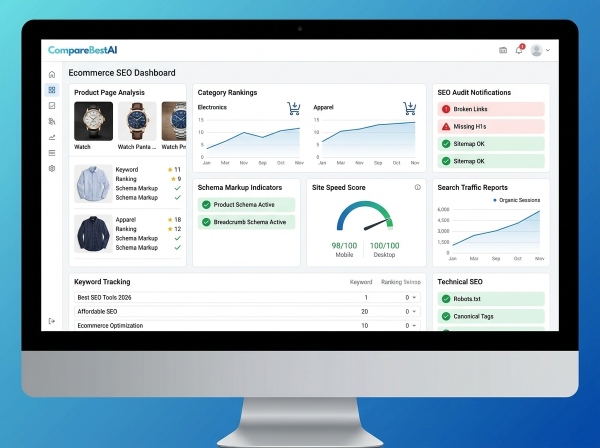
Ecommerce sites need stronger technical coverage because product and category architecture introduces:
- duplicate URLs
- faceted navigation
- canonical problems
- product schema
- internal-link depth
- discontinued products
- pagination
- page speed problems
For small stores, Screaming Frog plus Search Console can reveal a surprising amount without a large software budget.
As the site grows, a paid all-in-one platform becomes easier to justify.
What About AI SEO Tools?
AI has added new functions to SEO platforms, including:
- content briefs
- keyword clustering
- AI-search tracking
- content optimization
- FAQ ideation
- schema assistance
- competitor summarization
But AI should not replace evidence.
Use it to accelerate analysis and production, then verify:
- facts
- search intent
- pricing
- citations
- product claims
- page experience
For a deeper look at this shift, read how AI-powered marketing tools are changing SEO in 2026.
How to Choose a Cheap SEO Tool
Before paying, answer five questions.
1. What is the actual bottleneck?
If you cannot find keywords, buy keyword research.
If pages are technically broken, buy crawling/audit capacity.
If you do not know what competitors rank for, buy competitor data.
Do not buy an entire suite to solve one problem.
2. How many websites do you manage?
One website has very different software requirements from a 50-client agency.
3. How many keywords do you track?
Entry plans often become expensive only when you exceed their keyword limits.
4. Do you need backlinks?
If link building is not part of your current strategy, paying primarily for a massive backlink database may be unnecessary.
5. Will you actually use the reports?
Software value comes from decisions and implementation—not dashboards.
The cheapest unused subscription is still wasted money.
Frequently Asked Questions
What are the best cheap SEO tools in 2026?
A practical budget stack includes Google Search Console, Bing Webmaster Tools, GA4 and Screaming Frog for free, with KeySearch, Ubersuggest, Ahrefs Starter, SpyFu or Mangools added when you need deeper keyword or competitor data.
Can cheap SEO tools help a website rank?
Yes, but the tools do not create rankings themselves. They help identify keywords, technical problems, backlink opportunities, content gaps and performance changes. Rankings depend on how well you act on that information.
What is the best SEO tool under $30 per month?
KeySearch currently starts at $24/month, while Ubersuggest Individual and Ahrefs Starter are both $29/month. The better choice depends on whether you prioritize keyword research, all-in-one functionality or competitor/backlink data.
What is the best free SEO tool?
Google Search Console is the strongest starting point for Google search performance because it provides first-party query, click, impression, CTR and average-position data.
Is Screaming Frog free?
Yes. Screaming Frog's free SEO Spider can crawl up to 500 URLs in one crawl. Advanced configuration and unrestricted crawling require a paid licence.
Is Ahrefs Starter worth $29?
Ahrefs Starter gives lower-cost access to Site Explorer, Keywords Explorer, Site Audit and Rank Tracker. It can suit occasional research, but its credits and limits make it less suitable for high-volume agency work.
Is Semrush a cheap SEO tool?
Not under the budget definition used in this article. Semrush's current SEO plan starts at $139/month on monthly billing, making it better treated as a premium upgrade.
Final Verdict
Cheap SEO tools are still enough for many websites in 2026.
But the smartest budget strategy is usually not finding one cheap platform that does everything.
It is building a small stack:
first-party data + technical auditing + one focused paid research tool.
Start with Search Console, Bing Webmaster Tools, GA4 and Screaming Frog.
Then add KeySearch, Ubersuggest, Ahrefs Starter, SpyFu or Mangools only when you can identify the specific gap that the paid tool will solve.
If you eventually need larger datasets, team workflows, APIs, AI-search monitoring or agency reporting, upgrade to a more advanced platform.
The tool supplies information.