
By CompareBestAI Editorial Team
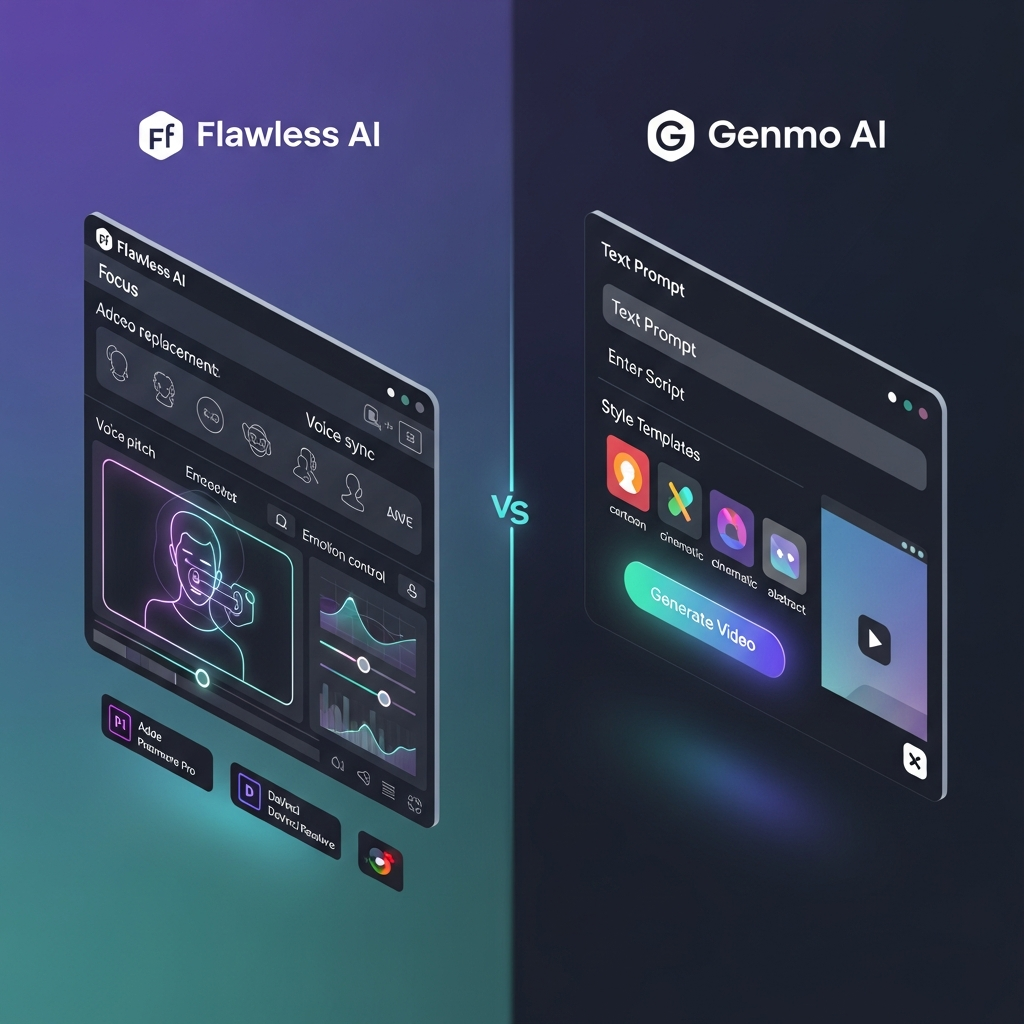
Quick Answer: Flawless AI and Genmo AI serve different video-production needs. Flawless uses DeepEditor and TrueSync to modify existing filmed performances, edit dialogue, and create visual dubs. Genmo uses its Mochi 1 text-to-video model to generate new video clips from written prompts. Flawless offers token-based and custom enterprise pricing, while Genmo provides free and paid credit-based plans.
Choosing between Flawless AI and Genmo AI requires understanding what each platform is designed to accomplish.
Both use artificial intelligence in video production, but their core technologies address different stages of the creative process.
Flawless focuses on post-production, allowing professional teams to modify dialogue and visual performances within existing footage. Genmo focuses on generative video, transforming text descriptions into new short clips.
This comparison examines their features, pricing, technical capabilities, workflows, limitations, and alternatives to help filmmakers, marketers, creative teams, and developers evaluate the two platforms.
Flawless AI vs Genmo AI: Quick Comparison
The main difference between these tools is whether the user needs to modify existing footage or generate new footage.
Feature | Flawless AI | Genmo AI |
|---|---|---|
Primary function | Performance editing and visual dubbing | Text-to-video generation |
Main products | DeepEditor and TrueSync | Mochi 1 and Genmo Playground |
Main input | Existing footage and dialogue data | Written text prompts |
Output | Modified filmed performances | Newly generated video clips |
Core audience | Film studios and post-production teams | Creators, researchers, and developers |
Video localization | TrueSync visual dubbing | Not a primary feature |
Dialogue editing | DeepEditor | Not a primary feature |
Open-source model | Not publicly offered as open weights | Mochi 1 under Apache 2.0 |
Free access | Product-specific evaluation access | Free credit plan |
Paid pricing | Tokens and custom quotes | Published monthly subscriptions |
Professional editing integration | Avid Media Composer extension | External workflows for further editing |
The appropriate platform depends on the production task rather than a single shared feature list.
A filmmaker changing an actor's dialogue is solving a different problem from a creator generating an entirely new scene.
For a wider overview of the category, explore CompareBestAI's AI video generation tools .
What Is Flawless AI?
Flawless AI is a filmmaking technology company developing tools for dialogue editing, performance refinement, and visual dubbing.
Its two principal products are DeepEditor and TrueSync.
DeepEditor enables production teams to modify an actor's visible dialogue performance within existing footage.
TrueSync focuses on visual dubbing, helping synchronize an actor's on-screen performance with dialogue in another language.
These applications are relevant to film, television, advertising, and professional post-production workflows.
Flawless AI's Main Capabilities
DeepEditor and TrueSync cover several related filmmaking tasks.
In-Vision ADR: Modify an actor's visible performance to match replacement dialogue.
Performance Transfer: Combine elements of different recorded performances within the editing process.
Performance Refinement: Adjust aspects of a performance after principal photography.
Visual Dubbing: Adapt visible dialogue performances for localization into other languages.
Professional Finishing: Prepare suitable outputs for established post-production and delivery workflows.
Flawless also supports rights-management processes through its Artistic Rights Treasury, which helps manage consent requirements associated with AI-assisted performance modifications.
These capabilities do not make Flawless a general-purpose text-to-video generator.
Its primary value proposition concerns changing filmed material rather than creating new scenes from a text prompt.
For a more detailed breakdown of its capabilities, read our Flawless AI review .
What Is Genmo AI?
Genmo AI is an artificial intelligence research company focused on video generation and world models.
Its Mochi 1 model converts text prompts into short video clips.
Instead of requiring existing filmed footage, Mochi 1 generates new visual sequences based on written descriptions.
For example, a user could describe a cinematic landscape, a moving subject, or a particular camera perspective and generate a corresponding clip.
Genmo provides access through its hosted Playground and offers the Mochi 1 model through an open-source repository.
Genmo AI's Main Capabilities
Genmo's published documentation identifies the following core functionality.
Text-to-Video Generation: Create short clips from descriptive prompts.
Motion Generation: Generate moving subjects and environments.
Prompt-Based Creative Control: Specify subjects, settings, camera angles, and motion through text.
Open-Source Access: Download and modify the released Mochi 1 model under its applicable license.
Hosted Generation: Use the Genmo Playground without setting up a local model.
Video Downloads: Export supported generated clips for further editing.
Mochi 1 is an open-source model, but using the hosted Playground is a separate service with its own credit system and subscription terms.
Users interested in the product can explore the Genmo AI profile and compare its documented capabilities.
Flawless AI vs Genmo AI: Feature Comparison
Understanding their respective features helps clarify why these platforms are not direct substitutes in every production workflow.
1. Video Creation vs. Video Modification
Genmo generates new footage.
A user provides a written description, and its video model synthesizes a clip matching the prompt.
This makes Genmo relevant to creative experimentation, concept development, and generating new visual material.
Flawless modifies existing footage.
DeepEditor begins with filmed material and additional performance or dialogue data.
The system generates visual adjustments that can be incorporated into an existing edit.
For example, Genmo could generate a short scene of a person walking through a futuristic city. DeepEditor could instead modify dialogue in a scene that a production team has already filmed.
The distinction becomes important when evaluating whether a project needs new footage or a controlled change to recorded material.
2. Lip-Sync and Visual Dubbing
Flawless provides dedicated capabilities for synchronizing visible performances with replacement dialogue.
DeepEditor supports dialogue modifications within existing footage.
TrueSync is designed for multilingual visual dubbing.
Genmo's primary publicly documented workflow focuses on text-to-video generation rather than replacing dialogue in professionally filmed scenes.
Its hosted Playground should not be presented as an equivalent to TrueSync.
For a project requiring visual localization, evaluate the relevant Flawless product and obtain a quotation based on the production's requirements.
3. Video Duration and Output
Genmo's official FAQ states that generated clips can be up to 5.4 seconds long at 30 frames per second.
Its base model produces 480p video, with higher-resolution options described for paid plans.
This means longer productions generally require generating and assembling multiple clips using additional editing software.
DeepEditor operates differently.
It processes existing shots and supports professional output formats for post-production.
Flawless's technical documentation identifies support for media up to 1,440 frames, equivalent to 60 seconds at 24 frames per second, subject to its supported media specifications.
Final-quality outputs can support resolutions up to 8192 × 8192 pixels.
These figures describe different systems and should not be interpreted as a direct image-quality benchmark.
4. Creative Control
Genmo's creative controls primarily operate through written prompts.
Users can describe lighting, subjects, environments, and camera movement.
The model interprets the prompt to generate a visual result.
However, prompt-based generation does not guarantee an exact composition or perfectly repeatable performance.
Flawless provides a more specialized editing workflow based on source footage, driving data, and visual-dub refinement.
DeepEditor includes controls for refining generated lip synchronization and reviewing the output.
Its creative process is therefore based on changing an existing performance rather than generating an entirely new one.
5. Workflow Integration
Flawless provides a DeepEditor extension for Avid Media Composer.
This allows supported editing operations to be incorporated into a professional post-production workflow.
It also supports relevant output formats for finishing and visual-effects work.
Genmo offers its hosted Playground and the option to work with Mochi 1 through open-source implementations.
Developers can explore the model through its repository or supported community workflows, including ComfyUI.
The two approaches serve different technical environments.
Studios should verify the media formats and finishing requirements of Flawless, while developers evaluating Genmo should account for model deployment and hardware requirements.
6. Commercial Usage and Rights
Flawless's Final token pricing depends on the intended commercial distribution scope.
Its workflow also includes consent-management functionality associated with performer rights.
Genmo's paid hosted plans advertise commercial usage.
Separately, the openly released Mochi 1 model uses the Apache 2.0 license.
However, an open-source model license does not automatically resolve every legal consideration associated with generated content.
Users should review the applicable product terms, source-media rights, performer permissions, and intended distribution requirements.

Flawless AI vs Genmo AI Pricing in 2026
Pricing is another substantial difference between the two platforms.
Flawless combines published DeepEditor token prices with enterprise quotations.
Genmo offers a hosted credit system with published subscription tiers.
Flawless AI Pricing
DeepEditor uses tokens to generate visual dubs, also called vubs.
Flawless defines a token as the credit needed to adjust one face in one shot.
Two quality levels are available: Draft and Final.
DeepEditor token | Published price |
|---|---|
Draft | $30 |
Final: Worldwide Advertising | $350 |
Final: Regional | $350 |
Final: Worldwide Streaming & Broadcast | $875 |
Final: Worldwide Theatrical | $2,000 |
Draft tokens are intended for offline editorial experimentation.
Final tokens are used for mastering and commercial delivery, subject to the selected distribution scope.
TrueSync pricing requires a custom enterprise quotation.
The DeepEditor price table should not be treated as a TrueSync price list.
For additional details about licensing and project costs, read our Flawless AI pricing guide .
Genmo AI Pricing
Genmo uses credits for video generation.
Its published plans include Free, Lite, and Standard.
Plan | Published monthly price | Included credits |
|---|---|---|
Free | $0 | 250 one-time credits |
Lite | $10/month | 1,200 per month |
Standard | $30/month | 5,000 per month |
The free credits are unlocked by adding a payment method, which Genmo states is not charged for the free allocation.
Free outputs include a Genmo watermark.
Paid plans provide watermark-free output and commercial usage.
Genmo also advertises annual billing discounts.
The official pricing page lists a Mochi video generation at 100 credits and a Replay video at 50 credits.
These allowances are not equivalent to unlimited video creation.
Readers investigating individual subscription tiers can review our Genmo AI pricing guide .
How Do the Costs Compare?
The tools use different billing units.
Genmo charges for hosted generation through a credit system.
Flawless charges for DeepEditor visual dubs through tokens associated with the required output quality and distribution scope.
A $10 Genmo subscription should therefore not be compared directly with a $350 Flawless Final token as if both purchase the same deliverable.
For Genmo, budget for the number of required generated clips.
For DeepEditor, estimate the number of visual dubs, necessary Draft iterations, Final outputs, and distribution rights.
For TrueSync, request a project-specific quotation.
Is Flawless AI or Genmo AI Free?
Both companies provide ways to evaluate their technology, but their access arrangements differ.
Flawless AI Trial
Flawless advertises a request-based DeepEditor evaluation offer.
The offer includes three free Draft vubs for non-commercial use, subject to the applicable account approval and trial terms.
These Draft outputs cannot be treated as licensed commercial deliverables.
Users should confirm the offer's current conditions before requesting access.
Genmo AI Free Plan
Genmo advertises a free hosted plan with 250 one-time credits.
A payment method is required to unlock those credits.
Free outputs include a watermark, and additional usage is subject to the applicable plan or credit requirements.
Mochi 1 is also available as an open-source model.
Running it independently avoids Genmo's hosted credit system, but requires suitable computing resources and technical setup.
Flawless AI vs Genmo AI: Real-World Use Cases
A useful comparison should start with the production task rather than the product category alone.
Use Case 1: Changing Dialogue in an Existing Film
Consider a production team that has completed filming but needs to replace a line of dialogue.
The actor's face is visible in the original shot, making a conventional audio replacement potentially noticeable.
DeepEditor provides a workflow for adjusting the visible performance to match replacement dialogue.
Genmo's text-to-video workflow does not provide an equivalent documented method for changing the performance within the existing shot.
Use Case 2: Generating Concept Footage
Consider a creative team developing visual ideas for a proposed advertisement.
The team wants short clips showing imaginary locations, moving subjects, and alternative visual treatments.
Genmo's text-to-video system can generate material from written descriptions.
Flawless's core products are not designed to replace that prompt-based generation workflow.
Use Case 3: Localizing a Film
A studio preparing a film for distribution in multiple languages may need localized dialogue and synchronized visible performances.
TrueSync addresses visual dubbing for this type of professional production.
Genmo's published Playground features do not establish an equivalent end-to-end localization process.
The studio should also account for translation, voice performances, editorial review, and commercial rights.
Use Case 4: Researching an Open-Source Video Model
A developer wants to experiment with generative video, inspect model components, or adapt an available implementation.
Mochi 1 provides an open-source model under the Apache 2.0 license.
The developer must still account for computing requirements, dependencies, and the applicable licensing terms.
Flawless does not publicly offer an equivalent downloadable open-weight filmmaking model.
Use Case 5: Preparing Commercial Marketing Videos
A marketing team may need different tools at different production stages.
Genmo can be used to generate new short visual clips.
Flawless may be relevant if the team needs to modify performances within existing filmed promotional material.
Neither should automatically be assumed to provide every component of a complete advertising production workflow.
Audio, editing, delivery formatting, and approval processes may require additional software and services.
Flawless AI and Genmo AI: Limitations
Each platform has constraints that should be considered during purchasing research.
Flawless AI Limitations
DeepEditor requires existing media and appropriate driving data.
Its production workflow is more specialized than a simple prompt-based generator.
Commercial Final token costs vary according to distribution rights.
TrueSync requires direct pricing enquiries.
Teams also need to consider source-media compatibility, editorial review, and applicable performer rights.
Genmo AI Limitations
The hosted Playground is primarily oriented toward short video generation.
Its documented clip-duration limit is 5.4 seconds.
The current official FAQ identifies image-to-video as a forthcoming capability rather than a generally available feature.
Mochi 1's base model produces 480p output.
Generating clips does not automatically provide a complete edited production with voiceover, captions, and synchronized dialogue.
Using the open-source model independently also requires technical resources.
These limitations should be evaluated in relation to the actual project rather than interpreted as interchangeable product weaknesses.
What Are the Alternatives to Flawless AI and Genmo AI?Several other AI video platforms address adjacent use cases.
Runway
Runway provides generative video tools for creating and transforming visual content.
Users investigating prompt-based video generation can compare its capabilities with Genmo.
Those researching existing-footage workflows can separately evaluate how its features differ from Flawless.
Our Flawless AI vs Runway comparison examines the product categories in greater detail.
Pika
Pika is another platform focused on creative AI video generation.
It can be relevant to users exploring short-form generated content and visual effects.
For more context, review our Flawless AI vs Pika comparison .
Other Genmo Alternatives
Other generative video platforms may provide different generation models, output lengths, creative controls, or pricing structures.
Readers can explore our Genmo AI alternatives guide to investigate additional options.
The important consideration is whether an alternative addresses text-to-video generation, visual dubbing, editing, or another specific requirement.
How to Evaluate Flawless AI vs Genmo AI Before Purchasing
Before selecting a subscription or requesting an enterprise quotation, document the production requirements.
Identify the Source Material
Determine whether the project starts with existing footage or requires the generation of entirely new clips.
This establishes which underlying workflow needs to be evaluated.
Define the Intended Output
Specify whether the deliverable is a dialogue-adjusted scene, localized film, short generated clip, or another type of video.
Consider runtime, resolution, file formats, and delivery requirements.
Calculate the Relevant Cost
For Flawless, estimate token consumption and distribution scope.
For Genmo, estimate the number of video generations and the associated credits.
Account for additional production work that the chosen platform does not provide.
Check Rights and Permissions
Verify applicable commercial usage conditions, source-material rights, and performer permissions.
A published software license does not necessarily establish permission to use every asset or likeness in a project.
Evaluate Actual Results
Use representative project material during any available trial or evaluation.
For Flawless, review synchronization, visual consistency, and compatibility with the production pipeline.
For Genmo, review prompt adherence, motion consistency, output length, and the suitability of generated clips.
Do not treat promotional examples or unverified user ratings as independent performance benchmarks.
Flawless AI vs Genmo AI: Which Workflow Fits Your Needs?
The purchasing decision depends primarily on the intended production process.
Flawless offers tools for making dialogue and performance adjustments to existing footage, along with visual dubbing for localization.
Genmo provides text-to-video generation through a hosted service and an openly released video model.
These capabilities may also be used at different stages of a broader creative project.
A production team could generate concept visuals using one platform while using a separate post-production tool to modify filmed material.
Before purchasing, compare the required inputs, outputs, licensing conditions, workflow integration, and complete production cost.
For detailed product information, explore the Flawless AI profile and review Genmo AI's features .
How We Compared Flawless AI and Genmo AI
This comparison uses the vendors' publicly available product documentation, published pricing information, technical specifications, and licensing descriptions.
The analysis focuses on product purpose, core functionality, supported workflows, pricing structure, technical requirements, and documented limitations.
The comparison does not rely on an independently conducted hands-on benchmark, private customer data, or an enterprise quotation.
Published prices and product capabilities may change. Users should confirm current terms with the relevant vendor before purchasing.
Frequently Asked Questions About Flawless AI vs Genmo AI
1. What is the main difference between Flawless AI and Genmo AI?
Flawless AI focuses on modifying existing filmed performances, editing dialogue, and visual dubbing. Genmo AI focuses on generating new video clips from text prompts through its Mochi 1 model.
2. How much does Flawless AI cost compared with Genmo AI?
DeepEditor Draft tokens cost $30, while Final tokens cost $350–$2,000. TrueSync requires a custom quote. Genmo offers a free plan, a $10/month Lite plan, and a $30/month Standard plan.
3. Can Genmo AI replace Flawless AI for visual dubbing?
Genmo's main publicly documented workflow is text-to-video generation. It does not offer an equivalent documented replacement for Flawless's professional DeepEditor and TrueSync visual-dubbing workflows.
4. Is Genmo AI open source?
Yes. Genmo released Mochi 1 under the Apache 2.0 license. Users can access its openly available model and implementation, subject to the license and their own computing requirements.
5. Does Flawless AI generate videos from text prompts?
Flawless's principal products focus on modifying existing filmed performances and visual dubbing rather than general-purpose text-to-video generation. Genmo provides a dedicated prompt-based video generation workflow.
6. Can Flawless AI and Genmo AI be used commercially?
Flawless's Final tokens have distribution-specific licensing. Genmo advertises commercial usage on paid hosted plans, while Mochi 1 is released under Apache 2.0. Users should verify the applicable rights and product terms before commercial distribution.
Final Thoughts
Flawless AI and Genmo AI represent different approaches to AI-assisted video production.
Flawless focuses on performance modifications, dialogue editing, and localization within existing footage. Genmo focuses on generating new short video clips from written prompts.
Their pricing models also reflect these differences.
Flawless uses output- and distribution-based DeepEditor token pricing alongside custom TrueSync quotations. Genmo offers hosted subscriptions and an openly released video model.
The appropriate evaluation should begin with the intended output and production workflow, followed by a comparison of technical requirements, licensing, and total cost.
For current product information, visit the official Flawless AI website or the official Genmo AI website .
Editorial disclosure: CompareBestAI may earn a commission through qualifying partner links. This article is for informational purposes. Pricing and product features may change.