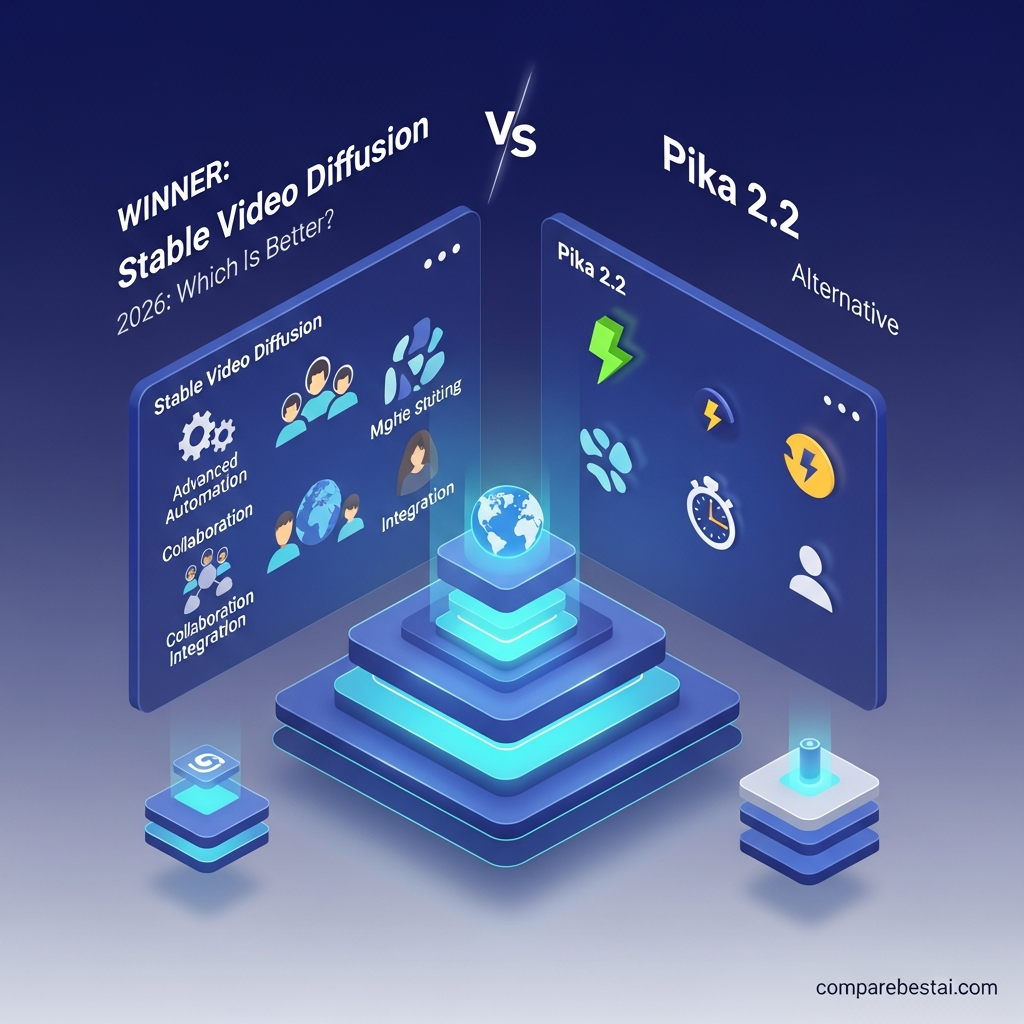

Quick verdict: Pika 2.2 is the better choice for most non-technical creators who want to generate short AI videos through a simple hosted interface. Stable Video Diffusion is better suited to developers, researchers, and organizations that want to self-host an AI video model, customize the workflow, or keep more control over infrastructure and data.
The biggest difference is that these are not directly equivalent products. Pika is a hosted AI video creation platform. Stable Video Diffusion is a Stability AI video model that is now primarily deployed through self-hosting after its hosted API was deprecated in July 2025.
There is also an important 2026 update: Pika 2.2 is no longer Pika's newest model. Pika's current website promotes Pika 2.5, so anyone choosing a platform today should consider the newer Pika version as well.
Get the Full Comparison Guide →
Try Stable Video Diffusion now
Stable Video Diffusion vs Pika 2.2 at a Glance
| Category | Stable Video Diffusion | Pika 2.2 |
|---|---|---|
| Product type | Self-hostable generative video model | Hosted AI video platform |
| Best for | Developers, researchers, technical teams | Creators, marketers, social video users |
| Setup | Technical | Beginner-friendly |
| Image-to-video | Yes | Yes |
| Text-to-video | Available within the broader SVD model family | Yes |
| Local/self-hosted use | Yes | No conventional local deployment |
| Hosted web interface | Not the main current access method | Yes |
| API | Official SVD hosted API deprecated | Pika offers API access for selected/current use cases |
| Customization | Strong for technical users | Primarily platform-level controls |
| Current-model status | Still available as a Stability AI Core Model | Pika 2.2 has been superseded by Pika 2.5 |
| Pricing model | Licensing and infrastructure costs | Credit-based subscriptions |
| Best overall for beginners | No | Yes |
| Best overall for self-hosting | Yes | No |
The right choice therefore depends less on which model has the longer feature list and more on how you intend to generate video.
Important 2026 Update Before Comparing Them
Stable Video Diffusion was originally released by Stability AI as a generative video foundation model. Stability AI made model weights and code available for local use and later offered Stable Video Diffusion through its developer API.
That hosted API is no longer available. Stability AI states that the Stable Video Diffusion API was officially deprecated on July 24, 2025 and now directs users who still want to use SVD toward self-hosting. Stable Video Diffusion remains among Stability AI's listed Core Models.
Pika followed a different path. It was designed around a hosted creative experience and has continued releasing new generations of its video models. Its website currently centers on Pika 2.5 rather than Pika 2.2.
That distinction matters because a search for Stable Video Diffusion vs Pika 2.2 is now partly a comparison between a self-hosted model ecosystem and an earlier version of a continuously updated commercial platform.
Try Stable Video Diffusion now
Get Stable Video Diffusion (official partner)
What Is Stable Video Diffusion?
Stable Video Diffusion, often abbreviated as SVD, is Stability AI's generative video model based on the Stable Diffusion family.
The original model was designed for generating short video sequences and can be deployed using downloadable model weights and reference code. Stability AI's model documentation lists variants that generate 14 or 25 frames, while the SVD 1.1 model card describes a 25-frame image-to-video model operating at 1024 × 576 resolution.
Stable Video Diffusion is therefore most relevant to users who want access to the underlying model rather than simply a browser-based video creation service.
Where Stable Video Diffusion Is Strong
Its main advantage is control.
Developers can deploy the model within their own environment, build custom generation pipelines around it, integrate it into internal applications, and adjust aspects of inference that would normally be hidden inside a hosted consumer product.
Self-hosting can also be attractive when an organization wants greater control over where data is processed.
The trade-off is that users are responsible for the technical environment, model deployment, compute resources, updates, and much of the surrounding workflow.

What Is Pika 2.2?
Pika 2.2 is a generation of Pika's hosted AI video platform aimed primarily at creators rather than ML engineers.
Pika's own documentation describes Pika 2.2 as supporting text-to-video, image-to-video, Pikascenes and Pikaframes workflows. Pikaframes allows creators to provide beginning and ending frames and generate movement between them. Standard Pika 2.2 generations can run for 5 or 10 seconds, while the company's FAQ says Pikaframes can extend further.
Pika 2.2 can generate in 720p or 1080p depending on the generation type and credit usage.
Its biggest advantage over Stable Video Diffusion is accessibility. Users do not need to download model weights, configure GPU environments, install libraries, or manage inference infrastructure.
Video Generation and Creative Control
For everyday creation, Pika has the easier workflow.
A user can open the service, supply a prompt or image, select available generation options, and create a clip without handling the underlying AI model.
Pika also provides creator-oriented tools that go beyond basic prompt-to-video generation. Its platform has included features such as Pikaframes, Pikascenes, Pikaffects, Pikaswaps, Pikadditions and Pikatwists across different model generations.
Stable Video Diffusion takes the opposite approach.
Instead of offering a polished social-video workflow, it gives technical users much greater freedom to build their own workflow around the model.
That can be valuable for research, custom applications, experimentation, internal AI tools, or businesses with engineering resources. It is much less convenient for someone who simply wants to generate several social clips in a browser.
Winner for creator workflow: Pika
Winner for model-level control: Stable Video Diffusion
Ease of Use
There is a clear winner here.
Pika is designed for people who may have little or no machine-learning experience. Generation takes place through a hosted interface, and the platform handles the infrastructure.
Stable Video Diffusion requires substantially more technical knowledge. Stability AI currently instructs users to download model weights, obtain its reference implementation, configure the environment and run the model locally or within their own infrastructure.
That makes SVD considerably more flexible, but it also increases setup and maintenance requirements.
Choose Pika if ease of use matters more than infrastructure control.
Choose Stable Video Diffusion if you have technical resources and want more control over how the model is deployed.
Stable Video Diffusion vs Pika 2.2 Pricing
Pricing is one of the areas where older comparisons can easily become misleading.
Stable Video Diffusion Cost
Stable Video Diffusion does not currently have a conventional Basic, Pro, or Enterprise monthly SaaS subscription.
Stability AI instead provides licensing for self-hosted Core Models.
Its current licensing page says the Community license is free for researchers, developers, creators and businesses below $1 million in annual revenue. Organizations exceeding that threshold for commercial use may need an Enterprise license with custom pricing.
The model itself is only part of the total cost, however. Self-hosted users must also account for GPU hardware or cloud compute, deployment work, storage, maintenance and engineering time.
This makes a simple "$0 versus $X per month" comparison misleading.
Pika Pricing
Pika uses a subscription and credit model.
As of August 2026, Pika's pricing page shows four plans when yearly billing is selected:
| Plan | Price shown | Monthly video credits |
|---|---|---|
| Basic | $0 | 80 |
| Standard | $8/month | 700 |
| Pro | $28/month | 2,300 |
| Fancy | $76/month | 6,000 |
These are current Pika platform prices rather than dedicated Pika 2.2 plans. The current plans provide access to newer Pika models, including Pika 2.5.
This distinction is important when reading older Pika 2.2 comparisons.
Winner for predictable no-code pricing: Pika
Winner for organizations that already have infrastructure and qualify for community licensing: potentially Stable Video Diffusion
Try Stable Video Diffusion now See Stable Video Diffusion Pricing Details
Commercial Use and Licensing
Commercial rights are another major difference.
Stability AI currently includes Stable Video Diffusion variants among its Core Models. Its Community license permits qualifying commercial use for individuals and organizations below the company's stated annual-revenue threshold, while larger commercial organizations may need an Enterprise agreement. Users should review the current Stability AI license before deploying the model commercially.
Pika handles commercial rights through its platform plans. Pika's FAQ states that content made under Pro or Fancy subscriptions may be used commercially, while Basic and Standard have different restrictions.
For business use, licensing should therefore be checked before choosing either option.
Performance and Output Quality
There is no reliable single benchmark that allows us to declare one universal quality winner across every type of prompt.
The tools were designed for different environments.
Stable Video Diffusion gives technical users access to an underlying generative model and greater ability to control the surrounding inference pipeline.
Pika emphasizes finished creator workflows, fast experimentation and visually engaging short-form content.
For social content, concept videos and rapid creative iterations, Pika's workflow is usually more practical.
For researchers or developers evaluating model behavior, building custom applications, or experimenting with self-hosted video generation, SVD can be more useful even if the workflow requires significantly more effort.
Avoid choosing either tool based solely on broad claims such as "cinematic quality" or "enterprise quality." Test the types of scenes you actually intend to generate.
Stable Video Diffusion vs Pika 2.2 for Developers
Stable Video Diffusion is the more natural choice for developers who specifically need control over model deployment.
Stability AI provides downloadable weights and reference implementation resources, and Hugging Face's Diffusers documentation supports Stable Video Diffusion pipelines.
That makes it possible to incorporate SVD into custom pipelines rather than being limited to a hosted user interface.
Pika does provide API capabilities, but its core user experience remains a managed platform. The choice therefore depends on whether you want to consume a service or operate a model.
Stable Video Diffusion vs Pika for Content Creators
For most content creators, Pika is the easier recommendation.
It eliminates model deployment and gives users a purpose-built environment for generating and manipulating short videos.
Features such as image-to-video, text-to-video, Pikaframes and Pika's effects-oriented tools make it more suitable for social posts, concept videos, creative experiments and short marketing assets.
Creators who do not have ML engineering experience are unlikely to gain much from Stable Video Diffusion's self-hosting flexibility.
Who Should Choose Stable Video Diffusion?
Stable Video Diffusion makes the most sense for developers, AI researchers, technical teams and organizations that specifically want self-hosted deployment.
It may also appeal to businesses that want greater infrastructure control or need to build the model into their own application.
It is less suitable for users looking for a polished browser-based editor, immediate creative templates, built-in project management, or a conventional SaaS subscription.
Who Should Choose Pika?
Pika is the better option for creators, marketers, freelancers, educators and teams that want to start generating AI video without setting up AI infrastructure.
It is especially appropriate when speed of experimentation and ease of access matter more than owning or modifying the underlying model.
Anyone evaluating Pika today should also compare Pika 2.5 rather than assuming Pika 2.2 represents the platform's current capabilities.
Alternatives Worth Comparing
Neither option is automatically the best AI video generator for every use case.
Users who want a fully managed professional video platform may also want to compare current offerings from Runway, Kling, Google Veo and other actively developed video platforms.
Developers interested in open or self-hosted video models should compare SVD against newer downloadable video-generation models rather than treating a 2023-era architecture as the only open alternative.
The important point is to compare like with like: hosted creator platforms should generally be evaluated against other hosted products, while self-hosted foundation models should be evaluated on deployment requirements, licensing, hardware needs and customization.
Methodology
For this comparison, we reviewed current documentation from Stability AI and Pika and focused on five factors: access, generation capabilities, ease of use, pricing and licensing.
Stable Video Diffusion access and licensing were checked against Stability AI's current Stable Video, Core Models, licensing and knowledge-base documentation. Pika capabilities and pricing were checked against Pika's current website, pricing page and FAQ.
Because AI video products change frequently, pricing and model availability should always be verified on the provider's official website before making a purchase or deployment decision.
FAQ
Is Stable Video Diffusion better than Pika 2.2?
It depends on your use case. Stable Video Diffusion is better for developers and technical teams that need self-hosting and model-level flexibility. Pika 2.2 is easier for creators who want a hosted, no-code video-generation workflow.
Is Stable Video Diffusion still available in 2026?
Yes. Stable Video Diffusion remains available for self-hosted use. However, Stability AI deprecated its hosted Stable Video Diffusion API on July 24, 2025.
Is Pika 2.2 still the latest version of Pika?
No. Pika's current website promotes Pika 2.5. Pika 2.2 remains relevant when comparing older capabilities or researching previous Pika generations.
Does Stable Video Diffusion have a monthly subscription?
Not as a conventional hosted SaaS product. Stability AI currently positions Stable Video Diffusion for self-hosted deployment under its licensing framework. Community use can be free for qualifying users, while larger commercial organizations may require an Enterprise license.
Which is easier to use, Stable Video Diffusion or Pika?
Pika is significantly easier for non-technical users because the generation infrastructure is handled by the platform. Stable Video Diffusion requires a more technical self-hosted setup.
Final Verdict: Stable Video Diffusion vs Pika 2.2
For most creators, Pika is the more practical choice. It provides a hosted interface, creator-focused video tools and straightforward credit-based access without requiring users to deploy their own AI infrastructure.
For developers, researchers and technically capable organizations, Stable Video Diffusion remains useful when self-hosting and customization matter more than convenience.
The most important conclusion in 2026 is that this is no longer a simple competition between two equivalent AI-video SaaS products. Stable Video Diffusion is primarily a self-hostable model, while Pika is an actively developed commercial creation platform whose current generation has already moved beyond Pika 2.2.
If you're choosing a tool today rather than researching older models, compare Stable Video Diffusion with Pika 2.5 and other current AI video generators before making your final decision.
Buy Stable Video Diffusion (official site) →
Review Stable Video Diffusion Plans
Get the Full Buyers Toolkit Now
Found this guide useful? Share it with your team.