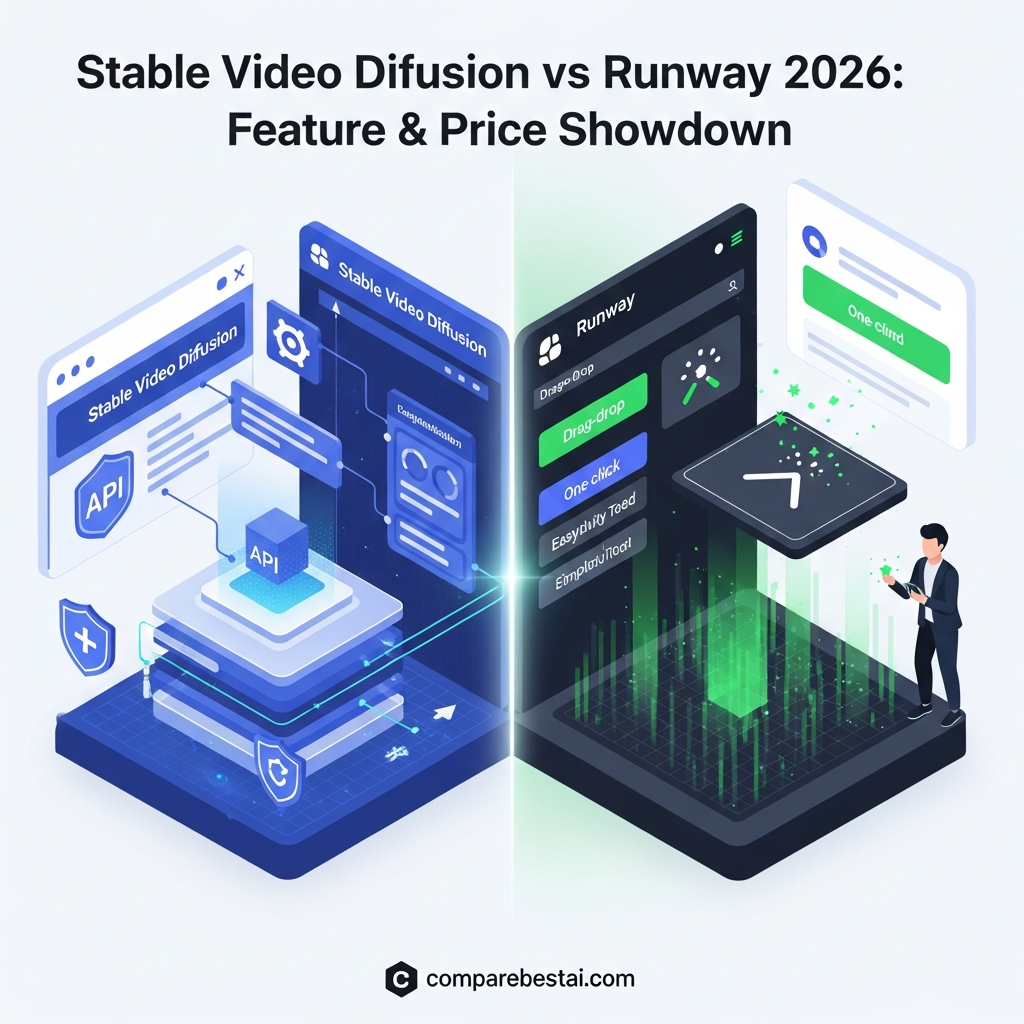

Quick Answer: Runway is the better option for most creators, filmmakers, marketers, agencies and production teams in 2026. It provides a hosted AI video platform with current generation models, editing tools, team features and subscription plans that let users start creating without managing their own infrastructure.
Stable Video Diffusion is the better fit for developers and technical organizations that specifically want to self-host a generative video model and control the underlying deployment.
The distinction matters because these are no longer directly equivalent products. Stability AI deprecated the hosted Stable Video Diffusion API on July 24, 2025 and now directs users toward self-hosting. Runway, meanwhile, continues to operate as an actively developed cloud-based creative platform.
Unlock the full breakdown & get pricing alerts →
Try Stable Video Diffusion (affiliate)
Stable Video Diffusion vs Runway at a Glance
| Category | Stable Video Diffusion | Runway |
|---|---|---|
| Product type | Self-hosted video generation model | Hosted AI creative platform |
| Best for | Developers, researchers, self-hosted AI workflows | Creators, filmmakers, agencies and teams |
| Current access | Self-hosted | Web platform and developer services |
| Current main video model | SVD / SVD 1.1 | Gen-4.5 |
| Image-to-video | Yes | Yes |
| Text-to-video | Limited depending on SVD implementation/model | Yes |
| Video editing tools | Build your own workflow | Built into Runway ecosystem |
| Setup | Technical | Beginner-friendly |
| Self-hosting | Yes | Not the standard creative-platform model |
| Hosted SVD API | Deprecated | Runway developer options available |
| Team workspace | Not native to the SVD model | Yes |
| Free access | Community licensing may be free | Free plan with 125 one-time credits |
| Paid pricing | Licensing + infrastructure costs | Standard, Pro, Max and Enterprise |
| Best for beginners | No | Yes |
| Best for model-level deployment control | Yes | No |
Bottom line: choose Runway when you want to make videos. Choose Stable Video Diffusion when you specifically want to operate and customize a video model yourself.
See live pricing & workflow demos →
Try Stable Video Diffusion (affiliate)
Get advanced tutorials by email →
What Is Stable Video Diffusion?
Stable Video Diffusion, usually shortened to SVD, is a generative video model developed by Stability AI.
Rather than operating primarily as a browser-based creative application, SVD can be downloaded and deployed within your own infrastructure.
The Stable Video Diffusion 1.1 model is an image-to-video model. Stability AI's official model documentation describes it as generating 25 frames at 1024×576 from a still image.
That gives technical users control over deployment and integration, but it also means SVD requires considerably more technical work than a hosted platform.
In July 2025, Stability AI discontinued the hosted Stable Video Diffusion API. Users who still want to work with SVD are now directed toward self-hosting the model.
Stable Video Diffusion is best for:
Developers building custom AI video applications
Researchers experimenting with generative video models
Organizations requiring self-hosted deployment
Technical teams that want control over infrastructure
Developers building their own inference or automation pipelines
It is much less suitable for a marketer or creator who simply wants to sign in, enter a prompt and generate a finished video.
What Is Runway?
Runway is a cloud-based generative AI platform built for video, image, audio and creative production workflows.
Its current video-generation lineup includes Gen-4.5, which supports both text-to-video and image-to-video.
Unlike Stable Video Diffusion, Runway handles the infrastructure behind the scenes. Users work through a hosted interface rather than downloading and deploying model weights themselves.
That difference makes Runway much easier to use for creators, filmmakers, advertising teams and agencies.
Runway also goes beyond basic generation. Its platform combines generative models with creative tools, asset storage, projects, workspaces, upscaling and enterprise collaboration features.
Runway is best for:
Filmmakers and visual creators
Advertising and marketing teams
Creative agencies
Social video production
Concept development
Storyboarding and previsualization
Businesses that want hosted AI video tools
Teams that need collaboration and administrative controls

A direct quality comparison is difficult because Stable Video Diffusion and Runway represent different generations and approaches to AI video.
Stable Video Diffusion 1.1 was designed to generate short clips from a conditioning image. Its official model card states that it generates 25 frames at 1024×576.
It also has important limitations.
Stability AI's model documentation notes that videos are short, photorealism is not perfect, motion can sometimes be limited, text rendering is unreliable and faces or people may not always be generated correctly.
Runway's current Gen-4.5 model is considerably newer.
Gen-4.5 supports both text-to-video and image-to-video generation. Runway says it is designed to improve motion quality, visual fidelity and prompt adherence while handling more detailed instructions involving camera movement, scene composition and sequencing.
Gen-4.5 supports clips from 2 to 10 seconds.
Its base video output is 720p, while Runway's paid plans include upscaling capabilities. That distinction is worth noting: upscaled 4K is not the same as native 4K model generation.
Winner for current generative video capabilities: Runway
For someone selecting an AI video tool in 2026, Runway offers the more modern and complete generation experience.
Stable Video Diffusion remains useful when access to the model itself is more important than having the newest hosted generation system.
Ease of Use
Runway wins this category decisively.
A Runway user can create an account, select a model, enter a prompt or upload an image and begin generating.
There is no need to configure a Python environment, download model weights, manage CUDA dependencies or provision GPU infrastructure.
Stable Video Diffusion works differently.
Stability AI's current guidance instructs users to review licensing, download the model weights, obtain the reference implementation, configure the environment and run the sampling code locally.
For developers, that flexibility may be a benefit.
For most creators, it is additional work.
Choose Runway if:
You want the shortest route from an idea to a generated clip.
Choose Stable Video Diffusion if:
You are comfortable managing AI infrastructure and specifically want control over the model deployment.
Stable Video Diffusion vs Runway Pricing
The pricing comparison is also very different from a normal SaaS-versus-SaaS comparison.
Stable Video Diffusion Pricing
Stable Video Diffusion does not currently have a conventional $49-per-month subscription.
It falls under Stability AI's licensing structure for self-hosted Core Models.
Under Stability AI's current Community license, qualifying researchers, developers, creators and businesses with less than $1 million in annual revenue can use eligible Core Models without paying a Stability AI license fee.
Businesses above that commercial revenue threshold may need an Enterprise license with custom pricing.
There can still be significant costs.
Self-hosting requires your own hardware or cloud infrastructure, GPU compute, storage, engineering work and ongoing maintenance.
For that reason, “free model” does not automatically mean “free production.”
Runway Pricing
Runway offers a Free plan plus Standard, Pro, Max and Enterprise options.
At the time of this update, annual billing shows:
| Plan | Price | Included credits |
|---|---|---|
| Free | $0 | 125 one-time credits |
| Standard | $12/month | 625/month |
| Pro | $28/month | 2,250/month |
| Max | $76/month | 9,500/month |
| Enterprise | Custom | Custom |
Without the annual discount, Runway lists Standard at $15 per month, Pro at $35 and Max at $95.
Runway's plans are credit based, so actual generation volume depends on the model being used.
For example, Gen-4.5 uses 12 credits per second.
That means the subscription price should not be evaluated without considering how heavily you intend to generate and iterate.
Pricing winner
For predictable hosted access: Runway.
For technical teams that already have infrastructure and qualify for Community licensing: Stable Video Diffusion can potentially be economical.
The two cost structures are fundamentally different.
See updated pricing & get ROI calculators for Stable Video Diffusion →
Try Stable Video Diffusion (affiliate)
Get instant quote & pricing breakdown →
Self-Hosting, API and Integrations
This category is where Stable Video Diffusion still has a clear reason to exist.
Stable Video Diffusion
SVD can be deployed in your own environment.
That gives developers considerable flexibility over:
Infrastructure
Inference settings
Application logic
Data handling
Custom interfaces
Pipeline design
Integration with other development tools
However, one outdated claim should be removed from older comparisons: the official hosted Stable Video Diffusion API is no longer available.
It was deprecated in July 2025.
If you want to expose SVD through an API now, your team would generally need to deploy the model and create the service layer around it.
Runway
Runway takes the managed-platform approach.
Its creative interface handles model access and generation without making users manage infrastructure.
Runway also has developer offerings for teams building applications around generative media, but its main advantage for ordinary users is still that the infrastructure is managed for them.
Winner for self-hosting: Stable Video Diffusion
Winner for managed access: Runway
Commercial Use and Licensing
Licensing deserves careful attention because the two tools use different models.
Stable Video Diffusion commercial use
Stability AI currently includes Stable Video Diffusion variants among its Core Models.
Its Community license allows qualifying users and businesses below its stated annual-revenue threshold to use eligible models commercially without a licensing fee.
Larger commercial organizations may need an Enterprise license.
Organizations should always review the latest Stability AI license and Acceptable Use Policy before deploying the model commercially.
Runway commercial use
Runway states that users retain their rights to the content they upload and generate on the platform.
Runway also says its generated content can be used for commercial purposes, including advertising, monetized video and social media.
Users should still ensure that their inputs, references and final outputs do not infringe third-party rights.
Winner
There is no universal winner here.
SVD offers an attractive licensing model for qualifying self-hosted users.
Runway provides simpler commercial usage for creators who want a hosted service.
Team and Enterprise Features
This is another area where the old comparison needs to be reversed.
Stable Video Diffusion itself is not a collaborative workspace product.
If your organization self-hosts SVD, you can build collaboration, authentication, workflow orchestration and access controls around it, but those features are not native SVD product capabilities.
Runway actually provides built-in team and Enterprise functionality.
Its current Enterprise offering includes features such as:
Single sign-on
Workspace analytics
Configurable teamspaces
Enterprise onboarding
Priority support
Custom team sizes
Custom credit packages
Runway also provides different workspace roles and administrative permissions.
Winner for out-of-the-box team features: Runway
Winner for organizations building a completely custom environment: Stable Video Diffusion
The second option requires considerably more engineering effort.
Runway Pros and Cons
Pros
Easy hosted interface
Current AI video models
Text-to-video and image-to-video
Strong creative workflow
Multiple generation models
Team and Enterprise features
Free entry option
Built-in asset and project management
Commercial usage rights
4K upscaling on paid plans
Cons
Credit usage can become expensive
Heavy experimentation consumes credits quickly
Cloud-based rather than self-hosted
Generation length remains limited
The newest models may require higher plans or more credits
Base Gen-4.5 output is currently 720p
Stable Video Diffusion Pros and Cons
Pros
Self-hosted deployment
Access to model weights
Strong developer flexibility
Can be integrated into custom applications
Community licensing may be free for qualifying users
Greater infrastructure control
Useful for research and experimentation
Cons
Requires technical setup
Hosted SVD API has been discontinued
Older model generation compared with current commercial platforms
SVD 1.1 focuses on short image-to-video generation
No native creative workspace
No native team collaboration platform
Infrastructure and GPU costs are your responsibility
Model card documents limitations with faces, motion and text rendering
Who Should Choose Stable Video Diffusion?
Choose Stable Video Diffusion if you are a developer, researcher or technical organization and self-hosting is a real requirement.
It makes sense when your priorities include:
Keeping inference in your own environment
Building custom AI applications
Experimenting with model pipelines
Controlling infrastructure
Avoiding dependency on a hosted creative interface
Researching generative video technology
Do not choose it because you expect a polished enterprise video-production SaaS platform.
That is not what SVD currently is.
Who Should Choose Runway?
Runway is the better choice for most people searching for an AI video generator in 2026.
It is particularly suitable for:
Filmmakers
Video editors
Creative agencies
Advertising teams
Marketing departments
Social creators
Designers
Production teams
Businesses experimenting with generative video
It requires far less setup and provides a much more complete creative environment.
For teams comparing tools based on actual production rather than model research, Runway is usually the more practical choice.
Stable Video Diffusion vs Runway for Developers
Developers face a more nuanced decision.
If you want the underlying model and need to run it yourself, Stable Video Diffusion has the advantage.
You can download model weights, configure your environment and build your own application or inference pipeline.
If you instead want to integrate modern generative video without operating GPU infrastructure yourself, a managed developer platform may be easier.
The important question is therefore not simply:
“Which model has more features?”
Ask:
“Do I want to operate the model myself or consume video generation as a managed service?”
That decision often determines the winner before output quality is even considered.
Stable Video Diffusion vs Runway for Businesses
For most ordinary business teams, Runway is easier to recommend.
A marketing department generally does not want to deploy PyTorch models or maintain GPU infrastructure just to produce campaign visuals.
Runway provides the interface, storage, administrative features and generation environment within one commercial product.
Stable Video Diffusion can make sense when the organization already has an AI engineering team and there is a specific requirement for local deployment, privacy controls or custom application development.
Self-hosting should therefore be treated as an architectural decision rather than simply another feature on a comparison table.
Alternatives to Stable Video Diffusion and Runway
The AI video market has moved quickly, so these two options should not be considered in isolation.
Depending on your workflow, alternatives may include:
Kling for character-focused and cinematic generation
Google Veo for advanced video and native-audio workflows
Pika for short-form and social creative effects
Luma Dream Machine for concept generation
LTX Studio for structured production workflows
Other downloadable video models for self-hosted research
If your priority is a hosted creative platform, compare Runway with other current hosted platforms.
If your priority is self-hosting, compare Stable Video Diffusion with other downloadable video models.
That produces a much more useful comparison than simply ranking all AI video products on one generic feature list.
How We Compared Stable Video Diffusion and Runway
This comparison focuses on information that can be verified through current vendor documentation.
We evaluated:
Current model access
Video-generation capabilities
Ease of use
Pricing
Licensing
Self-hosting
Team capabilities
Developer flexibility
Current product status
Stable Video Diffusion information was checked against Stability AI's current licensing, Core Models and SVD access documentation, along with Stability AI's official SVD model documentation.
Runway information was checked against its current pricing page and product documentation for Gen-4.5, usage rights and workspace features.
Because AI video products change rapidly, model availability, pricing and credit costs should be checked again before subscribing or deploying production infrastructure.
FAQ
Is Runway better than Stable Video Diffusion?
Runway is better for most creators, filmmakers, marketing teams and agencies because it provides a complete hosted AI video platform with modern generation models and creative tools.
Stable Video Diffusion is better when self-hosting and access to the underlying video model are more important than ease of use.
Is Stable Video Diffusion still available in 2026?
Yes.
Stable Video Diffusion remains listed among Stability AI's Core Models and can be deployed through self-hosting.
However, its official hosted API was deprecated on July 24, 2025.
Is Stable Video Diffusion free?
It can be.
Stability AI's current Community licensing allows qualifying users and businesses with less than $1 million in annual revenue to use eligible Core Models without paying a Stability AI licensing fee.
You may still need to pay for GPU compute, hosting, storage and engineering resources.
Does Stable Video Diffusion still have an API?
The hosted Stability AI Stable Video Diffusion API has been discontinued.
Technical users can self-host the model and create their own application or API layer around it.
Is Runway free?
Runway has a Free plan with 125 one-time credits.
Paid plans provide larger monthly credit allowances and additional features.
How much does Runway cost?
With annual billing, Runway currently lists Standard at $12 per month, Pro at $28 per month and Max at $76 per month.
Monthly billing costs more.
Runway also offers a custom Enterprise plan.
Which is better for professional video production?
Runway is generally the stronger choice for professional creative production because it provides current AI video models, a hosted workflow, projects, asset management and team features.
Stable Video Diffusion is better suited to technical teams building their own video-generation infrastructure.
Can Stable Video Diffusion generate 8K video?
The official SVD 1.1 model documentation does not support an 8K claim.
It describes the model as generating 25 frames at 1024×576 from an input image.
Claims that Stable Video Diffusion natively generates 8K video should therefore be treated cautiously unless supported by a specific third-party implementation.
Final Verdict: Stable Video Diffusion vs Runway
Runway wins for most users in 2026.
It is the better choice for creators, filmmakers, agencies, marketers and organizations that want a practical AI video platform they can begin using immediately.
It combines current video-generation models with a managed creative environment, straightforward subscription options and team features.
Stable Video Diffusion wins in a narrower but important category: self-hosting.
Developers, researchers and technically capable organizations that want access to model weights and control over deployment may prefer SVD.
The key distinction is that Stable Video Diffusion and Runway are no longer equivalent commercial platforms.
One is primarily a self-hosted video-generation model.
The other is an actively developed cloud-based AI creative platform.
For most people asking “Stable Video Diffusion vs Runway, which should I choose?”, the practical answer is Runway.
Choose Stable Video Diffusion only when the ability to host and customize the underlying model is a meaningful requirement.
Download the Free Buyers Guide →
Try Stable Video Diffusion (affiliate)
Found this guide useful? Share it with your team.