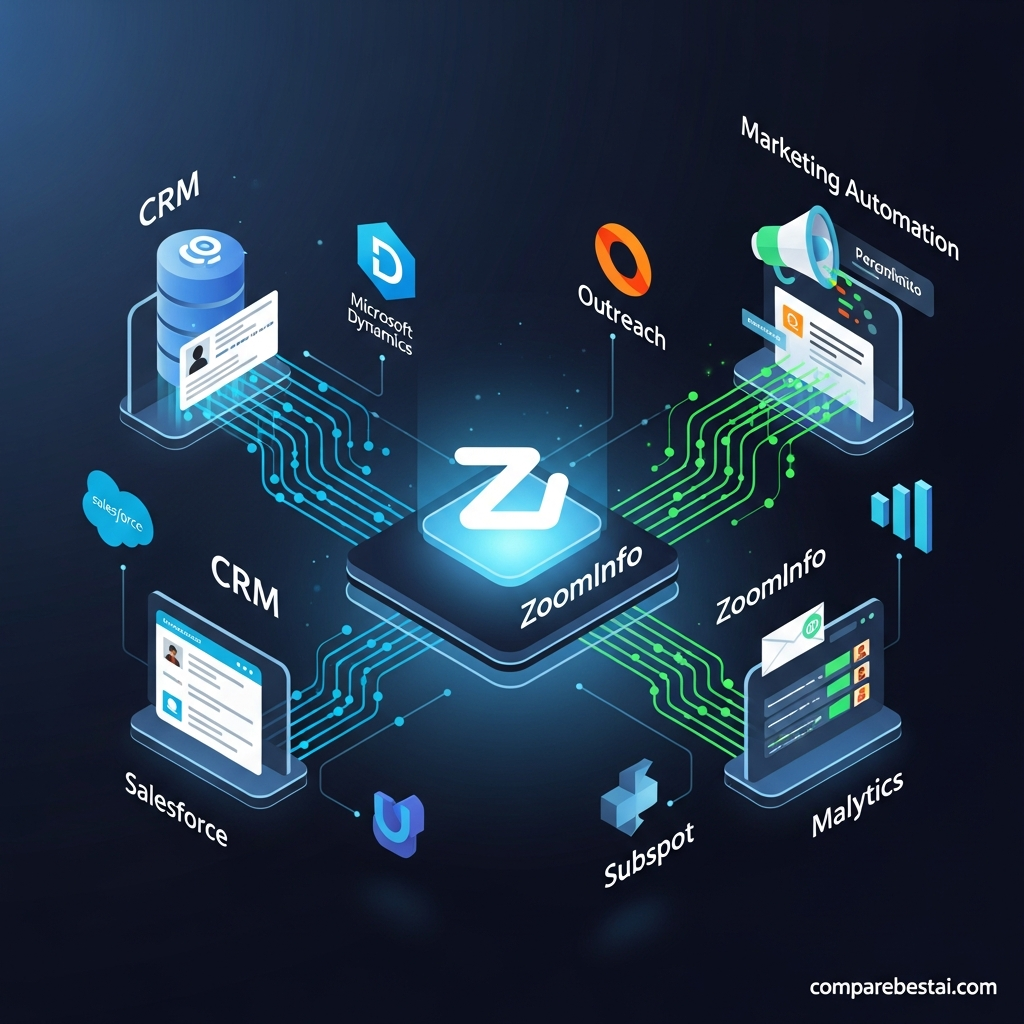
Quick Answer: The best AI tools for digital marketing in 2026 include ChatGPT for strategy and ideation, Jasper for brand-controlled content, Semrush for SEO and AI visibility, AdCreative.ai for paid-ad creative, Buffer for social media, Canva for design, ActiveCampaign for email automation, HubSpot Breeze for CRM-connected marketing, OpusClip for short-form video, and Zapier for marketing workflow automation.
The best choice depends on where your marketing workflow is actually slowing down.
A team struggling with organic visibility needs a different platform from one producing dozens of paid-ad variations every week. A small business may need simple email and social automation, while an agency may care more about brand consistency, reporting and workflow scale.
This guide compares 10 leading AI tools across the main digital marketing jobs rather than recommending ten products that all solve the same problem.
Last reviewed: August 31, 2026
Pricing, AI allowances and plan availability change frequently. Always confirm current details with the provider before purchasing.
Best AI Digital Marketing Tools Compared
| Rank | Tool | Best For | Starting Option |
|---|---|---|---|
| 1 | ChatGPT | Strategy, research and general marketing work | Free; Plus $20/month |
| 2 | Jasper | Brand-controlled marketing content | Pro from $59/month annually |
| 3 | Semrush | SEO and AI-search visibility | SEO from $117.33/month annually |
| 4 | AdCreative.ai | Paid-ad creative | Credit-based paid plans |
| 5 | Buffer | Social media publishing | Free; Essentials $5/channel/month annually |
| 6 | Canva | Visual marketing and design | Free; Pro $144/year |
| 7 | ActiveCampaign | Email and lifecycle automation | From $15/month for 1,000 contacts |
| 8 | HubSpot Breeze | CRM-connected marketing | Free tier; paid plans scale by edition |
| 9 | OpusClip | Short-form video repurposing | Free; Starter $15/month |
| 10 | Zapier | Marketing workflow automation | Free; Professional from $19.99/month annually |
The important point is that these tools perform different jobs.
ChatGPT and Jasper support ideation and content.
Semrush works on search visibility.
AdCreative.ai focuses on paid creative.
Buffer handles distribution.
Canva helps with visual production.
ActiveCampaign and HubSpot work closer to leads, customers and lifecycle marketing.
OpusClip solves video repurposing.
Zapier connects the rest of the stack.
Buying all ten would usually create unnecessary overlap.
How We Selected the Best AI Tools for Digital Marketing
A useful AI marketing platform should improve a real marketing workflow rather than simply add an AI button to an existing product.
For this guide, we considered practical marketing usefulness, AI functionality, ease of implementation, integrations, scalability, pricing structure, workflow depth and whether the product solves a clearly defined marketing problem.
We also considered specialization.
A tool that performs one important task exceptionally well can provide more value than a larger platform containing dozens of features your team rarely uses.
The goal is not to build the largest AI stack.
It is to remove the most expensive marketing bottlenecks first.
1. ChatGPT: Best Overall AI Assistant for Digital Marketing
Best for: Marketing strategy, ideation, research, drafting, analysis and campaign planning.
ChatGPT is one of the most flexible tools available to digital marketers because it is not restricted to one channel.
Marketers can use it to brainstorm campaign concepts, analyze customer feedback, draft landing-page copy, develop content briefs, review messaging, summarize research, work with uploaded files and generate campaign variations.
ChatGPT Plus currently costs $20 per month for individual users. OpenAI also offers ChatGPT Business, with Standard business seats priced at $20 per user per month when billed annually or $25 monthly.
Why ChatGPT stands out
Its main advantage is flexibility.
A marketer does not necessarily need a separate basic AI application for every small writing, brainstorming or analysis task.
The same workspace can support several stages of campaign development.
Main limitation
General-purpose AI does not automatically understand your customers, positioning or current campaign data.
Marketing claims, statistics, product details and strategic recommendations still require human review.
Choose ChatGPT if
You want one flexible AI assistant that can support many different marketing activities without being tied to one channel.
2. Jasper: Best for Brand-Controlled Marketing Content
Best for: Marketing departments and agencies producing content at scale.
Jasper AI is more specialized around marketing than a general-purpose AI assistant.
Its current Pro plan includes marketing-oriented agents, brand customization through Brand Voices, Knowledge and Audiences, and a workspace designed around content creation.
Jasper currently lists Pro at $59 per month when billed annually or $69 monthly, with a seven-day free trial.
Why Jasper stands out
Content volume is not the only problem large marketing teams face.
Consistency matters too.
Multiple employees and agencies may need to produce emails, landing pages, advertisements and articles while following the same brand terminology and messaging rules.
Jasper is designed around that requirement.
Main limitation
A solo marketer producing occasional content may get enough value from a general-purpose AI assistant.
Jasper becomes more compelling when content volume, collaboration and brand governance increase.
Choose Jasper if
You need repeatable marketing content across several campaigns while maintaining consistent brand positioning.
3. Semrush: Best for SEO and AI-Search Visibility
Best for: SEO, competitive research and visibility across traditional and AI search.
Semrush remains one of the broadest digital marketing platforms for organic-search teams.
Its current SEO offering includes keyword research, competitor analysis, position tracking and technical auditing, while newer plans increasingly integrate AI-search visibility.
The current SEO plan starts at $117.33 per month when billed annually. Semrush also offers a standalone AI Visibility Base plan at $99 per domain per month on annual billing, tracking mentions across systems including ChatGPT, Google AI, Gemini and Perplexity.
Why Semrush stands out
Search visibility is no longer limited to traditional rankings.
Marketing teams increasingly want to know whether their brands are being mentioned or cited when customers use AI answer systems.
Semrush combines that emerging requirement with established SEO and competitive-research workflows.
Main limitation
Cost and complexity.
A very small business that only needs basic keyword research may pay for significantly more functionality than it uses.
Choose Semrush if
SEO and search visibility are important acquisition channels and you need both competitive intelligence and AI-search monitoring.
Internal link: Compare Semrush pricing, SEO features and AI visibility on CompareBestAI.
4. AdCreative.ai: Best for Paid-Ad Creative at Scale
Best for: Performance marketers producing large numbers of paid-ad variations.
Paid media requires constant creative testing.
AdCreative.ai focuses specifically on that workflow by helping marketers produce advertising assets, product creative and variations designed for digital campaigns.
Its current platform uses credit-based plans and includes advertising-platform integrations, creative insights and competitor-analysis functionality on higher tiers.
Why AdCreative.ai stands out
The practical value is iteration speed.
A paid-media team may need several versions of:
Headlines
Product images
Calls to action
Layouts
Formats
Platform sizes
Generating those variations quickly allows marketers to test more ideas without making every asset manually.
Main limitation
High-volume advertising creative is not the same as distinctive brand design.
AI-generated ads can become formulaic, so premium brand campaigns still benefit from experienced creative direction.
Choose AdCreative.ai if
Your paid campaigns need more creative variations than your design resources can produce comfortably.
Internal link: Review AdCreative.ai features, pricing and use cases on CompareBestAI.
5. Buffer: Best for Affordable AI Social Media Management
Best for: Creators, small businesses and lean marketing teams.
Buffer is one of the simplest ways to combine social scheduling with AI assistance.
Its free plan currently supports up to three channels, 10 scheduled posts per channel and access to its AI Assistant.
Essentials begins at $5 per month per channel when billed annually and adds unlimited scheduled posts and advanced analytics.
Why Buffer stands out
Many businesses do not need an enterprise social-media suite.
They need a dependable place to:
Capture ideas
Rewrite posts
Repurpose content
Schedule publishing
Review basic performance
Buffer keeps that process relatively straightforward.
Main limitation
It does not provide the depth of enterprise social listening and consumer intelligence available in much more expensive platforms.
Choose Buffer if
Your primary social-media problem is publishing consistently rather than running sophisticated social intelligence programs.
Internal link: Compare Buffer pricing and AI scheduling features on CompareBestAI.
6. Canva: Best for AI-Assisted Visual Marketing
Best for: Social graphics, presentations, advertising assets and everyday creative production.
Canva combines AI-assisted creation with templates, brand controls, image editing, video tools and social scheduling.
Its current Free plan includes limited AI allowances. Canva Pro costs $144 per year for one person and substantially increases AI usage while adding premium tools, templates and Brand Kits.
Why Canva stands out
Visual marketing involves more than generating an image.
Teams also need to resize assets, apply branding, create channel-specific formats, collaborate and export finished materials.
Canva brings those tasks into one environment.
Main limitation
Template-driven creative can become visually repetitive.
Important brand campaigns should still receive human creative direction.
Choose Canva if
You need to produce large amounts of professional-looking visual marketing without sending every asset through a dedicated designer.
Internal link: Compare Canva's AI features, pricing and design capabilities on CompareBestAI.
7. ActiveCampaign: Best for AI Email and Lifecycle Automation
Best for: Businesses that have moved beyond basic newsletters and need automated customer journeys.
ActiveCampaign combines email marketing, CRM functionality, segmentation and multi-step automation.
The company's current entry-level Starter pricing begins at $15 per month for up to 1,000 contacts. Starter includes an AI-powered automation builder, while higher plans expand automation, personalization and predictive capabilities. ActiveCampaign also offers a 14-day trial.
Why ActiveCampaign stands out
The real value is lifecycle marketing.
Not every subscriber should receive the same message.
Businesses can create journeys that change according to customer behavior, engagement and other signals.
Main limitation
Advanced automation requires thoughtful setup.
Building complicated workflows without first mapping the actual customer journey can automate a bad process rather than improve it.
Choose ActiveCampaign if
Email nurturing, retention and lifecycle automation are important revenue channels.
Internal link: Compare ActiveCampaign AI automation, CRM features and pricing on CompareBestAI.
8. HubSpot Breeze: Best for CRM-Connected Digital Marketing
Best for: Growing businesses that want marketing, lead management and CRM data connected.
HubSpot's Breeze AI operates directly inside the HubSpot customer platform.
The current free edition includes Breeze Assistant and embedded AI features, while higher editions add AI agents, AEO functionality, email assistance and deeper automation.
HubSpot's Marketing Hub has a free tier for up to two users. Paid marketing plans then scale substantially based on edition, contacts and functionality.
Why HubSpot stands out
CRM context is the main advantage.
Marketing activity does not operate in isolation.
Forms, emails, leads, deals and customer records can all sit inside the same platform, giving AI more useful context around the customer journey.
Main limitation
Cost can increase sharply as companies move from free or entry-level functionality into advanced automation and larger marketing-contact databases.
Choose HubSpot if
Your biggest problem is fragmented customer and marketing data rather than content creation alone.
Internal link: Review HubSpot Breeze, Marketing Hub pricing and CRM features on CompareBestAI.
9. OpusClip: Best for Repurposing Long Videos Into Social Content
Best for: Podcasts, webinars, interviews and long-form video marketing.
OpusClip specializes in converting longer video into shorter clips for platforms such as TikTok, Instagram Reels and YouTube Shorts.
Its current Free plan includes limited monthly credits. Starter costs $15 per month, while Pro costs $29 monthly or $14.50 per month equivalent on annual billing.
Why OpusClip stands out
Video repurposing is expensive when every short clip must be edited manually.
A webinar, interview or podcast may contain dozens of potentially useful social moments.
AI-assisted clipping can make more of that existing content usable.
Main limitation
Automatically selected clips still need editorial judgment.
The segment an algorithm predicts will perform well may not be the segment that best supports your brand or campaign.
Choose OpusClip if
You already produce long-form video and want to distribute more of it across short-form social channels.
10. Zapier: Best for Marketing Workflow Automation
Best for: Connecting marketing tools and removing repetitive manual work.
Zapier works between applications rather than replacing them.
A marketing workflow could take a new lead from a form, enrich the record, add it to a CRM, notify a salesperson and trigger another action without requiring someone to copy the information manually.
Zapier currently offers a free plan with 100 monthly tasks. Professional starts at $19.99 per month when billed annually. AI by Zapier now uses model-tier task pricing, with Standard, Advanced and Premium AI steps consuming different task multipliers.
Why Zapier stands out
Many marketing teams already use good specialist tools.
Their biggest inefficiency is that those systems do not communicate well.
Zapier can remove those manual hand-offs.
Main limitation
Automation sprawl can become a problem.
Teams should document important workflows and monitor task consumption, particularly when AI steps increase usage.
Choose Zapier if
The repetitive work happens between your marketing applications rather than inside one of them.
Internal link: Compare Zapier AI automation, pricing and integrations on CompareBestAI.
Which AI Digital Marketing Tool Should You Choose?
Start with your largest marketing bottleneck.
If strategy, research and general drafting consume too much time, start with ChatGPT.
If brand-controlled content production is difficult to scale, consider Jasper.
If organic search is a major acquisition channel, evaluate Semrush.
If paid-media creative is slowing down testing, AdCreative.ai may provide more direct value.
If social posting is inconsistent, Buffer is a practical starting point.
If visual production is the problem, use Canva.
If email and lifecycle nurturing matter to revenue, evaluate ActiveCampaign.
If your customer and marketing data are fragmented, HubSpot may solve a broader problem.
If long videos are underused, OpusClip can help repurpose them.
If employees repeatedly move information between tools, automate the workflow with Zapier.
The goal is not to own all ten.
Best AI Marketing Stack by Business Type
Small business
A small business should keep its stack lean.
A practical setup might combine ChatGPT for ideation, Canva for visual production, Buffer for social publishing and an email or CRM platform when the audience grows.
Do not add specialist software until a clear workflow justifies the expense.
Content-led business
Companies relying heavily on content and search may benefit from ChatGPT or Jasper for drafting and campaign development, Semrush for search intelligence and Canva for supporting visual assets.
The content itself should still contain original expertise, examples, evidence and human editorial review.
Ecommerce business
Ecommerce marketers may get greater value from AdCreative.ai for creative iteration, ActiveCampaign for lifecycle communication and Canva for visual production.
The best stack will depend heavily on the existing ecommerce platform and CRM.
Growing marketing team
As teams grow, coordination and customer data become more important.
HubSpot can provide the CRM foundation, while specialist tools such as Semrush, Canva or Buffer handle deeper channel-specific requirements.
Zapier can connect systems where native integrations are insufficient.
How to Test an AI Marketing Tool Before Paying
Start with one real workflow.
Do not test an AI platform only by asking it a few generic questions.
If you are evaluating an SEO tool, optimize an actual page.
If you are evaluating an email platform, create a real automation.
If you are testing an ad tool, build several variants from the same campaign brief.
If you are evaluating automation, measure how many manual steps disappear.
Establish the baseline first.
Track time required, output quality, revision effort, integrations, usage limits and the business metric connected to the task.
A tool should solve a measurable problem.
Having more AI features is not itself a marketing result.
Avoid Building an Expensive AI Marketing Stack
Software overlap is increasing rapidly.
ChatGPT can write copy.
Jasper can write copy.
Canva can now assist with copy.
HubSpot contains writing and campaign AI.
ActiveCampaign includes AI inside email and automation workflows.
Buying every product because it contains an AI feature can create more subscriptions without improving marketing performance.
Assign every platform a specific job.
If two paid products solve essentially the same problem, compare actual usage and results before renewing both.
Human Review Still Matters
AI can dramatically accelerate marketing production.
It does not remove responsibility for accuracy, positioning, brand judgment or customer understanding.
Review important claims, prices, statistics and product information before publication.
Human oversight is particularly important for:
Brand positioning
Sensitive customer communication
Paid-ad claims
Legal or regulated statements
Original research
Product comparisons
Crisis communication
The strongest marketing workflow is usually AI-assisted rather than AI-only.
Frequently Asked Questions
What are the best AI tools for digital marketing in 2026?
Strong options include ChatGPT for strategy and ideation, Jasper for brand-controlled content, Semrush for SEO and AI visibility, AdCreative.ai for paid advertising, Buffer for social media, Canva for design, ActiveCampaign for email automation, HubSpot for CRM-connected marketing, OpusClip for video and Zapier for automation.
What is the best AI marketing tool for small businesses?
There is no universal winner. ChatGPT provides broad flexibility, Canva helps with visual production, Buffer is affordable for social scheduling and HubSpot offers free CRM and marketing functionality. Start with the platform that solves your biggest current bottleneck.
What is the best AI tool for SEO and digital marketing?
Semrush is one of the strongest all-in-one options for businesses that need keyword research, competitor analysis, technical SEO and AI-search visibility. More specialized SEO content tools may be appropriate when content optimization is the only requirement.
What is the best AI tool for email marketing?
ActiveCampaign is particularly strong for businesses that need sophisticated automation and customer journeys rather than simple newsletter sending. HubSpot is another strong option when email needs to operate alongside CRM, sales and broader marketing data.
What is the best free AI marketing tool?
The best free option depends on the job. ChatGPT provides free general-purpose AI access, Canva has a useful free design plan, Buffer provides free social scheduling and HubSpot offers free CRM and marketing tools. Free-plan limits should always be checked before building an important workflow around them.
How many AI marketing tools should a business use?
Most businesses should begin with the smallest stack that covers distinct marketing needs. Add another tool only when there is a measurable workflow gap and the functionality is not already available inside software you pay for.
Final Verdict
The best AI digital marketing tool depends on which part of marketing you need to improve.
ChatGPT is the most flexible general marketing assistant.
Jasper is better suited to controlled marketing content at scale.
Semrush stands out for SEO and AI-search visibility.
AdCreative.ai focuses on paid-media creative.
Buffer offers accessible social publishing.
Canva remains one of the strongest tools for everyday visual marketing.
ActiveCampaign handles sophisticated email and lifecycle automation.
HubSpot Breeze connects AI with CRM and customer data.
OpusClip accelerates short-form video repurposing.
Zapier automates the hand-offs between the rest of your stack.
Do not subscribe to all ten.
Shortlist the two or three platforms connected to your largest marketing bottlenecks, test them using real campaigns and compare the measurable improvement before committing.
Next step: Compare your shortlisted AI marketing tools on CompareBestAI by current pricing, features, integrations, limitations and business fit before choosing your final stack.