
The best AI search engines in 2026 include Perplexity, ChatGPT Search, Google AI Mode, Claude, Microsoft Copilot, Brave Search, Grok, Kagi, You.com, and DeepSeek. Perplexity is particularly strong for citation-focused research, ChatGPT Search works well for conversational research, Google AI Mode is built for broad everyday discovery, and Brave Search stands out for privacy-focused search.
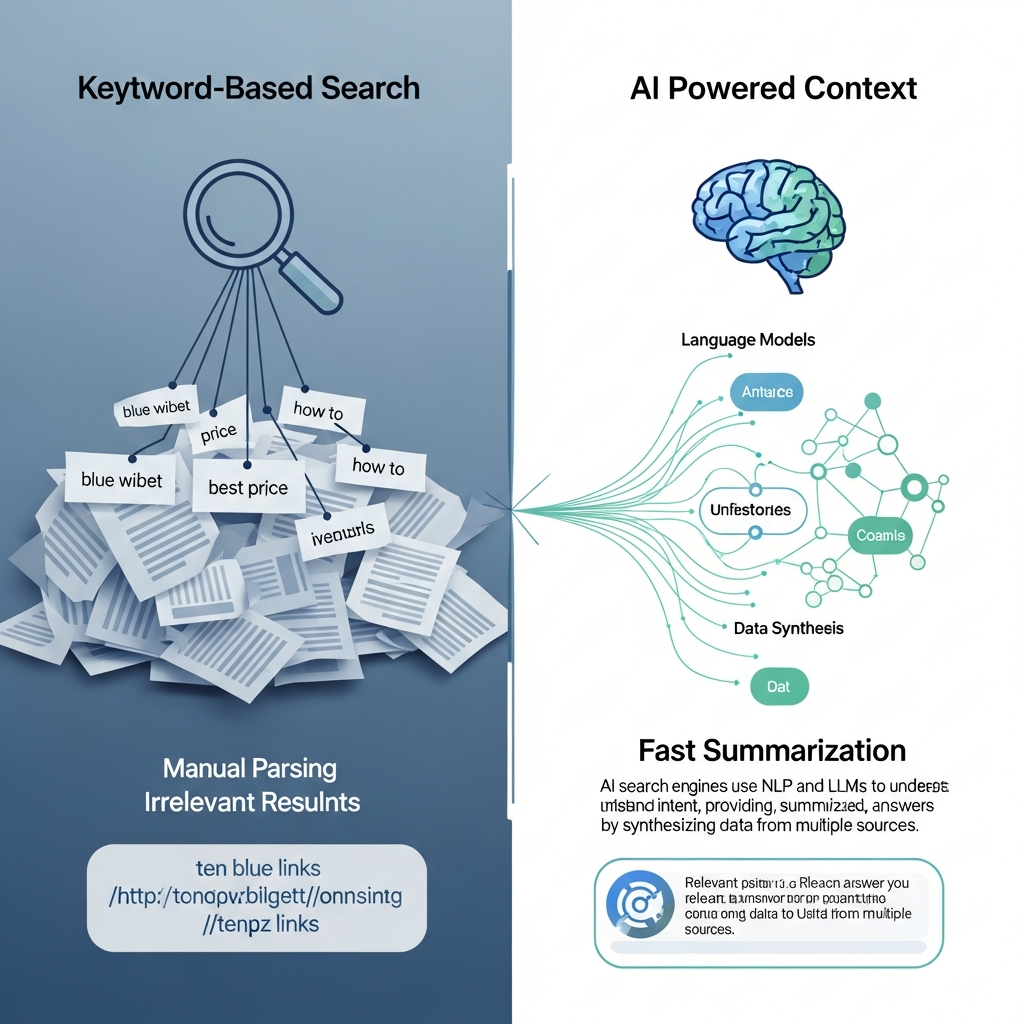
Unlike traditional search engines that primarily return ranked webpages, AI search engines can interpret natural-language questions, retrieve information from multiple sources, and synthesize that information into a direct response.
Best AI Search Engines in 2026 at a Glance
| AI Search Engine | Best For | Web Search | Source Citations | Free Access |
|---|---|---|---|---|
| Perplexity | Citation-focused research | Yes | Yes | Yes |
| ChatGPT Search | Conversational research | Yes | Yes | Yes |
| Google AI Mode | Everyday and complex search | Yes | Yes | Yes |
| Claude | Deep research and analysis | Yes | Yes | Yes |
| Microsoft Copilot | Microsoft users and work research | Yes | Yes | Yes |
| Brave Search | Privacy-focused AI search | Yes | Yes | Yes |
| Grok | Current web and X information | Yes | Yes | Limited/free access |
| Kagi Assistant | Ad-free private research | Yes | Yes | Paid plans |
| You.com | AI search infrastructure and research | Yes | Yes | Varies |
| DeepSeek | General AI research and reasoning | Yes | Varies by search mode | Yes |
Quick recommendation: Start with Perplexity when verifying sources is your priority. Choose ChatGPT Search when you want search combined with a broader AI assistant. Google AI Mode is particularly useful when you want Google's search infrastructure combined with conversational AI.
What Is an AI Search Engine?
An AI search engine uses artificial intelligence to understand a question, retrieve relevant information and produce a synthesized answer rather than simply displaying a list of webpages.
Most modern AI search systems combine information retrieval with large language models. The search component finds relevant documents or webpages, while the language model analyzes that information and generates an answer.
This approach is closely related to retrieval-augmented generation, or RAG. Instead of relying only on information contained in a model's training data, the system retrieves external information and uses it to ground its response.
That distinction matters for current information.
A language model working only from training data may not know what happened yesterday. An AI system with live web search can retrieve newer information before answering.

AI Search vs Traditional Search
Traditional search and AI search increasingly overlap, but the user experience remains different.
| Area | Traditional Search | AI Search |
|---|---|---|
| Query style | Keywords or short phrases | Natural-language questions |
| Main output | Ranked webpages | Synthesized answer |
| Follow-up questions | Usually separate searches | Conversational follow-ups |
| Sources | Search-result links | Often inline citations or source panels |
| Research process | User reads and compares sources | AI summarizes multiple sources |
| Complex questions | Often require several searches | Can break questions into several research steps |
Traditional search is still useful when you want to explore many original sources yourself. AI search becomes particularly useful when you need a fast synthesis, comparison or starting point for deeper research.
Neither approach eliminates the need to verify important information.
How We Selected the Top AI Search Engines
Rather than ranking platforms solely by model benchmarks, this comparison focuses on features that matter during everyday search.
We considered:
Access to current web information
Visibility and quality of source citations
Ability to understand complex questions
Follow-up and conversational search
Research capabilities
Privacy and user control
Availability to ordinary users
Suitability for specific workflows
AI products change quickly, so features, models and usage limits should always be checked directly with each provider.
1. Perplexity: Best for Citation-Focused AI Search
Best for: Research, fact-checking and source discovery
Perplexity is one of the clearest examples of an AI-native search engine.
Rather than starting with a conventional results page, users ask a question and receive a synthesized response supported by links to the underlying sources.
Perplexity describes its platform as an AI-powered search engine that searches the web and delivers conversational answers backed by verifiable sources. Its answers include citations that allow users to inspect the original material.
The platform also offers more advanced search and research capabilities for complex questions.
Why Perplexity stands out
Prominent source citations
Current web retrieval
Conversational follow-up questions
Dedicated research workflows
Useful for comparing multiple sources quickly
Limitation
A cited answer should not automatically be treated as correct. Users should still open important sources and make sure the cited material actually supports the generated claim.
Best choice for: Researchers, students, journalists, analysts and anyone who regularly checks primary sources.
2. ChatGPT Search: Best All-Round Conversational Search
Best for: Conversational research and mixed AI workflows
ChatGPT combines general AI assistance with live web search.
OpenAI says ChatGPT can search the web when current information would improve an answer, and users can also start web search manually. Search-based responses can include citations and links to relevant sources.
This makes ChatGPT Search different from a dedicated search-only product. Search sits alongside writing, analysis, coding, file work and other AI capabilities.
Why ChatGPT Search stands out
Natural conversational interface
Current web information when search is used
Source citations
Strong follow-up experience
Search integrated into a broader general-purpose AI assistant
OpenAI has also expanded web-search availability across ChatGPT plans, making search accessible to a broad user base.
Limitation
Not every ChatGPT answer necessarily requires a web search. For current or high-stakes information, users should confirm that web sources were actually retrieved and inspect the citations.
Best choice for: Users who want search, analysis and general AI capabilities in one interface.
3. Google AI Mode and AI Overviews: Best for Everyday Search
Best for: Everyday discovery, complex questions, local and multimodal search
Google has been integrating generative AI directly into its traditional search experience through AI Overviews and AI Mode.
AI Overviews provide generated summaries for eligible searches, while AI Mode offers a more conversational search experience designed for complex and multi-part questions.
Google says AI Mode uses a technique called query fan-out, breaking a question into subtopics and issuing multiple related searches. The results are then combined into an AI-generated response with links to web content.
Google reported in May 2026 that AI Mode had surpassed one billion monthly active users globally. Google also reported later in 2026 that AI Overviews had more than 2.5 billion monthly active users.
Those figures demonstrate how quickly AI-generated answers have become part of mainstream search.
Why Google AI Search stands out
Deep integration with Google Search
Access to Google's existing information systems
Multimodal searching
Follow-up questions
Strong everyday discovery experience
Links to original websites
Limitation
AI-generated summaries can reduce the need to click multiple search results, and the experience varies depending on query type and location.
Best choice for: Users who already rely heavily on Google and want AI assistance inside a familiar search environment.
4. Claude: Best for Deep Web Research
Best for: Detailed analysis and longer research tasks
Claude is primarily an AI assistant rather than a traditional search engine, but its web-search and research capabilities make it an important part of the AI-search landscape.
Anthropic introduced web search so Claude could retrieve current information from the internet and provide direct citations to sources.
Claude's broader research functionality can conduct multiple searches, analyze information from numerous sources and build a structured response.
Why Claude stands out
Web search with source citations
Strong long-form analysis
Multi-step research
Useful for professional and technical research
Can combine web information with connected or uploaded information in supported workflows
Limitation
Claude remains a broad AI assistant rather than a search-first product. Users looking for a conventional search results page may prefer Google, Brave or Kagi.
Best choice for: Analysts, researchers and professionals who need synthesis rather than only quick answers.
5. Microsoft Copilot: Best for Microsoft Users
Best for: Web research combined with Microsoft workflows
Microsoft Copilot can use web search to incorporate recent publicly available information into its responses.
Microsoft explains that Copilot can search relevant content across the web, summarize the information it finds and provide citations so users can inspect the source material.
Within Microsoft work environments, Copilot can also combine public web information with organizational information when appropriate permissions and products are available.
Why Microsoft Copilot stands out
Web grounding through Bing
Source citations
Strong Microsoft ecosystem integration
Useful for workplace research
Natural-language querying
Limitation
The exact experience and available capabilities differ between consumer Copilot, Microsoft 365 Copilot and organizational configurations.
Best choice for: Microsoft 365 users and organizations already working within Microsoft's ecosystem.
6. Brave Search: Best Privacy-Focused AI Search Engine
Best for: Private web search with AI-generated answers
Brave Search combines conventional web search with AI Answers and Ask Brave.
Its AI Answers feature generates concise responses from web-search results and includes source references. Ask Brave expands this into a more conversational experience with follow-up questions and deeper research.
One of Brave's strongest differentiators is its independent search infrastructure and privacy positioning.
Brave states that its search service does not profile users and that AI Answers provide references so users can examine where the information came from.
Why Brave Search stands out
Privacy-focused design
Independent search index
AI-generated answers
Source citations
Conventional search results remain available
Ask Brave supports conversational follow-ups
Limitation
Its broader ecosystem and personalization options differ from Google's much larger search ecosystem.
Best choice for: People who want AI-assisted search while minimizing search profiling.
7. Grok: Best for Web and X-Based Real-Time Discovery
Best for: Fast-moving conversations, news and X content
Grok combines general AI capabilities with web search and access to information from X.
xAI says Grok can draw from both webpages and posts on X and provide citations that allow users to examine the source.
That combination makes Grok particularly interesting for topics where online conversation is moving quickly.
Why Grok stands out
Real-time web search
Access to information from X
Citations
Useful for emerging topics and social discussion
General AI reasoning alongside search
Limitation
Social-media information can be noisy, incomplete or incorrect. Primary sources should still be prioritized when accuracy matters.
Best choice for: Users following rapidly developing stories and online conversations.
8. Kagi Search and Kagi Assistant: Best Ad-Free Premium Search
Best for: Privacy-conscious users willing to pay for search
Kagi takes a different approach from most mainstream search engines because its core product uses a subscription model rather than an advertising-based search model.
Kagi Assistant can combine large language models with results from Kagi Search. Users can control whether the Assistant has web access and can use Kagi's search customization features.
Kagi says Assistant data is not used to train AI models, and its search product places significant emphasis on privacy and user control.
Why Kagi stands out
Ad-free search model
Strong privacy positioning
Multiple AI models
Search-grounded AI responses
Search customization and lenses
Dedicated research assistants
Limitation
Kagi is a paid search product, making it less attractive for users primarily looking for a free AI search engine.
Best choice for: Heavy search users who value privacy, control and an ad-free experience.
9. You.com: Best for AI Search Infrastructure and Developers
Best for: Developers, enterprise AI and search-powered applications
You.com has increasingly positioned itself around AI search infrastructure.
Its search technology is designed to provide real-time, citation-backed information that developers can use to ground AI applications and agents.
You.com describes modern AI search as a system that combines retrieval and generation. Relevant information is retrieved first and then passed to an AI model that synthesizes an answer.
Why You.com stands out
AI search APIs
Real-time web information
Citation-backed results
RAG and agent-oriented infrastructure
Useful for enterprises building AI applications
Limitation
Its current positioning is increasingly focused on infrastructure and enterprise use cases rather than competing only as a mainstream consumer search engine.
Best choice for: Developers and companies building search-enabled AI products.
10. DeepSeek: Best Free AI Alternative for Research and Reasoning
Best for: Users wanting a free general AI alternative
DeepSeek offers web and app access to its AI models and has become a significant alternative in the broader AI-assistant market.
Its strength is less about replacing Google with a conventional results page and more about using AI reasoning together with current-information capabilities where available.
Why DeepSeek stands out
Free web access
Strong general reasoning capabilities
Accessible AI interface
Useful alternative to larger Western AI platforms
Limitation
Source presentation and web-search behavior may differ from citation-first products such as Perplexity.
Best choice for: Users looking for another general-purpose AI research option without immediately paying for a subscription.
Which AI Search Engine Is Best?
There is no universal winner because the right choice depends on the task.
Choose Perplexity when citations and source verification matter most.
Choose ChatGPT Search when you want web research combined with a powerful general AI assistant.
Choose Google AI Mode when you want conversational AI built around Google's search ecosystem.
Choose Claude when the task requires longer, deeper synthesis.
Choose Microsoft Copilot when your workflow already revolves around Microsoft products.
Choose Brave Search when privacy is the priority.
Choose Grok when following fast-moving information from both the web and X.
Choose Kagi when you prefer a premium, ad-free and privacy-oriented search experience.
Choose You.com when you are building AI products that need web-search infrastructure.
Choose DeepSeek when you want a free alternative for AI-assisted research.
Are AI Search Engines Better Than Google?
Not always.
AI search engines are often faster when the goal is to answer a complicated question, summarize multiple sources or compare several options.
Traditional Google Search remains useful when users want to browse original webpages themselves, compare a large number of results, find local information, shop, navigate to a specific site or independently assess competing sources.
The distinction is also becoming less clear because Google itself now provides AI-generated search experiences through AI Overviews and AI Mode.
The future of search is therefore unlikely to be simply AI search versus Google.
Google Search itself is becoming AI search.
Are AI Search Engines Accurate?
AI search engines can improve the research process, but none should be assumed to be perfectly accurate.
A generated answer may:
Misinterpret a source
Overstate what a source says
Use outdated information
Combine conflicting sources incorrectly
Miss an important source
Produce a factual error despite providing citations
Citations make verification easier. They do not eliminate the need for verification.
For medical, legal, financial, scientific or other high-impact questions, users should prioritize primary and authoritative sources rather than relying solely on an AI-generated summary.
What AI Search Means for SEO
AI search is also changing how websites earn visibility.
Traditional SEO focuses heavily on rankings and clicks. AI-search visibility increasingly includes whether a website is retrieved, referenced or cited inside a generated answer.
That makes several content qualities more important:
Clear answers near the beginning of a section
Specific facts rather than vague statements
Strong primary-source citations
Descriptive headings
Clear entity names
Original data or expertise
Updated information
Crawlable pages
Strong topical authority
SEO is therefore not disappearing. Search interfaces are changing.
Websites still need to be discoverable and trustworthy before an AI system can confidently use them as a source.
If your goal is to increase that visibility, read our guide on how to rank in AI search and our comparison of the best GEO tools for AI search visibility.
How to Choose an AI Search Engine
Before choosing a platform, ask what you actually need from search.
Choose citation quality first for research
If you regularly need to verify information, prioritize engines that make sources highly visible.
Prioritize freshness for current topics
News, software updates, regulations, prices and product features can change quickly. Confirm that the system is actively searching the current web rather than relying only on model knowledge.
Consider privacy
Search prompts can reveal significant information about a person's interests or work. Review how a provider stores search activity and whether data is used for personalization or model improvement.
Consider your existing ecosystem
Google users may prefer AI Mode. Microsoft users may benefit more from Copilot. Someone already doing most of their work in ChatGPT may not need a separate search product.
Test more than one engine
For important research, comparing the answers from two different AI search engines can expose missing information or conflicting interpretations.
Frequently Asked Questions
What is the best AI search engine in 2026?
Perplexity is one of the strongest options for citation-focused web research, while ChatGPT Search is an excellent all-round choice for conversational research. Google AI Mode is particularly strong for users who want AI-powered answers integrated directly into Google Search. The best choice depends on your workflow.
Is there a free AI search engine?
Yes. ChatGPT Search, Perplexity, Google AI Mode, Brave Search and several other AI search platforms provide free access, although usage limits and premium capabilities vary.
Is Perplexity better than Google?
Perplexity can be more convenient when you want a synthesized, citation-backed answer to a research question. Google can be better when you want broad web discovery, local results, shopping information or direct control over which webpages you open. Google AI Mode is also narrowing the difference between the two experiences.
Is ChatGPT an AI search engine?
ChatGPT is primarily a general-purpose AI assistant, but ChatGPT Search gives it AI-search capabilities. It can retrieve current information from the web and provide citations and links to relevant sources.
What is the difference between an AI search engine and an AI chatbot?
An AI chatbot can generate answers from its model knowledge without necessarily accessing live information. An AI search engine retrieves external information, usually from the web, before generating an answer. Modern products increasingly combine both capabilities.
Do AI search engines provide sources?
Many leading AI search tools provide source citations, including Perplexity, ChatGPT Search, Claude, Microsoft Copilot, Brave Search and Grok. Citation formats and coverage differ by platform.
Can AI search engines replace Google?
AI search engines can replace some traditional searches, particularly research, summarization and comparison questions. They are less likely to completely replace conventional search because users still need navigation, local results, shopping results, original webpages and independent source discovery.
How can my website appear in AI search engines?
Publish clear, factual and well-sourced content that directly answers users' questions. Maintain strong technical SEO and crawlability, use descriptive headings, cite primary sources and keep important facts current. AI visibility generally builds on the same authority and relevance signals that make strong search content valuable.
Final Verdict
AI search is no longer a niche alternative to conventional search. In 2026, Google, OpenAI, Perplexity, Microsoft, Anthropic, Brave and other technology companies are all combining information retrieval with generative AI.
For most users, Perplexity, ChatGPT Search and Google AI Mode are the strongest places to start.
Perplexity is particularly useful when citations are central to the task. ChatGPT Search provides the broadest combination of web research and general AI assistance. Google AI Mode brings AI-powered discovery into the world's most familiar search environment.
Specialist alternatives also matter. Brave prioritizes privacy, Claude is well suited to deeper research, Copilot fits Microsoft workflows, Grok brings web and X information together, and Kagi offers an ad-free premium approach.
The smartest approach is not to choose an AI search engine based on hype. Choose it based on the information you need, how easily you can verify its sources and how well it fits the way you already work.
Next step: Learn how to rank in AI search if you want your own website to become one of the sources these platforms retrieve and cite.