
Quick Verdict: Undetectable AI is a writing platform built around AI-text detection and rewriting AI-assisted drafts to sound more natural. Its core tools include an AI Detector and AI Humanizer, with paid humanization plans starting at $9.99 per month for 10,000 words. It can be useful for editing stiff or formulaic drafts, but detector scores are not proof of authorship and should not be treated as an SEO ranking metric. For publishers, the strongest workflow is to use humanization as an editing aid, then manually verify facts, add original expertise and review the final copy.
Undetectable AI Review 2026: At a Glance
| Category | Undetectable AI |
|---|---|
| Best for | Rewriting stiff AI-assisted drafts and checking AI-detector signals |
| Main tools | AI Detector and AI Humanizer |
| Starting paid price | $9.99/month |
| Annual starting price | $5/month, billed $60/year |
| Entry allowance | 10,000 humanization words/month |
| Free trial | 250 words |
| AI detection | Unlimited on current paid plans |
| API | Available |
| Chrome extension | Available |
| Multilingual support | Yes |
| Business plans | Custom |
| Biggest strength | Combines detection and rewriting in one workflow |
| Biggest limitation | Detector scores are probabilistic, not proof of authorship |
| SEO verdict | Useful as an editing aid, not as a ranking or compliance shortcut |
Pricing checked against Undetectable AI's official pricing page in September 2026. Plans and promotional discounts can change.
What Is Undetectable AI?
Undetectable AI is a writing and detection platform designed around two core tasks:
estimating whether text may be identified as AI-generated
rewriting text so it reads more naturally
The platform's current toolset extends beyond those two functions, but the AI Detector and AI Humanizer remain the most relevant features for writers and publishers.
The basic workflow is straightforward.
Paste or upload text, run the detector, review the result, and optionally send the text through the Humanizer for rewriting.
Undetectable AI also provides an API and browser extension for users who need the workflow outside the main website.
What Does the Undetectable AI Humanizer Do?
The Humanizer rewrites text rather than merely giving it an AI-detection score.
Undetectable AI says its system analyzes characteristics of a draft and adjusts areas such as:
sentence structure
vocabulary
tone
phrasing
writing level
overall flow
The company positions this partly around reducing AI-detector flags.
That should not be the only way to judge the output.
A useful humanizer should also preserve:
factual meaning
clarity
brand voice
grammar
important terminology
logical structure
If a rewrite receives a lower detector score but introduces inaccuracies or awkward language, the edit has made the content worse.
Does Undetectable AI Really Make Writing Sound More Human?
It can make formulaic drafts less repetitive, but “human” is not a measurable writing style.
Real writers vary enormously.
A technical researcher, a sales manager and a novelist may all write naturally while sounding completely different.
A better evaluation framework is:
Does the rewrite sound less formulaic?
Look for repetitive transitions, identical paragraph structures and overused phrases.
Does it preserve meaning?
Humanization should not alter an important factual claim simply to change sentence structure.
Does it match the intended reader?
A medical explainer, SaaS landing page and casual newsletter require different tones.
Does it require heavy cleanup afterward?
If every output needs another rewrite, the automation may not be saving much time.
That is more useful than judging the product solely by whether a detector labels the text “human.”
How the Undetectable AI Detector Works
Undetectable AI provides an AI-text detector alongside its Humanizer.
The platform describes its detector as a multi-model system designed to assess whether writing resembles text produced by common AI systems.
Users can paste text into the interface and receive an AI-versus-human assessment.
This can be useful as one additional editorial signal.
It should not be treated as definitive proof.
AI Detectors Are Not Proof of Authorship
AI detection remains an imperfect classification problem.
Different detectors can return different answers for the same passage.
Human-written text can also be falsely flagged.
Research from Stanford researchers found substantial problems with AI detectors when evaluating writing from non-native English speakers, including high false-positive rates.
That matters in publishing, education and workplace settings.
A detector result should therefore be interpreted as:
“This system found patterns associated with AI-generated text.”
Not:
“This proves who wrote the text.”
Even Undetectable AI's own current educational material acknowledges that no AI detector is infallible.
Should SEO Teams Care About AI Detector Scores?
Not as a Google ranking metric.
Google does not say content must pass GPTZero, Undetectable AI, Copyleaks or another third-party detector to rank.
Google's current guidance focuses on whether content is:
useful
accurate
original
reliable
relevant
created primarily for people
Google also says generative AI can be useful for research and content structure.
The SEO risk appears when automation is used to create large amounts of low-value content primarily to manipulate rankings.
That means your editorial question should not be:
“Does this pass an AI detector?”
It should be:
“Would this page still be genuinely useful if the reader knew AI helped create the first draft?”
If the answer is no, the draft needs more work.
What Google Actually Says About AI-Generated Content
Google's Search Central guidance is much more nuanced than “AI content is penalized.”
Google says its systems aim to reward helpful and reliable content regardless of how it was produced.
However, automatically creating large amounts of content without adding meaningful user value may violate Google's scaled-content-abuse policies.
For publishers, the practical workflow is:
Use AI where it genuinely speeds up research, outlining or drafting.
Verify factual claims.
Add original analysis or first-hand experience.
Remove generic repetition.
Cite primary sources.
Make sure the page satisfies the searcher's actual goal.
Disclose automation where readers would reasonably benefit from knowing how the content was produced.
This is much more sustainable than optimizing around a detector score.
Undetectable AI Pricing in 2026
Undetectable AI currently prices its Humanizer by monthly word allowance.
10,000 Words
Monthly: $9.99/month
Annual: $5/month, billed $60/year
20,000 Words
Monthly: $19/month
Annual: $9.50/month, billed $114/year
35,000 Words
Monthly: $31/month
Annual: $15.75/month, billed $189/year
Higher Volumes
Larger allowances are available, including 50,000 words and higher-volume configurations.
Business customers can also request custom plans with non-expiring bulk credits and additional commercial options.
What Is Included in Paid Plans?
Current paid plans advertise features including:
AI Humanizer
Unlimited AI detection
Writing-level matching
API compatibility
Human Auto Typer
Higher humanization word limits
Business plans add custom pricing and higher-volume options.
Because Undetectable AI's wider product suite changes frequently, buyers should verify the current feature list before assuming every tool shown on the website is included in every paid tier.
Does Undetectable AI Have a Free Trial?
Yes, but the current free Humanizer trial is limited.
Undetectable AI says the free trial provides 250 words of humanization.
That is enough to understand the basic rewriting workflow, but not enough to meaningfully evaluate a long-form publishing process.
A better test is to use the free allowance on a representative section of the type of content you normally write.
Check:
factual preservation
grammar
tone
readability
amount of manual editing required
Those are more useful measures than only looking at the detector result.
Undetectable AI's Refund Guarantee
Undetectable AI currently advertises a guarantee tied to its humanized outputs.
Its help documentation says users can contact the company if generated content is detected and request a refund for the generation under its guarantee.
That is a vendor guarantee.
It should not be interpreted as proof that every output will always receive the same result across every detector, because detector models and thresholds change.
Read the current guarantee terms before purchasing specifically for this reason.
Supported Languages
Undetectable AI's help documentation lists English as its primary focus and supports humanization across a large range of additional languages.
Those include languages such as:
Spanish
French
German
Portuguese
Italian
Dutch
Arabic
Hindi
Japanese
Korean
Chinese
Turkish
Ukrainian
and many others.
Quality can vary by language, so multilingual teams should test representative content rather than assuming English-level performance everywhere.
Undetectable AI API
An API is available for teams that want to integrate detection or humanization into a larger workflow.
Potential uses include:
content-management workflows
internal editing tools
quality-control pipelines
high-volume rewriting
Before implementing the API at scale, define what the output is being optimized for.
If the objective is only lowering detector scores, the workflow can easily sacrifice meaning and editorial quality.
For publishing, the API should ideally sit before a human quality-control step rather than directly before automatic publication.
Undetectable AI Pros and Cons
| Pros | Cons |
|---|---|
| Combines AI detection and rewriting | Detector scores are not proof of authorship |
| Low starting price | Humanized output still requires review |
| Free 250-word trial | Rewriting can change nuance |
| Annual discounts | Word allowances can be restrictive at volume |
| API available | Detector-evasion marketing can distract from content quality |
| Chrome extension available | No rewrite guarantees SEO performance |
| Multilingual support | Different detectors can disagree |
| Business plans available | Not a substitute for expert editing |
| Simple workflow | Legal or academic policies still apply regardless of detector result |
What We Like About Undetectable AI
The biggest advantage is workflow simplicity.
Writers do not have to use one product for detection and a separate tool for rewriting.
The entry-level price is also relatively low compared with many broader AI writing platforms.
Undetectable AI can be particularly useful when a first draft feels repetitive or overly polished in the generic style common to many AI outputs.
Used responsibly, the Humanizer can function as another editing pass.
What We Don't Like
The strongest concern is the heavy emphasis on detector scores.
That framing can encourage users to optimize for the wrong metric.
A page can receive a “human” detector score and still be:
inaccurate
unoriginal
boring
poorly sourced
off-topic
legally problematic
unhelpful to readers
The opposite is also true.
Excellent human-written text can occasionally trigger an AI detector.
For publishers and businesses, editorial quality must remain the primary benchmark.
Undetectable AI for SEO Content
Undetectable AI can fit into an SEO workflow, but not in the way many “AI bypass” articles imply.
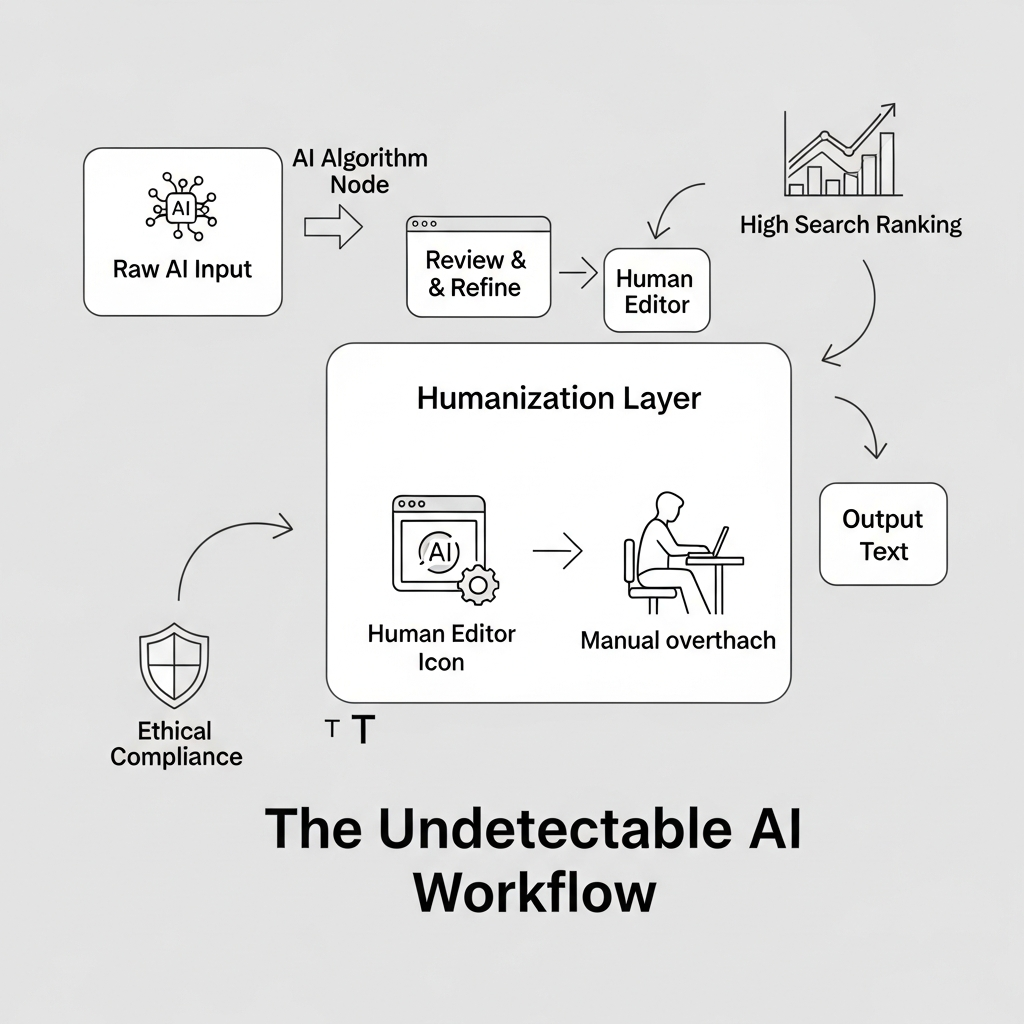
A healthier workflow is:
Step 1: Research from reliable sources
Use primary documentation, interviews, first-party data and subject-matter experts.
Step 2: Build an outline around search intent
Determine exactly what the reader needs to know.
Step 3: Use AI selectively
AI can help organize research, create draft sections or generate alternatives.
Step 4: Edit for originality
Add:
original observations
specific examples
real testing
first-hand experience
expert quotations
proprietary data
Step 5: Humanize where necessary
Use an editor or a rewriting tool to remove repetitive, stiff or unnatural language.
Step 6: Verify every factual claim
Human-sounding misinformation is still misinformation.
Step 7: Publish for the reader, not the detector
The final quality check should focus on usefulness and trust.
Manual Editing vs Undetectable AI
| Factor | Manual Editing | Undetectable AI |
|---|---|---|
| Speed | Slower | Fast |
| Brand nuance | Excellent with skilled editor | Depends on input/output |
| Fact checking | Can be integrated into review | Not automatic |
| Scale | More expensive | Easier |
| Detector score | Not predictable | Product is designed around it |
| Original insight | Possible | Cannot invent genuine experience |
| Best use | Important/high-value content | First-pass rewriting at scale |
The strongest workflow for most professional publishers is hybrid.
Use software for repetitive rewriting, then let a knowledgeable human decide whether the final copy is accurate, useful and true to the brand.
Undetectable AI vs QuillBot
QuillBot is primarily known for paraphrasing, grammar and rewriting.
Undetectable AI places much more emphasis on AI detection and detector-oriented humanization.
Choose QuillBot when rewriting quality and general language assistance matter more.
Consider Undetectable AI when you specifically want detection and rewriting in one interface.
Undetectable AI vs Grammarly
Grammarly is fundamentally an editing and writing-assistance platform.
Its strengths include:
grammar
clarity
tone
rewriting
professional communication
Undetectable AI is more specialized around AI-content classification and rewriting AI-assisted drafts.
A professional writer may reasonably use Grammarly for final editing even after another system generates or humanizes the first draft.
Undetectable AI vs StealthGPT
StealthGPT is another product focused on AI detection and humanization.
The strongest way to compare them is not to ask which one claims to be “more undetectable.”
Use the same source passage and compare:
preservation of factual meaning
clarity
grammar
tone
price
supported languages
integration options
manual editing required afterward
CompareBestAI also maintains a dedicated StealthGPT tool page for users evaluating this category.
Is Undetectable AI Ethical to Use?
The answer depends on how it is used.
Using a rewriting tool to improve the clarity of a legitimate AI-assisted business draft is different from using one to misrepresent authorship where original human work is explicitly required.
Before using a humanizer in:
academic submissions
job assessments
professional certifications
regulated documentation
client work
check the applicable rules.
Passing a detector does not override an institution's or employer's AI policy.
Should Businesses Disclose AI-Assisted Content?
There is no single universal disclosure rule covering all businesses and all forms of AI-assisted writing.
Requirements vary by:
jurisdiction
industry
contract
platform
content type
audience expectations
Google recommends considering disclosures when readers would reasonably benefit from knowing how automated content was produced.
Businesses should therefore develop a consistent internal policy rather than assuming a humanizer removes the need for transparency.
Is Undetectable AI Worth It in 2026?
It can be worth considering if your recurring problem is editing AI-assisted drafts that sound stiff or generic and you also want AI-detection tools in the same platform.
Its starting price is low enough for individuals to test without a large financial commitment.
However, it becomes poor value if the only goal is getting a particular detector score.
Detector results are probabilistic and can change.
SEO performance depends on content quality rather than whether a third-party detector labels the text human.
The best users for Undetectable AI are therefore writers and teams that treat it as an editing tool, not as proof of authenticity.
Frequently Asked Questions
What is Undetectable AI?
Undetectable AI is a platform that combines AI-text detection with tools designed to rewrite AI-assisted text so it reads more naturally. Its main products include the AI Detector and AI Humanizer.
How much does Undetectable AI cost in 2026?
Current pricing starts at $9.99 per month for 10,000 humanization words. Annual billing starts at $60 per year, equivalent to $5 per month.
Does Undetectable AI have a free plan?
The current Humanizer trial is limited to 250 words. Unlimited or higher-volume humanization requires a paid plan.
Does Undetectable AI really pass AI detectors?
Undetectable AI markets its Humanizer around reducing AI-detector flags and offers a refund guarantee under its published conditions. Results can vary, however, and no AI detector should be treated as definitive proof of authorship.
Are AI detectors accurate?
They can identify statistical patterns associated with machine-generated text, but false positives and false negatives occur. Independent research has documented significant reliability problems, including false positives affecting non-native English writers.
Does Google penalize AI-generated content?
Google does not say content is penalized simply because AI helped create it. Its guidance focuses on useful, accurate, reliable and people-first content. Scaled automation used primarily to manipulate search rankings can violate Google's spam policies.
Is Undetectable AI good for SEO?
It can help rewrite stiff copy, but lowering an AI-detector score is not an SEO tactic by itself. SEO teams should prioritize original expertise, accurate sourcing, intent fulfillment and strong editorial review.
Is using Undetectable AI ethical?
It depends on context. Using it to improve legitimate AI-assisted writing is different from using it to conceal prohibited AI use in an academic, employment or regulated setting. Always follow the relevant rules.
What are the best Undetectable AI alternatives?
QuillBot is stronger for general paraphrasing, Grammarly for editing, and StealthGPT is a closer alternative in the AI-humanizer/detector category.
Is Undetectable AI worth paying for?
It can be worthwhile for writers who regularly revise AI-assisted drafts and want detection and rewriting in one platform. It is less useful if the only goal is chasing detector scores.
Final Verdict
Undetectable AI addresses a real problem, but the problem should be defined carefully.
AI-generated drafts can be repetitive, generic and overly polished.
Rewriting those drafts to make them clearer, more natural and closer to a genuine brand voice can be useful.
Undetectable AI provides a convenient combination of detection and rewriting at a relatively accessible starting price.
But its value should not be measured solely by whether a detector changes from “AI” to “human.”
Third-party detector scores are imperfect, and Google does not require content to pass an AI detector to rank.
For professional publishing, the more durable workflow is:
AI assistance → source verification → original insight → human editing → final fact check.
Use a Humanizer when it improves the writing.
Do not use a detector score as a substitute for editorial quality.
Bottom line: Undetectable AI can be a useful editing tool in 2026, particularly for repetitive or formulaic AI-assisted drafts. It should not be treated as an SEO shortcut, proof of human authorship or a replacement for real editorial oversight.
Next step: Test the free 250-word allowance on a real piece of content and judge the result on readability, factual preservation and editing time before choosing a paid plan.