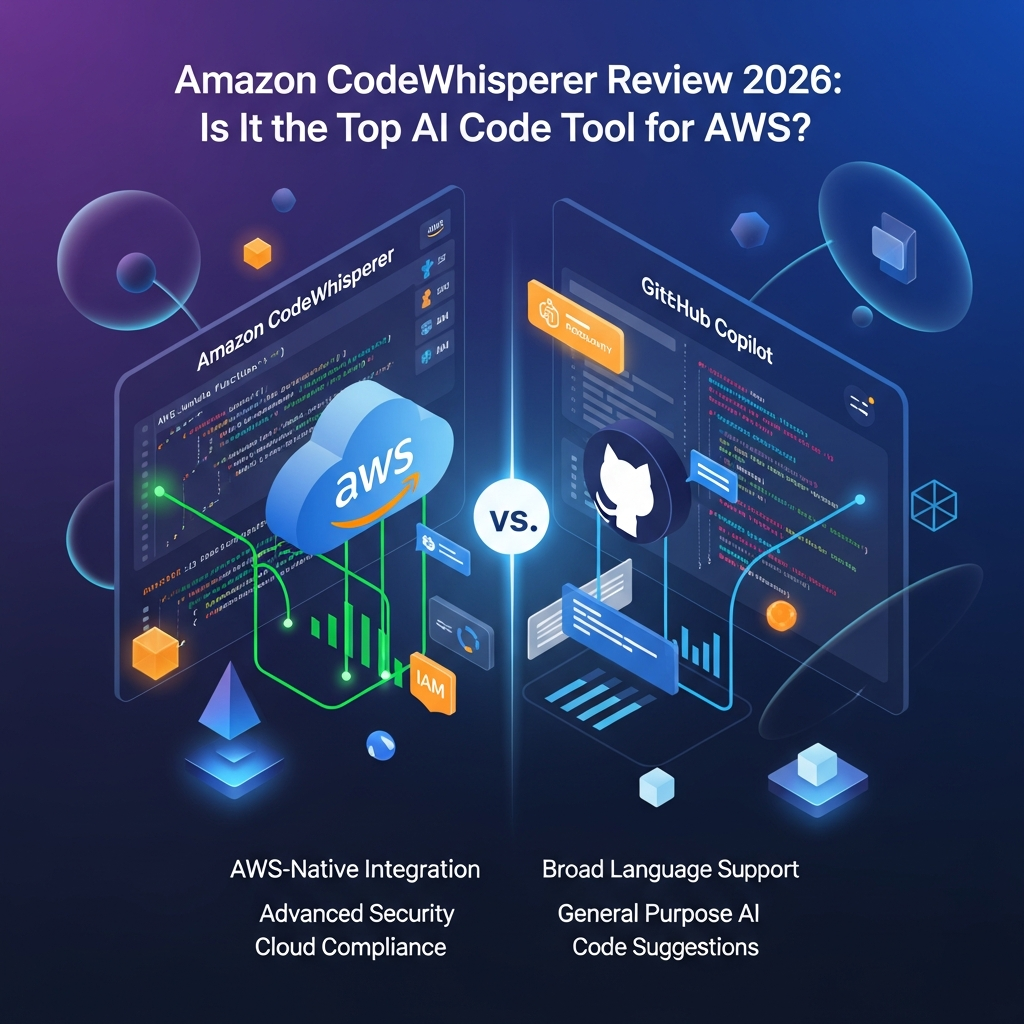

Quick Answer: Amazon CodeWhisperer no longer exists as a standalone AI coding assistant. AWS moved its capabilities into Amazon Q Developer on April 30, 2024. In 2026, Amazon Q Developer's IDE experience is also being phased toward Kiro: new Q Developer IDE accounts and subscriptions stopped on May 15, 2026, while existing users can continue until IDE plugin support ends on April 30, 2027. New developers should evaluate Kiro or competing AI coding tools rather than starting with the old CodeWhisperer product.
If you're searching for an Amazon CodeWhisperer review in 2026, the most important thing to understand is that the product name is now historical.
CodeWhisperer's code completion, security scanning and developer-assistance capabilities were absorbed into Amazon Q Developer. Amazon Q Developer then expanded far beyond the original CodeWhisperer feature set with chat, agentic coding, code reviews, transformations, AWS Console assistance and broader developer workflows.
But AWS's developer-tool strategy has changed again.
As of September 2026, AWS is transitioning the IDE side of Amazon Q Developer toward Kiro, its newer agentic development environment.
Last Updated: September 3, 2026
Amazon CodeWhisperer Review: Current Verdict
CodeWhisperer was a useful AWS-focused AI coding assistant, but it is no longer a product new developers should evaluate on its own.
For existing Amazon Q Developer users, the product still provides useful capabilities such as inline code suggestions, chat, agentic coding, code reviews, security analysis and AWS-specific assistance.
For a new developer choosing an AI coding platform in late 2026, however, the more relevant AWS product is Kiro.
That makes the verdict straightforward:
Existing Q Developer user: continue if it still fits your workflow, but plan your migration.
New AWS-focused developer: evaluate Kiro first.
Developer wanting a broad non-AWS coding assistant: compare alternatives such as GitHub Copilot and Windsurf/Codeium before choosing.
What Happened to Amazon CodeWhisperer?
Amazon CodeWhisperer was AWS's AI coding assistant for generating code recommendations inside development environments.
On April 30, 2024, AWS incorporated CodeWhisperer into Amazon Q Developer.
AWS says familiar CodeWhisperer capabilities—including coding suggestions in IDEs, AWS-context suggestions, command-line functionality and code reviews—continued as Amazon Q Developer features.
This means “Amazon CodeWhisperer” and “Amazon Q Developer” should not be treated as two competing AWS coding products.
In 2026:
CodeWhisperer = legacy product name
Amazon Q Developer = the expanded product that inherited CodeWhisperer's functionality
What Is Amazon Q Developer?
Amazon Q Developer is a generative AI assistant designed to help developers build, understand, troubleshoot, secure and operate software and AWS applications.
AWS currently documents capabilities including:
- conversational coding assistance;
- inline code generation;
- agentic coding;
- security scanning;
- code reviews;
- code refactoring;
- application transformations;
- AWS architecture assistance;
- AWS resource and cost questions;
- console error diagnosis;
- command-line assistance.
Amazon Q Developer is powered through Amazon Bedrock and is designed to incorporate AWS-specific context into its responses.
This is substantially broader than the original CodeWhisperer positioning.

The Biggest 2026 Change: Amazon Q Developer Is Moving Toward Kiro
Anyone publishing an Amazon CodeWhisperer review in 2026 needs to include this section.
AWS announced that Amazon Q Developer IDE plugins and paid subscriptions will reach end of support on April 30, 2027.
More importantly for new buyers, AWS stopped allowing:
new Q Developer Free Tier IDE account creation
and
new Q Developer subscription creation
starting May 15, 2026.
Existing Q Developer Pro customers can continue adding users to existing subscriptions and can continue using the IDE plugins during the transition period.
AWS recommends Kiro for developers who want current agentic coding, chat and MCP functionality.
What this means for buyers
If you already use Q Developer, there is no immediate need to stop.
If you're starting fresh in September 2026, buying decisions should not be based on an old CodeWhisperer comparison.
The relevant AWS decision is increasingly:
Kiro vs GitHub Copilot vs Windsurf vs other modern coding agents
rather than:
CodeWhisperer vs GitHub Copilot
Amazon CodeWhisperer / Q Developer Features
Inline Code Suggestions
The CodeWhisperer-style inline completion workflow still exists through Amazon Q Developer.
Q can use surrounding code and comments to generate suggestions directly in supported development environments.
AWS's documentation lists strong inline-suggestion support across languages including Python, Java, JavaScript, TypeScript, C#, Go, Rust, PHP, Ruby, Kotlin, C, C++, SQL, Swift and others.
AI Chat
Amazon Q Developer can answer questions about code, software development and AWS.
Unlike the original CodeWhisperer experience, Q Developer expanded significantly into conversational assistance.
It can provide help with:
- existing code;
- AWS architecture;
- AWS APIs;
- documentation;
- debugging;
- optimization;
- refactoring.
Agentic Coding
Amazon Q Developer now supports agentic coding in its supported IDEs.
That allows it to do more than autocomplete the next line. Q can work across files, generate changes and assist with broader coding tasks. Current AWS documentation shows agentic coding support in VS Code, JetBrains, Eclipse and Visual Studio.
This is another reason older descriptions of CodeWhisperer as only an autocomplete tool are outdated.
Security Reviews
Security remains one of the stronger parts of the AWS developer-assistant proposition.
Amazon Q Developer can review an individual file or an entire codebase for security and code-quality issues.
AWS says these reviews combine generative AI with rule-based automated reasoning and security detectors informed by AWS and Amazon security practices.
That makes Q useful when the development workflow already depends heavily on AWS infrastructure and security practices.
Code Transformation
Amazon Q Developer also provides code-transformation capabilities.
Current AWS documentation supports Java transformation workflows in VS Code and JetBrains and .NET/C# transformation functionality in Visual Studio.
Existing teams using these features should note that AWS says transformation functionality tied to the Q Developer IDE plugins is also part of the April 2027 end-of-support transition.
Which IDEs Does Amazon Q Developer Support?
Current AWS documentation lists support across:
| IDE / Environment | Current Q Developer Support |
|---|---|
| Visual Studio Code | Yes |
| JetBrains IDEs | Yes |
| Eclipse | Yes |
| Visual Studio | Yes |
| AWS coding environments | Selected functionality |
| Command line | Yes |
Feature availability varies by environment.
Chat, agentic coding, MCP servers, workspace context and inline suggestions are currently documented across several major IDEs.
The major caveat is the announced April 30, 2027 IDE-plugin end-of-support date.

Amazon Q Developer Pricing in 2026
AWS currently publishes two Amazon Q Developer pricing levels:
Free Tier: $0
Pro Tier: $19 per user/month
The Free Tier currently includes 50 agentic requests per month and up to 1,000 lines of Java code transformation per month.
Pro provides higher agentic limits and includes 4,000 lines of Java transformation per user per month, pooled at the account level. Additional eligible Java transformation usage is currently priced at $0.003 per submitted line of code.
There is an important qualification:
new Q Developer IDE accounts and new Q Developer subscriptions stopped being available on May 15, 2026.
Therefore, these prices are most relevant to existing subscriptions, retained service usage and AWS environments where Q Developer continues—not as a recommendation that a new user should simply subscribe today.
What About Kiro Pricing?
Kiro is now the more relevant AWS coding product for new users.
Kiro currently lists:
- Free: $0 with 50 credits
- Pro: $20/month with 1,000 credits
- Pro+: $40/month with 2,000 credits
- Pro Max: $100/month with 5,000 credits
- Power: $200/month with 10,000 credits
Paid plans can purchase additional credits at $0.04 per credit.
The pricing model is therefore different from Q Developer's request/inference structure.
This matters when comparing total cost because AI coding agents can consume usage very differently depending on task complexity.
Amazon CodeWhisperer / Q Developer Privacy and Security
AWS provides several controls worth understanding before using generated code in production.
Code ownership
AWS says developers own the code they write, including suggestions generated by Amazon Q Developer.
However, AWS also makes clear that developers remain responsible for reviewing and validating accepted code.
Reference tracking
Current Amazon Q Developer pricing includes reference tracking and the ability to suppress certain suggestions associated with public code.
Training and service improvement
For Amazon Q Developer Pro, AWS says customer content is not used for service improvement or to train underlying foundation models.
Free Tier content may be used for improvement unless the user opts out.
This distinction should be visible in any business or enterprise-focused review.
Compliance
AWS says Amazon Q Developer is included in its current SOC 1, SOC 2 and SOC 3 reports.
Amazon CodeWhisperer Pros
Strong AWS Context
The original CodeWhisperer proposition made the most sense for developers working heavily with AWS.
That advantage remains relevant through Amazon Q Developer because Q can answer AWS-specific architecture, resource, documentation and operational questions.
Built-In Security Workflows
Security review capabilities are integrated directly into the developer workflow rather than requiring a completely separate assistant.
Free Usage for Existing Eligible Users
Amazon Q Developer continues to provide Free Tier functionality with monthly limits.
Broader Capabilities Than Original CodeWhisperer
Q Developer added chat, agentic coding, application transformation, console assistance and many other capabilities that were outside CodeWhisperer's original scope.
Amazon CodeWhisperer Cons
The Product Name Is Retired
You cannot reasonably evaluate “CodeWhisperer” as a new standalone subscription in 2026.
Q Developer IDE Is Already in Transition
New signups stopped in May 2026 and IDE plugin support ends in April 2027. This is now the most important limitation for new buyers.
Migration Creates Workflow Uncertainty
Existing teams need to decide when and how to move to Kiro.
Free Usage Is Not Unlimited Across Everything
Older reviews often describe Amazon's free developer assistant too broadly. Current AWS pricing explicitly places monthly limits on agentic requests and transformations.
Who Should Still Use Amazon Q Developer?
Amazon Q Developer still makes sense for:
- existing Q Developer subscribers;
- teams deeply integrated with AWS;
- developers using its security review capabilities;
- teams completing Java or .NET transformations before the IDE sunset;
- AWS Console users who rely on Q for resources, architecture and troubleshooting.
AWS has specifically said Q Developer functionality in the AWS Management Console and certain first-party AWS experiences is not affected by the IDE-plugin sunset.
Who Should Choose Something Else?
New developers selecting an AI coding environment should look beyond the legacy CodeWhisperer brand.
Kiro is the obvious AWS-native migration path.
GitHub Copilot remains another relevant option for developers who want an established coding assistant across broader workflows.
Windsurf/Codeium is also worth evaluating when agentic editing and a dedicated AI coding environment are priorities.
The right choice depends on your IDE, cloud stack, codebase, privacy requirements, usage volume and whether you want autocomplete or a more autonomous coding agent.
Amazon CodeWhisperer vs Amazon Q Developer
There is no current competitive comparison between these two products.
Amazon Q Developer absorbed CodeWhisperer's functionality.
Think of it this way:
CodeWhisperer → original AWS AI coding assistant
Amazon Q Developer → expanded successor containing CodeWhisperer capabilities
Kiro → AWS's current migration target for the IDE/agentic coding future
That timeline is much more useful for readers than comparing CodeWhisperer and Q Developer as separate tools.
Is Amazon CodeWhisperer Worth It in 2026?
Not as a new standalone product.
Amazon CodeWhisperer itself has effectively become a legacy search term.
Existing Amazon Q Developer users can continue using its coding, security and AWS-assistance capabilities during the transition.
But for someone starting from scratch in September 2026, the better question is whether Kiro, GitHub Copilot, Windsurf or another current AI coding platform best matches their workflow.
That is the decision this review should help readers make.
Final Verdict
Existing Q Developer users: Continue if it provides value, but prepare for the April 2027 IDE transition.
New AWS-focused developers: Evaluate Kiro first.
Developers wanting broad ecosystem flexibility: Compare multiple current coding assistants before committing.
Recommended CTA: Compare Current AI Coding Tools Before You Choose →
Frequently Asked Questions About Amazon CodeWhisperer
Does Amazon CodeWhisperer still exist?
Not as a standalone product. Amazon CodeWhisperer became part of Amazon Q Developer on April 30, 2024.
What replaced Amazon CodeWhisperer?
Amazon Q Developer absorbed CodeWhisperer's coding functionality. AWS is now also transitioning its IDE-based developer-assistant strategy toward Kiro.
Is Amazon Q Developer free?
Amazon Q Developer has a Free Tier with monthly limits. AWS currently documents 50 agentic requests per month and 1,000 lines of Java transformation per month for eligible Free Tier users.
How much does Amazon Q Developer Pro cost?
The published Pro price is $19 per user per month. However, AWS stopped new Q Developer subscription creation on May 15, 2026 as part of its transition toward Kiro.
When will Amazon Q Developer IDE support end?
AWS says Amazon Q Developer IDE plugins will reach end of support on April 30, 2027.
Is Kiro replacing Amazon Q Developer?
For IDE-based agentic coding, AWS is directing users toward Kiro. Amazon Q Developer continues in several AWS Console and first-party AWS experiences, so it is more accurate to describe this as a migration of the IDE experience rather than the complete disappearance of Q Developer.
Is Amazon Q Developer good for AWS developers?
It remains useful for existing AWS-focused users because it can assist with AWS architecture, resources, code, security and development workflows. New developers should also evaluate Kiro because that is AWS's current direction for IDE-based agentic development.