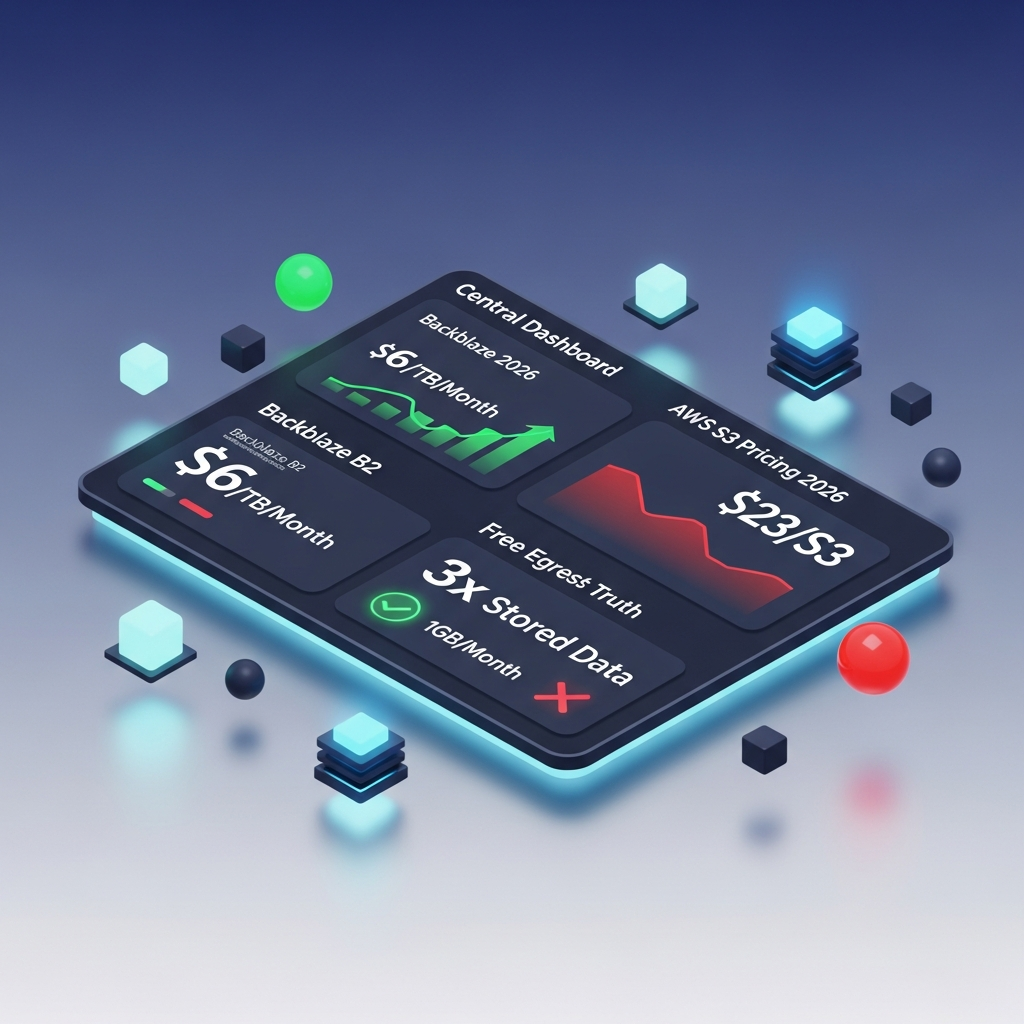

Answer First: Backblaze B2 Cloud Storage starts at $6.95 per TB per month for pay-as-you-go object storage. The first 10GB of storage is free, egress is free up to 3× your average monthly stored data, and additional public-internet egress costs $0.01/GB. Class A, B, and C API transactions are free for pay-as-you-go accounts, while Class D transactions have a small usage fee. B2 Overdrive starts at $15/TB/month for large high-throughput workloads.
Backblaze B2 pricing is appealing to developers, backup teams, SaaS companies, media businesses, and data-heavy organizations that want S3-compatible object storage without a complicated hyperscaler bill.
The most important point, however, is that the headline storage price does not tell the whole story. Your real cost depends on stored data, egress, transaction patterns, performance requirements, and whether you use standard B2, B2 Reserve, or B2 Overdrive.
For CompareBestAI's structured feature and pricing summary, see the Backblaze B2 pricing and features profile.
Backblaze B2 Pricing: Quick Summary
| Pricing factor | Backblaze B2 |
|---|---|
| Pay-as-you-go storage | Starts at $6.95/TB/month |
| Free storage | First 10GB |
| Standard free egress | Up to 3× average monthly storage |
| Egress above allowance | $0.01/GB unless eligible partner routing applies |
| Class A API calls | Free for pay-as-you-go |
| Class B API calls | Free for pay-as-you-go |
| Class C API calls | Free for pay-as-you-go |
| Class D transactions | $0.004 per 10,000, first 2,500/day free |
| Minimum file-size fee | None |
| Minimum storage-duration fee | None |
| B2 Overdrive | Starts at $15/TB/month |
| Overdrive egress | Unlimited free egress |
| Overdrive commitment | Multi-petabyte |
| B2 Reserve | Annual capacity model, starting at 20TB |
| S3 compatibility | Yes |
Current pricing is based on Backblaze's published pricing as checked September 4, 2026. Pricing can change, so production deployments should always verify the vendor's live calculator and pricing page.
What Is Backblaze B2?
Backblaze B2 is an S3-compatible cloud object storage service designed for workloads such as backup and disaster recovery, application storage, media archives, content delivery, AI datasets, and other data-intensive applications.
Backblaze positions B2 as always-hot object storage rather than a broader hyperscale cloud platform. Its current product includes features such as server-side encryption, Object Lock, fine-grained API keys, bucket access logs, CORS, cloud replication, event notifications, and integrations with backup, infrastructure, media, and data tools.
That narrower focus is important when comparing B2 with Amazon S3.
AWS offers a far wider ecosystem of compute, database, networking, serverless, and managed-cloud services. Backblaze focuses much more directly on object storage and predictable storage economics.
You can browse related Infrastructure & Hosting tools on CompareBestAI if you are evaluating B2 alongside broader infrastructure platforms.
Backblaze B2 Pay-As-You-Go Pricing
Backblaze's standard B2 Cloud Storage currently starts at $6.95 per TB per month.
Billing is usage-based. Backblaze says pay-as-you-go storage is calculated from the amount stored per byte-hour during the billing period.
That means you do not necessarily pay for the highest amount of data that appeared in the bucket at any point during the month.
The service also has:
- no minimum file-size fee,
- no minimum storage-duration fee,
- monthly pay-as-you-go billing,
- volume and term discounts for qualifying customers, and
- the first 10GB of storage free.
For an organization storing 1TB continuously for a month, the headline storage portion is therefore approximately $6.95 before any billable excess egress, Class D transactions, premium support, or other optional services.
How Backblaze B2 Free Egress Works
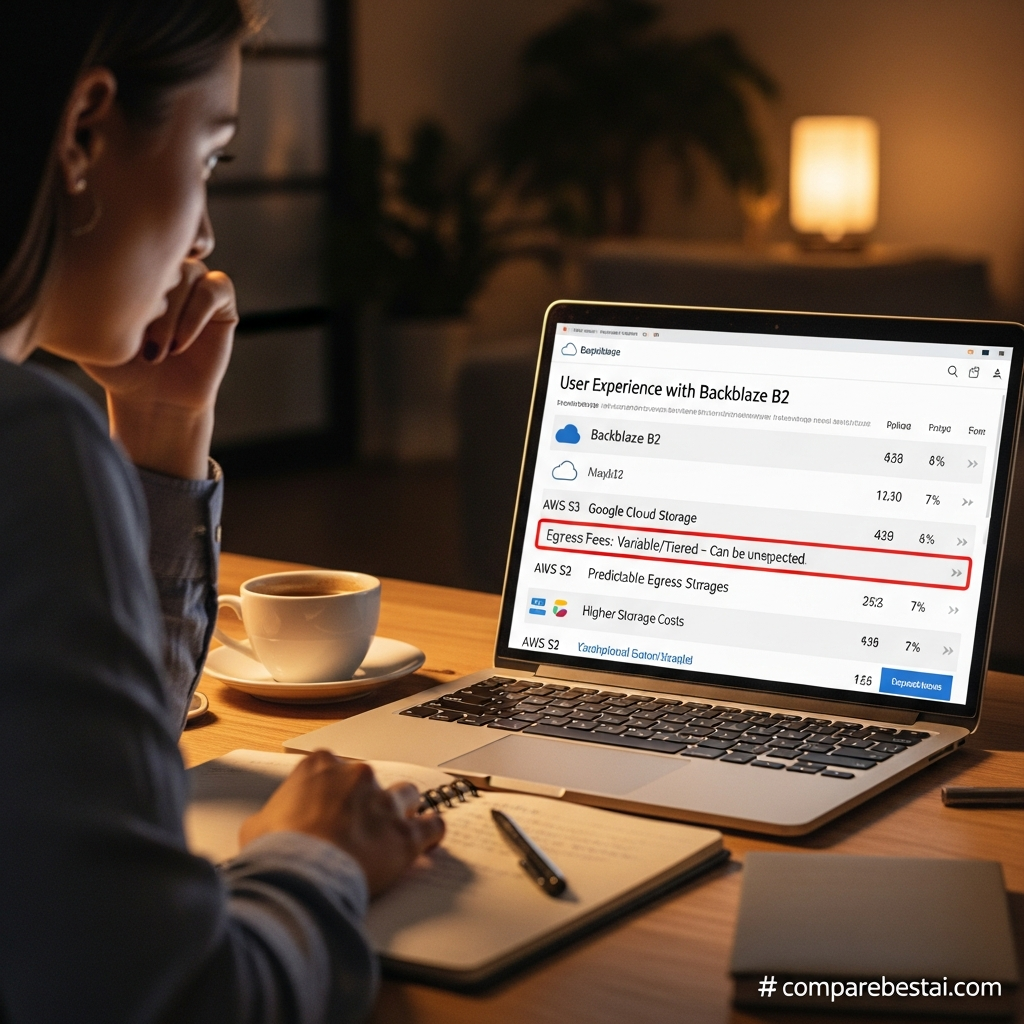
Egress is one of the biggest reasons teams compare Backblaze B2 with Amazon S3.
Standard B2 includes free egress equal to three times your average monthly amount of stored data.
If your monthly average is 1TB, you can transfer up to roughly 3TB out under that standard allowance.
If your monthly average is 4TB, the corresponding free allowance is up to roughly 12TB.
Backblaze calculates the allowance using average monthly storage based on byte-hours. Egress beyond the 3× allowance is billed at $0.01 per GB.
Example: 4TB Stored and 7TB Downloaded
Assume your business averages 4TB of stored data throughout the month.
Storage:
4 × $6.95 = $27.80
Standard free egress allowance:
4TB × 3 = 12TB
Monthly downloads:
7TB
Because 7TB is below the 12TB allowance, there is no standard excess-egress charge in this example.
The previous version of this article incorrectly charged the customer $30 for 3TB of excess egress. That calculation was wrong because the 7TB workload never exceeded the 12TB free allowance.
Can Backblaze B2 Egress Be Completely Free?
In some workflows, yes.
Backblaze says downloads to or through a number of partner CDN and compute services can receive unlimited free egress. Current examples listed by Backblaze include Cloudflare, Fastly, bunny.net, CacheFly, CoreWeave, Vultr, Equinix Metal, and phoenixNAP.
This can materially change total cost for media delivery and cloud architectures built around compatible partners.
B2 Overdrive is different again: it includes unlimited free egress to any destination as part of that product's pricing model.
Backblaze B2 API and Transaction Fees
It is inaccurate to say that every B2 API request is free.
For standard pay-as-you-go B2, Backblaze currently states that Class A, B, and C API calls are free.
Class D transactions are priced at $0.004 per 10,000 calls, with the first 2,500 Class D calls per day free.
For many normal backup and object-storage workloads, transaction fees may therefore remain negligible.
But applications generating very large numbers of Class D operations should include those costs in their forecast rather than treating the entire API layer as unmetered.
Backblaze B2 Overdrive Pricing
B2 Overdrive is Backblaze's high-throughput object storage offering for demanding AI, machine-learning, HPC, research, analytics, and media-processing workloads.
Current pricing starts at:
$15 per TB per month.
Overdrive includes:
unlimited free egress, dedicated vaults, private-networking options, high-throughput infrastructure, and white-glove onboarding/support.
It also requires a multi-petabyte commitment, so this is not simply a premium $15/TB plan intended for ordinary small B2 accounts.
Backblaze currently describes Overdrive throughput options ranging from 100Gbps to 1Tbps.
That makes it most relevant to organizations repeatedly feeding large datasets into GPU clusters, training infrastructure, analytics systems, and other throughput-intensive compute environments.
What Is B2 Reserve?
B2 Reserve is designed for organizations that prefer predictable annual capacity commitments rather than purely monthly pay-as-you-go billing.
Backblaze currently says B2 Reserve capacity starts at 20TB, with annual arrangements suited to customers that want consistent billing and larger storage commitments.
The correct choice depends on scale and budgeting preference.
Pay-as-you-go is generally the simpler option for smaller or variable workloads.
Reserve becomes more relevant when storage needs are substantial and predictable enough to justify a committed annual arrangement.
Backblaze B2 Free Tier
The first 10GB of B2 storage is free.
Unlike a limited-time introductory trial, this storage allowance is presented as an ongoing free amount.
That makes it useful for testing integrations, experimenting with S3 compatibility, running small development workloads, or validating your application before committing meaningful data.
It should not, however, be confused with unlimited free object storage.
Once storage exceeds the free allocation, normal B2 pricing applies.
Does Backblaze B2 Have Minimum Storage Duration Fees?
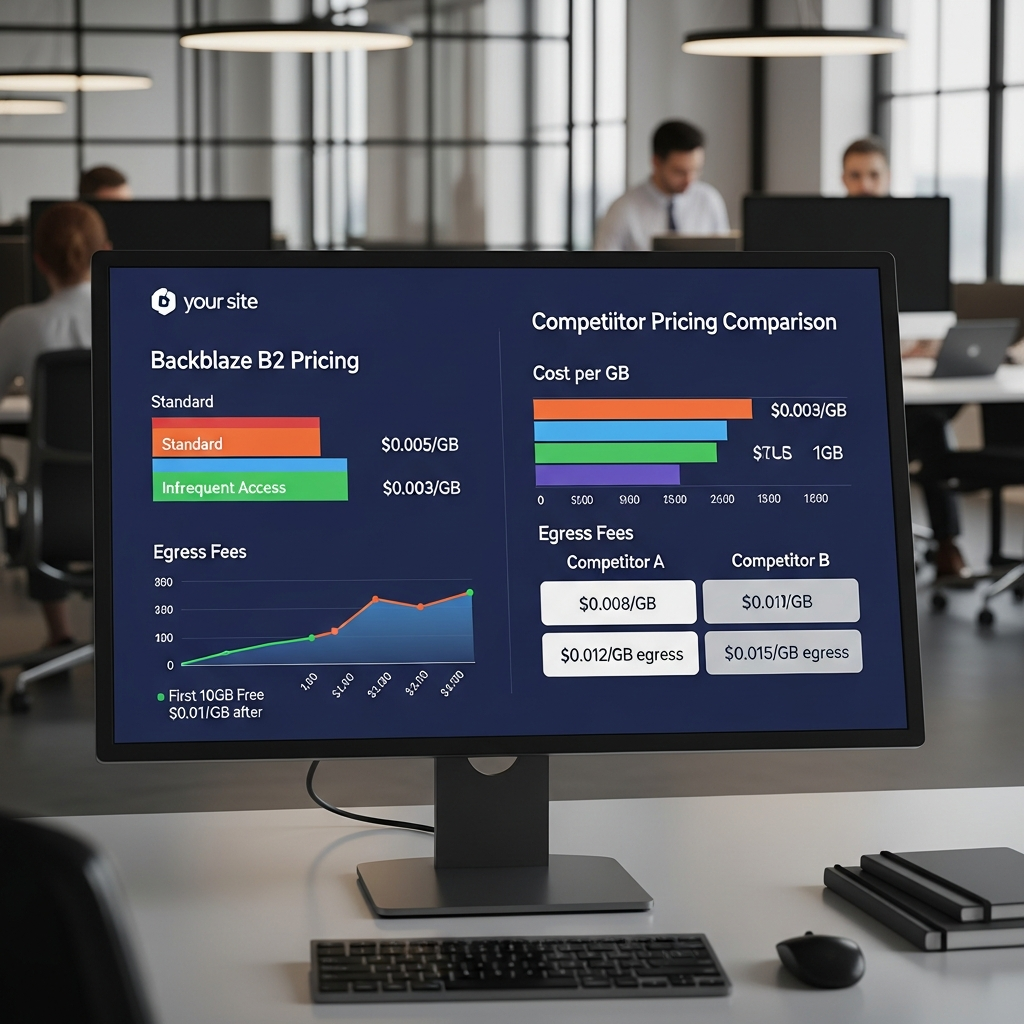
Standard B2 pay-as-you-go currently has no minimum storage duration fee and no minimum file-size fee.
This can matter for dynamic workloads.
If data is frequently uploaded and deleted rather than retained for months, minimum-duration policies can materially affect the real cost of some competing storage services.
With standard B2, you pay based on the data actually stored over time rather than being forced into a minimum retention period for every object.
Backblaze B2 vs Cloudflare R2 Pricing
Cloudflare R2 takes a different approach.
R2 Standard storage currently costs $0.015 per GB-month, and Cloudflare says internet egress is free for its storage classes.
However, R2 charges for operations.
Standard-storage pricing currently includes:
$4.50 per million Class A operations and $0.36 per million Class B operations, after applicable free-tier allowances.
Cloudflare's Standard free tier includes 10GB-month of storage, one million Class A operations, ten million Class B operations, and free egress.
That means R2 can be extremely attractive for bandwidth-heavy public delivery, while B2 may be compelling when lower storage pricing and B2's transaction model better match the workload.
The old version of this article incorrectly stated that R2's free egress was limited to transfers through other Cloudflare services. Cloudflare's current documentation explicitly states that direct R2 internet egress is free.
Backblaze B2 vs Wasabi Pricing
Wasabi Hot Cloud Storage currently starts at $7.99 per TB per month under its pay-as-you-go model.
Wasabi advertises no separate fees for egress or API requests under that pricing structure.
That makes the comparison more nuanced than the previous article suggested.
Backblaze has a lower current headline storage rate at $6.95/TB and gives standard B2 users 3× free egress before charging $0.01/GB.
Wasabi has a higher current headline storage rate but markets a no-egress-fee model.
The right choice depends on your storage-to-download ratio and the contractual or workload conditions applying to your account.
Backblaze B2 vs Amazon S3
Amazon S3 remains substantially broader than Backblaze B2.
AWS pricing is composed of multiple elements including storage class, requests, retrievals, data transfer, replication, and optional management features. AWS explicitly notes that S3 request costs vary by operation and that data-transfer charges can apply.
S3 Standard in common U.S. regions continues to use a first-tier storage rate around $0.023 per GB-month for the first 50TB, but AWS pricing varies by region and usage tier.
Rather than claiming Backblaze is always “80% cheaper,” calculate the workload.
Backblaze tends to be particularly compelling when your requirements center on object storage and you care heavily about predictable egress.
AWS becomes more compelling when the storage layer is tightly integrated with the enormous AWS compute, database, networking, analytics, serverless, and security ecosystem.
Current Backblaze B2 Pros and Cons
| Pros | Cons |
|---|---|
| $6.95/TB/month starting storage rate | No hyperscaler-sized managed-service ecosystem |
| First 10GB free | Standard free egress is capped at 3× average storage |
| 3× free standard egress | Excess public egress can cost $0.01/GB |
| No minimum storage duration fee | Some transaction classes are not free |
| No minimum file-size fee | Fewer infrastructure regions/services than AWS |
| Class A/B/C transactions free for pay-as-you-go | Full S3 feature parity should not be assumed |
| S3-compatible APIs | High-throughput Overdrive requires very large commitments |
| Object Lock and cloud replication | Premium support can be an add-on |
| Partner routes can provide unlimited free egress | Primarily object storage, not an all-in-one cloud platform |
| Overdrive supports high-throughput AI/HPC workloads | Pricing still needs workload-specific modeling |
Who Should Use Backblaze B2?
Backblaze B2 is particularly well suited to teams that need inexpensive always-hot object storage without needing the entire ecosystem of a hyperscale cloud.
Strong use cases include backup and disaster recovery, immutable backup repositories, media archives, application object storage, S3-compatible SaaS backends, AI training datasets, model artifacts, and content workflows.
Backblaze's current product also includes Object Lock, cloud replication, event notifications, and broad integrations with backup and infrastructure tools.
For broader infrastructure evaluation, see CompareBestAI's guide to comparing infrastructure and hosting platforms.
Who Should Consider an Alternative?
Cloudflare R2 deserves serious consideration when internet egress volume dominates the economics of the workload.
Wasabi can make sense for organizations attracted to a capacity-focused price with no separate egress or API-request fees.
Amazon S3 remains attractive when storage needs to operate deeply inside AWS services or when global hyperscale infrastructure breadth outweighs simpler storage pricing.
The best provider therefore depends on total workload cost, not storage price alone.
How We Evaluated Backblaze B2 Pricing
This pricing review uses current first-party documentation rather than assuming that old published prices remain accurate.
We evaluated:
storage pricing, free storage, egress allowances, excess-egress pricing, API transaction fees, minimum-duration policies, B2 Overdrive, B2 Reserve, S3 compatibility, and current competitor pricing.
The most important update from the previous version is the standard B2 storage price: $6.95/TB/month, not $6.
We also corrected the Cloudflare R2 egress model, Wasabi's current headline price, B2 transaction-fee wording, and Overdrive egress and commitment details.
Frequently Asked Questions About Backblaze B2 Pricing
How much does Backblaze B2 cost in 2026?
Backblaze B2 pay-as-you-go currently starts at $6.95 per TB per month. The first 10GB of storage is free.
How does Backblaze B2 free egress work?
Standard B2 includes free egress of up to three times your average monthly stored data. Additional egress is normally $0.01/GB, although supported CDN and compute partners can provide unlimited free egress paths.
Does Backblaze B2 charge for API requests?
Class A, B, and C API calls are currently free for pay-as-you-go customers. Class D transactions cost $0.004 per 10,000 calls after the first 2,500 calls per day.
What does B2 Overdrive cost?
B2 Overdrive starts at $15/TB/month, includes unlimited free egress, and is designed for high-throughput workloads such as AI/ML and HPC. A multi-petabyte commitment is required.
Is Backblaze B2 cheaper than Cloudflare R2?
For raw Standard storage, Backblaze's $6.95/TB starting rate is lower than Cloudflare R2 Standard's $0.015/GB-month rate. However, Cloudflare R2 provides free internet egress while charging for operations, so the cheaper provider depends on how much data you store, download, and access.
Is Backblaze B2 S3 compatible?
Yes. Backblaze markets B2 as S3-compatible object storage and supports integration with many existing cloud, backup, media, and infrastructure tools.
Final Verdict: Is Backblaze B2 Pricing Competitive in 2026?
Yes, Backblaze B2 remains highly competitive for teams that want affordable S3-compatible object storage with predictable egress costs.
At $6.95/TB/month, it is no longer the $6/TB product described in the old version of this article, but its current economics remain straightforward: 10GB free storage, 3× free standard egress, $0.01/GB excess egress, no minimum storage duration, and free Class A/B/C transactions for pay-as-you-go users.
The best fit is a workload where storage cost and predictable data movement matter more than having hundreds of adjacent cloud services.
For high-throughput multi-petabyte AI/HPC workloads, Overdrive changes the equation by adding unlimited egress and substantially higher throughput.
For egress-heavy public delivery, Cloudflare R2 should also be modeled.
And for deeply integrated AWS architectures, S3 may remain worth the higher complexity.