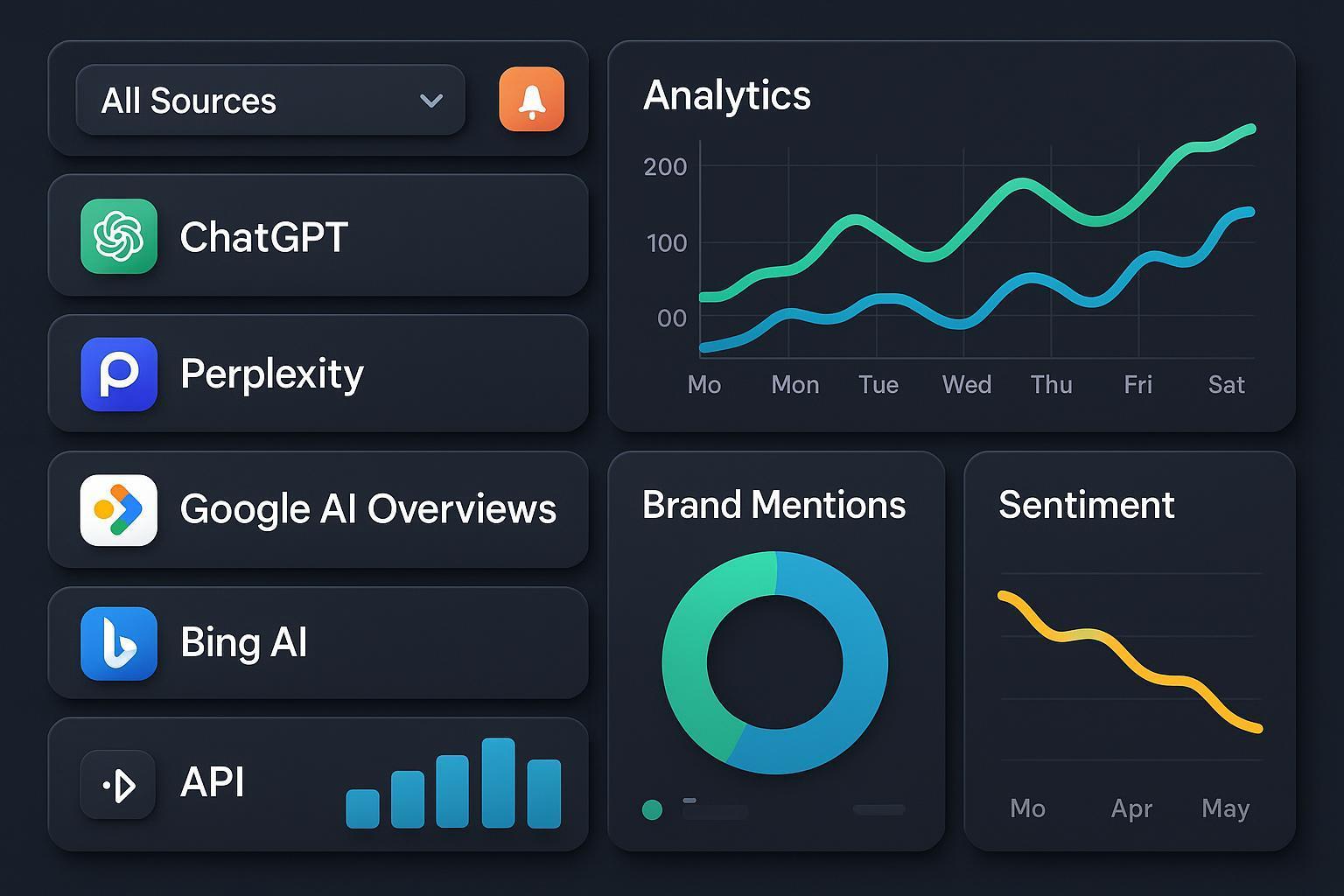

The best AI search visibility tools in 2026 are Peec AI and Otterly.AI for dedicated tracking, Semrush's AI Visibility Toolkit and Ahrefs Brand Radar for teams already using an SEO suite, and Profound for large enterprises. Prices start around $29 a month for Otterly Lite, $95 for Peec AI Starter, and $99 per domain for Semrush. These tools show how often ChatGPT, Perplexity, Gemini, and Google AI Overviews mention or cite your brand.
Choose Otterly.AI if you're a small business testing AI tracking on a budget. Choose Peec AI for flexible, prompt-based tracking across several AI engines. Choose Semrush or Ahrefs if you already pay for one of them. Choose Profound if you're an enterprise that needs many engines and custom reporting.
What Is AI Search Visibility?
AI search visibility is how often, and how favorably, your brand appears in answers generated by AI tools such as ChatGPT, Perplexity, Gemini, Microsoft Copilot, and Google AI Overviews. It includes direct brand mentions, links that cite your website, and how you're described compared with competitors. Optimizing for it is often called GEO (generative engine optimization) or AEO (answer engine optimization).
In this guide, you'll learn:
- How AI visibility tools work and which metrics matter
- What the leading tools cost and which AI engines they cover
- How to measure and audit your LLM visibility step by step
- How to improve AI search visibility with a practical checklist
How Do AI Visibility Tools Work?
AI visibility tools send a set of prompts to AI engines on a schedule, record the answers, and measure how often your brand and your competitors appear. A prompt is a question your customers might ask, such as "What's the best CRM for a small real estate team?"
Most tools follow the same process:
- You add prompts. These are the questions you want to track, usually grouped by topic or product.
- The tool queries AI engines. It runs each prompt on engines like ChatGPT, Perplexity, Gemini, and Google AI Overviews, daily or weekly.
- It analyzes the answers. It checks whether your brand is mentioned, whether your site is cited as a source, and how you're described.
- It reports trends. You see visibility scores, competitor comparisons, and changes over time.
AI Search Visibility Metrics That Matter
Metric | What it measures |
|---|---|
Mention rate | The share of tracked prompts where your brand appears |
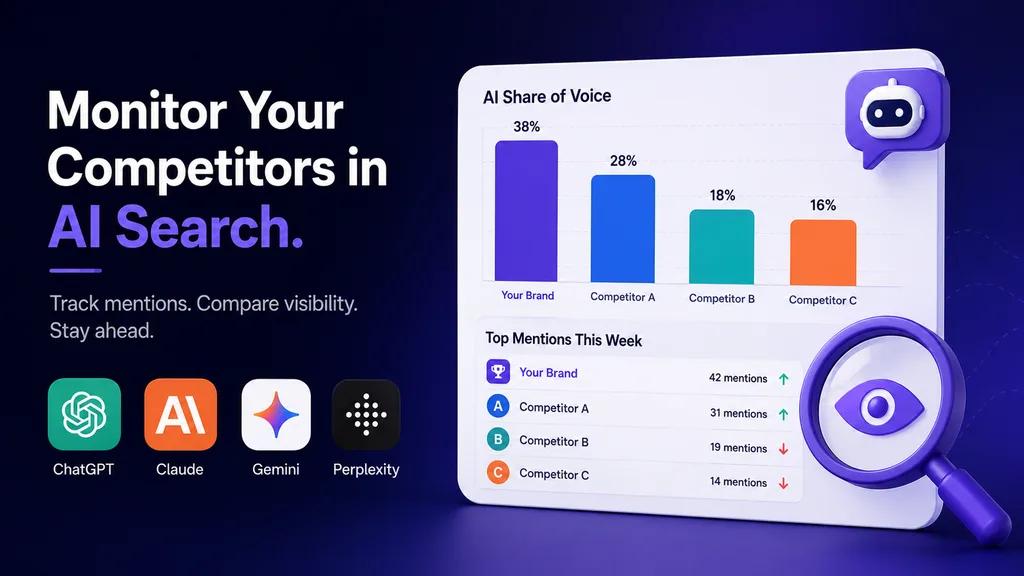
Share of voice | Your mentions compared with competitors across the same prompts |
Citation rate | How often your website is linked as a source |
Position | Where your brand appears in the answer (first, middle, or last) |
Sentiment | Whether the AI describes your brand positively, neutrally, or negatively |
Source domains | Which websites the AI relies on when answering prompts in your category |
An LLM visibility score is usually a single number that combines several of these metrics. Each tool calculates it differently, so compare scores within one tool, not across tools.
Can You Really Track Your Brand in ChatGPT?
Yes, but with limits. AI answers change from one run to the next, and results can differ by location, account, and model version. That's why good tools run each prompt repeatedly and report trends, rather than treating one answer as the truth.
AI Search Visibility Tools Compared (2026 Pricing)
Otterly.AI has the lowest entry price at $29 a month, while SE Ranking gives the most prompts for the money among SEO suite add-ons. Prices are US monthly list prices from recent 2026 pricing reports and vendor pages, and they change often.
Tool | Type | Entry price | Prompts tracked (entry) | AI engines covered |
|---|---|---|---|---|
Otterly.AI Lite | Dedicated tracker | $29/mo | 15 | ChatGPT, Google AI Overviews, Perplexity, Copilot (more as add-ons) |
Surfer AI Search Analytics | SEO tool add-on | $82/mo billed yearly | 50 (daily) | Not fully listed |
SE Ranking AI Search | SEO suite add-on | $89/mo | 200 | Multiple AI engines |
Peec AI Starter | Dedicated tracker | $95/mo | 50 | Choose 3, such as ChatGPT, Google AI Mode, AI Overviews, Gemini (Perplexity +$35) |
Semrush AI Visibility Toolkit | SEO suite add-on | $99/mo per domain | 25 (+50 for $60/mo) | Google AI and ChatGPT confirmed |
Ahrefs Brand Radar | SEO suite add-on | Included with paid plans; AI index from about $199/mo | 5 custom on Lite | Includes Claude |
Frase | Content tool with tracking | $39/mo billed yearly | Included | ChatGPT and Google AI on Starter |
Profound | Enterprise platform | Custom (sales demo) | Custom | Up to 9 engines |
Profound's 2026 Pricing Change
Profound removed its self-serve brand plans in mid-September 2026. Its Starter ($99/month) and Growth ($399/month) plans are gone, and brands now go through an Enterprise sales process. Agencies can still sign up at $399 a month per client workspace.
The Best AI Search Visibility Tools, Reviewed
AI visibility tools fall into two groups: dedicated trackers built only for AI search, and add-ons inside SEO platforms you may already use.
1. Otterly.AI: Best Budget AI Visibility Tool
Otterly.AI is the cheapest way to start tracking AI search. Lite costs $29 a month for 15 prompts on ChatGPT, Google AI Overviews, Perplexity, and Copilot. Standard costs $189 for 100 prompts. Google AI Mode and Gemini are $9 add-ons, and Claude is a $29 add-on.
- Pros: Low entry price, four engines included, simple setup
- Cons: Only 15 prompts on Lite; add-ons raise the real cost
2. Peec AI: Best for Flexible Multi-Engine Tracking
Peec AI is a dedicated tracker that monitors brand mentions, competitors, and the sources AI engines cite. Starter costs $95 a month for 50 prompts on three engines of your choice, Pro costs $245 for 150, and Advanced costs $495 for 350. Perplexity is a $35 add-on, and Claude requires Enterprise.
- Pros: Good mid-market value, choose the engines that matter to you
- Cons: Engine limits on self-serve plans
3. Semrush AI Visibility Toolkit: Best for Semrush Users
Semrush sells its AI Visibility Toolkit for $99 a month per domain, with 25 prompts and 50 more for $60 a month. It's also bundled into Semrush One plans. If you already use Semrush for SEO, keeping AI tracking in the same dashboard is convenient.
- Pros: Combines SEO and AI data, familiar interface
- Cons: Few prompts at the base price; Semrush's pages disagree on which engines are covered
4. Ahrefs Brand Radar: Best for Ahrefs Users
Ahrefs includes Brand Radar with paid plans, starting with 5 custom prompts on Lite. A fuller AI Visibility Index starts around $199 a month. It's useful for comparing your brand's AI presence with competitors.
- Pros: Included with existing paid plans, covers Claude, competitor comparison
- Cons: Very few custom prompts on lower plans
5. SE Ranking AI Search: Best Value SEO Suite Add-On
SE Ranking offers an AI Search add-on at $89 a month ($71.20 billed yearly) for 200 prompts. That's far more prompts per dollar than Semrush's base toolkit.
- Pros: Strong prompt volume for the price, sits alongside rank tracking
- Cons: Requires an SE Ranking plan
6. Profound: Best for Enterprises
Profound tracks up to nine AI engines, including ChatGPT, Perplexity, Gemini, Claude, Copilot, and Google AI Mode. Since September 2026 it's sold through custom enterprise pricing only, with agency workspaces at $399 a month each.
- Pros: Widest engine coverage, built for large brands and agencies
- Cons: No self-serve brand plan or public pricing
Content Tools With Built-In AI Tracking
If you mainly need tracking alongside content work, Frase includes AI visibility on every plan from $39 a month billed yearly, and Surfer offers AI Search Analytics at $82 a month billed yearly. For more options focused on GEO, see our guide to the best GEO tools.
How to Measure and Audit Your LLM Visibility
You can run a basic LLM visibility audit by hand before paying for a tool. A manual audit shows where you stand today, and a tool then tracks changes over time.
LLM Visibility Audit in 6 Steps
- List 20 to 30 buyer questions. Use real questions from sales calls, support tickets, and Google Search Console, such as "best accounting software for freelancers."
- Ask each AI engine. Run every question in ChatGPT, Perplexity, Gemini, and Google AI Mode, using a logged-out or clean session where possible.
- Record the results. Note whether your brand is mentioned, cited with a link, and where it appears in the answer.
- Note your competitors. List which brands show up instead of you and how they're described.
- Check the sources. Look at which websites the AI cites, such as review sites, forums, or industry publications.
- Repeat monthly. AI answers shift often, so a single snapshot can mislead. Track the trend.
A simple spreadsheet with columns for prompt, engine, mentioned (yes/no), cited (yes/no), position, and competitors is enough to start.
Do You Need an AI Search Visibility Tool?
You need a tool once manual checks become too slow, usually when you track more than a few dozen prompts or several engines. Tools also run prompts repeatedly, which gives a more reliable picture than a few manual checks.
AI Search Visibility vs SEO: What's the Difference?
Factor | Traditional SEO | AI search visibility |
|---|---|---|
Goal | Rank in Google's list of results | Get mentioned or cited in AI answers |
Main metric | Rankings, clicks, impressions | Mention rate, citations, share of voice |
Tracking tools | Google Search Console, rank trackers | AI visibility trackers |
What influences it | Content, links, technical health | Content, brand mentions across the web, crawler access, and traditional SEO signals |
The two overlap more than they differ. Google says there are no extra requirements to appear in AI Overviews or AI Mode beyond being indexed and eligible to show a snippet. Strong SEO is still the foundation. Our guide on how to rank in AI search goes deeper on the overlap.
How to Improve AI Search Visibility: A Practical Checklist
There's no trick that guarantees AI mentions. AI engines draw on content they can access and trust, so the best strategies combine solid SEO with a strong presence across the web.
AI Search Visibility Checklist
- Let AI crawlers reach your site. OpenAI's crawler documentation says sites that block OAI-SearchBot won't be shown in ChatGPT search answers, so check your robots.txt.
- Keep pages indexable. Google's guidance on AI features says a page needs to be indexed and eligible to show a snippet to appear in AI Overviews or AI Mode, with no extra technical requirements.
- Answer questions directly. Put a clear, one- or two-sentence answer right under each question-based heading.
- Use specific facts. Include prices, dates, names, and numbers that AI tools can quote.
- Add comparison tables and lists. Structured content is easier for AI systems to summarize.
- Build brand mentions. Earn coverage on review sites, industry publications, podcasts, and community forums that AI engines cite.
- Keep information consistent. Make sure your business details match across your site, profiles, and directories.
- Update key pages. Refresh pricing, features, and statistics so AI tools don't repeat outdated facts.
Does Structured Data Help AI Search Visibility?
It helps search engines understand your pages, but it isn't a requirement for AI features. Google states that no special schema.org markup is needed to appear in AI Overviews or AI Mode. Use structured data as part of good SEO, and make sure it matches the visible text on the page.
Why Brand Mentions Matter for AI Search Visibility
AI engines often build answers from several sources, including review sites, comparisons, and discussions. If your brand rarely appears on the sites that rank for your category, AI tools have little to draw from. Use your visibility tool's source data to find the domains AI cites most, then focus your PR and outreach there.
How to Optimize Website Pages for AI Search
- Start each page with a direct answer to its main question.
- Use descriptive, question-based H2 and H3 headings.
- Break long paragraphs into short sections with one idea each.
- Add a summary or key takeaways section.
- Show expertise with author details, sources, and original data where you have it.
AI Search Visibility Tools FAQs
What are AI visibility tools?
AI visibility tools track how often AI engines like ChatGPT, Perplexity, Gemini, and Google AI Overviews mention or cite your brand. They run your chosen prompts on a schedule and report mentions, citations, and competitor share of voice.
How much do AI search visibility tools cost?
Entry plans cost about $29 to $99 a month. Otterly.AI starts at $29, Peec AI at $95, Semrush's AI Visibility Toolkit at $99 per domain, and SE Ranking's add-on at $89. Enterprise platforms like Profound use custom pricing.
How do you measure AI search visibility?
Track a set of buyer questions across AI engines and measure mention rate, citation rate, share of voice, position, and sentiment over time. You can start manually with a spreadsheet, then move to a tool as you scale.
How do you monitor your brand in ChatGPT, Perplexity, and Google AI?
Use a tracker such as Otterly.AI or Peec AI that runs your prompts on each engine regularly. For a free start, ask each engine your top questions monthly and log the results.
Is AI search visibility the same as SEO?
No, but they overlap. SEO focuses on rankings in search results, while AI search visibility focuses on mentions and citations in AI answers. Good SEO remains the foundation for both.
Do you need structured data for AI search visibility?
No. Google says no special structured data is required to appear in AI Overviews or AI Mode. Structured data still supports general SEO when it matches visible content.
Which AI visibility tool should a small business use?
Otterly.AI Lite at $29 a month is the easiest starting point. If you already pay for Semrush, Ahrefs, or SE Ranking, try its AI add-on first.
How long does it take to improve AI search visibility?
There's no fixed timeline. Changes to crawler access and on-page answers can show up faster, while earning brand mentions across the web takes longer. Track monthly trends rather than daily swings.
Key Takeaways
- Best budget tracker: Otterly.AI, from $29 a month for 15 prompts
- Best multi-engine tracker: Peec AI, from $95 a month for 50 prompts
- Best for SEO suite users: Semrush ($99 per domain), Ahrefs Brand Radar (included with paid plans), and SE Ranking ($89 for 200 prompts)
- Best for enterprises: Profound, now custom-priced only
- Key metrics: Mention rate, citation rate, share of voice, position, and sentiment
- Biggest improvement levers: Crawler access, indexable pages, direct answers, and brand mentions on cited sites
- Structured data: Helpful for SEO, but not required for Google's AI features
Final Verdict: Start Small, Then Scale Your AI Tracking
AI search visibility tools are worth it once AI answers start influencing how customers find you. Start with a manual audit of 20 to 30 buyer questions, then pick a tool that fits your budget and the engines your audience uses. Small businesses can begin with Otterly.AI, growing brands with Peec AI or an SEO suite add-on, and enterprises with Profound.
At CompareBestAI, we compare AI and SEO tools side by side on pricing, features, and real use cases, so you can choose with confidence. Ready to pick a tracker? Use the CompareBestAI comparison tool to compare AI search visibility tools and SEO platforms head to head. If you’re also interested in maximizing your Learning & Courses strategy with AI, check out our dedicated roundup. And for additional methods on how to track AI search visibility in 2026, see our latest practical guide.


