
By CompareBestAI
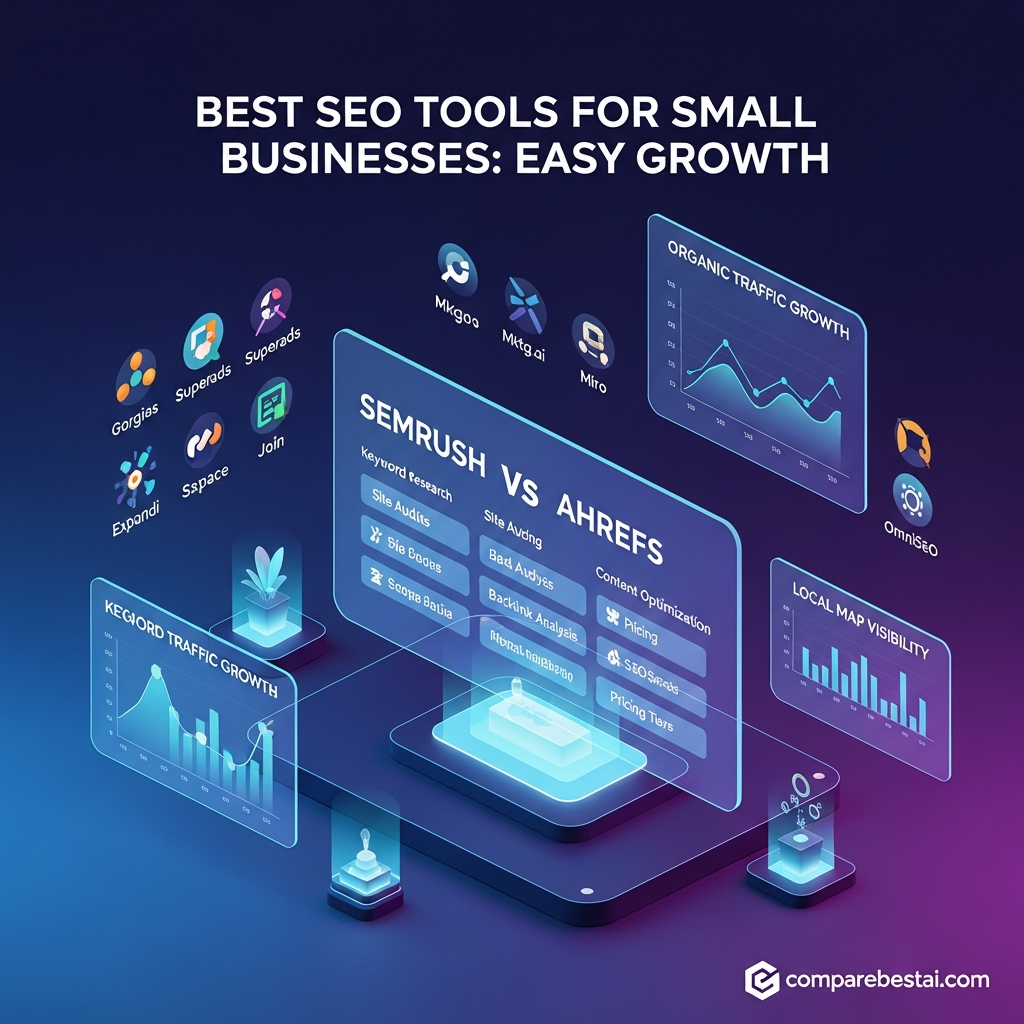
Quick Answer: The best SEO tools for small businesses in 2026 are Google Search Console for free first-party Google data, Ubersuggest for budget-friendly all-in-one SEO, Semrush for businesses investing seriously in organic growth, Ahrefs for backlinks and competitor research, Screaming Frog for technical SEO, SE Ranking for growing teams that need SEO plus AI-search tracking, and BrightLocal for local search visibility. Most small businesses do not need all seven—start with free Google data, then add one paid tool that solves your biggest SEO bottleneck.
Small businesses rarely fail at SEO because they lack enough dashboards.
They usually struggle because they have limited time, limited budget, and no clear way to turn SEO data into next actions.
The right small-business SEO stack should therefore answer a few practical questions:
- What are customers searching for?
- Which pages already have visibility?
- What technical issues are blocking the site?
- What are competitors ranking for?
- Are rankings improving?
- For local businesses, can nearby customers actually find the company on Google?
The goal isn't to buy the most powerful SEO platform.
It is to buy the smallest useful stack that helps your business make better search decisions every week.
For a budget-first comparison, see CompareBestAI's affordable SEO tools for small businesses.
Best SEO Tools for Small Businesses at a Glance
| Rank | Tool | Best For | Free Option | Paid Starting Point |
|---|---|---|---|---|
| 1 | Google Search Console | First-party Google search data | Yes | Free |
| 2 | Ubersuggest | Budget all-in-one SEO | Limited free access | $29/month |
| 3 | Semrush | Premium all-in-one SEO | Limited free account | $139/month |
| 4 | Ahrefs | Backlinks and competitor research | Free verified projects | Starter $29; Lite $129/month |
| 5 | Screaming Frog | Technical SEO audits | Up to 500 URLs | $279/year |
| 6 | SE Ranking | SEO + AI visibility for growing teams | 14-day trial | Core $129/month |
| 7 | BrightLocal | Local SEO | Trial available | Platform pricing varies; citations from $2 each |
Pricing checked September 7, 2026. Plan names, feature limits and discounts change, so verify current provider pricing before purchasing.
Google Search Console is free. Ubersuggest's Individual plan is $29/month. Semrush's current SEO plan costs $139 monthly or $117.33/month equivalent on annual billing. Ahrefs Lite is $129/month, while its Starter plan is $29. Screaming Frog's free edition crawls up to 500 URLs and its US paid licence is $279/year. SE Ranking Core is $129 monthly or $103.20/month equivalent when billed annually.
Best starting strategy: use Google Search Console first. Add one paid tool only after you can clearly name the SEO problem that free Google data cannot solve efficiently.
How We Chose the Best SEO Tools for Small Businesses
Small businesses should not be ranked against agency or enterprise requirements.
We evaluated these tools around seven SMB-specific factors.
1. Useful SEO Coverage
A small-business platform should help with at least one major search workflow:
- Keywords
- Site auditing
- Search performance
- Rank tracking
- Competitor research
- Backlinks
- Content optimization
- Local SEO
2. Ease of Use
A tool that takes weeks to understand can be expensive even when the subscription looks cheap.
3. Price-to-Usefulness
We care more about the features a small business will actually use than the total number available.
4. Actionability
Does the platform help identify what should be done next?
5. Free or Low-Risk Entry
Free accounts, trials, and low-cost plans matter when the business is still proving its SEO workflow.
6. Scalability
The tool should remain useful as the website adds pages, locations, products, or team members.
7. Current Search Visibility
In 2026, some businesses also want to monitor visibility beyond traditional blue links, including AI search environments. This matters more as SEO and AI-search measurement begin to overlap.
For more information about CompareBestAI's evaluation process, see how CompareBestAI ranks tools.
1. Google Search Console — Best Free SEO Tool for Small Businesses
Best for: Every website owner.
Price: Free.
Google Search Console should usually be the first SEO tool a small business sets up.
Google describes Search Console as a free service that helps website owners monitor, maintain and troubleshoot their presence in Google Search. It provides information about queries, clicks, impressions, crawling, indexing and links.
That makes it fundamentally different from third-party SEO software.
Platforms such as Semrush, Ahrefs or Ubersuggest estimate large parts of the search market.
Search Console tells you what your verified site actually experienced in Google Search.
What Search Console Can Tell You
You can use it to identify:
- Queries generating impressions.
- Pages gaining or losing clicks.
- Search click-through rates.
- Country-level performance.
- Indexing problems.
- Crawling issues.
- Sitemap problems.
- Linking information.
- Pages that already have visibility but may need improvement.
Google's Performance reports expose metrics including clicks, impressions, CTR and average position.
Why It Matters for Small Businesses
Suppose a local accounting firm discovers that its page about “small business tax accountant” receives 4,000 monthly impressions but very few clicks.
That is a much more actionable opportunity than randomly generating another 50 blog ideas.
Search Console helps identify demand that already exists around your own site.
Main Limitation
It does not provide full competitive intelligence.
You cannot rely on it alone for deep competitor keyword research, broad backlink databases or market-wide keyword discovery.
Verdict: Every eligible business website should set up Search Console before paying for an SEO suite.
2. Ubersuggest — Best Budget All-in-One SEO Tool
Best for: Solo owners, bloggers, service businesses and small teams that want multiple SEO functions without premium pricing.
Ubersuggest is one of the easiest paid platforms to justify when budget is tight.
Its current Individual plan costs $29/month and supports one project, 125 tracked keywords, weekly site crawling of up to 1,000 pages per report, keyword research, competitor analysis, backlinks and AI-search visibility features.
What Ubersuggest Covers
The platform currently includes:
- Keyword research.
- Keyword ideas.
- Rank tracking.
- Site audits.
- Competitor analysis.
- Content ideas.
- Backlinks.
- AI-search visibility.
- SEO training and support.
Why It Fits Small Businesses
A business owner often does not need maximum database depth.
They need a platform that answers:
What should I publish?
What is wrong with my site?
Where do I rank?
What are competitors doing?
Ubersuggest addresses all four without requiring a three-figure monthly subscription.
Ubersuggest's Main Limitation
The lower price comes with lower usage limits and less depth than premium SEO datasets.
A multi-site agency or advanced SEO team can outgrow the Individual plan quickly.
Explore Ubersuggest on CompareBestAI.
Verdict: Ubersuggest is our strongest budget all-in-one starting point for a small business that has moved beyond free Google tools.
3. Semrush — Best Premium All-in-One SEO Platform
Best for: Small businesses where organic search is already a serious growth channel.
Semrush is considerably more expensive than Ubersuggest, but it also provides a broader SEO research environment.
The current Semrush SEO plan costs $139/month, or $117.33/month equivalent when billed annually. It supports five monitored websites and 500 daily tracked keywords, along with keyword research, competitor analysis, Position Tracking, Site Audit and AI-search visibility functionality.
Where Semrush Is Strong
A growing small business can use it for:
- Keyword research.
- Competitor analysis.
- Ranking monitoring.
- Site audits.
- Content opportunities.
- Backlink workflows.
- Search visibility.
- AI-search monitoring.
When the Price Makes Sense
Semrush becomes easier to justify when:
- SEO produces leads every month.
- You publish consistently.
- You actively monitor competitors.
- You manage multiple websites or locations.
- Rank tracking is part of a weekly workflow.
- An in-house marketer regularly uses the data.
When It Is Probably Too Much
If you open your SEO software once every six weeks, Semrush may be overkill.
A $139 subscription cannot generate ROI from a workflow that does not exist.
Read the Semrush SEO review or explore Semrush AI.
Verdict: Semrush is the strongest premium option here when SEO is strategically important enough to justify a full platform.
4. Ahrefs — Best for Backlinks and Competitor Research
Best for: Small businesses operating in competitive organic-search markets.
Ahrefs is particularly useful when your questions are competitive:
- Why does that competitor outrank us?
- Which websites link to them?
- Which pages bring them traffic?
- What keywords do their strongest pages rank for?
- Where are our content gaps?
Ahrefs currently offers a $29 Starter plan, while Lite costs $129/month. Lite is explicitly positioned for small businesses and personal projects and currently includes five projects, 750 tracked keywords and 100,000 crawl credits.
What Ahrefs Is Strong At
Ahrefs provides:
- Site Explorer.
- Keywords Explorer.
- Backlink research.
- Competitive analysis.
- Site Audit.
- Rank Tracker.
- Content research.
- SERP history.
- AI-search tracking on supported plans.
Starter vs Lite for a Small Business
The $29 Starter plan can be useful when you need occasional research without committing to the full Lite subscription.
Lite makes more sense when SEO is a recurring activity rather than an occasional check.
Main Limitation
At $129/month for Lite, Ahrefs is not automatically a good investment simply because its data is powerful.
If your SEO strategy is still at the “set up basic pages and fix obvious problems” stage, Search Console plus a lower-cost product may deliver better value.
Explore Ahrefs on CompareBestAI.
Verdict: Ahrefs is best for small businesses where competitor research and backlinks are central to growth.
5. Screaming Frog SEO Spider — Best Technical SEO Tool
Best for: Website audits, migrations, ecommerce sites and businesses with technical SEO problems.
Screaming Frog SEO Spider solves a different job from Semrush, Ahrefs or Ubersuggest.
It crawls your website and exposes technical implementation at URL level.
The free version currently crawls up to 500 URLs. The paid US licence costs $279 per year and adds unrestricted crawling subject to machine resources, scheduling, JavaScript rendering, crawl comparisons, structured-data validation and multiple integrations.
What It Can Find
Screaming Frog can identify:
- Broken internal links.
- Redirect chains.
- Missing titles.
- Duplicate metadata.
- Canonical issues.
- Hreflang errors.
- Duplicate content.
- Structured-data issues.
- JavaScript-rendering problems.
- Internal-linking weaknesses.
- Missing directives.
- Sitemap problems.
Why the Free Version Is Valuable
Many small-business websites contain fewer than 500 crawlable URLs.
That means the free edition can be enough for substantial technical auditing without any subscription.
Main Limitation
Screaming Frog is not designed to replace a keyword database or competitive backlink platform.
It works best alongside Search Console or another research tool.
Explore Screaming Frog SEO Spider.
Verdict: For a small website with technical problems, Screaming Frog's free version may create more value than another expensive keyword platform.
6. SE Ranking — Best for Growing Teams and SEO + AI Visibility
Best for: Businesses that have outgrown beginner software and want rank tracking, auditing, competitor research and AI visibility in one environment.
SE Ranking's product has moved considerably upmarket.
Its current Core plan costs $129/month, or $103.20/month equivalent on annual billing. Core includes 10 projects, 2,000 daily tracked keywords, 100 tracked AI prompts, five domains for GEO research and up to 250,000 audited pages per month.
Why It Can Make Sense
For one tiny website, those limits may be excessive.
But they become more useful for a growing company with:
- Multiple locations.
- Several websites.
- Multiple product/service categories.
- A dedicated marketing employee.
- Regular rank tracking.
- AI-search visibility requirements.
SEO + GEO
SE Ranking now combines traditional search measurement with AI-search monitoring.
That can help teams monitor both rankings and emerging visibility across AI-driven search systems.
Main Limitation
It is no longer the ultra-cheap rank tracker that some older comparisons describe.
Evaluate current pricing, limits and add-ons rather than relying on historical SE Ranking pricing.
Explore SE Ranking on CompareBestAI.
Verdict: SE Ranking makes the most sense once your small business behaves more like a small marketing team than a solo DIY operation.
7. BrightLocal — Best for Local SEO
Best for: Dentists, clinics, restaurants, plumbers, electricians, lawyers, agencies, salons, home-service companies and other location-dependent businesses.
A local small business has a different SEO problem from a national ecommerce company.
The business may care less about ranking a blog internationally and much more about appearing when someone nearby searches:
“dentist near me”
or:
“emergency plumber in Austin.”
BrightLocal is built specifically around local search.
Its current platform supports:
- Local SEO audits.
- Local rank monitoring.
- Competitor tracking.
- Geo-grid rank tracking.
- Citation auditing.
- Google Business Profile auditing.
- Listing management.
- Reputation/local presence workflows.
BrightLocal's current pricing page displays platform pricing based on the number of locations rather than exposing one universal static monthly figure in the crawl. Its Citation Builder starts from $2 per citation.
Why It Is Different
Ahrefs and Semrush are broad search platforms.
BrightLocal is specialized around local visibility.
For a service-area company, that specialization can matter more than having millions of additional international keyword records.
Explore BrightLocal on CompareBestAI.
Verdict: BrightLocal is the specialist choice when local rankings, citations and Google Business Profile visibility matter more than national SEO research.
Google Business Profile: Essential for Local Small Businesses
If your company serves customers face to face at a storefront or in a service area, Google Business Profile should be part of your local visibility setup.
Google states that eligible businesses can create and manage a Business Profile on Search and Maps at no charge. Businesses can manage hours, location/service-area information, photos, reviews and other customer-facing information.
It does not replace BrightLocal or a full SEO suite.
But for an eligible local business, ignoring it while paying for expensive SEO software makes little sense.
Best SEO Tool by Small-Business Use Case
| Business Need | Best Starting Choice |
|---|---|
| Free Google performance data | Google Search Console |
| Lowest-cost all-in-one | Ubersuggest |
| Premium all-in-one SEO | Semrush |
| Backlinks and competitors | Ahrefs |
| Technical auditing | Screaming Frog |
| Growing multi-site SEO team | SE Ranking |
| Local SEO | BrightLocal |
Best SEO Tool by Budget
$0 Budget
Start with:
Google Search Console + Google Business Profile if eligible + Screaming Frog Free
That gives many small businesses enough information to begin improving search visibility without paying anything.
Around $30 per Month
Add:
Ubersuggest
This creates a useful combination of first-party Google data plus third-party keyword, competitor and audit information.
$100–$150 per Month
At this level, consider:
Semrush, Ahrefs Lite or SE Ranking
But choose based on workflow rather than brand reputation.
Paying for three overlapping suites is rarely necessary for a small company.
Do Small Businesses Need Semrush and Ahrefs?
Usually not.
Both products cover significant portions of:
- Keyword research.
- Competitor research.
- Site auditing.
- Rank tracking.
- Backlink research.
Their datasets, interfaces and specialist strengths differ, but a small company rarely needs to maintain both unless SEO already generates enough revenue to justify the duplicated cost.
A more rational stack is often:
Search Console + Semrush
or
Search Console + Ahrefs
rather than:
Search Console + Semrush + Ahrefs + three more overlapping tools.
For broader platform comparisons, explore CompareBestAI's guide to all-in-one SEO tools.
Which SEO Tools Should Local Businesses Use?
For a local business, prioritize:
- Google Search Console.
- Google Business Profile.
- BrightLocal if deeper local rank/citation monitoring is required.
- One keyword/competitor platform such as Ubersuggest, Semrush or Ahrefs.
- Screaming Frog if technical auditing is required.
A local plumbing company does not need the same software stack as a national SaaS company.
Its most valuable visibility may come from:
- Maps.
- Local organic results.
- Service-area pages.
- Reviews.
- Business Profile visibility.
- Local citations.
- Conversion-focused service pages.
How to Choose an SEO Tool for Your Small Business
Step 1: Set Up Free Google Data First
Before buying anything, configure Search Console.
If eligible for local search, also configure Google Business Profile.
Step 2: Identify Your Biggest SEO Bottleneck
Choose one:
- “We don't know what keywords to target.”
- “Our website has technical issues.”
- “We don't know why competitors outrank us.”
- “We need local rankings.”
- “We cannot track progress.”
- “We need content ideas.”
Step 3: Choose a Tool Built for That Job
Do not buy a general platform because its feature list is longer.
Step 4: Check Real Plan Limits
Compare:
- Number of projects.
- Keywords tracked.
- Crawl limits.
- Competitors.
- Users.
- Locations.
- AI prompts.
- Reports.
- Data exports.
Step 5: Test It on Your Own Website
Do not judge a platform from its demo dashboard.
Use your domain.
Ask it to solve a real problem.
Step 6: Measure Actionability
A useful SEO tool should change what you do next.
If the platform shows 300 charts and generates no clear action, its data has little operational value.
Step 7: Measure Business Results
Track:
- Search impressions.
- Organic clicks.
- Qualified leads.
- Calls.
- Form submissions.
- Ecommerce revenue.
- Local actions.
- Conversion rate.
Rankings alone are not the business objective.
What Metrics Should Small Businesses Actually Watch?
Small companies do not need to monitor 100 SEO KPIs.
Start with:
Google Search Impressions
Are more relevant users seeing the site?
Organic Clicks
Are those impressions turning into visits?
Qualified Organic Leads
Are search visitors becoming prospects?
Organic Conversion Rate
Does SEO traffic produce business outcomes?
Local Visibility
For local companies, are important searches triggering the business in relevant areas?
Technical Health
Are indexing, crawling or site errors preventing important pages from performing?
Rankings for High-Value Queries
Track keywords connected to revenue rather than vanity terms.
Third-Party SEO Data vs Google Search Console
This distinction is important.
Semrush, Ahrefs, Ubersuggest and similar products estimate many search-market metrics using their own datasets and methodologies.
Search Console provides data from your verified property's actual Google Search performance.
Use third-party software for:
discovery, competitor intelligence and opportunity research
Use first-party data for:
validation and business decision-making
Do not interpret third-party traffic estimates as exact analytics figures.
Do SEO Tools Guarantee Higher Rankings?
No.
SEO software provides information.
It does not make Google's ranking decisions for you.
A tool can identify:
- Keywords.
- Technical problems.
- Competitors.
- Backlinks.
- content gaps.
- ranking movements.
But execution still matters:
- Content quality.
- Website structure.
- technical implementation.
- Search intent.
- Links.
- reputation.
- product/service quality.
- user experience.
Buying an SEO subscription without implementing the findings usually produces little value.
FAQs About SEO Tools for Small Businesses
What is the best SEO tool for a small business?
For most businesses, Google Search Console should be the first tool because it is free and provides first-party Google Search data. Ubersuggest is a strong budget all-in-one option, Semrush is suitable for businesses investing heavily in organic growth, and BrightLocal is particularly useful for local companies.
What is the best free SEO tool for small businesses?
Google Search Console is the strongest free foundation. It provides information about clicks, impressions, queries, indexing and other Google Search performance signals. Screaming Frog also offers a free 500-URL crawler, which is especially useful for smaller websites.
Is Ubersuggest good for a small business?
Yes, particularly when cost is a major consideration. Its Individual plan currently costs $29/month and combines keyword research, rank tracking, site auditing, competitor analysis, backlinks and AI-search features.
Is Semrush worth it for a small business?
It can be when SEO is already an important customer-acquisition channel and someone on the team uses the platform consistently. At $139/month on monthly billing, it is harder to justify for businesses that only perform occasional SEO work.
What is the best local SEO tool for a small business?
Google Business Profile is an essential free foundation for eligible local businesses. BrightLocal is a stronger specialist option when you need deeper local rank tracking, geo-grid analysis, citation management and Google Business Profile auditing.
How many SEO tools does a small business need?
Usually fewer than expected. A practical starting stack is Google Search Console plus one paid SEO tool. Add a specialist technical or local SEO platform only when a specific workflow justifies the additional cost.
Final Verdict: Which SEO Tool Should a Small Business Choose?
For most small businesses, the right SEO stack starts with Google Search Console.
It is free, first-party, and tells you how your site actually performs in Google Search.
Add Ubersuggest when you need affordable keyword and competitor research.
Choose Semrush when SEO has become a serious growth channel and a broader premium platform is justified.
Choose Ahrefs when backlinks and competitor research drive your strategy.
Use Screaming Frog when technical problems are the bottleneck.
Choose SE Ranking when your business is growing into a more structured SEO and AI-visibility operation.
Use BrightLocal when local search is how customers discover you.
The best small-business SEO stack is usually not seven paid subscriptions.
It is:
one free measurement layer + one paid research platform + one specialist tool only when necessary.
Compare before you subscribe: identify your biggest SEO problem, test two relevant tools against the same website, and choose the platform that helps you make useful decisions with the least cost and complexity.