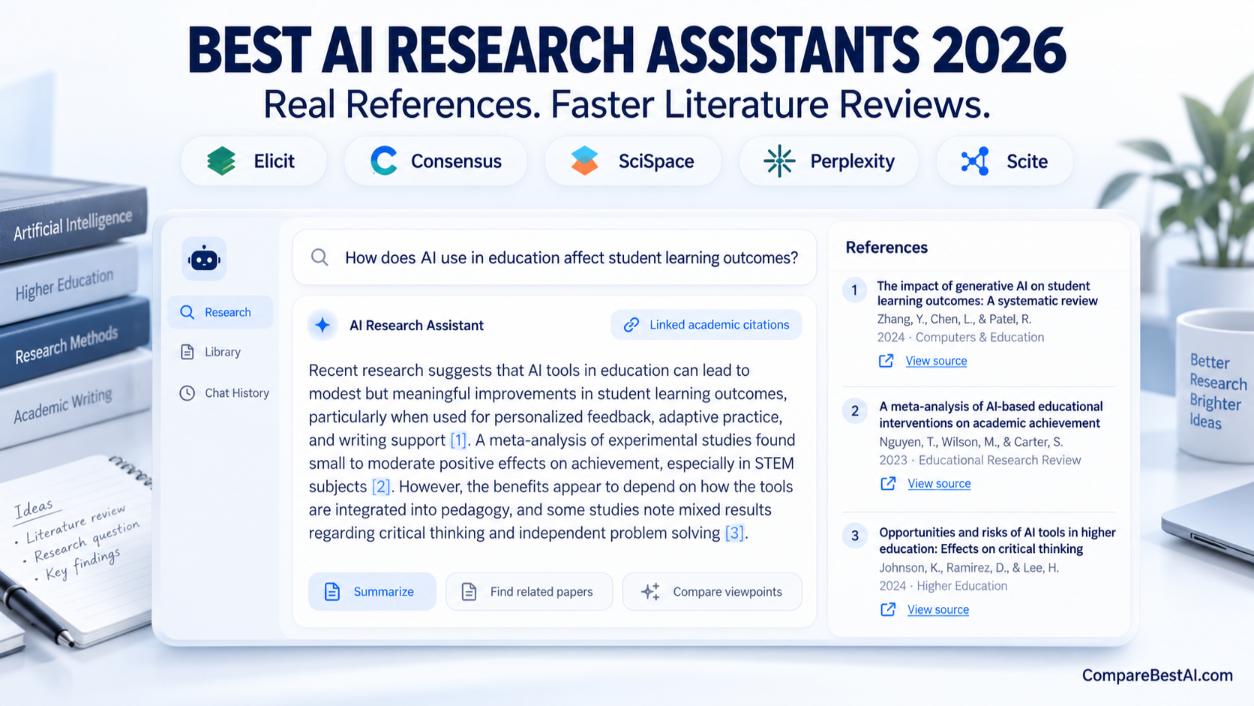

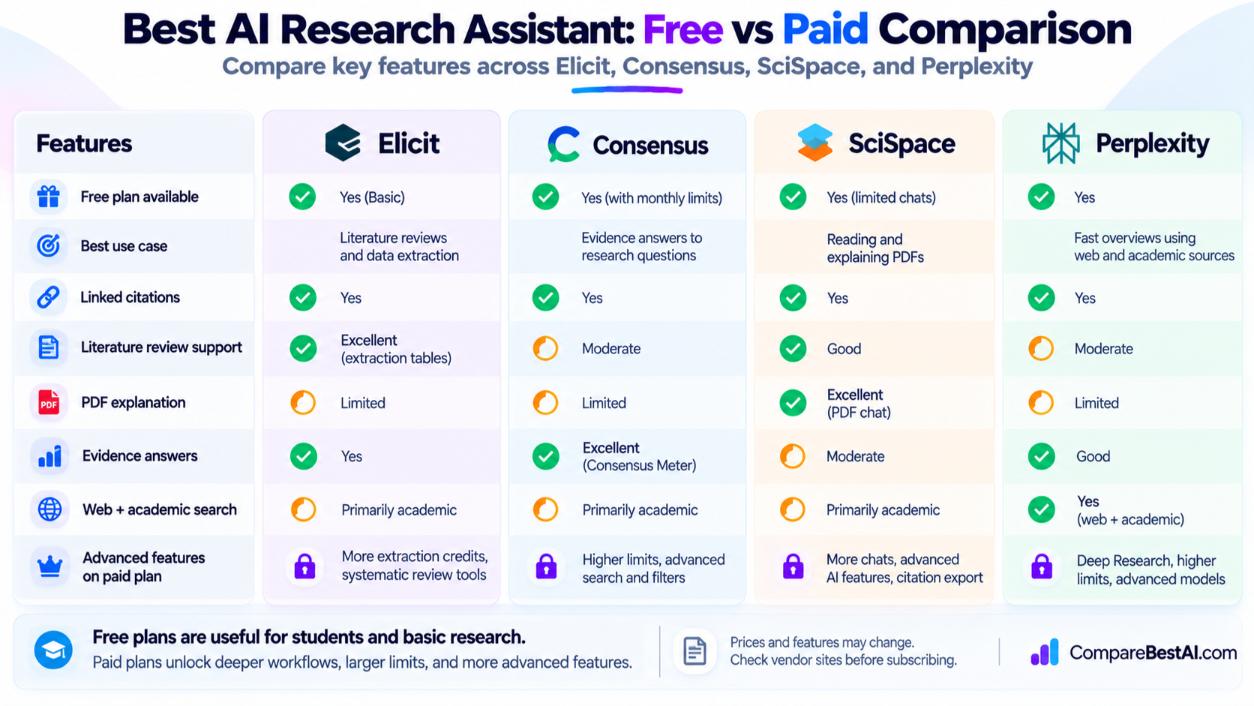
The best AI research assistant depends on the job. Elicit is the strongest pick for literature reviews and pulling data from many papers. Consensus gives the fastest evidence-backed answers to yes-or-no research questions. SciSpace is best for reading and explaining dense PDFs. Perplexity is best for quick overviews that mix web and academic sources. Scite is best for checking whether a paper's claims hold up. All five link answers to real, published sources, which matters because general chatbots can still invent references.
This guide compares the top tools on citations, free plans, cost, and best use cases. You will also learn a simple five-minute method for checking any citation an AI gives you.
What Is an AI Research Assistant?
An AI research assistant is a tool that uses large language models to search, read, summarize, and organize research. The best ones search a database of real academic papers first, then write answers grounded in those papers with links you can open and verify.
That design is the key difference from a general chatbot. A chatbot writing from memory can produce references that look correct but do not exist. A research assistant built on a paper database, such as Semantic Scholar from the Allen Institute for AI, points to records that already exist.
Why Real References Matter: The Fake Citation Problem
Fabricated citations are a documented problem, not a rumor. A 2023 study in Scientific Reports checked 636 citations produced by ChatGPT and found that 55% of GPT-3.5 citations and 18% of GPT-4 citations were fabricated. Even among the real citations, a significant share contained substantive errors in details such as authors, dates, or page numbers.
Newer models have improved, but the lesson still applies in 2026: never paste an AI-generated reference into a paper without opening the source. An AI research assistant with real references reduces this risk because each claim links back to a specific paper. It does not remove the need to read that paper.
Best AI Research Tools Compared (2026)
Tool | Best for | Source base | Free option | Paid plans from |
|---|---|---|---|---|
Elicit | Literature reviews, data extraction | 138M+ academic papers | Yes (Basic) | About $11/month, billed yearly (academic Plus) |
Consensus | Evidence answers to research questions | 200M+ papers (vendor figure) | Yes, with monthly limits | Under $20/month |
SciSpace | Reading and explaining PDFs | Large academic index | Yes, limited chats | About $12/month billed yearly ($20 monthly) |
Perplexity | Fast overviews, web plus academic | Live web and academic sources | Yes | $20/month Pro; $10/month Education Pro for verified students |
Scite | Checking how papers are cited | 1.6B+ Smart Citations | 7-day trial on paid plans | $20/month billed yearly |
Semantic Scholar | Free paper discovery | 214M papers | Completely free | Free |
Prices reflect published plan data as of October 2026 and change often. Check each vendor's pricing page before subscribing.
Elicit AI Research Assistant
Elicit searches more than 138 million academic papers and returns answers with source links. Its standout feature is the extraction table: you add columns such as sample size, method, or outcome, and Elicit fills them in across dozens of papers. Pro plans add a systematic review workflow for screening thousands of papers.
Best for: graduate students, PhD candidates, and researchers doing structured literature reviews.
Consensus
Consensus is built for questions like "Does creatine improve memory?" It searches its paper database, summarizes the findings, and shows a Consensus Meter with the share of top studies that say yes, no, or mixed. Our full Consensus AI review covers its accuracy and limits.
Best for: students, health and science writers, and anyone who needs a quick read on what the evidence says.
SciSpace AI Research Assistant
SciSpace shines when you already have a paper. Upload a PDF and ask it to explain a formula, a table, or a methods section in plain English. It also exports citations in BibTeX and RIS formats for reference managers.
Best for: students reading outside their field and anyone who struggles with dense academic writing.
Perplexity AI Research Assistant
Perplexity answers questions using live web results with numbered citations. The Pro plan adds Deep Research for longer reports. It is fast and broad, but it pulls from websites as well as journals, so you need to check whether each source is peer-reviewed.
Best for: early-stage topic exploration, background research, and current events.
Scite
Scite classifies how papers cite each other as supporting, contrasting, or mentioning. That helps you spot whether a famous study has been challenged by later work, something most AI tools will not tell you.
Best for: academics verifying claims before citing them and reviewers checking evidence quality.
AI Research Tools for Literature Review
A literature review needs three things: finding the right papers, reading them efficiently, and organizing findings. No single tool does all three perfectly, so many researchers combine them.
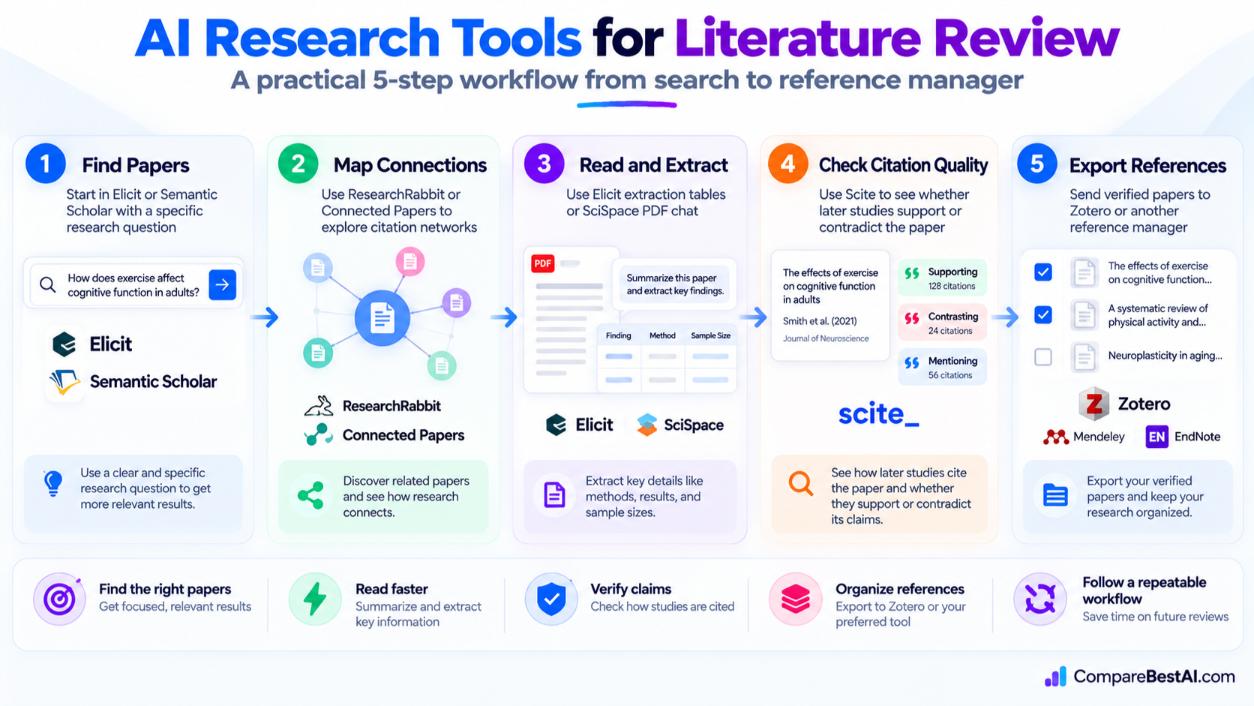
A practical literature review stack:
- Find papers: Start in Elicit or Semantic Scholar with a specific research question.
- Map connections: Use ResearchRabbit or Connected Papers to find related work through citation networks.
- Read and extract: Use Elicit's extraction tables or SciSpace's PDF chat to pull key details.
- Check citation quality: Run key papers through Scite to see if later studies support or contradict them.
- Export references: Send verified papers to Zotero or another reference manager.
For formal systematic reviews, AI tools can speed up screening, but your process should still follow the PRISMA reporting guidelines that journals expect. Document which tools you used and how you checked their output.
Best AI research tools for literature review, free: Semantic Scholar, ResearchRabbit, Elicit's free Basic plan, and Consensus's free plan together cover a lot of ground at no cost.
How to Check AI Citations in Five Minutes
Use this checklist for any AI research assistant, free or paid:
- Open every link. Confirm the paper exists and the title matches.
- Check the authors and year. Small errors here are common.
- Find the claim in the paper. Search the abstract or full text for the specific finding.
- Confirm the source type. Peer-reviewed journal, preprint, or website? Each carries different weight.
- Look for later challenges. A quick Scite check shows whether newer studies disagree.
If a reference fails step one, delete it. If it fails step three, the AI misread the paper, and you should read it yourself.
Best AI Research Assistant by User Type
AI Research Assistant for Students
Undergraduates get the most value from free tools. Start with Consensus for quick evidence checks, SciSpace for reading difficult papers, and Perplexity for background. Always confirm your school's AI policy before using any tool in graded work. Our guide to AI writing tools for students covers responsible use in more depth.
AI Research Tools for PhD Students and Academics
For thesis work and publishable reviews, Elicit's extraction and screening features save the most time. Pair it with Scite to verify citation context and a reference manager for organization. Paid plans make sense here because the hours saved on a single review usually outweigh the cost.
Free AI Research Assistant Options
If your budget is zero, combine Semantic Scholar (free), Elicit Basic, Consensus Free, and Perplexity Free. Expect monthly caps on advanced features, but basic search and summaries are enough for most coursework.
Pros and Cons of Using an AI Research Assistant
Pros
- Cuts hours of manual searching and skimming
- Surfaces papers you might miss with keyword search
- Explains complex methods in plain language
- Links answers to real sources you can verify
Cons
- Summaries can misstate findings or miss nuance
- Paywalled papers may only be analyzed from abstracts
- Advanced features often require paid plans
- Can encourage skipping the actual reading
Key Takeaways
- The best AI research assistant depends on your task: Elicit for reviews, Consensus for evidence answers, SciSpace for PDFs, Perplexity for overviews, Scite for citation checks.
- Tools built on academic databases link to real papers; general chatbots can still invent references.
- Free plans from Semantic Scholar, Elicit, Consensus, and Perplexity cover most student needs.
- Always open and verify every citation before using it.
Frequently Asked Questions
What is the best AI research assistant in 2026?
Elicit is the best overall AI research assistant for academic literature reviews. Consensus is better for quick evidence-based answers, and SciSpace is better for understanding individual papers.
Is there a free AI research assistant?
Yes. Semantic Scholar is completely free. Elicit, Consensus, SciSpace, and Perplexity all offer free plans with monthly limits on advanced features.
Which AI research assistant gives real references?
Elicit, Consensus, SciSpace, Scite, and Semantic Scholar ground their answers in academic paper databases, so citations point to real papers. You should still open each source to confirm the details.
Can ChatGPT be used as an AI research assistant?
It can help brainstorm and explain concepts, but research has shown general chatbots can fabricate citations. Use a dedicated research tool for references and verify every source. For a closer look at large language model accuracy and their limits in research settings, check out our guide to GPT-4 Capabilities Explained.
Is Elicit or Consensus better for students?
Consensus is easier for quick answers and coursework. Elicit is better for longer projects such as theses, where you need to compare many papers in a structured table.
Can AI write my literature review?
AI can speed up searching, screening, and summarizing, but you should write the analysis yourself. Most universities and journals require you to disclose AI use and take responsibility for accuracy.
Final Verdict: Choose the Right AI Research Assistant for Your Work
There is no single best AI research assistant for everyone. Students should start with free tools such as Consensus and SciSpace. PhD students and academics will get the most from Elicit paired with Scite. Whatever you choose, treat every AI answer as a starting point and every citation as something to verify.
At CompareBestAI, we review and compare AI tools side by side so you can choose with confidence. Browse our Best AI Tools in 2026: 10 Top Picks Compared by Use Case, or use the CompareBestAI comparison tool to compare Elicit, Consensus, SciSpace, and Perplexity before you subscribe.