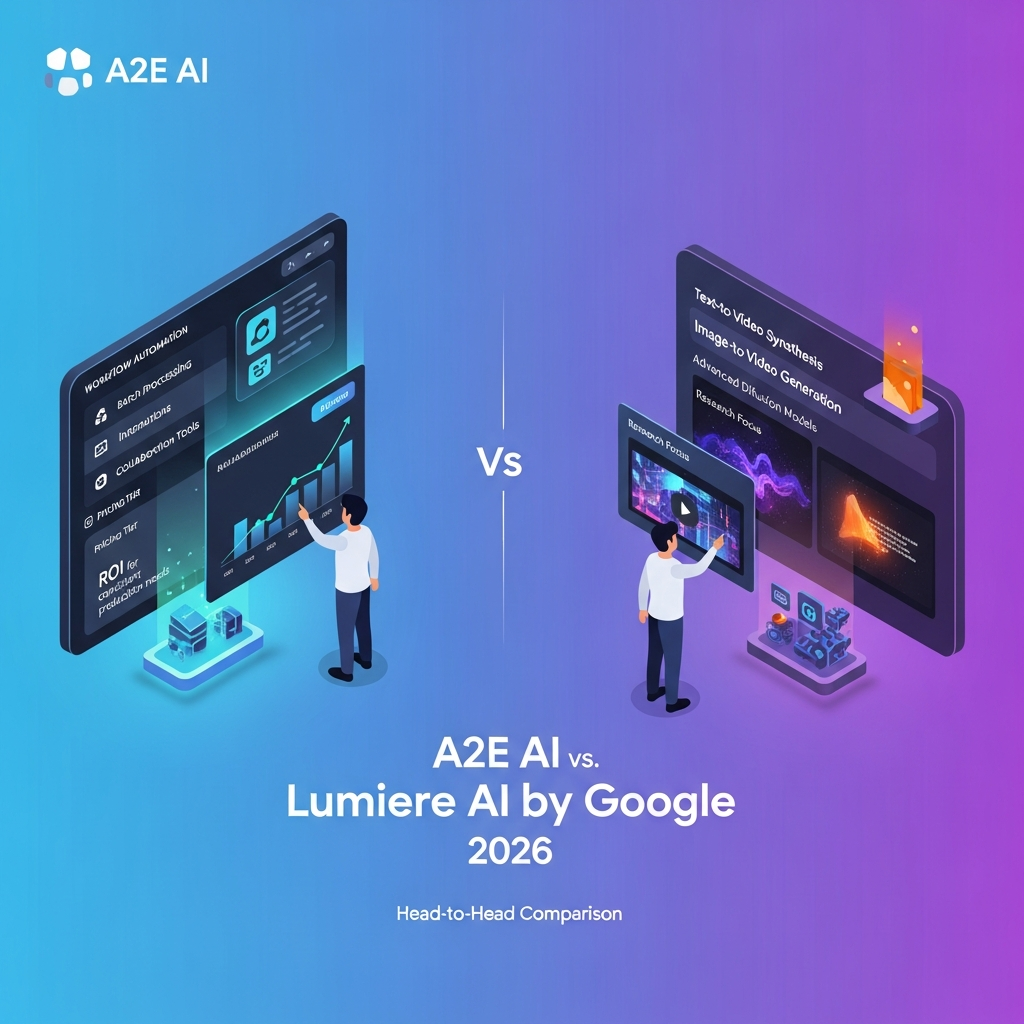

Quick Answer: In an A2E AI vs Lumiere AI by Google comparison, A2E AI is the practical choice for anyone who needs an AI video tool they can actually use today. A2E provides browser-based video generation, image-to-video, avatars, voice tools, reusable AI workflows, paid API access, and a free tier. Lumiere, by contrast, was introduced by Google Research in 2024 as an experimental video-generation model rather than a public SaaS product. For a current Google video-generation alternative, Veo 3.1 is the more relevant comparison in 2026.
Published: July 7, 2026
Last Updated: August 30, 2026
For our current testing notes, specifications, and pricing overview, read our A2E AI review.
A2E AI vs Lumiere AI by Google at a Glance
| Category | A2E AI | Lumiere AI by Google |
|---|---|---|
| Status in 2026 | Publicly accessible AI platform | Google Research model introduced in 2024 |
| Best for | Creators, marketers, developers, e-commerce teams | AI video research and technical reference |
| Public self-serve access | Yes | No public Lumiere product |
| Free access | Yes | No public commercial plan |
| Paid plans | Pro and Ultra | None publicly offered for Lumiere |
| Image-to-video | Yes | Demonstrated in research |
| Text-to-video | Available through supported models/workflows | Demonstrated in research |
| AI avatars | Yes | No |
| Voice cloning / TTS | Yes | No |
| Lip sync | Yes | No |
| Workflow automation | A2E Canvas + APIs | Not a commercial workflow platform |
| Developer API | Yes on eligible plans | No public Lumiere API |
| Current Google video alternative | — | Veo 3.1 |
| Best practical choice | A2E AI | Research reference |
The important takeaway is that this is not a conventional comparison between two competing SaaS products.
A2E AI is an accessible product.
Lumiere is primarily a research model.
That distinction should influence every pricing, workflow, support, and buying comparison on this page.
You can also see the dedicated A2E AI tool profile and Lumiere AI profile for additional context.
What Is A2E AI?
A2E AI is a browser-based generative media platform that combines video, image, avatar, voice, transformation, and developer workflows.
Its current tools include capabilities such as:
- image-to-video
- talking photos
- talking video and lip sync
- AI avatars
- voice cloning
- text-to-speech
- face and head swapping
- virtual try-on
- product avatars
- text-to-image
- video enhancement
- API-based generation
A2E also provides access to multiple third-party and supported AI models rather than limiting users to a single video-generation engine.
The newer A2E Canvas expands this approach by letting users build reusable node-based workflows that connect multiple AI models into a sequence. A creator can, for example, generate an image, process it, turn it into a video, and continue the workflow without manually moving files between several disconnected platforms.
For practical examples, see our guide to A2E AI use cases.
What Is Lumiere AI by Google?
Lumiere is a video-generation research model introduced by researchers from Google and collaborating institutions in January 2024.
Its central technical contribution is a Space-Time U-Net architecture designed to generate a video's temporal duration through a single model pass rather than first generating distant keyframes and then applying temporal super-resolution.
The researchers presented Lumiere as a way to improve temporal consistency in generated video.
The paper demonstrated several capabilities:
- text-to-video generation
- image-to-video generation
- video inpainting
- stylized video generation
- coherent motion generation
Lumiere was therefore an important AI video research project—but that does not automatically make it a commercially available Google product.
Important 2026 Context: Lumiere Is Not Google's Current Video Product
This is the most important point for anyone reading an A2E AI vs Lumiere AI by Google comparison in 2026.
Google's current public video-generation model family is Veo.
Google DeepMind now presents Veo 3.1 as its leading video-generation model, with access through Gemini, Google Flow, and developer tools. It supports modern text-to-video and image-to-video workflows and extends generation into native audio.
Google's current model-card directory lists Veo 3.1 Lite and Veo 3 among its active generative-video models rather than Lumiere.
That means there are really two questions:
Historical/research question:
How does the practical A2E platform compare with Google's Lumiere research approach?
Buying question:
Should I use A2E AI or one of Google's current Veo-powered products?
For the second question, Lumiere is no longer the most useful Google comparison point.
See our Veo 3.1 review if you are evaluating Google's current video-generation technology.
A2E AI vs Lumiere AI: Availability
A2E AI Availability
A2E AI can be accessed directly in a browser.
New users can register and test its platform using the free tier and bonus credits.
That gives individuals and teams a practical way to evaluate the platform against real production tasks before purchasing.
Lumiere Availability
Lumiere does not operate like A2E.
Google Research published the model's research, demonstrations, and technical results, but there is no public Lumiere SaaS product with a standard signup, subscription, commercial dashboard, or public Lumiere API.
That means statements such as “choose Lumiere if your company has an R&D team” can be misleading.
A company cannot simply select Lumiere from a pricing page and deploy it as an alternative to A2E.
Availability winner: A2E AI
For U.S. creators, marketers, agencies, and businesses evaluating a tool they can deploy now, A2E is the only directly accessible product in this particular comparison.
A2E AI vs Lumiere AI Pricing
Pricing creates one of the clearest differences.
A2E AI Pricing
A2E currently provides a Free plan at $0, along with paid Pro and Ultra options.
At the time of this update, A2E's primary pricing cards display approximately:
| Plan | Current Listed Price |
|---|---|
| Free | $0 |
| Pro | $14.90 for 1 month |
| Ultra | $59.90 for 1 month |
A2E also sells additional credits and provides separate higher-volume/API arrangements.
However, A2E's own pricing page currently contains some inconsistent figures across different sections. Because AI SaaS pricing changes quickly, users should treat the live checkout screen as the final source of truth.
Lumiere Pricing
Lumiere has no conventional public commercial pricing because it is not offered as a public standalone Lumiere subscription.
There is therefore no meaningful:
- Lumiere Free plan
- Lumiere Pro plan
- Lumiere Enterprise subscription
- Lumiere credit pack
- public Lumiere API price
Pricing winner: A2E AI, because it is the only commercially accessible product being compared.
Video Generation Capabilities
A direct quality comparison needs caution because A2E and Lumiere represent different product categories.
A2E AI
A2E combines its broader generative-media platform with multiple video-generation workflows and model options.
Its advantage is not necessarily that one proprietary A2E model beats every competing model.
Its advantage is workflow breadth.
A user can move between image generation, image-to-video, lip sync, voice, avatars, product visuals, and other AI media tasks from the same broader ecosystem.
For more detail, read our A2E AI features guide.
Lumiere
Lumiere's research focused heavily on temporal coherence.
Its Space-Time U-Net architecture was designed to generate a full-frame-rate video in a way that improves consistency across time.
The research also demonstrated image-to-video, stylization, and video inpainting.
That made Lumiere technically important in the evolution of AI video research.
But technical research performance should not be converted into claims about modern commercial usability without evidence.
Research innovation: Lumiere
Practical workflow breadth: A2E AI
Workflow Automation: A2E Has the Clear Advantage
The old version of this article overstated A2E's enterprise collaboration capabilities.
The stronger and more defensible A2E argument is different:
A2E supports reusable AI-generation workflows.
A2E Canvas lets users connect AI models in node-based pipelines.
For example:
Prompt → Image Generation → Image Processing → Video Generation
A saved pipeline can then be reused with different inputs.
A2E's own documentation also describes batch generation for appropriate workflows, while its APIs allow developers to automate media-generation tasks programmatically.
That is real workflow automation.
It is much stronger than claiming native HubSpot, Adobe, Canva, or CRM integrations without documentation.
Lumiere provides no comparable public workflow platform.
Workflow winner: A2E AI
API and Developer Access
A2E publishes APIs for multiple media workflows.
Current API documentation covers areas such as video generation, image generation, avatars, lip sync, voice workflows, and reference-to-video generation.
For example, A2E documents endpoints for starting reference-to-video tasks and retrieving generation results.
API access makes A2E relevant for:
- custom AI applications
- internal content tools
- automated creative pipelines
- product-media systems
- e-commerce content generation
- developer integrations
Lumiere does not have a comparable public developer API.
If programmatic access is part of the buying requirement, this comparison is therefore straightforward.
Developer winner: A2E AI
Ease of Use
A2E is designed for direct browser use.
Someone can register, claim free credits, select a workflow, provide an image or prompt, and begin experimenting without implementing the underlying AI model.
That creates a much lower practical adoption barrier.
Lumiere is fundamentally different.
The public Lumiere material is a research paper and demonstration of a model architecture, not a polished end-user video application.
Comparing their interfaces or onboarding processes therefore doesn't make sense.
There is no equivalent public Lumiere dashboard to score against A2E's interface.
Ease-of-use winner: A2E AI by default
A2E AI Pros and Cons
Pros
- Publicly accessible
- Free tier available
- Multiple generative-media workflows
- Image-to-video capabilities
- AI avatars and talking-video tools
- Voice cloning and TTS
- API access on eligible plans
- Reusable Canvas workflows
- Multiple AI model options
- Useful for creators and developers
Cons
- Credit-based usage can make costs harder to estimate
- Premium models can consume credits quickly
- Pricing documentation is not perfectly consistent
- A2E Canvas has a learning curve for users unfamiliar with node-based workflows
- It should not be confused with a full professional timeline video editor
Lumiere AI Pros and Cons
Pros
- Important contribution to generative-video research
- Space-Time U-Net approach targeted temporal coherence
- Demonstrated text-to-video and image-to-video
- Demonstrated video inpainting
- Demonstrated stylized generation
- Useful historical reference for understanding AI video development
Cons
- Not a public standalone commercial product
- No public Lumiere pricing
- No conventional Lumiere subscription
- No public Lumiere developer API
- No public commercial support structure
- Not directly comparable with modern SaaS video platforms
Who Should Choose A2E AI?
Choose A2E AI if you need to create AI-generated media now.
It is more appropriate for:
- content creators
- marketers
- e-commerce brands
- agencies
- social-media teams
- developers
- product-content teams
- users who want to test multiple AI workflows
The free tier also makes it possible to test a realistic workflow before committing to a paid plan.
For a deeper evaluation of where the platform works best, see our A2E AI use cases.
Who Should Research Lumiere?
Lumiere makes sense as a research topic if you want to understand:
- diffusion-based video generation
- temporal consistency
- Space-Time U-Net architectures
- video-generation research history
- Google's earlier generative-video work
But that is different from recommending Lumiere as software a buyer can purchase today.
If your goal is to compare A2E with other accessible generative-video products, better comparisons include our A2E AI vs Moonvalley AI and A2E AI vs Nemovideo guides.
You can also browse the full AI video generation tools category.
What Are Better A2E Alternatives in 2026?
If you are looking for commercially accessible alternatives rather than research projects, consider current generative-video platforms.
For more creator-focused production workflows, read our Runway AI video generation review.
For Google's current generation technology, evaluate Veo 3.1.
These comparisons are generally more useful for purchase decisions because both sides represent technology users can realistically evaluate or access.
Frequently Asked Questions
What is the main difference between A2E AI and Lumiere AI by Google?
A2E AI is an accessible generative-media platform with free and paid plans, video tools, avatars, voice features, workflows, and APIs. Lumiere is a Google Research video-generation model introduced in 2024 rather than a public standalone SaaS product.
Is Lumiere AI by Google available to the public?
Google has publicly released Lumiere's research paper and demonstrations, but there is no standard public Lumiere product with a self-serve subscription comparable to A2E AI.
Is A2E AI free?
Yes. A2E currently offers a $0 Free tier with daily bonus credits. Paid Pro and Ultra plans provide additional credits, higher output options, priority processing, and eligible API access.
Which is better for business use, A2E AI or Lumiere?
A2E AI is the practical business choice because it is an accessible platform. Lumiere is better treated as a research model rather than software that a company can simply subscribe to and deploy.
Does Lumiere AI have an API?
There is no public standalone Lumiere commercial API comparable to A2E's documented developer APIs. Google's current commercial video-generation developer ecosystem centers on the Veo family rather than Lumiere.
Is Google's Veo 3.1 more relevant than Lumiere in 2026?
Yes. For users evaluating current Google video generation, Veo 3.1 is more relevant. Google presents Veo 3.1 as its current leading video model and provides access through Gemini, Flow, and developer tools.
Final Verdict: A2E AI vs Lumiere AI by Google
A2E AI wins this comparison for practical use—but mainly because Lumiere is not a directly competing commercial product.
A2E gives creators, marketers, e-commerce teams, and developers a platform they can sign up for, test, and integrate into real workflows.
Lumiere remains significant as a Google Research contribution to generative-video technology, particularly because of its Space-Time U-Net approach and work on temporally coherent generation.
For a buyer in 2026, however, the better question is not simply:
“A2E AI or Lumiere?”
It is:
“A2E AI or a current commercial video generator such as Google Veo 3.1, Runway, or another accessible platform?”
If you need video generation, avatars, voice tools, reusable workflows, and API access today, A2E AI is the practical choice between these two options.
For a broader decision, compare AI video generation tools before committing to a paid plan.