
By CompareBestAI Editorial Team
Answer first: The best way to boost productivity with AI tools is to automate or accelerate one repeatable bottleneck at a time. Use ChatGPT for everyday drafting and analysis, Claude for long documents, Perplexity for research, Notion AI for workspace knowledge, Otter.ai for meetings, Zapier for repetitive workflows, Reclaim.ai for calendar management, and Canva AI for faster visual creation. The right tool is the one that removes a specific step from your workflow without creating more software overhead.
AI productivity is not about adding as many tools as possible. It is about reducing the time and attention required to complete recurring work. For most people, the biggest gains come from a few high-friction tasks: writing, researching, finding information, taking meeting notes, moving data between apps, managing calendars, and creating visual content.
If you want a ranked product comparison with current pricing, start with our guide to the best AI productivity tools for work. This article takes a different approach: it shows how to use AI inside practical workflows so you can identify where automation will actually save time.
Key Takeaways
- Start with one bottleneck, not ten tools. Pick the task that repeats most often and consumes the most time.
- General AI assistants are useful for drafting and analysis, but specialist tools are usually better for meetings, scheduling, and cross-app automation.
- Free plans can be enough to test a workflow before you pay. Compare limits before upgrading.
- Measure the result using time saved, steps removed, error reduction, or output volume rather than “how often you use AI.”
- Keep a human review step for important decisions, customer-facing work, confidential information, and factual claims.
AI Productivity Tools at a Glance
| Workflow | Tool | Best For | Useful 2026 Fact |
|---|---|---|---|
| Everyday drafting and analysis | ChatGPT | Writing, planning, file analysis, brainstorming | ChatGPT Plus is $20/month in the U.S.; a Free plan is also available |
| Long documents and deep analysis | Claude | Reports, documents, reasoning, structured analysis | Free and paid access are available; usage limits vary by plan |
| Research with sources | Perplexity | Fast research, source discovery, fact-finding | Best used when you need cited web research rather than task management |
| Workspace knowledge | Notion AI | Team docs, search, notes, internal knowledge | Full Notion AI access is tied to Business and Enterprise plans; Free and Plus receive limited trial responses |
| Meeting capture | Otter.ai | Transcription, summaries, searchable meeting notes | The Basic plan includes 300 transcription minutes per month |
| Cross-app automation | Zapier | Repetitive workflows and app-to-app data movement | The Free plan includes 100 tasks per month |
| Calendar optimization | Reclaim.ai | Focus time, habits, meetings, scheduling | Reclaim offers a free-forever Lite plan |
| Visual content creation | Canva AI | Presentations, social graphics, images, design workflows | Canva AI combines generative design, editing, and content tools in one workspace |
Pricing and plan limits can change. Verify current vendor terms before purchasing. OpenAI currently lists ChatGPT Plus at $20/month; Notion says full AI access is on Business and Enterprise with limited complimentary responses on lower plans; Otter lists 300 monthly transcription minutes on Basic; Zapier's Free plan includes 100 monthly tasks; and Reclaim currently offers a free Lite plan.
What Does “Boost Productivity With AI Tools” Actually Mean?
Using AI productively means reducing the number of manual steps required to complete a real task. A tool is valuable when it helps you finish work faster, improves consistency, or removes repetitive decisions.
That is different from simply generating more content. If a new AI app takes 30 minutes to configure but only saves two minutes a week, it is not a productivity win. If a workflow removes 20 minutes of repetitive admin every day, it probably is.
A practical way to evaluate an AI workflow is to ask four questions:
- How often does this task happen?
- How long does it take without AI?
- Which steps can AI safely perform or accelerate?
- How will the output be reviewed before it is used?
Before adding another subscription, read our guide on how to choose an AI tool. You can also browse the broader AI productivity and collaboration category to compare tools by use case.
1. Use ChatGPT for First Drafts, Planning, and Everyday Analysis
ChatGPT is useful when the work starts with a blank page, a messy document, a dataset, or a problem that needs to be broken into steps.
A productive workflow is to give ChatGPT context, define the output, and then use the result as a draft rather than a final answer. For example, you can provide meeting notes and ask for an action plan, upload a spreadsheet and request a summary of patterns, or turn a rough brief into a structured outline.
A simple writing workflow looks like this:
Input → first draft → human edit → final version
That is faster and safer than asking AI to produce a finished deliverable with no review. It also makes the quality easier to control because the human editor remains responsible for facts, tone, and business decisions.
OpenAI's current documentation lists ChatGPT Plus at $20 per month in the U.S., while the Free plan remains available. If writing is your main bottleneck, compare specialist options in our guide to the best AI writing tools for bloggers and content creators.
Best for: marketers, founders, analysts, students, freelancers, and general knowledge workers.
Use it when: the task requires drafting, summarizing, restructuring, ideation, file analysis, or planning.
Do not use it blindly for: legal, financial, medical, compliance, or high-stakes factual decisions without independent verification.
2. Use Claude for Long Documents and Complex Information
Claude is a strong fit when the productivity problem is not generating a short answer but understanding a large amount of material.
For example, a consultant can upload a long report and ask for the main findings, contradictions, open questions, and next actions. A project manager can compare requirements across multiple documents. A developer can use it to reason through code or technical documentation.
The highest-value workflow is not simply “summarize this.” It is a sequence:
Extract facts → organize themes → identify gaps → produce an actionable output
That structure gives the model a clearer job and makes the result easier to review.
If you work with long reports, contracts, research notes, technical material, or detailed project documents, this can reduce the time spent searching through text manually.
Best for: long-form analysis, structured reasoning, research synthesis, and document-heavy work.
Use it when: the bottleneck is reading and organizing information rather than capturing meetings or automating apps.
3. Use Perplexity to Reduce Research Time
Traditional research often involves opening many tabs, scanning pages, copying notes, and then trying to remember which source supported which claim. Perplexity can compress the early part of that process by returning an answer with sources attached.
The productivity benefit is not that it replaces research. It reduces the discovery phase.
A better workflow is:
Ask a focused question → inspect the cited sources → open the strongest sources → verify important claims → save the evidence
That is especially useful for market research, competitor research, content briefs, industry definitions, and early-stage fact-finding.
For even faster browser-based workflows, see our list of AI Chrome extensions that can save time.
Best for: research, source discovery, comparisons, and fact-finding.
Use it when: you need to move from a broad question to a set of sources quickly.
Do not use it as: a replacement for checking primary sources when the claim is important.
4. Use Notion AI to Find and Reuse Team Knowledge
Teams lose time when information exists but nobody knows where it is.
Notion AI is most useful when your projects, notes, procedures, meeting records, and internal documentation already live in Notion. Instead of opening several pages and manually searching, users can ask questions against workspace information and connected sources.
Notion states that full Notion AI access is available on Business and Enterprise plans, while Free and Plus users receive limited complimentary AI responses. Current Notion AI capabilities include workspace search, research, meeting notes, and AI agents.
The productivity workflow is straightforward:
Capture knowledge once → organize it → retrieve it with AI → turn it into the next action
This can be more valuable than adding a separate chatbot because the AI operates closer to the information your team already uses.
Best for: teams that already use Notion for projects, knowledge bases, SOPs, meeting notes, or documentation.
Use it when: people regularly ask, “Where is that document?” or repeat questions that have already been answered somewhere inside the workspace.
If you are still testing different products, our guide to AI tools with free plans can help you evaluate options before paying.
5. Use Otter.ai to Turn Meetings Into Searchable Work
Meeting notes are a classic productivity leak. People either take incomplete notes while trying to participate or spend extra time writing summaries afterward.
Otter.ai's Basic plan currently includes 300 transcription minutes per month, plus live transcription, speaker identification, AI Chat, and support for Zoom, Microsoft Teams, and Google Meet.
The useful workflow is not just “record the meeting.” It is:
Meeting → transcript → summary → decisions → action items → searchable record
That creates a reusable source of truth after the call.
For teams with many meetings, the time savings can compound because people no longer need to search through chat threads or rely on memory to reconstruct what was agreed.
Best for: interviews, client calls, internal meetings, lectures, and recurring team discussions.
Use it when: your team spends meaningful time writing notes, recapping calls, or searching for past decisions.
6. Use Zapier to Remove Repetitive Cross-App Work
Some productivity problems are not writing problems at all. They are “copy this from one system and put it into another system” problems.
Zapier is designed for those workflows. Its Free plan currently includes 100 tasks per month and two-step Zap workflows, which gives users room to test simple automations before moving to larger task volumes.
A typical workflow might be:
New form submission → create CRM record → notify Slack → add follow-up task
Another might be:
New qualified lead → enrich data → draft email → assign owner
The biggest mistake is automating a broken process. First make sure the workflow is worth keeping. Then automate the repetitive steps.
If you want more ideas beyond the obvious tools, see our guide to hidden AI productivity tools for workflow improvement.
Best for: operations, marketing, sales, customer support, data movement, and recurring admin tasks.
Use it when: the same trigger repeatedly causes the same set of actions across multiple apps.
7. Use Reclaim.ai to Protect Focus Time Automatically
A calendar can become a second job when priorities change throughout the week.
Reclaim.ai focuses on automatically placing and protecting work blocks, habits, buffers, and meetings around existing calendar commitments. Its current pricing page includes a free-forever Lite plan for individual users.
The productivity gain comes from reducing manual rescheduling.
A useful setup is:
Define priorities → set focus-time goals → connect calendar → let the system place flexible work → review exceptions
This works best for people whose workday is already calendar-driven. If your schedule rarely changes, the benefit will be smaller.
Best for: managers, consultants, remote teams, and knowledge workers with meeting-heavy calendars.
Use it when: your day is frequently fragmented by meetings and you repeatedly move focus blocks by hand.
8. Use Canva AI to Speed Up Visual Production
Visual work often contains many small repetitive steps: resizing designs, removing backgrounds, adapting one asset into multiple formats, drafting presentation visuals, and generating first-pass creative concepts.
Canva's AI tools combine generative design, image editing, writing, and layout capabilities inside the same workspace. Canva's 2026 AI 2.0 release expanded this further with conversational, agentic creative workflows and capabilities spanning connectors, web research, scheduling, brand intelligence, Sheets AI, and Canva Code.
A productive workflow is:
Create one strong source design → use AI for variations → apply brand rules → review → publish
That is especially useful for social teams and small businesses that need many assets but do not want every variation to start from a blank canvas.
For channel-specific ideas, see our guide to AI tools for social media success.
Best for: marketers, creators, small businesses, educators, and teams producing frequent visual content.
Use it when: you repeatedly repurpose the same message into presentations, social posts, ads, graphics, or other visual formats.
How to Build an AI Productivity Stack Without Creating Tool Overload
The goal is not to use all eight tools. A good stack may contain only two or three.
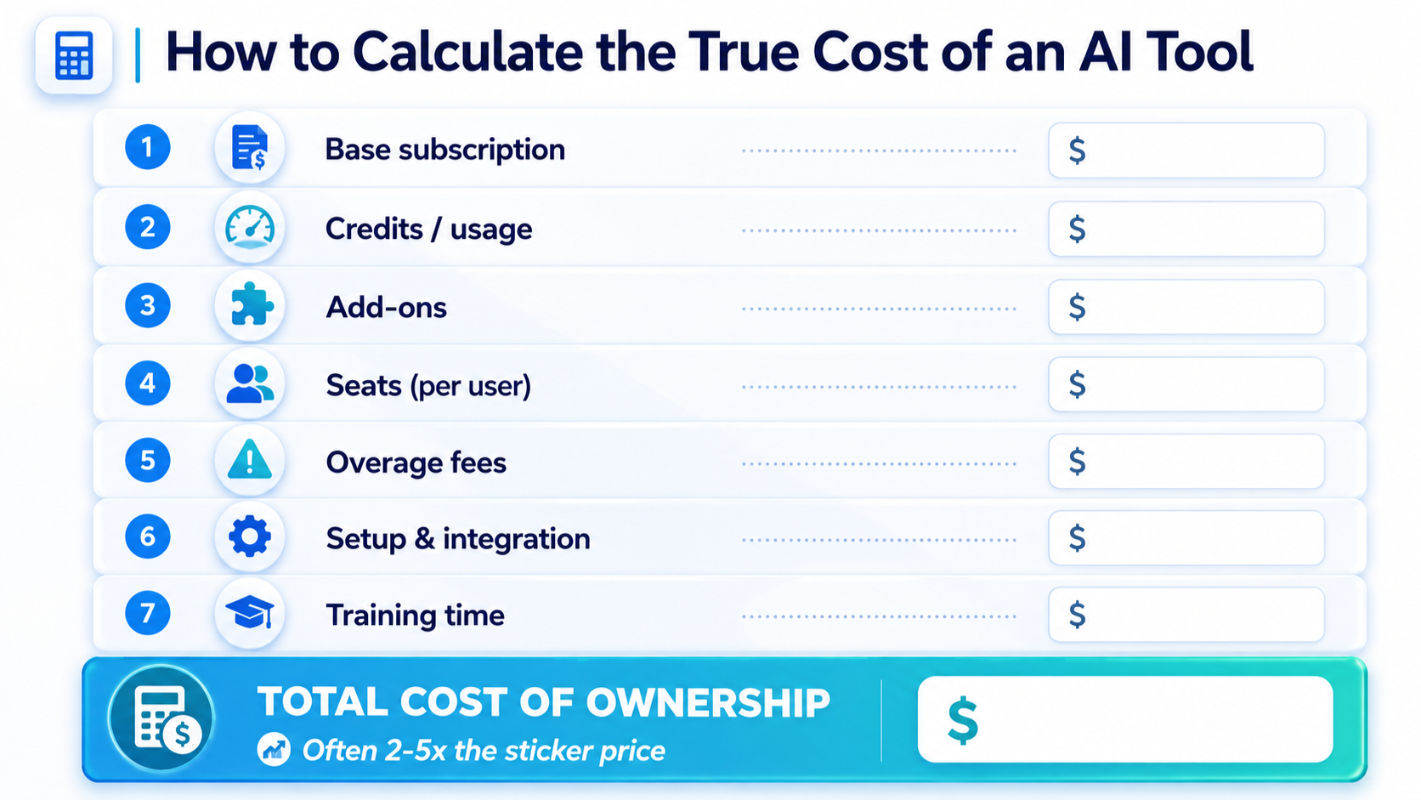
Start with your highest-cost bottleneck. If research consumes four hours a week, solve research first. If meetings consume six hours and another two hours of follow-up, solve meeting capture and action extraction. If your team manually moves lead data between tools every day, solve automation.
Then measure the result for two weeks.
Track:
Time saved: How many minutes did the workflow remove?
Steps removed: Which manual actions disappeared?
Quality: Did the output require more or less correction?
Reliability: Did the workflow work consistently?
Adoption: Did people actually use it after the first week?
This is the difference between AI adoption and AI productivity. Buying software is not the outcome. Removing friction is.
If your team already bought several tools but still feels overloaded, read why tools did not fix productivity. It explains why adding software without changing the workflow can make the problem worse.
Common AI Productivity Mistakes to Avoid
Using Multiple Tools for the Same Job
If ChatGPT, Claude, Gemini, and another assistant all serve the same role in your workflow, you may be paying for overlap instead of productivity. Give each tool a defined job.
Automating Before Defining the Process
Automation makes a good process faster. It can also make a bad process fail faster. Write the workflow in plain language before automating it.
Sending Sensitive Data Without Checking Policies
Before uploading customer information, contracts, internal documents, or regulated data, review the provider's privacy, retention, security, and enterprise controls.
NIST's Generative AI Risk Management Framework profile is designed to help organizations manage generative-AI risks across the AI lifecycle and is a useful independent framework for this type of evaluation.
Trusting Generated Facts Without Verification
AI-generated text can be fluent and wrong at the same time. Use primary sources for prices, legal requirements, technical specifications, medical guidance, or any fact that could create material risk.
Measuring Activity Instead of Outcomes
“Employees used AI 200 times” is not a productivity metric.
“The weekly reporting process dropped from three hours to 45 minutes” is.
Measure what changed in the workflow.
How to Choose the Right AI Productivity Tool
The useful question is not, “Which AI tool has the most features?”
It is:
“Which tool solves this workflow with the least friction?”
Evaluate each tool against the same criteria:
Use-case fit: Does it solve the actual task?
Setup cost: How long does implementation take?
Learning curve: Can the user get value quickly?
Integrations: Does it work with your existing stack?
Output quality: How much human review is required?
Data handling: Is it appropriate for the information you will provide?
Pricing model: Are you paying per user, task, minute, prompt, or credit?
Scalability: Will the workflow still make sense at higher volume?
CompareBestAI evaluates tools against consistent practical criteria so recommendations stay focused on workflow fit rather than feature count alone.
FAQ
What are the best AI tools to boost productivity?
The best tool depends on the bottleneck. ChatGPT is useful for everyday drafting and analysis, Claude for long documents, Perplexity for research, Notion AI for knowledge, Otter.ai for meetings, Zapier for automation, Reclaim.ai for scheduling, and Canva AI for visual production.
How can AI improve productivity at work?
AI can improve productivity by reducing repetitive steps, accelerating first drafts, summarizing information, capturing meetings, scheduling focus time, finding internal knowledge, and automating data movement between apps. The best results come from applying AI to frequent, well-defined tasks.
Which AI productivity tools have free plans?
Several tools in this guide offer free access, including ChatGPT, Otter.ai, Zapier, Reclaim.ai, and Canva. Free limits vary by product and can change, so verify the current plan before building a workflow around a specific allowance.
Can AI tools replace employees?
AI tools are usually more useful as workflow accelerators than full replacements. They can handle repetitive steps, drafts, summaries, scheduling, and automation, while people remain responsible for judgment, review, relationships, exceptions, and high-stakes decisions.
How many AI tools should I use?
Use as few as possible. Start with one tool for the most expensive bottleneck, measure the outcome for two weeks, and only add another tool when it solves a different recurring problem. Overlapping tools can increase cost and cognitive load.
Are AI productivity tools safe for confidential business data?
Safety depends on the tool, plan, settings, data type, and company policy. Review retention, training, access controls, security certifications, and enterprise terms before uploading confidential or regulated information. Use stricter controls for customer, financial, health, legal, or proprietary data.
Final Verdict
The fastest way to boost productivity with AI tools is not to build the biggest AI stack. It is to remove one repeatable source of friction at a time.
Use a general assistant for drafting and analysis, a specialist tool when the workflow requires meetings or scheduling, and automation when the same actions repeat across applications. Then measure the result in time saved, steps removed, and output quality.
Next step: Compare the best AI productivity tools for work and choose the platform that matches the bottleneck you want to remove first.